Best Side Hustles 2024
Complete side hustle guide • Income calculator • Strategies
Side Hustle Overview:
Calculate IncomeA side hustle is a secondary source of income that supplements your primary job or business. The best side hustles leverage your skills, interests, or spare time to generate additional revenue. Modern side hustles often utilize digital platforms, remote work, or online marketplaces to reach customers globally.
Key side hustle characteristics:
- Flexible Schedule: Work around your main job
- Skill-Based: Leverage existing talents and abilities
- Low Barrier to Entry: Minimal upfront investment required
- Scalable: Potential to grow over time
- Remote-Friendly: Can often be done from anywhere
- Passive Income Potential: Some can generate ongoing revenue
Successful side hustles require dedication, time management, and a willingness to learn new skills.
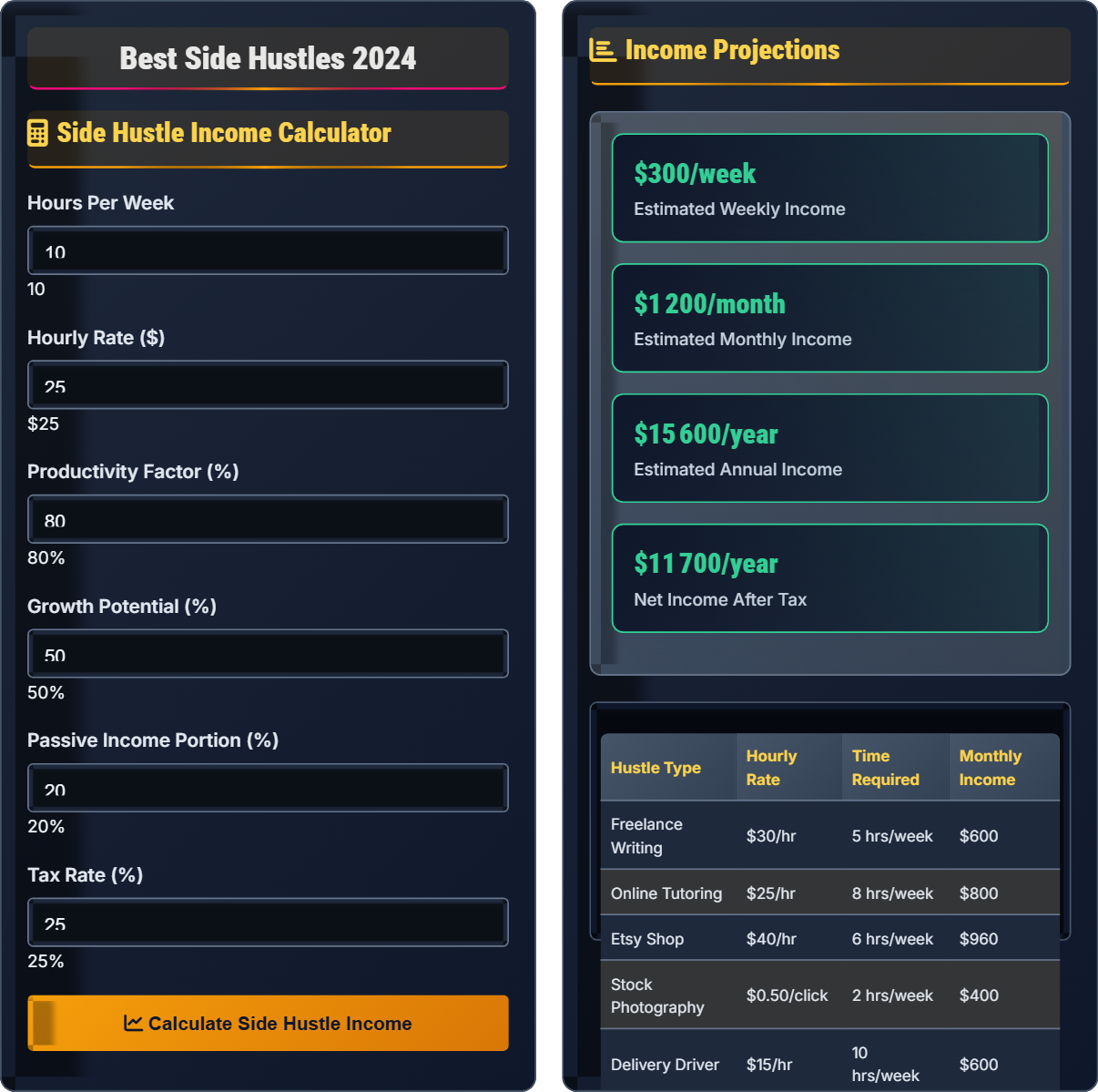
Side Hustle Income Calculator
Income Projections
| Hustle Type | Hourly Rate | Time Required | Monthly Income |
|---|---|---|---|
| Freelance Writing | $30/hr | 5 hrs/week | $600 |
| Online Tutoring | $25/hr | 8 hrs/week | $800 |
| Etsy Shop | $40/hr | 6 hrs/week | $960 |
| Stock Photography | $0.50/click | 2 hrs/week | $400 |
| Delivery Driver | $15/hr | 10 hrs/week | $600 |
Side Hustles Explained
A side hustle is a secondary source of income that supplements your primary job or business. It's typically pursued in your spare time and can range from occasional freelance work to more substantial ventures that generate significant income. Side hustles can be skill-based, service-oriented, or product-focused.
Key areas where side hustles provide value:
- Supplemental Income: Additional money to cover expenses or save
- Financial Independence: Reduce reliance on single income source
- Portfolio Building: Create portfolio of work or products
- Skill Development: Learn new skills and gain experience
- Future Business: Test business ideas and concepts
- Personal Fulfillment: Pursue passions and interests
- Service-Based: Freelancing, tutoring, consulting, cleaning
- Product-Based: E-commerce, crafts, print-on-demand
- Content Creation: Blogging, YouTube, podcasting
- Investment-Based: Real estate, stocks, peer-to-peer lending
- Platform-Based: Uber, DoorDash, Airbnb, TaskRabbit
- Teaching-Based: Online courses, tutoring, coaching
Best Side Hustles
Offer your professional skills on platforms like Upwork, Fiverr, or Toptal. This includes writing, design, programming, marketing, and consulting services.
- Identify your marketable skills
- Create professional profiles on freelancing platforms
- Build a portfolio of work
- Set competitive but fair pricing
- Deliver quality work consistently
- Build client relationships and seek referrals
Start an online store selling products through platforms like Etsy, eBay, Amazon, or Shopify. This can include handmade goods, vintage items, or dropshipping.
- Research profitable product niches
- Source products or create your own
- Set up online store
- Optimize product listings for search
- Implement marketing strategies
- Provide excellent customer service
Create content through blogging, YouTube, podcasting, or social media. Monetize through ads, sponsorships, affiliate marketing, and memberships.
- Choose content platform and niche
- Create consistent content schedule
- Optimize for platform algorithms
- Build and engage with audience
- Monetize through multiple channels
- Scale through partnerships and diversification
Side Hustle Type Analysis
Side Hustle Income Growth Path
Growth Milestones:
- Month 1-3: Learn basics, set up systems, make first sales
- Month 4-6: Establish consistent workflow, improve quality
- Month 7-12: Scale operations, automate processes, expand
- Year 2+: Diversify income streams, potentially go full-time
Side Hustle Strategies
Strategy Best Practices:
- Start with skills you already have
- Focus on consistent, quality delivery
- Build relationships with customers
- Reinvest profits into growth
- Track and analyze performance metrics
- Gradually scale successful ventures
Side Hustle Quiz
Which side hustle is best for someone with strong writing skills?
Freelance writing is the best side hustle for someone with strong writing skills. This leverages their existing talent to create content for businesses, publications, or individuals who need quality writing services. Writing skills are in high demand for content marketing, copywriting, ghostwriting, and technical writing.
The answer is B) Freelance writing.
Successful side hustles typically leverage existing skills and talents. When you use skills you already possess, you can start earning money immediately without needing to learn new competencies. Writing skills are particularly valuable in today's digital economy where content creation is essential for businesses.
Freelance: Independent contractor work
Writing Skills: Ability to communicate effectively through text
Content Marketing: Marketing through valuable content
• Leverage existing skills first
• Choose based on market demand
• Consider time availability
• Build a portfolio of writing samples
• Start with smaller projects to build reputation
• Specialize in specific niches
• Undervaluing writing services
• Not having clear contracts
• Taking on projects beyond skill level
Explain how to choose the right platform for your side hustle and provide examples for different types of hustles.
Factors for Platform Selection:
1. Audience Match: Choose platforms where your target customers spend time
2. Fee Structure: Consider platform fees, transaction costs, and revenue sharing
3. Competition Level: Evaluate how saturated the platform is with similar services
4. Skill Requirements: Ensure the platform matches your skill level and abilities
5. Growth Potential: Look for platforms with expanding user bases
Platform Examples:
Freelance Services: Upwork, Fiverr, Toptal, Freelancer
E-commerce: Etsy, eBay, Amazon Handmade, Shopify
Content Creation: YouTube, TikTok, Instagram, Medium
Delivery Services: DoorDash, Uber Eats, Instacart, Postmates
Teaching: Udemy, Teachable, Wyzant, Preply
Transportation: Uber, Lyft, Bolt, Grab
The platform you choose significantly impacts your side hustle's success. Different platforms cater to different audiences and have varying fee structures, user bases, and growth opportunities. The key is matching your skills and goals with the right platform ecosystem.
Platform: Digital marketplace or service
Fee Structure: Costs associated with using platform
Revenue Sharing: How platform splits earnings
• Research platform reputation
• Understand fee structures
• Consider long-term growth potential
• Start with one platform initially
• Diversify across multiple platforms
• Read terms and conditions carefully
• Not researching platform fees
• Choosing oversaturated platforms
• Ignoring platform policies
A person works a full-time job (40 hours/week) and wants to start a side hustle. They can dedicate 10 hours per week to their side hustle. They estimate they can earn $25/hour. After taxes (25%), what will be their monthly and annual net income from the side hustle?
Calculations:
Weekly gross income: 10 hours × $25/hour = $250
Weekly net income: $250 × (1 - 0.25) = $187.50
Monthly net income: $187.50 × 4 weeks = $750
Annual net income: $187.50 × 52 weeks = $9,750
Analysis: With 10 hours per week at $25/hour and 25% tax rate, the side hustle generates $750 monthly and $9,750 annually in net income. This represents a significant addition to their primary income and demonstrates the potential of side hustles.
Side hustles can provide substantial additional income even with limited time commitment. The key is finding a balance between time investment and earning potential. This example shows that just 10 hours per week can generate nearly $10,000 annually after taxes, which can make a significant difference in financial stability.
Gross Income: Total earnings before deductions
Net Income: Earnings after taxes and deductions
Time Investment: Hours dedicated to side hustle
• Account for taxes in calculations
• Consider productivity factors
• Factor in platform fees
• Track actual vs. estimated hours
• Monitor tax implications
• Plan for irregular income
• Not accounting for taxes
• Overestimating productivity
• Ignoring platform fees
A person wants to build a diversified side hustle portfolio. They have 15 hours per week available and want to combine freelance writing (3 hours), online tutoring (5 hours), and content creation (7 hours). Calculate their potential monthly income if they can earn $30/hour from writing, $25/hour from tutoring, and $20/hour from content creation.
Breakdown by Hustle:
Freelance Writing: 3 hours/week × $30/hour = $90/week
Online Tutoring: 5 hours/week × $25/hour = $125/week
Content Creation: 7 hours/week × $20/hour = $140/week
Total Weekly Income: $90 + $125 + $140 = $355/week
Monthly Income: $355 × 4 weeks = $1,420/month
Annual Income: $355 × 52 weeks = $18,460/year
Advantages: Diversified income streams reduce risk and provide multiple growth opportunities. Different skills can complement each other (writing skills enhance content creation, teaching skills improve communication).
Diversifying side hustles reduces risk and can lead to synergistic benefits. Different hustles may peak at different times, providing more stable income. Additionally, skills developed in one area often enhance performance in another, creating compound growth opportunities.
Diversification: Spreading across multiple income sources
Synergistic: Combined effect greater than sum of parts
Risk Reduction: Minimizing impact of single source failure
• Balance time across hustles
• Track performance separately
• Look for complementary skills
• Start with one hustle before adding others
• Use similar skills across hustles
• Automate where possible
• Overcommitting time initially
• Not tracking individual performance
• Taking on incompatible hustles
Which side hustle has the highest potential for passive income?
Stock photography has the highest potential for passive income. Once you upload photos to platforms like Shutterstock, Getty Images, or Adobe Stock, they can be licensed repeatedly without additional work. Each sale generates income without requiring your direct involvement, creating true passive income.
The other options require active participation for each transaction or service delivery.
The answer is B) Stock photography.
Passive income requires upfront work but generates ongoing revenue with minimal maintenance. Stock photography exemplifies this concept - photographers invest time creating and uploading content, but once published, the photos can generate income continuously. Other passive income opportunities include creating online courses, writing books, or building websites with ad revenue.
Passive Income: Earnings with minimal ongoing effort
Active Income: Earnings requiring direct work
Upfront Investment: Initial work for future returns
• Passive income requires active setup
• Maintenance is often needed
• Quality affects long-term success
• Focus on high-quality content
• Optimize for search and discovery
• Diversify passive income sources
• Expecting immediate passive income
• Not maintaining quality standards
• Focusing on one source only
Side Hustle FAQ
Q: How much time should I dedicate to a side hustle initially?
A: Start with 5-10 hours per week to test your concept without overwhelming your schedule. This allows you to learn the ropes, build initial customers, and gauge your interest level. As you become more efficient and see positive results, gradually increase your time investment. The key is consistency over intensity in the beginning.
Many successful side hustlers start with just 2-3 hours per evening or weekend time, proving that significant results can come from consistent, small efforts.
Q: What's the difference between a side hustle and a business?
A: The main differences between a side hustle and a business:
Side Hustle: Secondary income source, often part-time, may not require formal business structure
Business: Primary focus, full-time operation, formal business structure, strategic planning
Many businesses start as side hustles and evolve over time. The transition typically occurs when the side hustle generates enough income to support full-time operations and when the owner decides to commit more resources and time to its growth.