How to Practice Coding?
Complete coding practice guide • Step-by-step learning paths
Coding Practice Fundamentals:
Show Practice SimulatorPracticing coding is essential for developing programming skills. Effective coding practice involves solving problems, building projects, and continuously challenging yourself with new concepts. The key to success is consistent practice, starting with simple problems and gradually increasing complexity.
Effective coding practice includes:
- Daily Practice: Consistent coding sessions build muscle memory
- Problem Solving: Algorithm challenges and coding puzzles
- Project Building: Real-world applications and portfolios
- Code Review: Analyzing and improving existing code
Modern coding practice combines various approaches including online platforms, open-source contributions, pair programming, and collaborative learning environments.
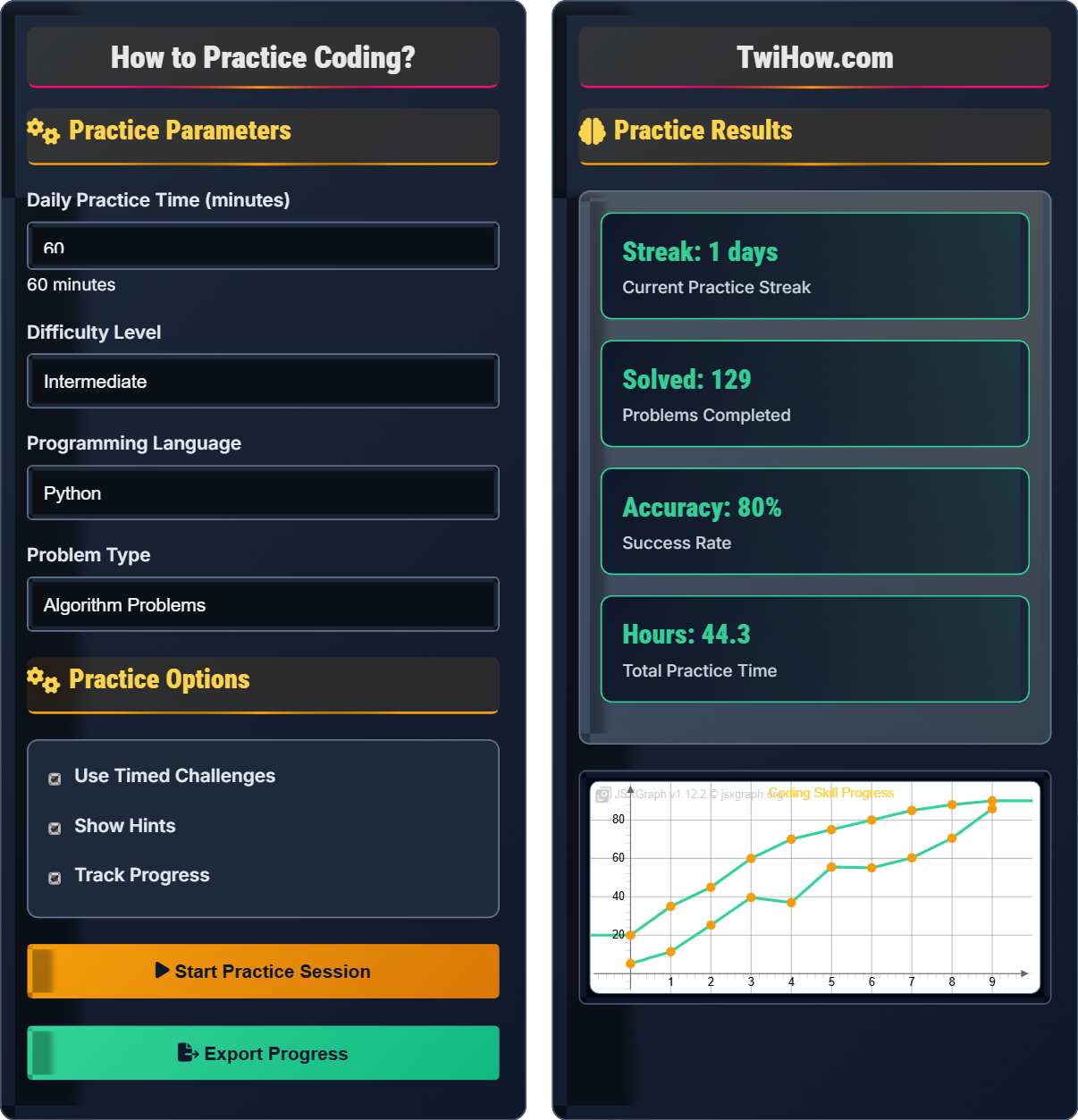
Practice Parameters
Practice Options
Practice Results
| Day | Problems | Time (min) | Accuracy |
|---|---|---|---|
| Mon | 5 | 45 | 85% |
| Tue | 7 | 60 | 92% |
| Wed | 6 | 50 | 88% |
| Thu | 8 | 70 | 91% |
| Fri | 4 | 35 | 87% |
Recommended Next Steps
- Focus on dynamic programming problems
- Review tree data structures
- Practice system design patterns
- Contribute to open source projects
How to Practice Coding Effectively
Coding practice is the systematic approach to improving programming skills through regular problem-solving, project building, and skill development. It involves writing code regularly, solving algorithmic challenges, and building real-world applications to reinforce concepts and gain experience.
Effective coding practice follows a structured approach:
Where:
- Consistency: Regular practice sessions
- Complexity: Gradually increasing difficulty
- Feedback: Code review and testing
Different approaches to effective coding practice:
- Algorithm Practice: Focus on problem-solving and logic
- Data Structures: Master efficient data organization
- Project Building: Create real-world applications
- Code Review: Learn from others' implementations
- Pair Programming: Collaborative problem solving
- Open Source: Contribute to community projects
- Consistency: Practice daily, even if just 15 minutes
- Documentation: Comment your code and explain decisions
- Testing: Write tests for your solutions
- Version Control: Use Git for tracking changes
- Readability: Write clean, maintainable code
- Continuous Learning: Stay updated with new technologies
Coding Practice Essentials
Consistency, problem-solving, debugging, testing, documentation, version control.
Skill = Consistency × Complexity × Feedback
Where Skill = programming proficiency, Consistency = regular practice, Complexity = difficulty progression.
- Practice daily for consistent improvement
- Start with simple problems and increase difficulty
- Review and refactor your code regularly
Practice Resources
LeetCode, HackerRank, Codewars, FreeCodeCamp, Exercism, Project Euler.
- Algorithm challenges
- Real-world projects
- Code reviews
- Community forums
- Choose resources matching your goals
- Balancing theory and practice
- Tracking progress effectively
- Seeking feedback actively
Coding Practice Quiz
Which of the following is the most important aspect of effective coding practice?
While all aspects contribute to effective coding practice, consistency is the foundation. Daily practice builds muscle memory, reinforces concepts, and creates sustainable habits. Research shows that regular, short practice sessions are more effective than infrequent, long sessions. Consistency allows for gradual skill building and prevents knowledge decay.
The answer is B) Consistent daily practice.
Learning to code is similar to learning a musical instrument or a new language - it requires regular practice to build fluency. The brain forms stronger neural pathways through repetition, making coding patterns more automatic over time. Consistent practice also helps maintain motivation and momentum in learning.
Consistency: Regular practice over time
Muscle Memory: Automatic responses developed through repetition
Neural Pathways: Connections in the brain strengthened through practice
• Practice daily, even if just 15 minutes
• Quality over quantity
• Gradual progression in difficulty
• Set a specific time for coding practice
• Use habit-stacking techniques
• Track your streak to stay motivated
• Inconsistent practice schedules
• Jumping to advanced topics too quickly
• Not reviewing completed code
Explain the difference between breadth-first and depth-first approaches to learning programming concepts. Which approach is more effective for coding practice and why?
Breadth-First Approach: Learn many different topics superficially, then revisit them in greater detail. This provides a wide overview of programming concepts.
Depth-First Approach: Master one topic thoroughly before moving to the next. This builds deep expertise in specific areas.
Most Effective Approach: A combination of both, starting with breadth to understand the landscape, then depth to master specific concepts. For coding practice, this means learning basic syntax and concepts first, then diving deep into specific areas while maintaining a broad understanding of other topics.
Effective learning often combines both approaches. Beginners benefit from breadth-first to get familiar with the programming landscape, while intermediate and advanced learners benefit from depth-first to specialize. The key is to balance exploration with specialization, ensuring a solid foundation while developing expertise in chosen areas.
Breadth-First: Wide coverage of topics at shallow level
Depth-First: Deep coverage of topics one at a time
Specialization: Expertise in specific areas
• Build foundational knowledge first
• Balance breadth and depth
• Connect related concepts
• Use the "spiral approach" - revisit topics with increasing depth
• Connect new concepts to previous learning
• Apply concepts immediately after learning
• Staying only in breadth mode without depth
• Trying to master everything simultaneously
• Not connecting different concepts
You're a beginner programmer trying to build a portfolio of projects to showcase your skills. Describe a structured approach to selecting and completing projects that will demonstrate your coding abilities to potential employers. Include timeline, project selection criteria, and best practices.
Timeline: Start with 1-2 week mini-projects, then 2-4 week medium projects, finally 1-2 month comprehensive projects over 6-12 months.
Selection Criteria: Choose projects that demonstrate different skills (frontend, backend, database, algorithms), solve real problems, and showcase best practices (testing, documentation, version control).
Best Practices: Document your process, write clean code, include tests, use proper version control, and deploy live demos. Focus on 3-5 quality projects rather than many incomplete ones.
Example Progression: Calculator → To-do app → Blog platform → E-commerce site → Full-stack application.
Portfolio projects serve as proof of your practical skills. Employers want to see your ability to build complete applications, solve real problems, and follow industry best practices. A structured approach ensures progressive skill development while creating tangible demonstrations of your abilities.
Portfolio: Collection of projects demonstrating skills
Best Practices: Industry-standard coding conventions
Progressive Learning: Building complexity gradually
• Focus on quality over quantity
• Include diverse technologies
• Document your learning process
• Choose projects that solve problems you care about
• Include README files with explanations
• Deploy projects for public access
• Starting with overly complex projects
• Copying code without understanding
• Not documenting or testing projects
You're working on a coding problem and your solution passes most test cases but fails on edge cases. Explain a systematic debugging strategy to identify and fix the issue, including tools and techniques you would use.
Systematic Debugging Strategy:
1. Reproduce the Issue: Run the failing test case to confirm the problem
2. Isolate the Problem: Identify which part of the code causes the failure
3. Print Debugging: Add console.log statements to trace execution
4. Edge Case Analysis: Consider boundary conditions, empty inputs, null values
5. Unit Testing: Write specific tests for problematic sections
6. Refactor: Improve code structure and handle edge cases explicitly
Tools: IDE debuggers, logging, unit testing frameworks, code linters.
Debugging is a crucial skill that requires systematic thinking and patience. The key is to approach problems methodically, isolate variables, and test assumptions. Good debugging skills save time and improve code quality. Practice debugging regularly to develop this essential skill.
Debugging: Finding and fixing code errors
Edge Cases: Boundary conditions and unusual inputsSystematic Approach: Methodical problem-solving process
• Always test edge cases
• Use systematic debugging methods
• Write testable code
• Write tests before implementing features
• Use version control to track changes
• Take breaks when stuck on difficult bugs
• Making random changes hoping to fix the issue
• Not understanding the root cause
• Rushing to implement fixes without analysis
Which of the following techniques is most effective for retaining programming concepts long-term?
While all techniques have value, active coding practice is most effective for retaining programming concepts. This involves hands-on coding, problem-solving, and building projects. Active practice engages multiple cognitive processes and creates stronger neural pathways than passive consumption of information. The act of writing, debugging, and refactoring code reinforces understanding.
The answer is C) Active coding practice.
Learning to code is primarily a skill-based activity. Like learning to play an instrument, you need to practice the actual activity to develop proficiency. Passive learning (reading, watching) provides knowledge, but active practice develops the skills to apply that knowledge effectively.
Active Practice: Hands-on coding and problem-solving
Passive Learning: Consuming information without practice
Skill-Based Learning: Learning through doing
• Code every day, even briefly
• Build projects to apply knowledge
• Practice coding challenges regularly
• Follow the 70/30 rule (70% practice, 30% study)
• Teach others to reinforce your own learning
• Participate in coding communities
• Spending too much time reading instead of coding
• Copying code without understanding
• Not practicing regularly enough
FAQ
Q: How many hours per day should I practice coding to become proficient?
A: Quality matters more than quantity when practicing coding. Consistency is key - aim for 30-60 minutes daily rather than 5 hours once a week. Daily practice builds muscle memory and keeps concepts fresh. Even 15 minutes of focused practice is better than no practice at all. The goal is to make coding a regular habit. As you advance, you can increase the duration, but prioritize consistency over intensity. Remember that taking breaks and allowing concepts to "sink in" is part of the learning process.
Q: Should I focus on one programming language or learn multiple languages simultaneously?
A: For beginners, focus on mastering one programming language completely before moving to another. This approach builds a strong foundation and prevents confusion from switching between different syntaxes and paradigms. Once you've achieved proficiency in one language (able to build projects, understand advanced concepts, and debug effectively), learning additional languages becomes easier as you'll recognize common patterns and concepts. Many successful programmers recommend starting with Python for its simplicity and versatility, or JavaScript for web development, depending on your interests and goals.