Best Web Development Frameworks
Complete framework guide • Comparison tools
Framework Selection Fundamentals:
Compare FrameworksWeb development frameworks are pre-built structures that provide developers with standardized tools, components, and conventions for building web applications. They streamline the development process by offering reusable code, established patterns, and optimized performance.
At their core, frameworks handle common tasks like DOM manipulation, state management, routing, and component lifecycle, allowing developers to focus on business logic rather than boilerplate code. Modern frameworks use virtual DOMs, reactive programming, and component-based architectures.
Key framework concepts:
- Component-Based: Reusable UI building blocks
- State Management: Handling data flow and updates
- Virtual DOM: Efficient rendering and updates
- Routing: Navigation between application views
- Performance: Bundle size, load time, and optimization
Popular frameworks like React, Vue, and Angular offer different approaches to solving common web development challenges, each with unique strengths for specific use cases.
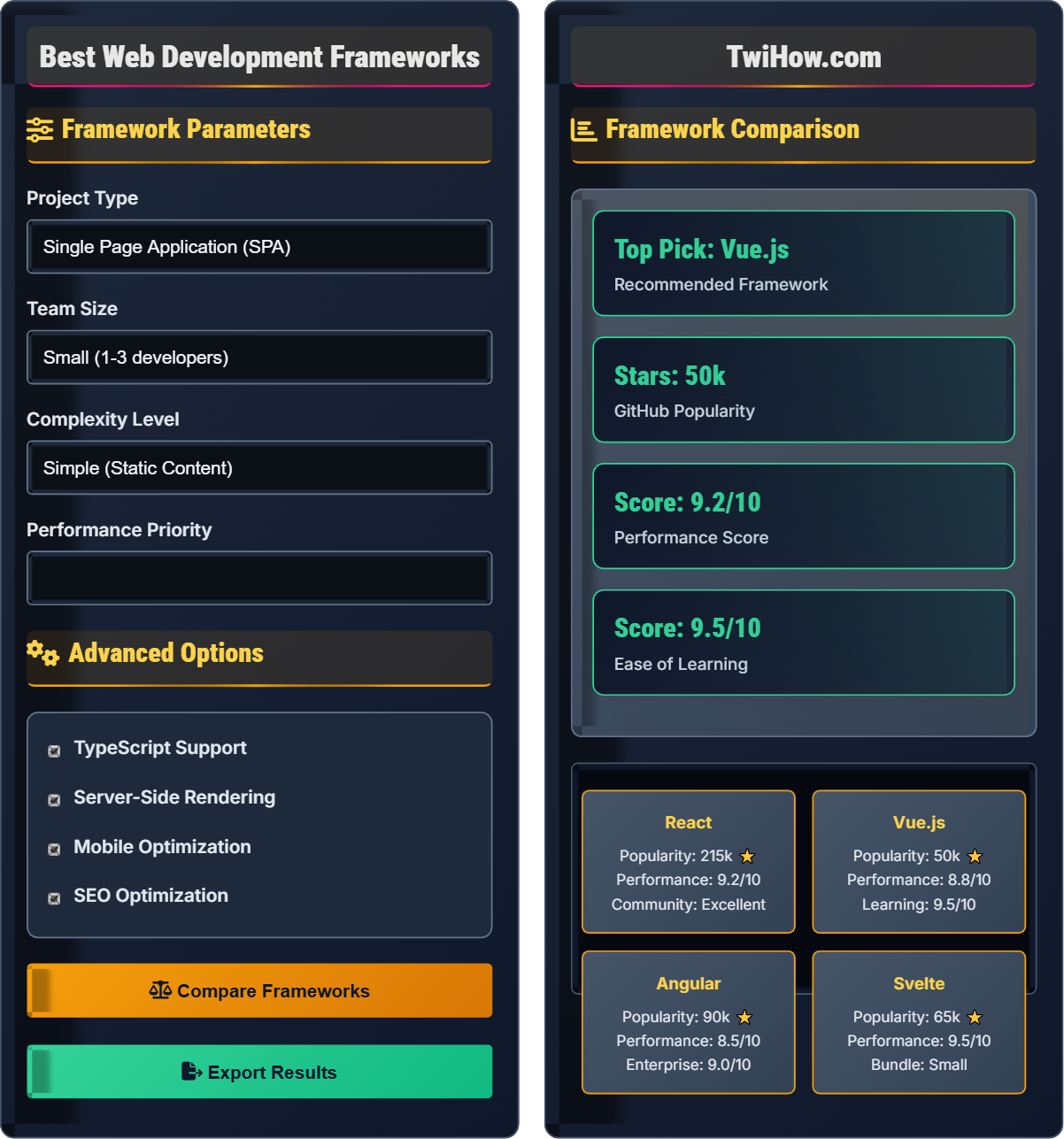
Framework Parameters
Advanced Options
Framework Comparison
| Framework | Learning Curve | Performance | Community |
|---|---|---|---|
| React | Moderate | Excellent | Excellent |
| Vue.js | Easy | Good | Good |
| Angular | Steep | Good | Excellent |
| Svelte | Easy | Excellent | Growing |
| Next.js | Moderate | Excellent | Excellent |
Framework Comparison Matrix
| Feature | React | Vue | Angular | Svelte |
|---|---|---|---|---|
| DOM Manipulation | Virtual DOM | Virtual DOM | Change Detection | Compile-time |
| Bundle Size | Medium | Small | Large | Small |
| Learning Curve | Moderate | Easy | Steep | Easy |
| Mobile Support | React Native | Vue Native | Ionic/Angular | Svelte Native |
Web Frameworks Explained
Web frameworks are comprehensive toolkits that provide developers with pre-built components, libraries, and architectural patterns for building web applications. They abstract away low-level complexities and provide higher-level abstractions for common web development tasks.
Modern web frameworks follow specific architectural patterns:
Where:
- Component-Based: Reusable UI building blocks
- State Management: Handling data flow and updates
- Reactivity: Automatic UI updates when data changes
- Rendering: Converting components to DOM elements
Key factors to consider when choosing a framework:
- Project Requirements: SPA vs SSR vs Static, complexity level
- Team Expertise: Familiarity with syntax and concepts
- Performance Needs: Load time, bundle size, runtime performance
- Community Support: Documentation, packages, community activity
- Long-term Maintenance: Upgrade path, stability, vendor lock-in
- Integration Needs: Backend systems, third-party services
- Island Architecture: Partial hydration for better performance
- Zero-Bundle Frameworks: Edge-side rendering without client bundles
- AI Integration: Frameworks with built-in AI capabilities
- WebAssembly: Frameworks leveraging WASM for performance
- Micro-frontends: Distributed frontend architectures
- Edge Computing: Frameworks optimized for edge deployment
Framework Fundamentals
Components, state management, virtual DOM, reactivity, routing, bundling.
Framework Choice = (Project Requirements + Team Skills + Community Support) × Performance Needs
Where Choice = optimal framework selection, Requirements = project specifications.
- Match framework to project complexity
- Consider long-term maintenance costs
- Evaluate team learning curve
- Check community activity regularly
Best Practices
Progressive enhancement, performance optimization, accessibility compliance, testing strategies.
- Start with minimal setup
- Use official documentation
- Implement proper state management
- Optimize for performance early
- SEO impact
- Accessibility compliance
- Security best practices
- Upgrade path planning
Framework Selection Quiz
Which framework is known for its "compile-time" approach that eliminates runtime overhead?
Svelte is unique among popular frameworks because it shifts much of the work to compile-time rather than runtime. Instead of shipping a runtime framework with the application, Svelte compiles components into efficient vanilla JavaScript, resulting in smaller bundle sizes and faster performance. This approach eliminates the need for a virtual DOM at runtime.
The answer is C) Svelte.
Understanding the difference between runtime and compile-time frameworks is crucial for making informed decisions. Most frameworks (React, Vue, Angular) include runtime code that runs in the browser to manage components and updates. Svelte takes a revolutionary approach by performing these operations at build time, which results in smaller, faster applications. This demonstrates how architectural choices fundamentally impact performance characteristics.
Runtime Framework: Executes code in the browser to manage components
Compile-Time Framework: Performs operations during build process
Virtual DOM: Memory representation of real DOM for efficient updates
• Runtime frameworks have larger bundle sizes
• Compile-time frameworks optimize at build time
• Performance trade-offs vary by use case
• Consider Svelte for performance-critical applications
• Runtime frameworks offer more flexibility
• Evaluate actual bundle size requirements
• Assuming all frameworks work the same way
• Not considering build time vs runtime differences
• Ignoring performance implications for mobile
Describe the systematic approach you would take to select a web framework for a new project. What criteria would you evaluate and in what order of priority?
Systematic Framework Selection Process:
1. Project Requirements Analysis: Define scope, complexity, target audience, and performance needs.
2. Team Assessment: Evaluate current skills, learning capacity, and preferred technologies.
3. Technical Evaluation: Compare frameworks on performance, bundle size, features, and ecosystem.
4. Community & Support: Check documentation quality, community activity, and long-term viability.
5. Proof of Concept: Build a small prototype to validate assumptions.
6. Decision Matrix: Score frameworks against weighted criteria to make objective choice.
Priority order: Project requirements > Team skills > Performance > Community support > Long-term maintenance.
Selecting a framework is one of the most critical decisions in web development, affecting the entire project lifecycle. The systematic approach ensures that emotional preferences don't override practical needs. Starting with project requirements prevents choosing a framework that's overkill or insufficient for the task. Team assessment is crucial because the best framework is useless if your team can't effectively use it.
Proof of Concept: Small implementation to validate feasibility
Decision Matrix: Scoring system for comparing alternatives
Long-term Viability: Sustainability and maintenance considerations
• Never choose framework based on hype alone
Your company needs to build a large-scale enterprise application with multiple teams working simultaneously. The application requires real-time updates, complex state management, and integration with legacy systems. Which framework would you recommend and why?
Recommendation: Angular for large-scale enterprise applications.
Reasons: Angular provides a comprehensive framework with built-in solutions for dependency injection, state management, and testing. Its opinionated structure ensures consistency across large teams. Strong typing with TypeScript catches errors early, and the modular architecture supports scalable development.
Enterprise Benefits: Comprehensive CLI tools, extensive documentation, corporate backing from Google, and mature ecosystem with enterprise-focused solutions.
Alternative: React with Redux Toolkit for teams already familiar with React ecosystem, but Angular's integrated approach is superior for large teams.
Implementation: Monorepo setup with Nx or Lerna for managing multiple applications and libraries.
Enterprise applications have unique requirements that favor frameworks with strong opinions and comprehensive toolsets. Angular's integrated approach provides consistency across large teams, whereas React requires more architectural decisions. The framework choice impacts not just development but also onboarding, maintenance, and scalability. For enterprise scenarios, predictability and structure often outweigh flexibility.
Monorepo: Single repository containing multiple related projects
Opinionated Framework: Provides prescribed way to do things
Dependency Injection: Design pattern for managing object dependencies
• Prioritize consistency over flexibility in large teams
• Consider long-term maintenance costs
• Evaluate tooling and ecosystem maturity
• Use schematics for consistent code generation
• Implement strict linting and code review processes
• Plan for gradual migration from legacy systems
• Choosing trendy framework without considering team expertise
• Underestimating maintenance complexity
• Not planning for scalability requirements
You're building a content-heavy website that needs excellent SEO and fast loading times. Which framework approach would optimize for these requirements, and what specific techniques would you implement?
Framework Approach: Next.js (React-based) with Server-Side Rendering (SSR) and Static Site Generation (SSG).
SEO Optimization: Server-side rendering ensures content is available to search engines immediately. Next.js provides automatic code splitting and optimized builds.
Performance Techniques:
1. Static Generation: Pre-render pages at build time for static content
2. Incremental Static Regeneration: Update static pages after deployment
3. Client-Side Hydration: Convert static HTML to interactive app
4. Image Optimization: Automatic resizing, compression, and format optimization
5. Font Optimization: Automatic font optimization and loading strategies
Alternative: Nuxt.js for Vue.js ecosystem with similar capabilities.
Content-heavy websites have different optimization priorities than interactive applications. The key is balancing SEO requirements with performance. Server-side rendering ensures search engines can index content while still providing a rich user experience. Modern frameworks have evolved to provide hybrid approaches that can statically generate content while maintaining interactivity where needed.
SSR: Server-Side Rendering - content generated on server
SSG: Static Site Generation - content pre-built at build time
Hydration: Converting static HTML to interactive app
• Content-first sites benefit from static generation
• SEO requires content to be available immediately
• Balance performance with development complexity
• Use Next.js Image component for optimization
• Implement proper meta tags and structured data
• Leverage CDN for asset delivery
• Building SPA-only for content-heavy sites
• Not optimizing for Core Web Vitals
• Ignoring accessibility in performance optimization
Which emerging trend in web frameworks focuses on partial hydration to improve performance?
Island Architecture is the emerging trend that focuses on partial hydration for performance optimization. Instead of hydrating the entire application at once, only interactive islands are hydrated, leaving static content as plain HTML. This reduces JavaScript payload and improves performance.
Frameworks like Astro, Fresh, and Qwik implement island architecture. Micro frontends deal with architectural separation, WebAssembly is about performance through compiled languages, and zero-bundle frameworks eliminate client-side JavaScript entirely.
The answer is A) Island Architecture.
Island architecture represents the next evolution in web performance optimization. Traditional hydration sends all JavaScript to the client, even for static content. Island architecture recognizes that only interactive parts need JavaScript, allowing static content to remain as fast-loading HTML. This approach maximizes performance while preserving interactivity where needed.
Island Architecture: Partial hydration approach for performance
Hydration: Converting static HTML to interactive app
Micro Frontends: Distributed frontend architecture
• Less JavaScript generally means better performance
• Only hydrate what needs interactivity
• Consider user experience across all devices
• Evaluate Astro for content-heavy sites
• Consider Qwik for maximum performance
• Measure Core Web Vitals regularly
• Over-hydrating static content
• Not measuring real-world performance
• Ignoring mobile performance impact
FAQ
Q: Should I learn multiple frameworks or specialize in one?
A: Start by mastering one framework deeply, then expand gradually:
Phase 1: Choose one framework (React, Vue, or Angular) and become proficient. Learn its ecosystem, best practices, and advanced features.
Phase 2: Once comfortable, explore concepts from other frameworks to broaden your perspective. Understanding different approaches makes you a better developer.
Phase 3: Learn 1-2 additional frameworks, but focus on how they solve problems differently rather than memorizing syntax.
The underlying concepts (components, state management, reactivity) transfer between frameworks. Deep knowledge of one framework provides a foundation for learning others quickly.
Q: Is it worth learning older frameworks like jQuery?
A: While jQuery isn't essential for new projects, understanding it has value:
Historical Context: jQuery pioneered many concepts now standard in modern frameworks (DOM manipulation, event handling).
Legacy Projects: Many existing websites still use jQuery, so knowing it helps with maintenance work.
Lightweight Tasks: For simple DOM manipulation, jQuery can be more concise than vanilla JavaScript.
However, prioritize learning modern frameworks first. jQuery knowledge is supplementary, not foundational. Focus your main efforts on React, Vue, or Angular.