How to Handle Home Sale Contingencies
Real estate guide • Step-by-step explanations
Home Sale Contingencies:
Show Contingency CalculatorHome sale contingencies are protective clauses in real estate contracts that allow buyers or sellers to back out of a deal under specific circumstances. When selling your current home, understanding and managing contingencies is crucial for a smooth transaction.
Common contingencies include:
- Inspection Contingency: Buyer can back out if inspection reveals major issues
- Financing Contingency: Buyer has time to secure mortgage financing
- Appraisal Contingency: Home must appraise for at least purchase price
- Sale of Current Home Contingency: Buyer must sell their home first
- Home Sale Contingency: Seller must find another home before closing
Successfully managing these contingencies requires preparation, timing, and strategic negotiation to protect both parties while moving the transaction forward.
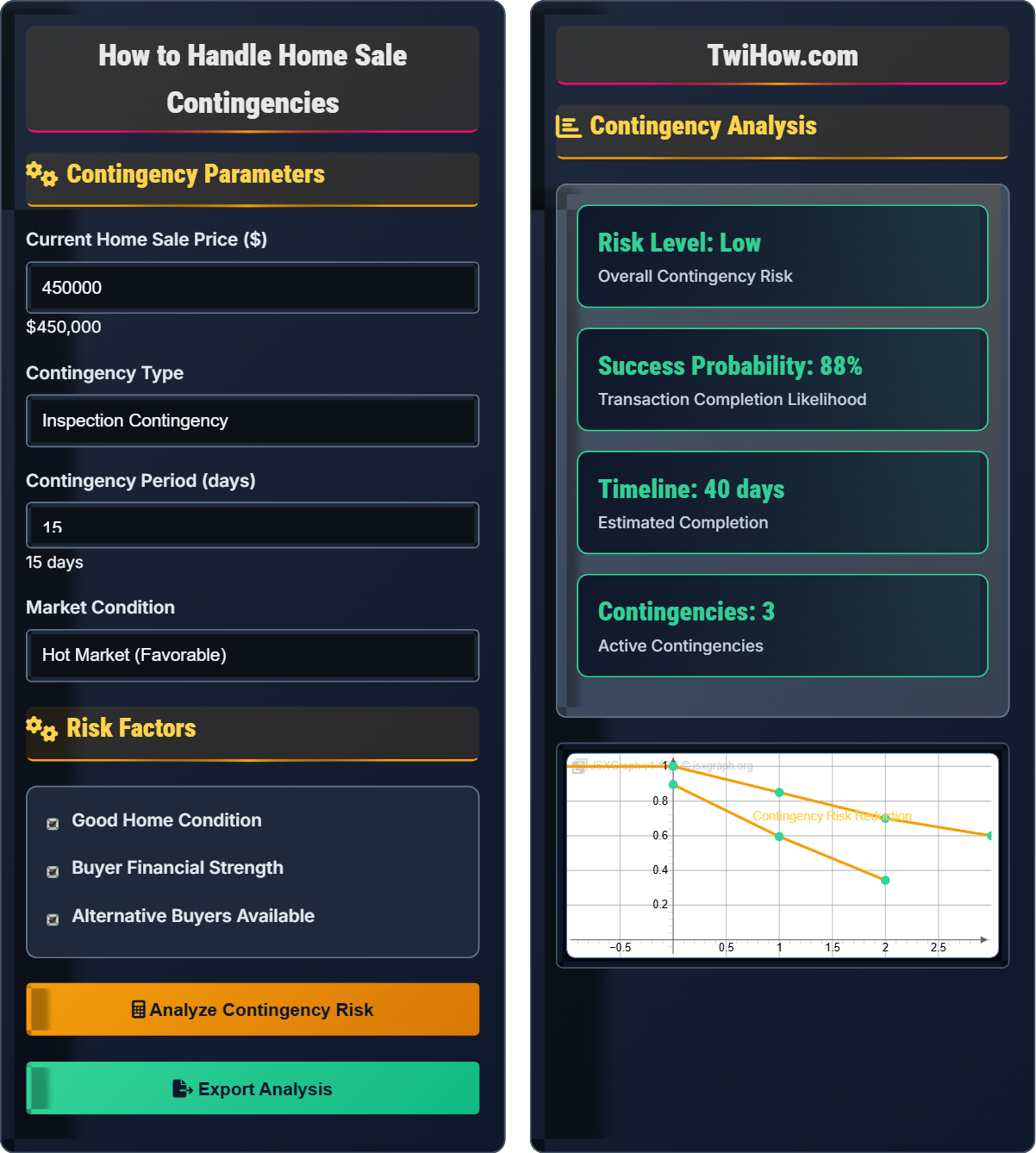
Contingency Parameters
Risk Factors
Contingency Analysis
| Contingency | Risk Level | Action Required | Priority |
|---|---|---|---|
| Inspection | Low | Prepare documentation | High |
| Financing | Moderate | Verify pre-approval | High |
| Appraisal | Low | Research comps | Medium |
Understanding Home Sale Contingencies
Contingencies are conditions that must be met for a real estate contract to proceed. They serve as protection for both buyers and sellers, allowing either party to walk away if specified conditions aren't satisfied. When selling your current home, you may encounter various types of contingencies that affect your timeline and obligations.
Common contingencies that affect home sales include:
- Inspection Contingency: Allows buyers to have the property professionally inspected
- Financing Contingency: Protects buyers if they can't obtain mortgage approval
- Appraisal Contingency: Ensures the home appraises for at least the purchase price
- Sale of Current Home Contingency: Buyer must sell their existing home first
- Home Sale Contingency: Seller must find a replacement home
- Title Contingency: Ensures clear title transfer
Effective strategies for managing contingencies:
- Pre-inspection: Conduct your own inspection to identify and address issues
- Documentation: Prepare maintenance records and warranties
- Backup Plans: Have alternative buyers lined up
- Communication: Maintain regular contact with all parties
- Professional Help: Work with experienced real estate agents and attorneys
- Timing: Coordinate with your own home purchase timeline
When selling your current home with contingencies, timing becomes critical:
- Staging: Keep your home ready to show at any time
- Financing: Get pre-approved for your next home before listing
- Temporary Housing: Arrange temporary accommodation if needed
- Utilities: Plan for utility transfers and deposits
- Contract Terms: Negotiate reasonable contingency periods
Contingency Fundamentals
Contingencies, risk assessment, timeline coordination, backup planning, market conditions.
Risk = (Likelihood of Failure × Impact of Failure) / Contingency Strength
Where Likelihood of Failure depends on market conditions, home condition, and buyer finances.
- Always prepare for contingency failures
- Keep your home market-ready during contingency periods
- Have backup plans for all major contingencies
- Communicate proactively with all parties
Management Strategies
Pre-inspection, documentation, communication, timing, professional assistance, alternative planning.
- Conduct pre-listing inspections
- Maintain detailed maintenance records
- Secure pre-approval for next home
- Prepare temporary housing options
- Work with experienced professionals
- Market conditions affect contingency success rates
- Timing coordination is critical for smooth transitions
- Professional guidance helps navigate complex situations
- Backup plans provide peace of mind and options
Home Sale Contingency Quiz
Which contingency allows a buyer to back out if the home doesn't appraise for at least the purchase price?
An appraisal contingency protects the buyer if the home appraises for less than the agreed-upon purchase price. This is particularly important because lenders won't finance more than the appraised value of the home.
The answer is B) Appraisal Contingency.
Appraisal contingencies are crucial in real estate transactions because they protect buyers from overpaying and lenders from lending more than a property's worth. When a home appraises below the purchase price, buyers may need to negotiate a lower price, increase their down payment, or cancel the contract. Sellers should research comparable sales to set realistic prices and avoid appraisal issues.
Appraisal: Professional estimate of a property's value by a licensed appraiser
Contingency: A condition that must be met for a contract to proceed
Loan-to-Value Ratio: The ratio of loan amount to property value
• Lenders require appraisals for mortgage loans
• Appraisals are based on recent comparable sales
• Contingency periods are time-sensitive
• Research recent comparable sales before pricing
• Ensure home is in good repair to maximize appraised value
• Work with experienced appraisers familiar with your area
• Setting unrealistic prices above market value
• Not maintaining the property properly
• Choosing inexperienced appraisers
Explain how a seller should prepare for and manage contingencies when selling their current home while trying to purchase another property. Include specific strategies for minimizing risks and ensuring a smooth transition.
Preparation Strategies: Sellers should conduct pre-listing inspections, gather all maintenance records, and get pre-approved for their next home. They should also research comparable sales to price their home appropriately and ensure it's in excellent condition.
Contingency Management: Maintain constant communication with all parties, keep the home ready to show at any time, and work with experienced professionals who understand the complexities of simultaneous buying and selling.
Risk Minimization: Have backup plans including temporary housing options, alternative buyers, and flexible closing dates. Consider lease-back agreements if needed.
Smooth Transition: Coordinate timelines carefully, plan utility transfers, arrange moving logistics, and prepare for potential delays in either transaction.
Selling and buying simultaneously is one of the most complex real estate scenarios. Success requires careful planning, flexibility, and multiple backup options. The key is to be prepared for various outcomes while maintaining control over the timeline. Sellers must balance keeping their home marketable while preparing for their move, which often requires advance planning and professional guidance.
Simultaneous Transaction: Selling and buying homes at the same time
Lease-back Agreement: Arrangement allowing seller to rent back the property
Bridge Loan: Short-term financing for overlapping transactions
• Always have a backup plan for both transactions
• Get pre-approved for your next home before listing
• Consider staging your home to maximize appeal
• Plan for temporary housing if transactions don't align
• Not having a backup plan for delayed closings
• Pricing the home unrealistically high
• Failing to keep the home ready for showings
Sarah is selling her $500,000 home to buy a $600,000 house. She has a financing contingency that expires in 10 days, but she hasn't found a suitable replacement home yet. Her current home has received an offer with a sale-of-current-home contingency. What should Sarah do to minimize risk and ensure a smooth transition?
Immediate Actions: Sarah should immediately get pre-approved for a bridge loan or home equity line of credit to secure financing regardless of her home sale. She should also expand her search criteria and work with multiple agents to find a suitable replacement quickly.
Contingency Management: Negotiate an extension on the financing contingency if possible. If the buyer is willing, Sarah could offer incentives to extend the timeline.
Risk Mitigation: Prepare for temporary housing arrangements and explore lease-back options with the buyer of her current home. Consider temporary storage solutions for belongings.
Professional Guidance: Work with a real estate attorney to understand contract terms and explore legal options for protecting both transactions.
This scenario demonstrates the complexity of contingent transactions. Sarah faces a double contingency - her purchase depends on selling her current home, while the buyer's offer depends on selling theirs. This creates a chain of dependencies that increases risk. The key is to break the dependency chain by securing independent financing and having backup plans for temporary housing. Professional guidance becomes crucial in navigating these complex contractual relationships.
Double Contingency: Both transactions depend on each other
Bridge Loan: Short-term financing for overlapping purchases
Lease-back: Renting back the sold property temporarily
• Never rely solely on the sale of one home to fund another
• Always have independent financing options available
• Plan for temporary housing when timelines don't align
• Get pre-approved for financing before listing
• Work with agents experienced in simultaneous transactions
• Prepare a comprehensive moving timeline
• Not having independent financing secured
• Being inflexible with search criteria
• Failing to plan for temporary housing needs
In a hot real estate market, a seller receives an offer with minimal contingencies from a cash buyer, but also receives a higher offer with multiple contingencies from a traditional buyer. Which offer should the seller accept and why? Consider both financial and timeline factors.
Financial Analysis: While the contingent offer may be higher, the cash offer provides certainty. In a hot market, the cash offer might be worth accepting even if slightly lower.
Timeline Considerations: Cash offers typically close faster with fewer complications. Contingent offers involve inspection, financing, and appraisal periods that can delay closing.
Risk Assessment: Contingencies introduce risk of cancellation. The higher offer might fall through, leaving the seller to restart the process.
Decision Framework: Compare the net value considering probability of closing. For example, a $490,000 cash offer with 95% certainty vs. a $500,000 contingent offer with 70% certainty: $490,000 × 0.95 = $465,500 vs. $500,000 × 0.70 = $350,000.
This problem illustrates the trade-off between price and certainty in real estate. Sellers must weigh the potential for a higher sale price against the risk of losing the transaction entirely. In hot markets, buyers often try to eliminate contingencies to make their offers more attractive, but sellers shouldn't automatically choose the highest offer without considering the probability of successful completion. The expected value calculation helps quantify this trade-off.
Expected Value: Probability-weighted average of possible outcomes
Cash Offer: Purchase without financing contingencies
Contingent Offer: Offer dependent on certain conditions
• Higher offers aren't always better if they're risky
• Certainty has value in real estate transactions
• Consider expected value, not just face value
• Calculate expected value of each offer
• Consider your timeline urgency
• Factor in the cost of restarting the process
• Accepting the highest offer without considering probability
• Ignoring timeline implications
• Underestimating the cost of failed transactions
When selling a home with multiple contingencies, which should a seller prioritize addressing first?
While all contingencies are important, the most critical approach is to address those with the highest risk of failure first. These contingencies pose the greatest threat to the transaction's success and require the most attention and resources to resolve. Addressing high-risk contingencies early allows time to implement backup plans if needed.
The answer is B) The contingency with the highest risk of failure.
Effective contingency management requires prioritization based on risk rather than just deadlines. While urgent deadlines must be met, focusing resources on the most likely points of failure maximizes the chance of successful transaction completion. Risk assessment should consider factors like market conditions, property condition, buyer financial stability, and historical success rates for similar contingencies in your area.
Risk Assessment: Evaluation of likelihood and impact of negative outcomes
Contingency Priority: Order of importance for addressing contingenciesTransaction Success Rate: Probability of completing the sale
• Prioritize by risk, not just urgency
• Address high-impact contingencies early
• Maintain focus on transaction completion
• Create a contingency risk matrix
• Focus resources on the most critical items
• Maintain communication with all parties
• Focusing only on deadlines instead of risks
• Spreading resources too thin across all contingencies
• Not identifying the most critical points of failure
FAQ
Q: What should I do if my home sale falls through due to a contingency?
A: Don't panic! Contingency failures are common in real estate. First, review the contract to understand exactly why the contingency wasn't satisfied. Then, evaluate whether the issues can be resolved (such as negotiating repairs or adjusting the price). If not, immediately begin marketing your home to other potential buyers. If you've been pre-approved for your next home, you may still be able to proceed with your purchase plans. It's crucial to have backup plans in place for both your sale and purchase transactions.
Q: How long do contingencies typically last and can they be extended?
A: Contingency periods vary by contract and location, but common durations are: Inspection (7-10 days), Appraisal (typically 7-14 days), and Financing (30-45 days). Most contingencies can be extended if both parties agree. Extensions usually require a written amendment to the contract and sometimes a fee paid to the seller. It's important to request extensions before the original deadline expires. However, sellers are not obligated to grant extensions and may choose to terminate the contract instead.