How Do I Handle Repairs or Credits Requested After a Home Inspection?
Complete home inspection guide • Repair negotiation
Home Inspection Repairs:
Show Repair CalculatorHandling repairs and credits after a home inspection is a critical negotiation phase in real estate transactions. Successful navigation requires understanding repair priorities, cost estimates, and effective communication strategies. The key is balancing your needs with market realities while maintaining positive relationships with sellers.
Key considerations include:
- Safety Concerns: Prioritize health and safety issues first
- Major Systems: Address HVAC, plumbing, electrical, and structural issues
- Cost-Benefit: Evaluate repair costs versus home value
- Negotiation: Balance requests with market conditions
- Documentation: Maintain clear communication records
Understanding these strategies helps ensure you get necessary repairs while preserving the transaction.
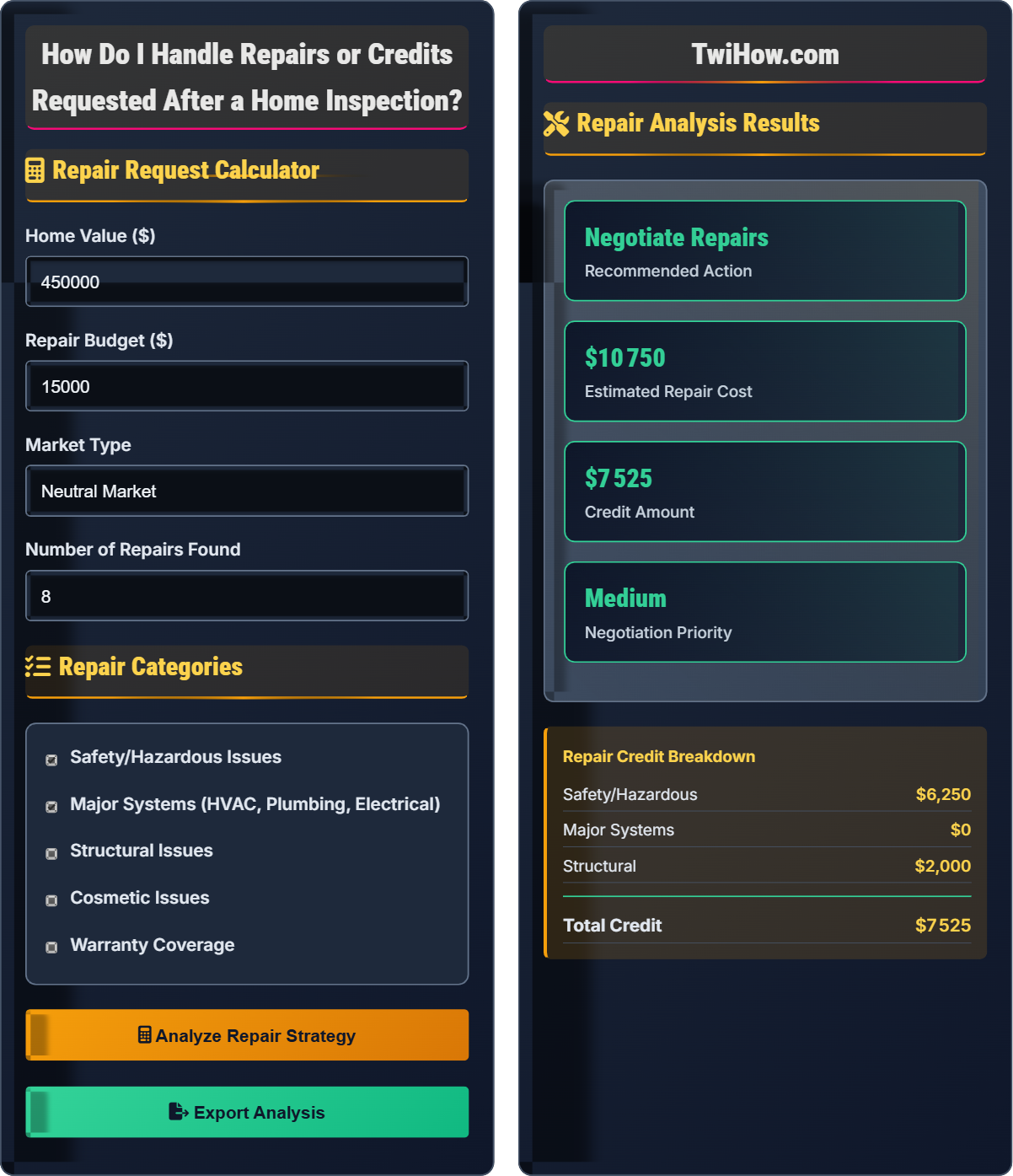
Repair Request Calculator
Repair Categories
Repair Analysis Results
• Be respectful and professional in all communications
• Focus on facts rather than emotions
• Provide cost estimates from licensed contractors
• Be willing to compromise on non-critical items
"Thank you for your consideration of our repair requests. We understand this is a significant transaction for both parties. We are requesting these repairs to ensure the safety and functionality of the home. We are open to discussing alternative solutions that work for both parties."
Handling Home Inspection Repairs Explained
After a home inspection, repairs should be categorized by priority and necessity:
- Critical Safety Issues: Health hazards, electrical problems, gas leaks, structural concerns
- Major System Failures: HVAC, plumbing, electrical, roofing systems needing repair
- Code Violations: Issues that violate local building codes
- Cosmetic Issues: Minor repairs that don't affect functionality
- Future Maintenance: Items that will need attention soon
When evaluating whether to request repairs or credits, consider this formula:
Where:
- Safety Impact: How much the issue affects health/safety (1-10 scale)
- Functionality Impact: How much the issue affects home functionality (1-10 scale)
- Cost of Repair: Actual or estimated repair cost
- Market Condition Factor: 1.2 (Buyer's market), 1.0 (Neutral), 0.8 (Seller's market)
Choose repairs or credits based on these factors:
- Request Repairs When: Issues affect safety, major systems, or require professional expertise
- Request Credits When: Minor cosmetic issues, when you prefer to handle repairs yourself, or when seller won't make repairs
- Consider Both: For major items, request seller repair with credit as backup
- Waive Requests: For minor issues that don't significantly impact value
- Professional Tone: Maintain respectful, business-like communication
- Fact-Based: Focus on objective issues rather than opinions
- Collaborative Approach: Frame requests as mutual problem-solving
- Flexibility: Be willing to compromise on non-critical items
- Documentation: Keep written records of all agreements
Repair Essentials
Home inspection, repair requests, repair credits, negotiation, safety issues, market conditions, contingency period.
Repair Priority = (Safety Impact + Functionality Impact) / Cost × Market Factor
Higher scores indicate more important repair requests.
- Address safety issues first
- Get professional estimates for major repairs
- Consider market conditions in negotiations
Negotiation Strategy
Home Inspection Repair Quiz
Which type of repair should always be addressed first in post-inspection negotiations?
Safety and health concerns should always be addressed first in post-inspection negotiations because they affect the habitability and insurability of the home. Issues like electrical problems, gas leaks, structural concerns, and health hazards pose immediate risks that must be resolved before other repairs. Insurance companies may refuse coverage for homes with unresolved safety issues.
The answer is B) Safety and health concerns.
Prioritizing repairs follows a hierarchy of importance. Safety and health concerns are paramount because they affect the fundamental habitability of the home. After addressing these, focus shifts to major systems that affect functionality, followed by other issues. This approach ensures the most critical problems are solved first while managing the overall repair burden.
Safety Concern: Issue that poses immediate risk to occupants
Health Hazard: Condition that could cause illness or injury
Major System: HVAC, plumbing, electrical, or structural components
• Safety issues take precedence over all others
• Health concerns affect insurance coverage
• Major systems affect home value
• Get professional estimates for safety issues
• Document all safety concerns
• Don't compromise on safety repairs
• Prioritizing cosmetic over safety issues
• Not documenting safety concerns properly
• Compromising on critical safety items
Explain when to request a repair credit versus asking the seller to make the repairs, and provide specific examples of each scenario.
Request Repairs When:
• Safety and health hazards that require professional expertise
• Major system failures (HVAC, plumbing, electrical) that need licensed professionals
• Structural issues that require permits and inspections
• Issues where you want warranty coverage from the seller's contractor
Example: Faulty electrical panel that needs licensed electrician
Request Credits When:
• Minor cosmetic issues that don't require special expertise
• When you prefer to use your own contractors
• When the seller refuses to make repairs
• When you want flexibility in how repairs are handled
Example: Painting touch-ups or minor fixture replacements
Consider Both: For major items, request seller repair with credit as backup option if seller refuses to repair.
The repair vs. credit decision depends on several factors including the nature of the issue, your comfort level with repairs, and market conditions. Safety and major system issues typically require professional attention, making seller repair preferable. Minor issues can often be handled with credits, giving you flexibility in timing and contractor selection.
Repair Credit: Monetary compensation instead of actual repairs
Repair Request: Direct request for seller to fix the issue
Professional Contractor: Licensed tradesperson with insurance
• Safety issues should be professionally repaired
• Credits give you control over repairs
• Consider contractor availability
• Get multiple estimates for major repairs
• Consider warranty coverage
• Evaluate your DIY skills honestly
• Asking for credits for safety issues
• Attempting major repairs yourself
• Not considering contractor availability
You're buying a $500,000 home in a seller's market with 15 days left in your inspection contingency period. The inspection revealed $25,000 in repairs, including $15,000 in major systems and $10,000 in safety issues. The seller has already rejected $10,000 of requests. How should you prioritize your remaining requests and what strategy should you employ?
Priority Assessment:
• Safety issues ($10,000) - Must address these first as they affect habitability
• Major systems ($15,000) - Important for home functionality and value
• Market condition - Seller's market means seller has leverage
Strategy:
1. Focus on Safety: Present $10,000 in safety issues as non-negotiable for health/insurance
2. Bundle Major Systems: Group remaining major system items into one request
3. Offer Flexibility: Suggest credits instead of repairs to reduce seller burden
4. Provide Estimates: Include professional estimates to support requests
5. Set Deadline: Request response within 48 hours to maintain momentum
Final Request: $10,000 credit for safety issues (non-negotiable) + $8,000 credit for major systems (flexible).
In seller's markets, buyers must be strategic about requests. Focus on the most critical issues and be willing to compromise on others. Presenting safety concerns as non-negotiable helps establish boundaries while showing flexibility on other items. Providing professional estimates adds credibility to requests and shows you've done your homework.
Seller's Market: More buyers than available properties
Contingency Period: Time frame to complete inspections and negotiations
Non-Negotiable: Issue that must be resolved for transaction to continue
• Adjust strategy to market conditions
• Prioritize safety over convenience
• Be strategic with limited time
• Focus on safety first in seller's markets
• Bundle multiple small items
• Be prepared to compromise
• Making too many requests in seller's market
• Not prioritizing safety issues
• Failing to provide professional estimates
The seller has rejected all your repair requests except for one minor item. The inspection found significant issues with the HVAC system ($8,000), electrical problems ($5,000), and minor cosmetic issues ($2,000). How should you approach the seller to request reconsideration?
Communication Strategy:
1. Express Appreciation: Acknowledge the one accepted repair
2. Focus on Safety: Emphasize electrical issues as safety concerns
3. Present Business Case: Explain how unresolved issues affect home value
4. Offer Alternatives: Suggest repair credits instead of actual repairs
5. Show Flexibility: Propose phased approach to major repairs
Sample Approach:
"We appreciate your agreement to the minor repair. However, the electrical issues pose safety concerns that insurance companies often require to be addressed. We'd be willing to accept a credit for the electrical work if you prefer not to have it done directly. For the HVAC, perhaps we could split the cost or find a qualified contractor you approve."
Key Points: Maintain professionalism, focus on facts, offer solutions, and show willingness to compromise.
Effective communication after rejection requires a delicate balance of firmness on important issues and flexibility on others. Start positively, focus on objective facts, and present alternative solutions. This collaborative approach often leads to better outcomes than adversarial negotiations. Remember that both parties want the transaction to close.
Business Case: Logical argument based on financial impact
Collaborative Approach: Working together toward mutually beneficial solution
Objective Facts: Measurable, verifiable information
• Maintain professional tone
• Focus on objective concerns
• Offer alternative solutions
• Start with positive acknowledgment
• Focus on safety concerns first
• Provide alternative solutions
• Becoming adversarial after rejection
• Not offering alternative solutions
• Focusing on emotions over facts
What documentation should you provide when requesting repairs or credits after a home inspection?
When requesting repairs or credits after a home inspection, you should provide the inspection report and professional estimates from qualified contractors. The inspection report documents the issues objectively, while professional estimates provide credible cost information that supports your requests. This documentation strengthens your position and demonstrates that you've done proper research.
The answer is B) Copy of inspection report and professional estimates.
Documentation is crucial in real estate negotiations because it provides objective evidence to support your requests. The inspection report serves as the authoritative record of issues found, while professional estimates demonstrate that your requests are reasonable and based on actual costs. Proper documentation protects both parties and helps ensure that agreements are clear and enforceable.
Professional Estimate: Cost assessment from licensed contractor
Inspection Report: Detailed documentation of property condition
Documentation: Written evidence supporting requests
• Always provide inspection report
• Include professional estimates for major items
• Document all agreements in writing
• Get estimates from licensed contractors
• Keep copies of all documentation
• Ensure estimates include labor and materials
• Not providing professional estimates
• Relying on verbal agreements
• Not documenting all requests
FAQ
Q: Can I request repairs for issues that weren't mentioned in the original inspection report?
A: Technically, you can request repairs for issues discovered after the inspection, but the seller is not obligated to address them since they weren't part of the original agreement. Issues that were visible and accessible during the inspection should have been identified. However, newly discovered issues (like problems revealed during repair work) can be addressed separately. It's important to conduct a thorough inspection to identify all potential issues before making requests.
Q: What if the buyer requests repairs that I believe are unnecessary or overestimated?
A: You have the right to dispute repair requests. You can:
1. Obtain your own estimates: Get quotes from your own contractors to verify costs
2. Question the necessity: Ask for documentation proving the repair is needed
3. Counter-offer: Propose alternative solutions or partial credits
4. Seek expert opinion: Consult with specialists for complex issues
5. Negotiate in good faith: Work toward a resolution that's fair to both parties
Remember that the goal is to reach an agreement that allows the transaction to close successfully.
Q: How do I handle repair requests when buying a home as an investment property?
A: When buying investment properties, your approach to repair requests differs:
1. Focus on safety and code violations: These affect insurance and tenant safety
2. Consider repair costs vs. rent potential: Evaluate if repairs improve ROI
3. Request credits instead of repairs: Gives you flexibility in contractor selection
4. Prioritize major systems: HVAC, plumbing, electrical affect tenant satisfaction
5. Plan for future maintenance: Budget for ongoing upkeep as landlord
Remember that as an investor, you're focused on long-term profitability rather than personal comfort.