How to Handle Home Purchase Paperwork & Documentation
Complete real estate guide • Step-by-step documentation process
Home Purchase Documentation:
Show Documentation AssistantHandling home purchase paperwork involves navigating a complex array of legal documents, financial records, and regulatory requirements. The process typically includes mortgage applications, purchase agreements, disclosures, title documents, and closing papers. Success requires organization, attention to detail, and understanding of legal requirements.
Essential documentation stages:
- Pre-Purchase: Mortgage pre-approval, financial documentation
- During Purchase: Purchase agreement, inspections, appraisals
- Before Closing: Title search, insurance, final walk-through
- At Closing: Final documents, deed transfer, keys
Modern home buying requires careful document management throughout the process. Digital tools and checklists help buyers stay organized and ensure no critical steps are missed.
Documentation Parameters
Document Preferences
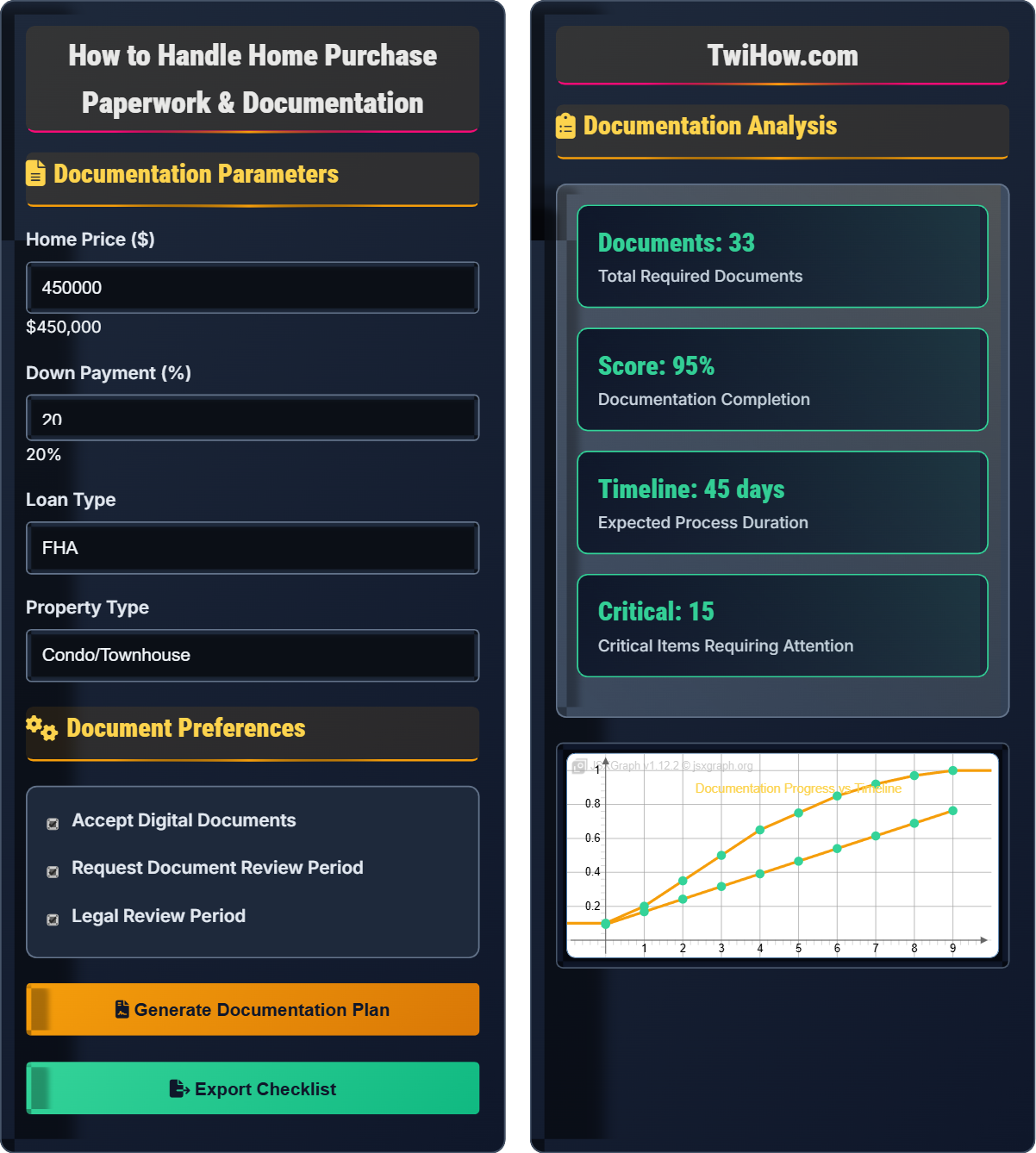
Documentation Analysis
| Document | Type | Priority | Due Date |
|---|---|---|---|
| Mortgage Pre-Approval | Financial | High | Before House Hunting |
| Purchase Agreement | Legal | High | After Offer Accepted |
| Home Inspection Report | Inspection | High | Within 10 Days |
| Appraisal Report | Valuation | Medium | Within 14 Days |
Home Purchase Documentation Process Explained
Home purchase documentation involves multiple legal and financial documents that formalize the transaction. The process typically spans 30-60 days and requires careful attention to deadlines, signatures, and compliance with state and federal regulations. Each document serves a specific purpose in protecting both buyer and seller interests.
Document Count = Base Documents + (Property Type Factor × Loan Type Factor) + State Specific Requirements
Where:
- Base Documents: Standard 15-20 documents
- Property Type Factor: Condos/Townhouses add 3-5 docs
- Loan Type Factor: FHA/VA loans add 5-10 docs
Key document categories in home purchase:
- Financial: Loan documents, income verification, asset statements
- Legal: Purchase agreement, title documents, deeds
- Property: Inspection reports, appraisal, survey
- Insurance: Homeowners insurance, flood certification
- Tax: Property tax records, homestead exemptions
- HOA: HOA documents, bylaws, financial statements
- Digital Filing: Scan and organize all documents electronically
- Physical Folder: Keep originals in chronological order
- Checklist Tracking: Mark off completed items
- Communication Log: Record all conversations and decisions
- Timeline Calendar: Track all deadlines and appointments
Documentation Fundamentals
Document management, legal requirements, financial verification, due diligence, closing process.
Document Count = Base Documents + (Property Type Factor × Loan Type Factor) + State Requirements
Where Document Count = total required documents, Base Documents = standard 15-20, Property Type Factor = additional docs based on property type.
- Keep all documents organized and accessible
- Review all documents carefully before signing
- Meet all deadlines to avoid delays
Process Stages
Pre-purchase, offer stage, due diligence, closing preparation, final closing.
- Gather financial documents
- Obtain pre-approval
- Review purchase agreement
- Complete due diligence
- Sign closing documents
- State-specific requirements vary
- Loan type affects documentation
- Property type influences process
- Timeline management is critical
Home Purchase Documentation Quiz
Which document is considered the most critical in the home buying process?
The Purchase Agreement is the most critical document as it legally binds both buyer and seller to the transaction terms. It establishes the purchase price, contingencies, closing date, and other essential conditions. Without a properly executed purchase agreement, the transaction cannot proceed.
The answer is B) Purchase Agreement.
The purchase agreement serves as the foundation for the entire home buying process. It creates a legally binding contract between buyer and seller, establishing rights, responsibilities, and obligations. All other documents flow from the terms established in the purchase agreement, making it the cornerstone of the transaction.
Purchase Agreement: Legally binding contract between buyer and seller
Contingencies: Conditions that must be met for contract to proceed
Legally Binding: Creates enforceable obligations for both parties
• Purchase agreement must be signed by both parties
• All terms must be clearly defined
• Contingencies provide buyer protection
• Review purchase agreement with attorney
• Understand all contingencies before signing
• Negotiate favorable terms early
• Not reading the agreement carefully
• Signing without understanding terms
• Missing contingency deadlines
Describe a comprehensive system for organizing home purchase documents and explain why this is important.
Organization System: Create a master folder with subfolders for each stage: Pre-Purchase, Offer, Due Diligence, Closing Preparation, and Post-Closing. Within each folder, arrange documents chronologically. Create a master checklist to track document completion.
Why Important: Organized documentation prevents missed deadlines, ensures compliance with lender requirements, helps during inspections, and provides legal protection. It also reduces stress and confusion during the complex home buying process.
Effective document management is crucial in home buying due to the volume of paperwork and tight deadlines. A systematic approach prevents critical items from being overlooked and ensures all parties have access to necessary information. Good organization also facilitates communication between buyer, agent, lender, and attorney.
Document Management: Systematic organization and tracking of paperwork
Chronological Order: Arranging documents by date
Master Checklist: Comprehensive tracking tool
• Keep both digital and physical copies
• Track all deadlines systematically
• Verify document authenticity
• Use cloud storage for backup
• Losing important documents
• Missing critical deadlines
• Not backing up digital files
You're purchasing a $400,000 home with a conventional loan. Your contract states inspection period is 10 days, appraisal within 14 days, and closing in 30 days. You discover major issues during inspection requiring negotiations. How should you manage your documentation timeline and what documents might you need to update?
Timeline Management: Immediately request extension of inspection period through an amendment to the purchase agreement. Document all inspection findings with photos and contractor estimates.
Documents to Update: 1) Purchase agreement amendment extending deadlines, 2) Repair request letter to seller, 3) Revised closing disclosure if loan terms change, 4) Updated timeline schedule.
Key Actions: Communicate with all parties immediately, get all extensions in writing, and ensure all documents reflect new timelines. This prevents contract defaults while maintaining negotiation leverage.
Timeline management is critical when unexpected issues arise. Any changes to deadlines must be documented through formal amendments to maintain legal validity. The key is proactive communication and proper documentation to protect your interests while preserving the transaction.
Purchase Agreement Amendment: Formal change to contract terms
Timeline Extension: Lengthening of contractual deadlines
Contract Default: Failure to meet contractual obligations
• All timeline changes must be in writing
• Both parties must agree to extensions
• Document all negotiations
• Always get extensions in writing
• Keep detailed communication log
• Plan buffer time for issues
• Assuming verbal agreements are valid
• Not documenting timeline changes
• Missing extended deadlines
You've identified three major issues during your home inspection: electrical panel needs replacement ($8,000), HVAC system has 2 years remaining ($12,000), and foundation crack requires repair ($5,000). Calculate the total estimated repair costs and develop a contingency strategy that balances your interests with the seller's willingness to negotiate.
Total Estimated Costs: $8,000 + $12,000 + $5,000 = $25,000
Contingency Strategy: 1) Request seller credit of $15,000, 2) Accept responsibility for HVAC replacement, 3) Negotiate timeline for foundation repair, 4) Request updated home warranty.
Rationale: Asking for all repairs may cause seller to reject. By requesting partial credit and accepting some responsibility, you maintain good faith while protecting your interests. This approach increases acceptance probability while managing costs.
Contingency management requires balancing buyer protection with seller cooperation. Successful negotiation involves prioritizing issues, offering reasonable compromises, and maintaining positive relationships. The goal is achieving satisfactory outcomes while preserving the transaction.
Contingency Management: Handling inspection findings within contract terms
Seller Credit: Dollar amount credited toward repairs
Good Faith Negotiation: Reasonable compromise seeking mutual benefit
• Document all inspection findings
• Make reasonable requests
• Maintain positive relationship
• Requesting all repairs at once
• Not getting professional estimates
• Being unreasonable in negotiations
Which document officially transfers ownership of the property from seller to buyer?
The Deed is the legal document that officially transfers ownership of real property from the seller to the buyer. While other documents are important for financing and protection, only the deed transfers title and ownership rights. Different types of deeds (warranty, quitclaim, etc.) provide varying levels of protection to the buyer.
The answer is B) Deed.
The deed is the fundamental document in real estate transactions. It creates the legal transfer of title and must be recorded with the county recorder to establish public notice of ownership. Understanding the difference between the deed and other documents is crucial for protecting your ownership rights.
Deed: Legal document transferring property ownership
Title: Legal ownership rights to property
Recording: Official registration with government authority
• Deed must be properly executed
• Must be recorded to establish ownership
• Verify deed type before signing
• Verify deed type matches expectations
• Ensure proper recording after closing
• Keep original deed in safe place
• Not understanding deed type differences
• Failing to record deed properly
• Not verifying deed accuracy
FAQ
Q: How long should I keep all my home purchase documents after closing?
A: Document retention periods vary by type:
• Tax-related documents (like closing costs): 3-7 years depending on state
• Warranty documents: Until warranty expires
• Deeds and title documents: Permanently
• Insurance policies: Until replaced
• Home improvement receipts: As long as you own the property (for tax purposes when selling)
It's safest to keep all documents for at least 7 years, with permanently important documents like deeds kept indefinitely.
Q: What's the difference between a title search and title insurance, and do I really need both?
A: These serve different but complementary purposes:
Title Search: Research conducted before closing to verify clear ownership history, identify liens, easements, and other encumbrances affecting the property.
Title Insurance: Protection policy purchased at closing that insures against future claims against your ownership that weren't discovered during the title search.
Yes, you need both! The title search reveals known issues, while title insurance protects against unknown issues that could surface later. Lenders typically require both for loan approval.