Understanding HOA Rules & Fees Before Buying
Complete guide • Step-by-step explanations
HOA Fundamentals:
Show HOA Cost CalculatorHomeowners Associations (HOAs) govern planned communities with rules, restrictions, and fees that significantly impact your property ownership experience. Understanding HOA operations before purchase is crucial for long-term satisfaction and financial planning.
Key considerations:
- Monthly Fees: Recurring costs for community maintenance and amenities
- Covenants & Restrictions: Rules governing property use and appearance
- Financial Health: Reserve funds and special assessments
- Governance: Board operations and decision-making processes
Successful HOA research involves examining financial documents, attending meetings, and understanding the community culture before making your purchase decision.
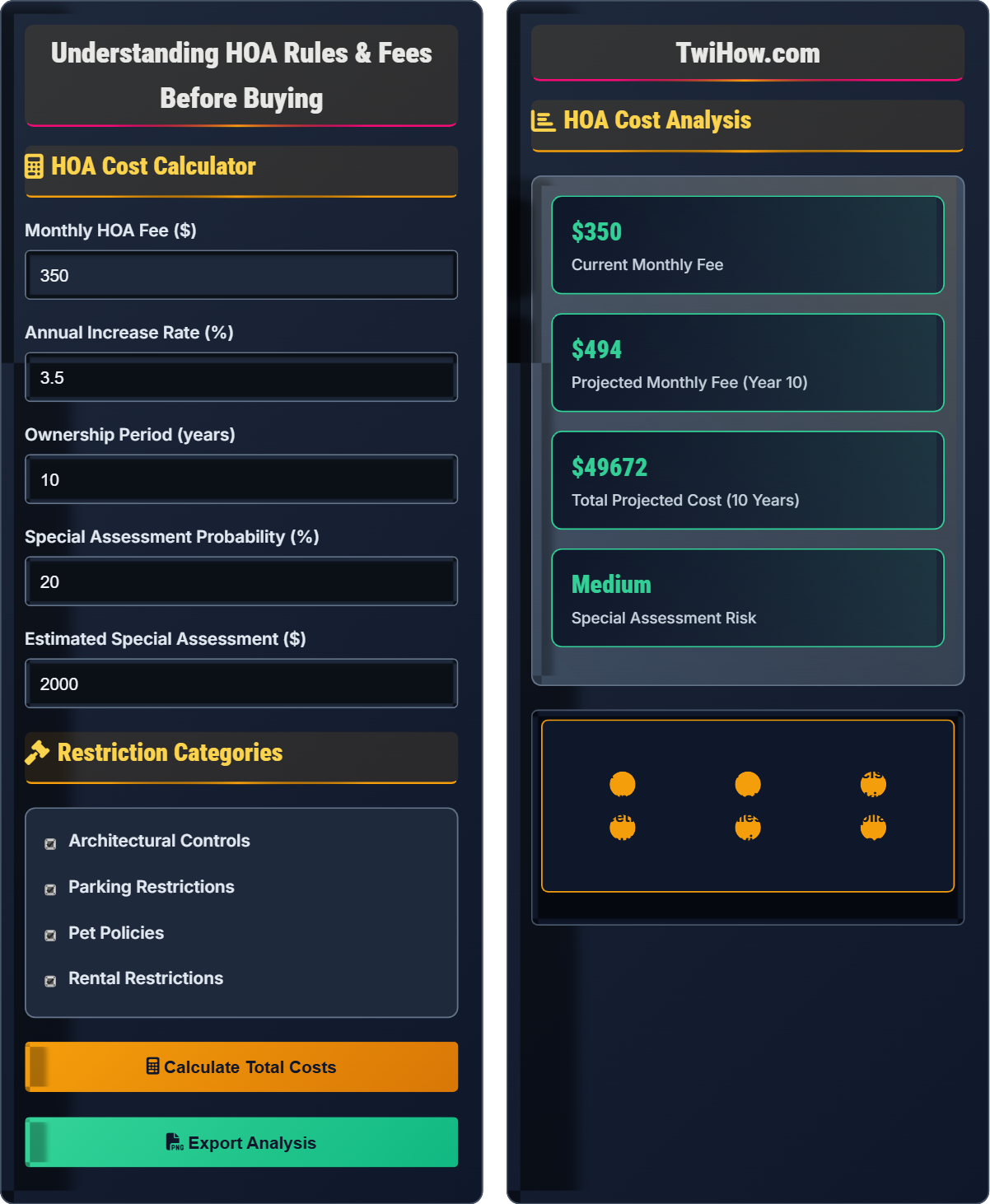
HOA Cost Calculator
Restriction Categories
HOA Cost Analysis
Documents
Minutes
Structure
Review
Making
Enforcement
| Category | Amount | Frequency |
|---|---|---|
| Monthly Fees | $350 | Monthly |
| Annual Increase | 3.5% | Annual |
| Special Assessments | $2,000 | As Needed |
| Reserve Contributions | $50 | Monthly |
Understanding HOA Rules & Fees Before Buying
A Homeowners Association (HOA) is a legal entity that governs planned communities, condominiums, and subdivisions. HOAs enforce community rules, maintain common areas, and collect fees from residents. Understanding HOA operations before purchase is essential for long-term satisfaction and financial planning.
HOA finances follow a structured approach:
Where:
- Monthly Fees: Recurring payments for community services
- Special Assessments: One-time fees for major projects
- Increases: Annual fee adjustments based on inflation and needs
HOA rules typically cover these areas:
- Architectural: Exterior appearance, landscaping, additions
- Behavioral: Noise, parking, pet policies
- Property Use: Rental restrictions, commercial activities
- Common Areas: Pool, gym, recreational facility use
- Communication: Satellite dishes, signage, antennas
- Environmental: Waste disposal, recycling, energy efficiency
- Document Review: Carefully read all HOA documents before signing
- Financial Analysis: Understand fee structure and historical increases
- Rule Compatibility: Ensure HOA rules align with your lifestyle
- Future Planning: Consider how rules may affect future plans
- Community Culture: Assess overall community satisfaction
- Board Engagement: Evaluate board responsiveness and professionalism
HOA Essentials
CC&Rs, bylaws, rules, monthly fees, reserve funds, architectural controls, enforcement policies.
Total Cost = (Monthly Fee × 12 × Years) + (Special Assessments × Probability) + (Annual Increases)
Where Total Cost = lifetime HOA expenses, Monthly Fee = recurring payment, Special Assessments = one-time fees.
- Review all documents before purchase
- Verify financial health of association
- Understand enforcement policies
Research Checklist
CC&Rs, bylaws, financial statements, meeting minutes, violation records, reserve studies.
- Request all governing documents
- Examine financial health
- Attend HOA meetings
- Speak with current residents
- Fee increase frequency and amounts
- Reserve fund adequacy
- Recent special assessments
- Rule enforcement consistency
HOA Knowledge Quiz
What is the primary legal document that gives an HOA authority to enforce rules and collect fees?
The Covenants, Conditions & Restrictions (CC&Rs) is the primary legal document that establishes the HOA's authority. CC&Rs are recorded with the county and bind all property owners in the community. They establish the HOA's right to collect fees, enforce rules, and manage common areas. The CC&Rs are typically filed at the time the subdivision is created and are binding on all subsequent property owners.
The answer is B) Covenants, Conditions & Restrictions (CC&Rs).
CC&Rs create a legally binding contract between property owners and the HOA that runs with the land. This means the obligations continue regardless of ownership changes. Understanding this hierarchy of documents is crucial because the CC&Rs typically override bylaws and rules if there's a conflict. The CC&Rs are the foundation of HOA authority.
CC&Rs: Covenants, Conditions & Restrictions - primary legal document
Bylaws: Internal governance rules for HOA operations
Rules & Regulations: Specific operational guidelines
• CC&Rs take precedence over other documents
• Recorded with county recorder's office
• Bind all property owners in community
• Always request CC&Rs during home search
• Look for amendment history
• Check for supermajority voting requirements
• Confusing bylaws with CC&Rs
• Not reading documents before purchase
• Assuming rules can be easily changed
Explain what special assessments are, when they might be levied, and how they differ from regular HOA fees. How should potential buyers prepare for special assessments?
Special Assessments: One-time fees levied by HOAs to cover unexpected expenses or major projects not funded by the regular budget. Unlike monthly fees, which cover routine maintenance and operations, special assessments address extraordinary expenses.
Common Triggers: Roof replacements, pool resurfacing, road repairs, emergency repairs, legal fees, or reserve fund shortfalls.
Timing: Typically levied when reserves are insufficient for major projects or when unexpected expenses arise. Amounts can vary significantly based on project costs and community size.
Preparation Strategies: Review the HOA's reserve study to assess funding adequacy, inquire about upcoming major projects, ask about recent special assessments, and budget for potential assessments as part of total ownership costs.
Payment Options: May be paid in full or sometimes offered in installments, depending on HOA policy and governing documents.
Special assessments represent a significant financial risk that many first-time HOA buyers overlook. Unlike predictable monthly fees, special assessments can be substantial and unexpected. The key to managing this risk is understanding the community's financial health and planning accordingly. A well-funded reserve account reduces the likelihood of special assessments.
Special Assessment: One-time fee for extraordinary expenses
Reserve Study: Analysis of long-term capital replacement needs
Regular Fees: Monthly payments for routine operations
• Special assessments are typically mandatory
• Amounts can be substantial
• Often cannot be avoided by residents
• Request reserve study during due diligence
• Ask about pending major projects
• Budget 1-2% of purchase price for potential assessments
• Not planning for special assessments
• Assuming all HOAs have adequate reserves
• Not inquiring about recent assessments
You're considering purchasing a home in an HOA community where you want to install a fence, paint your house a different color, and build a deck. The HOA requires architectural approval for exterior changes. The architectural review process takes 30 days and costs $150 per application. What steps should you take before making these improvements, and what are the potential consequences of proceeding without approval?
Pre-Approval Process: Before making any exterior changes, you must submit architectural applications with detailed plans, materials, colors, and specifications. The HOA's architectural review committee will evaluate compliance with community guidelines.
Application Requirements: Complete application form, detailed drawings, color samples, material specifications, and required fees ($150 per application). Multiple applications may be needed if changes are unrelated.
Timeline Considerations: 30-day review period means you should plan projects accordingly. Some HOAs allow proceeding after the review period if no response is received, but check governing documents.
Consequences of Non-Compliance: Fines, orders to remove unapproved improvements, legal action, and potential liens on property. The HOA can force removal of non-compliant structures at owner expense.
Best Practice: Submit applications well in advance of desired installation dates. Some HOAs maintain lists of approved materials and colors to streamline the process.
Cost Planning: Budget for application fees ($150 each) and potential revisions if initial applications are denied.
This scenario demonstrates the importance of understanding HOA approval processes before making property improvements. The architectural review process exists to maintain community standards and property values, but it can slow down owner improvements. Understanding these requirements helps avoid costly mistakes and legal conflicts.
Architectural Review Committee: Board-appointed group reviewing exterior changes
CC&Rs: Governing documents specifying approval requirements
Non-Compliance: Making changes without required approval
• Always seek approval before making exterior changes
• Follow specific application procedures
• Understand that compliance is mandatory
• Request sample applications before purchase
• Ask about approved materials lists
• Plan projects around review timelines
• Starting work before approval
• Assuming minor changes don't require approval
• Not budgeting for application fees
You're reviewing HOA financial documents and find the following information: Annual budget of $500,000, total reserve fund of $200,000, estimated major replacement costs of $800,000 over next 10 years, and 200 units in the community. Is this HOA financially healthy? What additional information would you need to make a complete assessment?
Current Analysis: The HOA has $200,000 in reserves against $800,000 in projected major expenses over 10 years, indicating a significant shortfall. The reserve fund covers only 25% of known upcoming expenses.
Ratio Calculation: Reserves to needed funding = $200,000 ÷ $800,000 = 25%. Industry standards suggest 70-80% funding is healthy.
Annual Shortfall: $80,000 per year in needed reserves vs. current reserves that may not be growing adequately.
Additional Information Needed: Reserve study with detailed replacement schedules, age of major components (roofs, HVAC, roads), historical special assessment frequency, debt obligations, and monthly fee increase patterns.
Risk Assessment: High likelihood of special assessments or significant monthly fee increases to fund upcoming projects. This could impact your long-term ownership costs.
Red Flags: Reserve fund less than 50% of needed funding typically indicates future special assessments.
This analysis demonstrates the importance of understanding HOA financial health before purchase. A reserve study shows the HOA's long-term financial planning and helps predict future costs. Buyers should look for well-funded reserves (70%+ of needed funding) and consistent fee increases that keep pace with inflation and growing maintenance needs.
Reserve Study: Analysis of long-term capital replacement needs
Funding Ratio: Percentage of needed reserves currently fundedSpecial Assessment: One-time fee for major projects
• Healthy reserves should be 70-80% funded
• Review detailed reserve studies
• Consider age of major components
• Request professional reserve study
• Ask about upcoming major projects
• Compare fees to similar communities
• Not reviewing reserve studies
• Assuming all HOAs are financially healthy
• Not considering future maintenance costs
An HOA prohibits rentals for the first year of ownership. What is this type of restriction typically called?
This restriction is typically called an "Owner-Occupancy Requirement." These provisions are designed to maintain the residential character of the community and ensure that owners have a stake in maintaining property values. They often require that new owners live in their homes for a specified period (such as one year) before renting them out. This helps ensure that new residents become familiar with community standards and guidelines before becoming landlords.
The answer is C) Owner-Occupancy Requirement.
Owner-occupancy requirements are common in HOAs to maintain community character and stability. They serve multiple purposes: ensuring owners understand community standards, reducing turnover among renters, and maintaining property values. These requirements can significantly impact investment strategies and should be carefully considered before purchase.
Owner-Occupancy Requirement: Requirement to live in property before renting
Lease Restriction: Limitations on rental activities
Use Restriction: Limitations on property use
• Requirements may vary by community
• Some allow exceptions for certain circumstances
• May impact investment strategies
• Clarify exceptions to occupancy requirements
• Understand penalties for violations
• Consider impact on future plans
• Not understanding occupancy requirements
• Assuming immediate rental is allowed
• Not planning for requirement timeline
FAQ
Q: Can HOA fees increase significantly after I buy the property?
A: Yes, HOA fees can increase significantly after purchase. Common reasons include:
• Annual Adjustments: Many HOAs increase fees annually for inflation and rising costs
• Major Repairs: Unexpected maintenance needs requiring special assessments
• Reserve Funding: Building reserves for future projects
• Utility Costs: Increases in water, electricity, or gas for common areas
• Insurance: Rising insurance premiums for common areas
• Management Fees: Increasing professional management costs
Review the HOA's historical fee increases and reserve study to anticipate future costs. Most HOAs have policies limiting annual increases to 10-20%, but special assessments can be much higher.
Q: How do I challenge HOA rules I disagree with?
A: Challenging HOA rules requires understanding the proper procedures:
• Read Governing Documents: Understand amendment procedures in CC&Rs
• Attend Meetings: Voice concerns during public comment periods
• Run for Board: Join the board to influence change from within
• Collect Support: Organize other homeowners with similar concerns
• Vote in Elections: Support candidates who share your views
• Legal Action: As a last resort, consult an attorney if rules violate laws
Most HOA rules can only be changed through formal amendment procedures that require member votes. Running for the board or supporting like-minded candidates is often the most effective approach. Legal challenges are expensive and time-consuming, reserved for serious violations of law or constitutional rights.