Property Condition Impact on Financing Options
Complete real estate guide • Financing strategies
Property Condition & Financing:
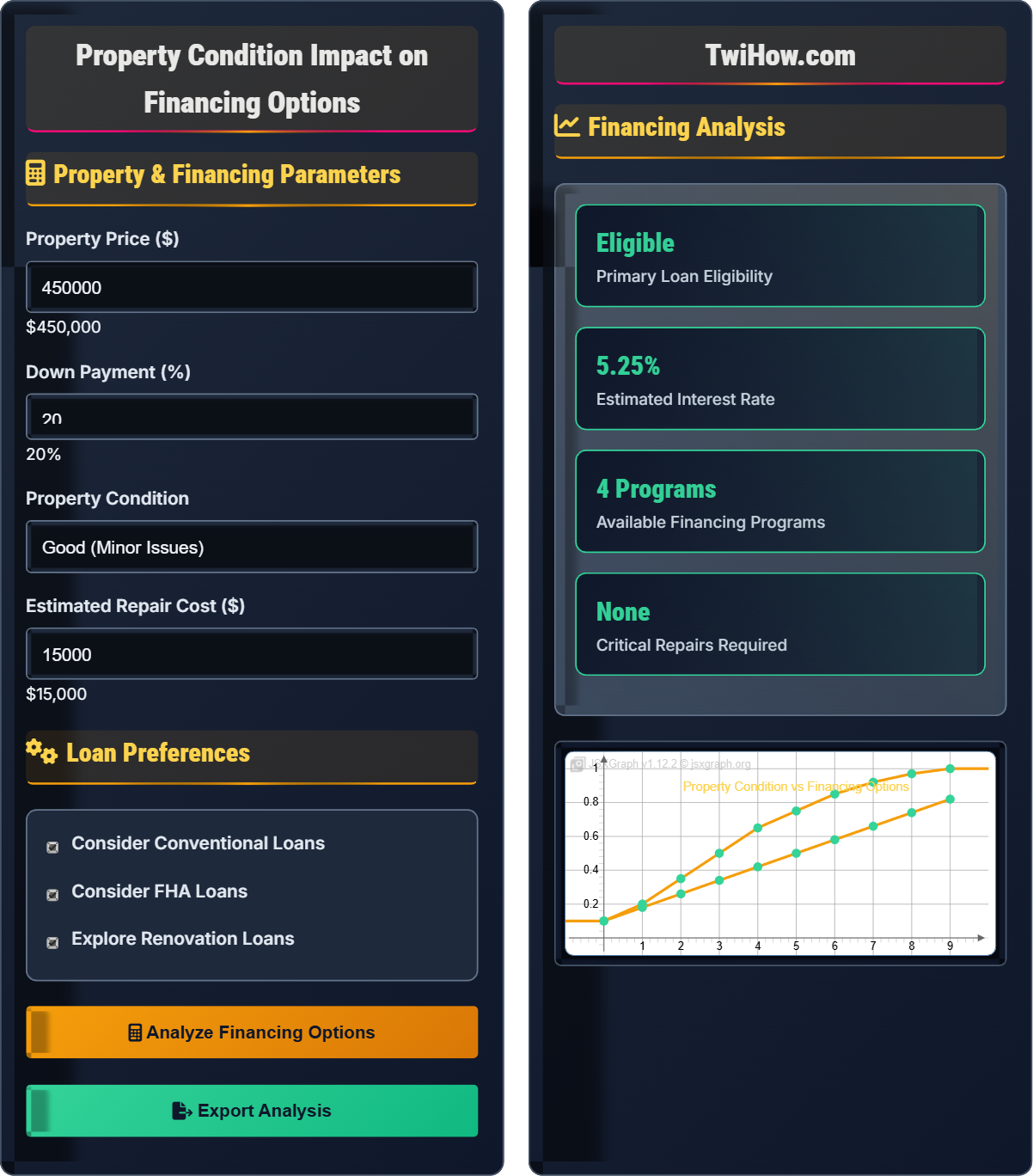
Show Financing CalculatorThe condition of a property significantly impacts financing options, affecting loan approval, interest rates, and available programs. Lenders evaluate property condition to assess risk and value. Poor conditions may limit financing options or require repairs before closing. Understanding these relationships helps buyers navigate financing challenges and make informed decisions.
Key relationships:
- Appraisal Value: Condition affects property valuation
- Loan Programs: Some require specific condition standards
- Repair Requirements: Certain issues must be addressed
- Interest Rates: Riskier properties may have higher rates
Modern lending standards require properties to meet minimum habitability requirements. Understanding these standards helps buyers anticipate financing challenges and plan accordingly.
Property & Financing Parameters
Loan Preferences
Financing Analysis
| Loan Program | Eligibility | Rate | Requirements |
|---|---|---|---|
| Conventional | Conditional | 5.25% | Minor repairs |
| FHA | Eligible | 5.50% | Must fix |
| Renovation | Eligible | 5.75% | Include repairs |
| USDA | Ineligible | N/A | Location req. |
Property Condition and Financing Relationship
Property condition significantly impacts financing options through appraisal requirements, loan program eligibility, and risk assessment. Lenders evaluate properties to ensure they meet minimum habitability standards and represent adequate collateral for the loan. Understanding these relationships helps buyers anticipate financing challenges and plan accordingly.
Financing Availability = (Property Condition Score × Appraised Value) / Risk Factor
Interest Rate Adjustment = Base Rate + (Condition Penalty × Repair Need Factor)
Where:
- Property Condition Score: Rating from 1-10 based on condition
- Appraised Value: Determined by professional appraisal
- Risk Factor: Lender's assessment of property risk
- Condition Penalty: Rate increase for poor condition
How property condition affects financing:
- Appraisal Value: Poor condition can reduce appraised value below purchase price
- Loan Programs: Some programs require move-in ready conditions
- Interest Rates: Riskier properties may have higher rates
- Down Payment: Some conditions require higher down payments
- Closing Timeline: Required repairs extend closing process
- Additional Costs: Repair escrows or renovation loans
- Renovation Loans: Include repair costs in mortgage
- Condition-Neutral Programs: Focus on borrower creditworthiness
- Hard Money Alternatives: For properties needing major work
- Partnership Structures: Share risk with investors
- Phased Approaches: Fix and refinance strategy
Financing Fundamentals
Property condition, financing eligibility, appraisal value, loan programs, repair requirements.
Financing Availability = (Property Condition Score × Appraised Value) / Risk Factor
Where Financing Availability = loan eligibility level, Property Condition Score = rating based on condition, Risk Factor = lender's assessment of property risk.
- Poor condition limits loan options
- Required repairs must be completed
- Appraisal affects loan-to-value ratio
Considerations
Appraisal, loan programs, interest rates, repair costs, closing timeline, additional requirements.
- Assess property condition thoroughly
- Research applicable loan programs
- Estimate repair costs
- Compare financing options
- Plan repair timeline
- Some programs require move-in ready condition
- Repair escrows may be required
- Timeline extends with required repairs
- Interest rates may increase with risk
Property Condition & Financing Quiz
How does poor property condition typically affect the appraisal value?
Poor property condition typically decreases the appraised value because appraisers compare the subject property to similar properties in good condition. If a property needs repairs, the appraiser may adjust the value downward to account for the cost of necessary improvements. This can create financing challenges if the appraised value falls below the purchase price.
The answer is B) Decreases the appraised value.
Appraisers use comparable sales (comps) to determine value, comparing the subject property to recently sold properties with similar characteristics. When a property is in poor condition compared to comps, the appraiser must account for the cost of repairs or the reduced desirability of the property. This relationship is fundamental to understanding how condition affects financing.
Appraisal: Professional estimate of property value
Comparable Sales: Similar properties used for valuation
Condition Adjustment: Value modification based on property state• Poor condition reduces appraised value
• Appraisers use comps for comparison
• Repair costs affect valuation
• Research comps before making offer
• Estimate repair costs accurately
• Consider condition when pricing
• Underestimating repair costs
• Not researching comps
• Ignoring condition impact
Explain how different loan programs have varying property condition requirements and why these differences exist.
Conventional Loans: Generally require properties to be move-in ready with no health/safety hazards. Minor cosmetic issues are acceptable.
FHA Loans: Have strict HUD requirements including working HVAC, plumbing, electrical, roof, and no lead paint in homes built before 1978.
VA Loans: Require properties to meet Minimum Property Requirements (MPRs) ensuring safety, structural integrity, and adequacy.
USDA Loans: Require properties to be in rural areas and meet basic livability standards.
Reasons for Differences: Government-backed loans (FHA, VA, USDA) have stricter requirements because the government guarantees the loans, protecting taxpayers. Conventional loans have fewer requirements since private lenders bear the risk.
Different loan programs have varying standards based on risk tolerance and government involvement. Government-backed loans have stricter requirements to protect public funds, while conventional loans allow more flexibility since private institutions bear the risk. Understanding these differences helps borrowers select appropriate financing.
HUD Requirements: Standards for FHA loan eligibility
Minimum Property Requirements: Standards for VA loan eligibility
Government-Backed: Loans guaranteed by federal agencies
• Each program has specific requirements
• Government programs have stricter standards
• Requirements protect loan guarantors
• Research program requirements before bidding
• Consider condition when selecting loan type
• Budget for required repairs
• Assuming all loans have same requirements
• Not budgeting for repairs
• Choosing program without considering property
You're purchasing a $300,000 home that needs $40,000 in repairs. The property appraises for $320,000 after repairs. Calculate the total loan amount needed if you choose a renovation loan, and explain the advantages and disadvantages of this approach compared to traditional financing with a separate home improvement loan.
Renovation Loan Calculation:
• Purchase Price: $300,000
• Repair Costs: $40,000
• Total Loan Amount: $340,000
Advantages: Single loan transaction, interest paid only on actual costs, simplified process, financing available at closing.
Disadvantages: Higher interest rates, more complex underwriting, limited to specific loan programs (like FHA 203(k) or Fannie Mae HomeStyle).
Traditional Approach: Would require separate loans for purchase and repairs, potentially higher monthly payments, and more complex financial management.
Renovation loans allow buyers to finance both purchase and repair costs in one loan, using the property's future value as collateral. This approach simplifies financing but requires specialized loan programs with different terms than traditional mortgages.
Renovation Loan: Mortgage that includes repair/rehabilitation costs
Future Value: Property value after planned improvements
Specialized Programs: FHA 203(k), Fannie Mae HomeStyle
• Renovation loans have specific requirements
• Based on future value, not current value
• Limited to certain loan programs
• Verify contractor credentials
• Get detailed repair estimates
• Understand program limitations
• Underestimating repair costs
• Not qualifying for renovation programs
• Choosing wrong contractor
You're buying a $400,000 home that has the following issues: broken HVAC system ($8,000 to fix), damaged roof ($15,000 to fix), and outdated electrical panel ($5,000 to fix). Which of these repairs are likely to be considered "critical" by lenders, and how would this affect your financing options?
Critical Repairs:
• Broken HVAC: CRITICAL - Required for conventional and government loans
• Damaged Roof: CRITICAL - Required for all loan programs due to safety/water damage risk
• Outdated Electrical: POTENTIALLY CRITICAL - May require upgrade depending on safety concerns
Financing Impact: The property will likely not pass inspection until critical repairs are completed. Most loan programs require these issues to be fixed before closing. This could delay closing, require repair escrows, or necessitate renovation financing.
Critical defects are those that affect health, safety, or structural integrity. Lenders require these to be fixed because they represent risks to both the borrower and the lender. Understanding which issues are critical helps buyers plan financing and timelines appropriately.
Critical Defect: Issue affecting health, safety, or structural integrity
Health/Safety: Issues posing risk to occupants
Structural Integrity: Issues affecting building stability
• Critical repairs must be completed
• Affects all loan programs
• Delays closing until fixed
• Identify critical issues early
• Budget for required repairs
• Plan timeline with repairs
• Misidentifying critical vs. cosmetic issues
• Not budgeting for required repairs
• Assuming all issues are negotiable
How does property condition typically affect mortgage interest rates?
Both A and B are correct. Better property condition typically results in lower interest rates because lenders perceive less risk, while poor condition often results in higher rates due to increased risk of default, repair costs, or property devaluation. The property serves as collateral, so its condition directly affects loan risk.
The answer is D) Both A and B are correct.
Interest rates reflect risk to the lender. A well-maintained property represents better collateral and lower risk of devaluation, leading to lower rates. Conversely, a property in poor condition poses higher risk to the lender, resulting in higher rates to compensate for the increased risk. This relationship incentivizes property maintenance.
Risk Assessment: Lender's evaluation of loan risk
Collateral Risk: Risk related to property value
Rate Adjustment: Modification based on risk factors
• Condition affects loan risk
• Risk affects interest rates
• Better condition = lower risk
• Maintain property condition
• Address issues proactively
• Consider condition when refinancing
• Ignoring condition impact on rates
• Delaying necessary repairs
• Not considering condition in refinancing
FAQ
Q: Can I get a mortgage on a house that needs major repairs?
A: Yes, but it depends on the type of repairs needed and the loan program:
Renovation Loans: Programs like FHA 203(k) or Fannie Mae HomeStyle allow you to finance both purchase and repairs in one loan.
Construction-to-Permanent: For major renovations, you might get a construction loan that converts to a permanent mortgage.
Hard Money: Alternative financing for properties needing significant work, though with higher rates.
However, critical health/safety issues must typically be addressed before closing on most conventional loans.
Q: How do lenders verify that required repairs have been completed?
A: Lenders use several verification methods:
Third-Party Inspections: Independent inspectors verify repairs are completed to standards.
Receipts and Contracts: Lenders may require proof of payment for major repairs.
Before/After Photos: Visual documentation of completed work.
Trade Professional Certifications: Licensed contractors may need to certify work completion.
For renovation loans, lenders often release funds in draws upon completion of specific milestones verified by inspectors.