Title Insurance: Complete Guide for Home Buyers & Sellers
Real Estate & Property • Home Buying & Selling
Title Insurance:
Show Title CalculatorTitle insurance protects property owners and lenders against losses arising from title defects, liens, encumbrances, or ownership disputes. Unlike other insurance types that protect against future events, title insurance safeguards against past issues that could affect ownership rights.
Understanding title insurance is crucial for both buyers and sellers in real estate transactions. It ensures clear ownership transfer and provides financial protection against hidden title problems that may surface years after purchase.
Key components include:
- Title Search: Comprehensive examination of public records
- Title Insurance Policy: Protection against covered title defects
- Abstract of Title: Historical record of property ownership
- Chain of Title: Sequential ownership history
Title insurance provides peace of mind and financial security, ensuring that your property investment is protected from potential legal challenges to ownership.
Title Insurance Calculator
Coverage Options
Title Insurance Analysis
- Defective title claims
- Liens and encumbrances
- Forgery and fraud
- Recording errors
- Undisclosed heirs
- Boundary disputes
- Priority of mortgage lien
- Valid mortgage lien
- Access to property
- Zoning compliance
- Survey matters
- Legal defense costs
- Post-policy forgery
- Encroachment issues
- Zoning violations
- Homeowners association liens
- Building permit violations
- Identity theft protection
Understanding Title Insurance
Title insurance protects against financial loss due to defects in a property's title. Unlike other insurance types that protect against future events, title insurance safeguards against problems from the past that could affect ownership rights.
- Owner's Policy: Protects the homeowner's interests
- Lender's Policy: Protects the mortgage lender's interests
- One-Time Premium: Paid at closing, coverage lasts as long as you own
- Retrospective Coverage: Protects against past events
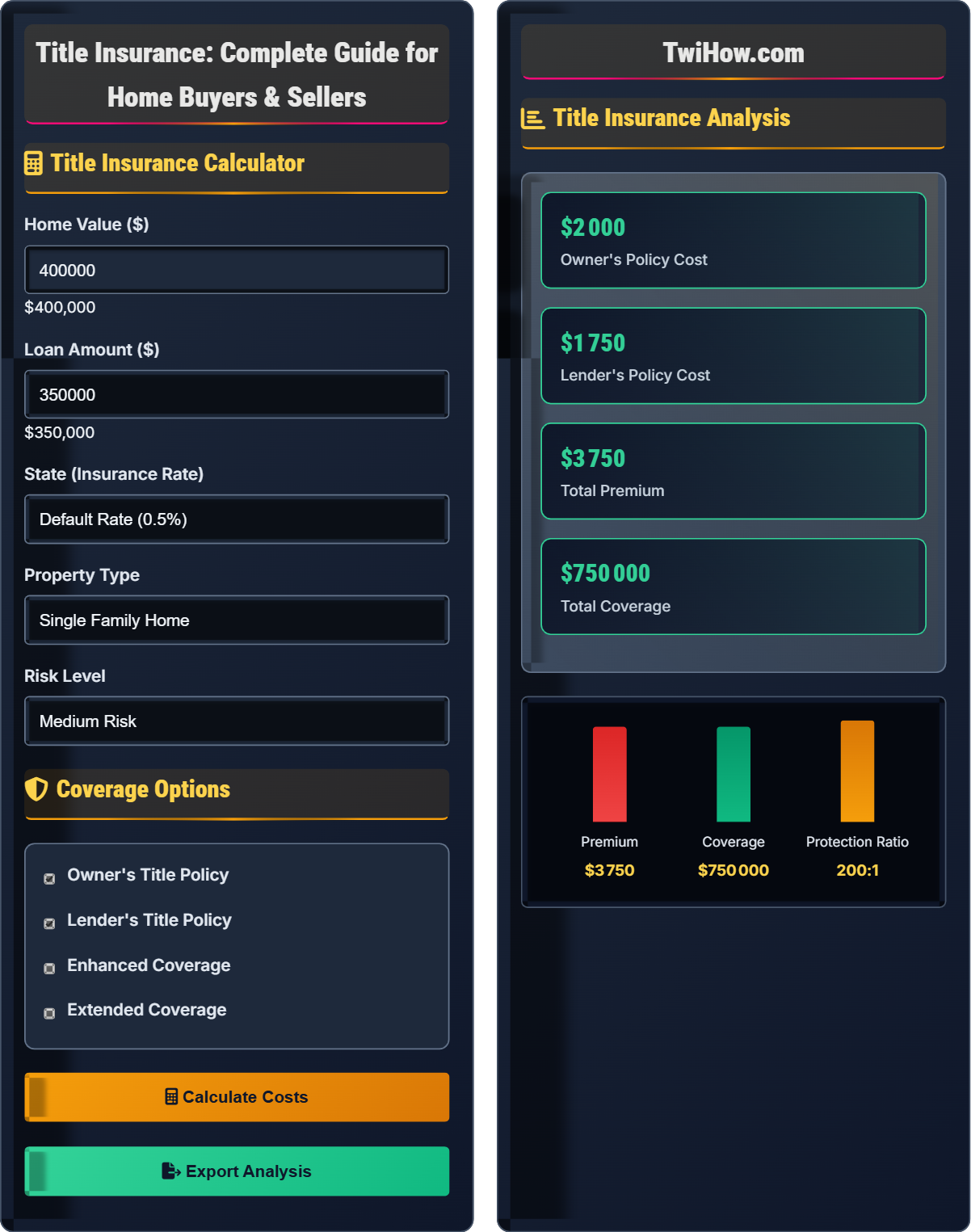
Insurance premium calculation:
Where the rate per thousand varies by state and property type. The coverage amount is typically the purchase price for owner's policy and loan amount for lender's policy.
Issues that title insurance protects against:
- Forged Deeds: Fraudulent transfers of ownership
- Recording Errors: Mistakes in public records
- Missing Heirs: Unknown heirs claiming ownership
- Undisclosed Liens: Unpaid taxes, contractor liens
- Boundary Disputes: Unclear property lines
- Improper Execution: Invalid signatures on documents
Types of Title Insurance
Distinct coverage for different parties in real estate transactions.
Common Title Issues
Real-world scenarios that title insurance protects against.
Scenario: Previous owner forged signature of heir to obtain clear title.
Impact: True heir emerges years later claiming ownership.
Protection: Title insurance covers legal costs and potential losses.
Scenario: Previous owner failed to pay property taxes.
Impact: Government places lien on property.
Protection: Insurance covers lien payment and associated costs.
Scenario: Survey reveals fence encroachment from previous owner.
Impact: Neighbor claims portion of property.
Protection: Insurance covers legal defense and settlement costs.
Scenario: Previous owner had unknown heir who surfaces years later.
Impact: Heir claims ownership interest in property.
Protection: Insurance provides legal defense and compensation.
- Thorough title search and examination
- Professional survey before purchase
- Verify all signatures and documents
- Research property history
- Obtain comprehensive title insurance
Title Insurance Quiz
What is the main difference between an owner's title policy and a lender's title policy?
The main difference is that a lender's title policy protects the mortgage lender's financial interest in the property (typically the loan amount), while an owner's title policy protects the buyer's ownership interest (typically the purchase price). The lender's policy expires when the loan is paid off, while the owner's policy lasts as long as the owner holds title.
The answer is B) Lender's policy covers the loan amount, owner's covers purchase price.
Understanding the difference between these policies is crucial for homebuyers. The lender's policy is typically required by the mortgage company and protects their investment, while the owner's policy protects your investment in the property. Both serve different purposes and protect different parties.
Owner's Policy: Protects buyer's ownership interest
Lender's Policy: Protects mortgage lender's interest
Chain of Title: Sequential ownership history
• Lender's policy is required for mortgages
• Owner's policy is optional but recommended
• Coverage amounts differ between policies
• Always purchase owner's policy
• Compare rates between companies
• Understand what's excluded
• Confusing policy purposes
• Not understanding coverage differences
• Skipping owner's policy to save money
Explain what title insurance covers and what it does not cover. Provide specific examples of both covered and excluded items.
Covered by Title Insurance:
• Forgery and fraud in previous deeds
• Undisclosed heirs claiming ownership
• Recording errors in public records
• Outstanding liens from previous owners
• Boundary disputes due to defective surveys
• Improperly executed documents
Not Covered by Title Insurance:
• Physical defects discovered after purchase
• Environmental hazards
• Violations of zoning ordinances
• Matters not discoverable in public records
• Government regulations affecting property
• Post-policy events (like new liens)
Examples:
Covered: Previous owner forged heir's signature to sell property
Not Covered: Termite damage discovered after purchase
Title insurance specifically protects against hidden title defects that existed before the policy date. It does not cover physical defects or post-policy issues. This distinction is important because buyers often confuse title insurance with home warranty or property inspection services.
Retrospective Coverage: Protection against past events
Public Records: Official documents affecting title
Hidden Defects: Issues not visible in records
• Covers only pre-policy title defects
• Does not cover physical conditions
• Exclusions are specified in policy
• Read policy exclusions carefully
• Consider separate inspections
• Research environmental issues
• Expecting coverage for physical defects
• Not reading policy exclusions
• Confusing with other insurance types
You're buying a $500,000 home with a $400,000 mortgage. Title insurance rates in your state are 0.5% of the coverage amount. The lender requires a lender's policy equal to the loan amount. You're considering an owner's policy for the full purchase price. Calculate the total cost and determine if this is a worthwhile investment compared to potential claim costs of $100,000.
Calculations:
Lender's Policy: $400,000 × 0.5% = $2,000
Owner's Policy: $500,000 × 0.5% = $2,500
Total Premium: $2,000 + $2,500 = $4,500
Protection Analysis:
Total Coverage: $400,000 (lender) + $500,000 (owner) = $900,000
Protection Ratio: $900,000 ÷ $4,500 = 200:1
Compared to potential $100,000 claim: $100,000 ÷ $4,500 = 22:1 return
Conclusion: For a $4,500 investment, you receive $900,000 in coverage. This provides excellent protection against title defects that could cost significantly more to resolve than the premium paid.
This demonstrates the exceptional value proposition of title insurance. The premium is a one-time cost that provides substantial coverage for as long as you own the property. The protection ratio of 200:1 shows how relatively small the premium is compared to the coverage provided.
Protection Ratio: Coverage amount divided by premium
Return on Investment: Benefit relative to costOne-Time Premium: Paid only at closing
• Premium is one-time payment
• Coverage lasts forever
• Exceptional protection ratio
• Calculate protection ratio
• Compare to potential costs
• Consider lifetime value
• Focusing only on upfront cost
• Not considering long-term value
• Underestimating potential claims
During a title search, you discover that the previous owner had a sibling who died without a will and never claimed their inheritance share. The sibling has children who are now adults. How would title insurance protect you in this scenario, and what would happen if you didn't have coverage?
With Title Insurance:
• Insurance company would defend against the heirs' claims
• Legal costs would be covered by the insurer
• If heirs have valid claims, insurance would compensate for losses
• You retain clear title or receive compensation
Without Title Insurance:
• You would bear all legal costs personally
• Risk of losing property or portions of it
• Potential need to buy out heir interests
• Significant financial exposure
Process:
The heirs would likely file a quiet title action or claim their inheritance interest. With title insurance, the company would handle the legal defense and resolution, protecting your ownership rights and covering associated costs.
This scenario illustrates a classic title defect that couldn't be discovered through normal title searches. Missing heirs or unknown inheritors represent a significant risk that title insurance specifically addresses. The insurance company has expertise and resources to handle complex legal challenges that individual property owners cannot manage alone.
Quiet Title Action: Lawsuit to establish clear ownership
Heir Property: Inheritance without clear title
Chain of Title: Ownership sequence history
• Title insurance covers hidden defects
• Protection against unknown heirs
• Legal defense included
• Research family history
• Verify inheritance claims
• Obtain comprehensive policy
• Not understanding heir rights
• Assuming all heirs are known
• Skipping title insurance
Which of the following properties would typically have the highest title insurance risk?
A 100-year-old home with multiple owners would have the highest title insurance risk. The longer the chain of title and the more owners involved, the greater the chance of title defects, recording errors, missing heirs, or other issues that could surface. Older properties may have documentation problems, boundary disputes, or unclear inheritance issues that are difficult to resolve.
The answer is C) 100-year-old home with multiple owners.
Risk assessment in title insurance considers the complexity of the ownership history. More owners over a longer period create more opportunities for title defects to occur. New construction typically has the lowest risk because the title history is short and well-documented.
Chain of Title: Ownership history sequence
Recording Errors: Mistakes in property records
Title Risk: Probability of title defects
• Longer chain of title = higher risk
• More owners = more potential issues
• New construction = lower risk
• Research property age
• Count ownership changes
• Consider historical context
• Not assessing property history
• Assuming all properties have same risk
• Ignoring chain of title length
FAQ
Q: Do I really need both owner's and lender's title insurance?
A: The lender's policy is required if you have a mortgage, as it protects the lender's interest in the property. The owner's policy is optional but highly recommended. Without it, you have no protection against title defects that could cost you your home or require expensive legal defense. The cost is typically less than 1% of your home's value but provides coverage for the full purchase price for as long as you own the property. Given the protection it offers, most experts recommend purchasing both policies.
Q: Can title insurance claims affect me after I sell the property?
A: Generally, title insurance policies run with the land and protect the current owner, not previous owners. However, in some cases, sellers may face liability for warranties they made about the title in the deed. Some states have seller disclosure requirements. Title insurance primarily protects the current owner from defects that occurred before their ownership. Once you sell, your title insurance policy typically ends, but you may still be liable for misrepresentations made during the sale process. This is why accurate disclosure is crucial.