Best Strategies for Competing in a Seller's Market
Complete real estate guide • Step-by-step strategies
Seller's Market Strategies:
Show Market SimulatorA seller's market occurs when demand for homes exceeds supply, giving sellers the advantage. To compete successfully, buyers must differentiate themselves through strategic positioning, flexible financing, and attractive offer structures. Key strategies include pre-approval letters, cash offers, flexible closing dates, and waiving contingencies where possible.
Essential components of a competitive strategy:
- Pre-approval: Secure financing before house hunting
- Flexible terms: Accommodate seller preferences
- Competitive pricing: Price appropriately for the market
- Contingency management: Balance protection with attractiveness
Modern seller's markets often feature bidding wars, requiring buyers to prepare comprehensive offers that stand out while protecting their interests. Success depends on preparation, flexibility, and understanding market dynamics.
Market Parameters
Offer Strategy
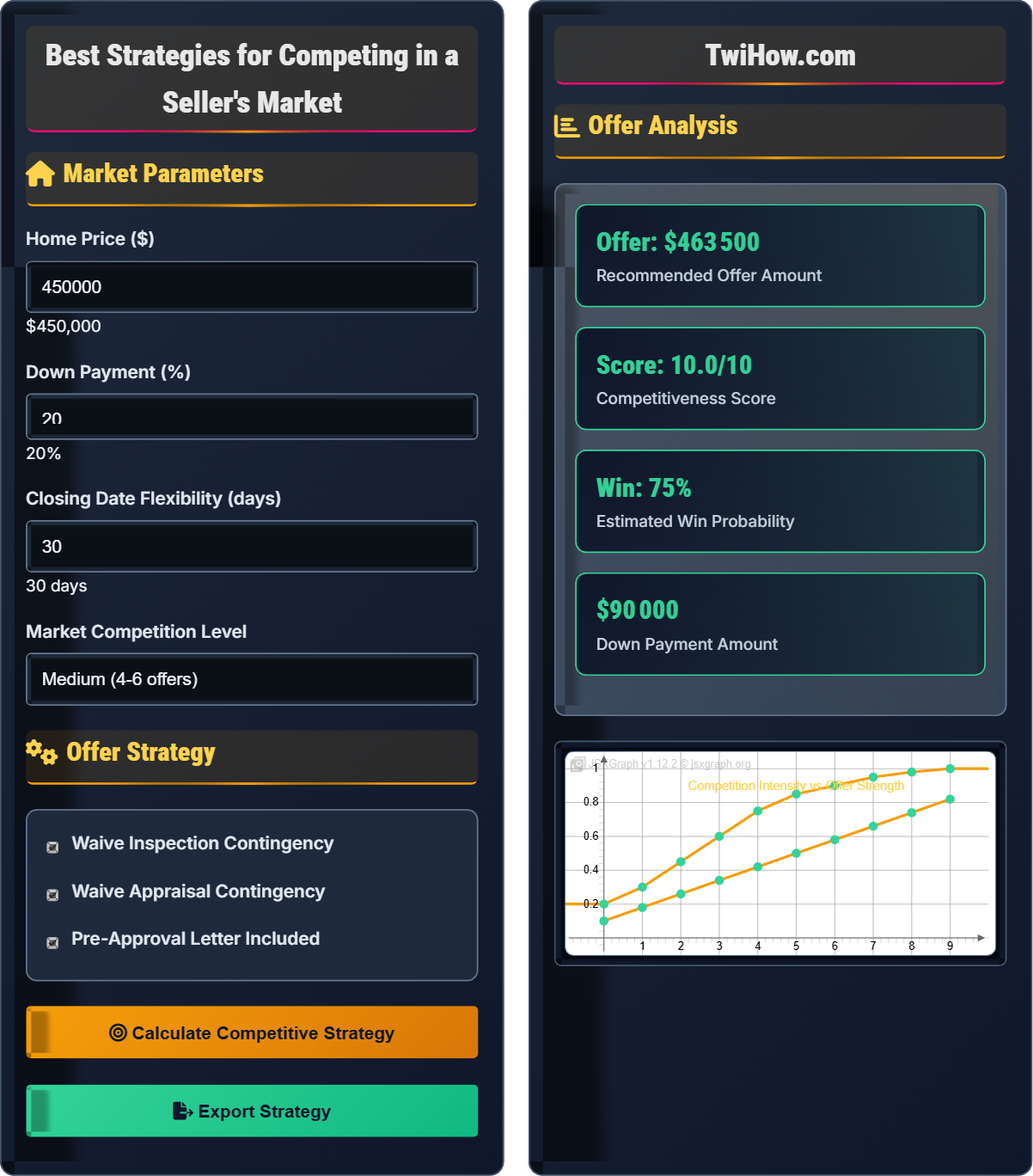
Offer Analysis
| Strategy Element | Value | Impact | Recommendation |
|---|---|---|---|
| Offer Price | $463,500 | High | +3.1% above asking |
| Down Payment | 20% | High | Strong financial position |
| Closing Date | 30 days | Medium | Standard timeframe |
| Contingencies | 2 waived | High | Reduced buyer risk |
Seller's Market Competition Strategies Explained
A seller's market is characterized by high demand and low inventory, giving sellers significant advantages in negotiations. Key characteristics include rising prices, multiple offers, and quick sales. Buyers face increased competition and must employ strategic tactics to secure properties.
Offer Amount = Home Price × (1 + Market Premium) × (1 + Flexibility Factor)
Where:
- Market Premium: Percentage increase based on competition level
- Flexibility Factor: Adjustment based on terms and conditions
- Contingency Reduction: Value added by waiving protections
Key factors that make offers stand out:
- Price: Competitive but realistic offer amount
- Financing: Cash offers or strong pre-approval
- Terms: Flexible closing dates and possession
- Contingencies: Minimizing protective clauses
- Timeline: Quick closing capability
- Personal Touch: Letter to sellers
- Escalation Clause: Automatic bid increases up to maximum
- Bridge Financing: Help seller with next purchase
- Flexible Possession: Accommodate seller needs
- Professional Presentation: Well-prepared offer package
- Direct Communication: Negotiate with listing agent
Seller's Market Fundamentals
Market competition, offer strategies, contingency management, pre-approval, closing flexibility.
Offer Amount = Home Price × (1 + Market Premium) × (1 + Flexibility Factor)
Where Offer Amount = recommended offer, Market Premium = competition-based increase, Flexibility Factor = terms-based adjustment.
- Higher down payments increase competitiveness
- Waiving contingencies reduces buyer risk
- Quick closing appeals to sellers
Strategies
Pre-approval letters, escalation clauses, flexible terms, contingency waivers, personal letters.
- Secure financing beforehand
- Research market conditions
- Prepare offer package
- Act quickly on new listings
- Balancing competitiveness with protection
- Understanding local market dynamics
- Legal and financial risks
- Emotional decision-making
Seller's Market Competition Quiz
Which of the following is NOT a characteristic of a seller's market?
A seller's market is characterized by high demand, low inventory, and quick sales with multiple offers. Properties sell faster than in balanced markets. Extended time on market is a characteristic of a buyer's market, where demand is lower and inventory is higher.
The answer is D) Extended time on market.
Understanding market dynamics is fundamental to developing effective strategies. In a seller's market, supply-demand imbalances favor sellers, leading to competitive conditions for buyers. The key is recognizing these conditions and adapting strategies accordingly. When inventory is low relative to demand, sellers have more negotiating power and buyers must differentiate their offers.
Seller's Market: Market condition with high demand and low inventory
Inventory: Number of homes available for sale
Time on Market: Duration a property remains listed before selling
• Seller's markets have high demand
• Inventory is typically low
• Properties sell quickly
• Monitor inventory levels in target areas
• Prepare finances before house hunting
• Act quickly on new listings
• Confusing seller's market with buyer's market
• Underestimating competition
• Not preparing finances in advance
Explain the trade-offs between offering a higher price versus waiving contingencies in a seller's market. Which approach is generally more effective and why?
Higher Price Approach: Increases immediate appeal but costs more money upfront. Provides clear value to sellers but doesn't necessarily address their timeline concerns.
Waiving Contingencies: Reduces buyer protections but provides certainty to sellers. Allows for faster closings and eliminates appraisal or inspection issues.
Waiving contingencies is generally more effective because it addresses sellers' primary concerns: certainty and timeline. A slightly lower offer without contingencies is often preferred over a higher offer with conditions that could delay or derail the sale.
In seller's markets, sellers prioritize certainty and convenience over maximum price. While offering more money is attractive, sellers often prefer offers that guarantee the transaction will close smoothly and on schedule. Waiving contingencies demonstrates commitment and reduces risk for sellers, making these offers more appealing even if the price isn't the highest.
Contingency: Condition that must be met for contract to proceed
Certainty: Likelihood of successful transaction completion
Timeline: Expected duration from contract signing to closing
• Sellers value certainty over price
• Waived contingencies reduce transaction risk
• Speed and flexibility matter more than price
• Prioritize seller preferences in offer terms
• Waive contingencies where comfortable
• Offer flexible closing dates
• Focusing only on price increases
• Not considering seller priorities
• Over-waiving contingencies
You're interested in a $500,000 home in a high-competition area where homes typically receive 8-10 offers. The listing says "all offers due by Sunday at 5 PM" with responses by Tuesday. You have a pre-approval letter for $510,000 but want to maximize your chances. Develop a comprehensive offer strategy including price, terms, and contingencies, and explain your reasoning.
Offer Price: $512,500 (2.5% above asking) - Competitive but not excessive
Terms: Flexible closing in 30-45 days, accommodate seller's timeline
Contingencies: Waive inspection and appraisal, keep financing contingency
Additional Elements: Include personal letter, proof of funds, and pre-approval letter
Reasoning: The 2.5% premium shows serious intent without overbidding. Waiving inspection and appraisal demonstrates confidence and reduces seller risk. The financing contingency protects the buyer while still appearing strong.
High-competition scenarios require strategic balance. In markets with 8-10 offers, you need to differentiate without overcommitting. The key is addressing seller concerns (certainty, timeline) while maintaining reasonable buyer protections. The 2.5% premium is typically sufficient in high-competition markets without going overboard.
Pre-Approval Letter: Lender's confirmation of loan eligibility
Proof of Funds: Documentation showing available cashPersonal Letter: Written appeal to sellers
• Differentiate without overbidding
• Address seller priorities first
• Maintain reasonable protections
• Research recent comparable sales
• Prepare documentation in advance
• Consider escalation clauses
• Not preparing documents ahead of time
• Over-waiving contingencies
• Ignoring seller preferences
A buyer is considering waiving the inspection contingency on a $400,000 home in a seller's market. The home is 30 years old with original electrical and plumbing. Calculate the potential financial risk of waiving inspection and propose a compromise strategy that maintains competitiveness while reducing risk.
Risk Assessment: On a 30-year-old home with original systems, potential inspection issues could cost $15,000-$50,000 for electrical, plumbing, and structural repairs. The risk of waiving inspection is significant.
Compromise Strategy: 1) Request a brief walk-through with the seller present, 2) Include a "kick-out" clause allowing inspection if seller accepts another offer, 3) Increase offer price by 1-2% to compensate for risk, 4) Verify seller's disclosure compliance.
This maintains competitiveness while providing some protection. The key is balancing seller preferences with reasonable buyer safeguards.
Risk assessment is crucial in seller's markets. While competition demands flexibility, buyers shouldn't waive all protections. The goal is finding compromises that satisfy both parties. In older homes, certain risks may be acceptable while others require attention. Strategic contingency management preserves deal-making power while limiting exposure.
Kick-Out Clause: Allows buyer to conduct inspection if another offer is received
Walk-Through: Brief visual inspection with seller present
Risk Assessment: Evaluation of potential financial exposures
• Assess risks before waiving contingencies
• Compromise without eliminating protections
• Balance competitiveness with safety
• Research neighborhood construction quality
• Consider age-related issues
• Negotiate alternative protections
• Waiving inspections on older homes
• Not assessing property-specific risks
• Over-waiving all protections
When is the optimal time to submit an offer in a seller's market where multiple offers are expected?
In seller's markets, submitting offers within 2 hours of viewing demonstrates genuine enthusiasm and seriousness. Sellers and agents appreciate quick action, especially when multiple offers are anticipated. This timing shows the buyer was prepared and committed, increasing the likelihood of favorable consideration compared to last-minute submissions that may appear rushed or less thoughtful.
The answer is D) Within 2 hours of viewing to demonstrate enthusiasm.
Timing matters significantly in competitive markets. Early submission signals preparedness and genuine interest. It also gives agents time to review your offer thoroughly before the deadline. Last-minute submissions can appear rushed and may not receive full consideration. The key is balancing urgency with thoroughness in your offer presentation.
Multiple Offers: Situation with several competing bids
Deadline: Time when all offers must be submitted
Enthusiasm: Demonstrated interest and commitment
• Act quickly in competitive markets
• Show genuine interest early
• Prepare offers in advance
• Have documents ready before viewing
• Submit offers promptly
• Communicate enthusiasm clearly
• Waiting until deadline to submit
• Not preparing documents in advance
• Failing to communicate interest
FAQ
Q: How much should I expect to pay above asking price in a seller's market?
A: In seller's markets, paying above asking price is common, but the percentage varies by location and market intensity:
• Low competition: 1-3% above asking
• Medium competition: 3-5% above asking
• High competition: 5-10% above asking
• Extreme competition: 10%+ above asking
Always research comparable sales in the specific neighborhood and calculate your maximum comfortable bid. Remember to factor in closing costs, moving expenses, and potential renovation costs when determining your budget ceiling.
Q: What's the difference between an escalation clause and a sealed bid in a seller's market?
A: These are two different strategies for handling multiple offer situations:
Escalation Clause: Automatically increases your offer by a set amount above the next highest competing offer, up to a predetermined maximum. Example: "We'll pay $5,000 more than any other offer, up to a maximum of $475,000."
Sealed Bid: All offers are submitted simultaneously without knowledge of competing bids. Agents collect offers and present them together to the seller, who then chooses the best offer based on price, terms, and conditions.
Escalation clauses can save you money by only paying what's necessary to win, while sealed bids rely on your best guess of the market competition.