First-Time Homebuyer Strategies with Limited Savings
Complete guide • Step-by-step explanations
Homebuyer Fundamentals:
Show Budget CalculatorBuying your first home with limited savings requires strategic planning and knowledge of specialized programs. Success comes from understanding down payment assistance, loan programs, and budgeting strategies that maximize your purchasing power while maintaining financial stability.
Key strategies:
- Down Payment Assistance: Government and nonprofit programs
- Specialized Loans: FHA, VA, USDA, and state-specific options
- Gift Funds: Family contributions and acceptable sources
- Alternative Financing: Shared equity and lease-to-own options
Successful first-time homebuyers leverage multiple strategies simultaneously, combining low-down-payment loans with assistance programs and careful budgeting to achieve homeownership goals.
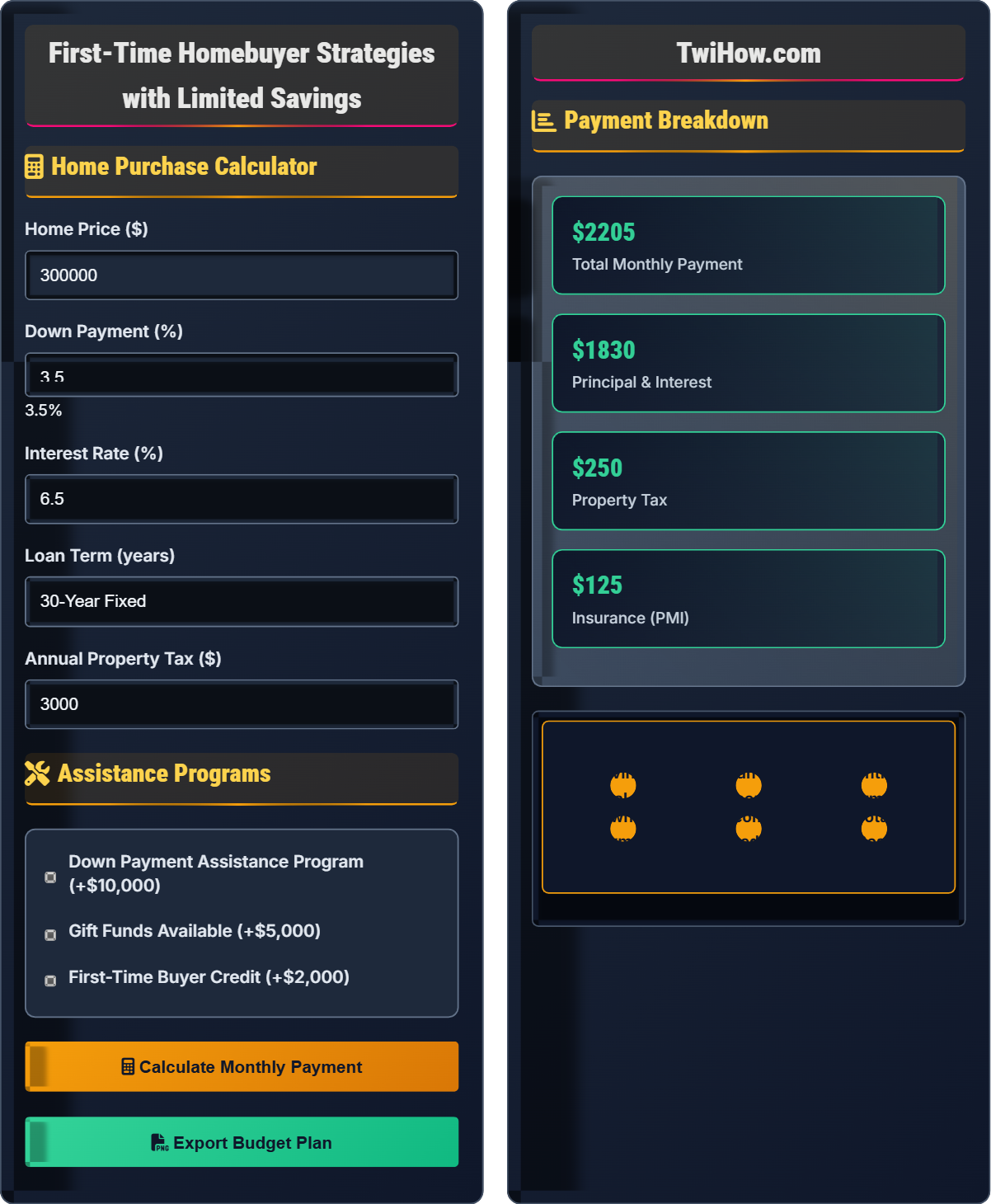
Home Purchase Calculator
Assistance Programs
Payment Breakdown
Goal
Payment
Amount
Needed
Payment
Cost
| Component | Amount | Percentage |
|---|---|---|
| Principal & Interest | $1,641 | 86% |
| Property Tax | $250 | 13% |
| Insurance | $115 | 6% |
| Total | $2,006 | 105% |
First-Time Homebuyer Strategies with Limited Savings
First-time homebuyer strategies with limited savings involve leveraging specialized programs, alternative financing options, and budgeting techniques to purchase a home without the traditional 20% down payment. These strategies help bridge the gap between limited savings and home purchase requirements while maintaining financial stability.
Successful homebuying with limited savings follows a strategic framework:
Where:
- Available Funds: Current savings and accessible resources
- Assistance: Down payment assistance, gift funds, credits
- Down Payment %: Required percentage for chosen loan program
Popular loan options for first-time buyers with limited savings:
- FHA Loans: 3.5% down, flexible credit requirements
- VA Loans: 0% down for eligible veterans and spouses
- USDA Loans: 0% down for rural property purchases
- State Programs: Various down payment assistance options
- Conventional 97: 3% down conventional loan
- Good Neighbor Next Door: HUD program for public servants
- Start Early: Begin saving and credit improvement immediately
- Maximize Assistance: Research all available programs
- Keep Credit Clean: Avoid new debt during the process
- Plan for Costs: Budget for closing costs and emergencies
- Work with Experts: Partner with experienced realtors and lenders
- Stay Flexible: Be open to different neighborhoods and home types
Homebuyer Essentials
Down payment assistance, loan programs, credit improvement, budget planning, closing costs, emergency fund.
Affordability = (Available Funds + Assistance) ÷ Down Payment Percentage
Where Affordability = maximum home price, Available Funds = current savings, Assistance = program benefits.
- Save for closing costs separately
- Improve credit score before applying
- Research all available assistance programs
Assistance Programs
Federal, state, and local down payment assistance, tax credits, grants, and forgivable loans.
- Research eligibility requirements
- Gather required documentation
- Submit applications early
- Combine multiple programs when allowed
- Income and location restrictions
- Repayment obligations
- Application deadlines
- Combination limitations
Homebuyer Knowledge Quiz
What is the minimum down payment required for an FHA loan for first-time homebuyers?
FHA loans require a minimum down payment of 3.5% of the home's purchase price for borrowers with a credit score of 580 or higher. This is significantly lower than the traditional 20% down payment required for conventional loans, making homeownership more accessible for first-time buyers with limited savings.
The answer is A) 3.5% of the home's purchase price.
FHA loans are government-insured mortgages designed to help first-time homebuyers enter the market with lower down payment requirements. The 3.5% minimum makes these loans particularly attractive for buyers with limited savings. However, borrowers must pay both upfront and annual mortgage insurance premiums, which increase the overall cost of the loan.
FHA Loan: Federal Housing Administration insured mortgage with lower down payment requirements
Mortgage Insurance: Insurance protecting lenders against borrower default
First-Time Buyer: Someone who hasn't owned a principal residence in past three years
• Minimum credit score of 580 required for 3.5% down
• Higher down payment (10%) required for scores below 580
• Mandatory mortgage insurance premium
• Combine with down payment assistance for even lower outlay
• Consider refinancing once equity builds up
• Budget for ongoing mortgage insurance costs
• Not budgeting for mortgage insurance costs
• Assuming all first-time buyers qualify
• Forgetting about other closing costs
Explain the rules for using gift funds for a down payment, including acceptable sources, documentation requirements, and lender guidelines. How do gift funds affect the mortgage approval process?
Acceptable Sources: Gift funds for down payments can come from family members (parents, grandparents, siblings, spouse), domestic partners, and sometimes close friends with documented long-term relationships.
Documentation Requirements: Lenders require a gift letter stating the donor's name, relationship to borrower, amount of gift, and confirmation that repayment is not expected. Donors must provide bank statements showing the source of funds.
Lender Guidelines: Most lenders allow gift funds for down payments, but the borrower must contribute a portion of their own funds (usually 5% of down payment) for some loan types. Gift funds must be deposited before loan application to avoid complications.
Approval Process: Gift funds are verified during underwriting. Lenders want to ensure the funds are truly gifts and not loans that would increase debt-to-income ratios. Proper documentation prevents delays in loan approval.
Loan-Specific Rules: FHA loans allow 100% gift funds for down payment. Conventional loans typically require at least some borrower contribution. VA and USDA loans also allow 100% gift funds.
Gift funds are a valuable strategy for first-time buyers with limited savings. The key is proper documentation to prove the funds are gifts, not loans. Lenders want to ensure borrowers aren't taking on additional debt that would affect their ability to repay the mortgage. Understanding these rules helps buyers plan effectively and avoid delays in the approval process.
Gift Letter: Formal documentation proving funds are gifts, not loans
Donor: Person providing gift funds to the borrower
Source of Funds: Documentation showing origin of gift money
• Gift letter must state no repayment expected
• Donor must provide financial documentation
• Funds must be properly documented
• Have donors prepare documentation early
• Deposit gifts well before application
• Verify lender-specific requirements
• Not providing proper gift letter
• Depositing gifts at last minute
• Assuming all gifts are acceptable
A first-time buyer has $8,000 in savings and wants to purchase a home. They qualify for an FHA loan with 3.5% down and a $5,000 down payment assistance program. The buyer's monthly gross income is $5,000. What is the maximum home price they can afford, and how should they budget for additional costs?
Total Available for Down Payment: $8,000 (savings) + $5,000 (assistance) = $13,000
Maximum Home Price: $13,000 ÷ 0.035 = $371,429
Monthly Income Analysis: Lenders typically allow housing expenses up to 28% of gross monthly income, so $5,000 × 0.28 = $1,400 maximum monthly housing payment.
Additional Costs to Budget: Closing costs (typically 2-5% of home price), moving expenses, home inspection ($400-$700), appraisal ($300-$500), and emergency fund for repairs.
Recommended Strategy: With $13,000 available, the buyer should target homes around $350,000 to stay within budget and leave room for closing costs. They should budget approximately $7,000-$17,500 for closing costs alone (2-5% of home price).
Final Recommendation: Consider a slightly lower price point to ensure adequate funds for all costs, perhaps targeting homes around $325,000-$350,000.
This problem demonstrates the importance of calculating affordability from both down payment and income perspectives. While the down payment allows for a higher price point, the income constraint limits monthly payment capacity. Successful buyers consider both constraints and plan for all associated costs, not just the down payment.
Down Payment: Initial payment made toward home purchase
Debt-to-Income Ratio: Percentage of income going toward debt payments
Closing Costs: Fees paid at home purchase completion
• Calculate affordability from multiple angles
• Budget for all associated costs
• Use online calculators for multiple scenarios
• Get pre-approved for maximum loan amount
• Negotiate closing costs with seller
• Only considering down payment capacity
• Forgetting about closing costs
• Not budgeting for ongoing expenses
A first-time buyer in California has $10,000 in savings and is looking for homes priced around $400,000. What California-specific assistance programs might they qualify for, and how would these programs affect their down payment requirements and monthly payments?
California Housing Finance Agency (CalHFA) Programs: The buyer might qualify for CalHFA's MyHome Assistance Program, which offers second mortgage loans for down payment assistance up to $50,000 or 20% of the first mortgage, whichever is less.
California Dream for All: Shared appreciation loan that provides up to 20% of the home's purchase price in exchange for sharing future appreciation with the state.
Local Programs: Many California counties offer additional down payment assistance programs with varying income limits and requirements.Impact on Down Payment: With $10,000 savings and CalHFA assistance, the buyer could potentially access $80,000 in assistance (20% of $400,000), eliminating the need for a traditional down payment.
Effect on Monthly Payment: While the down payment assistance reduces upfront costs, the second mortgage or shared equity arrangement may increase monthly obligations. The CalHFA MyHome loan typically has zero interest and no monthly payments for 30 years, but must be repaid upon sale or refinancing.
Eligibility Requirements: Income limits (typically 80% of area median income), first-time buyer status, and principal residence requirements apply to most programs.
State-specific programs can dramatically expand homebuying opportunities for those with limited savings. California's programs are particularly generous, offering substantial assistance that can eliminate down payment requirements entirely. However, buyers must understand the long-term implications of second mortgages and shared equity arrangements, which may affect future selling or refinancing decisions.
Second Mortgage: Additional loan secured by the same property
Shared Appreciation: Arrangement sharing home value increases
Area Median Income: Median income for specific geographic area
• Research all available state programs
• Understand long-term obligations
• Verify income and location requirements
• Contact state housing agency directly
• Apply for multiple programs simultaneously
• Consider long-term implications carefully
• Not researching state-specific programs
• Forgetting about income limits
• Misunderstanding repayment terms
How does a credit score of 620 affect first-time homebuyer options compared to a score of 740?
A credit score of 620 versus 740 significantly impacts homebuyer options. With a 620 score, buyers can still qualify for FHA loans (minimum 580 for 3.5% down) but will face higher interest rates and mortgage insurance premiums. Conventional loans may be available but typically with higher down payment requirements (10%+) and elevated rates. A 740 score qualifies for the best rates and terms across all loan types.
The answer is D) Higher interest rates and PMI requirements.
Credit scores directly impact loan eligibility and pricing. Lower scores result in higher borrowing costs through increased interest rates and mandatory mortgage insurance premiums. The difference between a 620 and 740 score can translate to hundreds of dollars in additional monthly payments and thousands over the life of the loan. Improving credit scores before applying can significantly reduce costs.
Credit Score: Numerical rating of creditworthiness
PMI: Private Mortgage Insurance for low down payments
Rate Pricing: Interest rate based on credit profile
• Higher scores get better rates
• FHA allows lower scores than conventional
• Credit improvement pays dividends
• Improve credit score before applying
• Shop for best rates across lenders
• Consider waiting to improve score
• Not checking credit reports
• Applying with poor credit scores
• Not comparing lender rates
FAQ
Q: How much money do I need to save for closing costs?
A: Closing costs typically range from 2% to 5% of the home's purchase price. For a $300,000 home, expect to pay $6,000 to $15,000 in closing costs. These include:
• Lender Fees: Origination charges, underwriting, processing
• Title Insurance: Lender and owner policies
• Appraisal Fee: $300-$500 for professional property valuation
• Home Inspection: $400-$700 for professional inspection
• Prepaid Items: Property taxes, homeowner's insurance, HOA fees
• Recording Fees: Local government recording charges
You can negotiate with sellers to pay some closing costs, especially in slower markets. Some lenders offer "lender credits" that offset closing costs in exchange for higher interest rates.
Q: Should I wait to buy until I have 20% down?
A: Waiting to save 20% may mean missing out on years of home equity growth. Consider these factors:
• Opportunity Cost: Home prices may rise faster than your savings
• Time Value: Building equity starts immediately with ownership
• Alternative Options: FHA (3.5%), VA (0%), USDA (0%) loans available
• PMI Consideration: Paying PMI for a few years may cost less than waiting
• Market Conditions: Rising rates or prices may increase costs later
If you're financially stable and plan to stay in the home for 3-5+ years, buying now with a low down payment program may be better than waiting. However, ensure you have adequate emergency funds and stable income.