Multi-Family Property Investment Considerations
Complete real estate guide • Investment strategies
Multi-Family Investment:
Show Investment CalculatorMulti-family properties offer unique investment opportunities with multiple income streams. Key considerations include rental income potential, property management complexity, financing options, tenant screening, maintenance costs, and local market conditions. Success requires understanding both the financial and operational aspects of managing multiple units.
Essential investment factors:
- Income Potential: Multiple rental streams from various units
- Management Complexity: Coordinating multiple tenants and maintenance
- Financing: Different loan programs and qualification requirements
- Market Analysis: Local rental rates and vacancy trends
Modern multi-family investing requires sophisticated analysis of cash flow, appreciation potential, and operational efficiency. The investment approach differs significantly from single-family rentals due to scale and complexity.
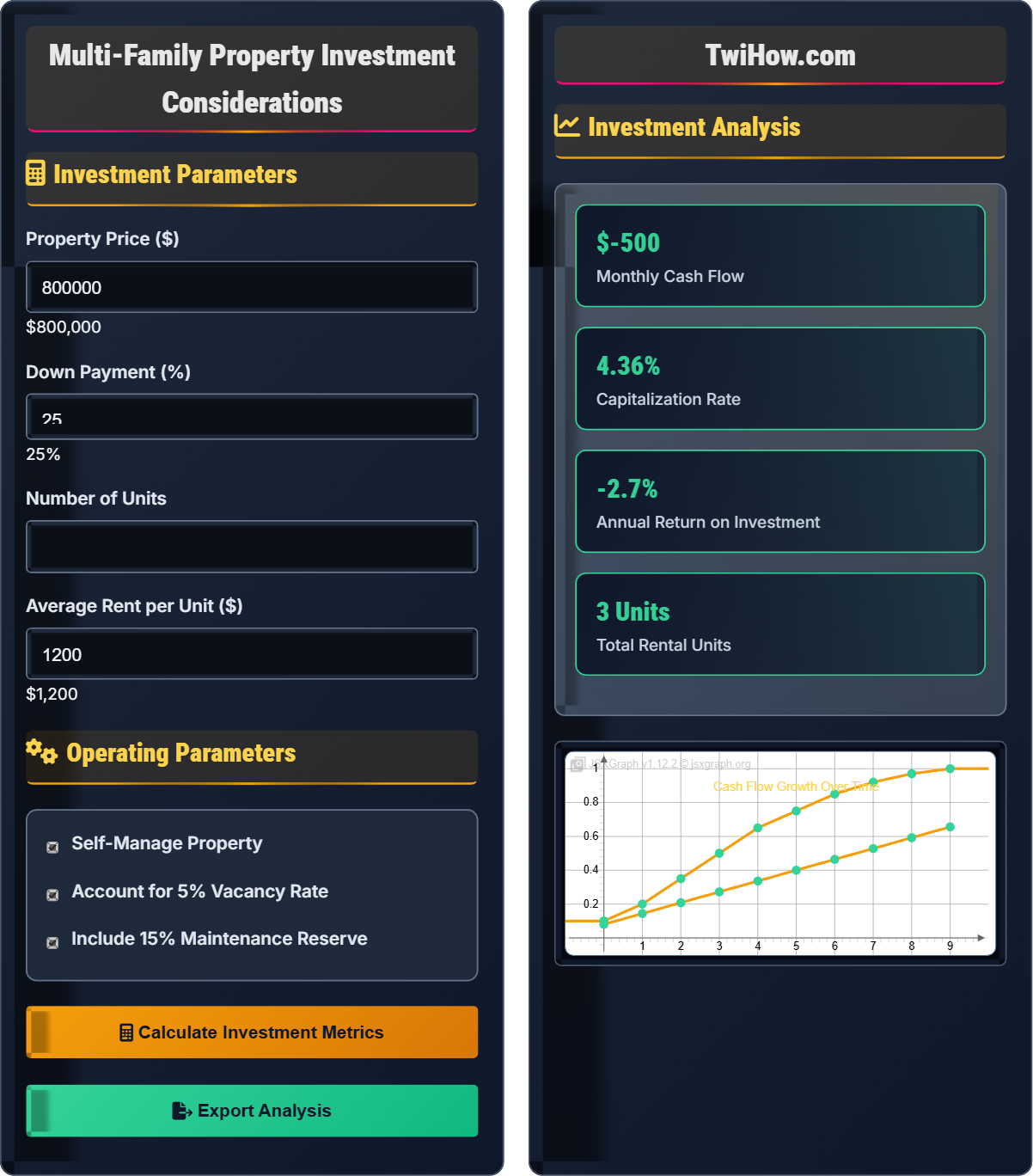
Investment Parameters
Operating Parameters
Investment Analysis
| Item | Monthly | Annual | Percentage |
|---|---|---|---|
| Gross Rental Income | $3,420 | $41,040 | 100% |
| Vacancy Loss | $171 | $2,052 | 5% |
| Operating Expenses | $1,800 | $21,600 | 52% |
| Net Operating Income | $1,449 | $17,388 | 43% |
Multi-Family Property Investment Explained
Multi-family properties (duplexes, triplexes, fourplexes, and apartment buildings) offer investors the opportunity to generate multiple rental income streams from a single property. These investments typically provide higher cash flow potential than single-family rentals while offering economies of scale in management and maintenance.
Monthly Cash Flow = (Gross Rental Income - Vacancy Loss) - Operating Expenses - Debt Service
Cap Rate = (Net Operating Income / Purchase Price) × 100
ROI = (Annual Cash Flow / Total Investment) × 100
Where:
- Gross Rental Income: Total monthly rent collected
- Vacancy Loss: Lost income due to empty units
- Operating Expenses: Maintenance, taxes, insurance, management
- Debt Service: Monthly mortgage payment
Essential considerations for multi-family investments:
- Rental Income: Multiple tenants provide diversified income streams
- Property Management: Scale economies vs. complexity trade-offs
- Financing: Higher down payments and different loan requirements
- Maintenance: More complex but potentially shared resources
- Tenant Screening: Managing multiple relationships
- Local Regulations: Rent control, landlord-tenant laws
- Buy-and-Hold: Long-term rental income and appreciation
- Renovation: Improving properties to increase rents
- Value-Add: Adding units or converting spaces
- Professional Management: Outsourcing operations
- Scalability: Building portfolio of multi-family properties
Investment Fundamentals
Multi-family properties, rental income, cash flow analysis, cap rate, ROI, property management.
Monthly Cash Flow = (Gross Rental Income - Vacancy Loss) - Operating Expenses - Debt Service
Where Monthly Cash Flow = net income after all expenses, Gross Rental Income = total rent collected, Operating Expenses = all property-related costs.
- Calculate all expenses before purchase
- Account for vacancy rates in projections
- Maintain adequate reserves for repairs
Considerations
Financing, management, maintenance, tenant relations, market analysis, regulatory compliance.
- Research local market conditions
- Analyze financial metrics
- Inspect property thoroughly
- Secure financing
- Plan management strategy
- Multi-family loans require higher down payments
- Management complexity increases with units
- Local regulations may apply
- Scale provides operational efficiencies
Multi-Family Investment Quiz
What is typically the minimum down payment requirement for a multi-family property with 2-4 units?
For multi-family properties with 2-4 units, lenders typically require 15-25% down payment, which is higher than single-family homes (usually 3-20%). This reflects the increased risk and complexity of multi-unit properties. Properties with 5+ units are considered commercial real estate and require even higher down payments.
The answer is C) 15-25%.
Lenders view multi-family properties as more complex investments due to multiple tenants, increased management responsibilities, and higher potential for complications. The higher down payment requirements help ensure investors have sufficient equity stake and financial cushion to handle challenges that may arise with multi-unit properties.
Down Payment: Initial cash investment in property purchase
Multi-Family Property: Residential property with 2+ rental units
Commercial Real Estate: Properties with 5+ units treated differently
• Multi-family loans require higher down payments
• Properties with 5+ units are commercial
• Research multiple lenders for best terms
• Consider partnership for higher down payments
• Plan for additional closing costs
• Underestimating down payment requirements
• Not planning for higher closing costs
• Assuming same terms as single-family
Explain how to calculate the Net Operating Income (NOI) for a multi-family property and why this metric is important for investors.
Net Operating Income (NOI) Calculation: NOI = Gross Rental Income - Vacancy Loss - Operating Expenses
Example: For a 3-unit property with $1,200/month rent each, 5% vacancy rate, and $1,800/month operating expenses:
• Gross Rental Income: 3 × $1,200 = $3,600
• Vacancy Loss: $3,600 × 5% = $180
• Effective Income: $3,600 - $180 = $3,420
• Operating Expenses: $1,800
• NOI: $3,420 - $1,800 = $1,620/month
Importance: NOI represents the property's income-producing capacity before debt service. It's used to calculate cap rates, determine property value, and assess investment performance.
NOI is the most important metric for evaluating multi-family investments because it represents the property's ability to generate income independent of financing. Investors use NOI to compare properties, calculate returns, and make informed purchasing decisions. Understanding how to accurately calculate NOI is crucial for successful investing.
Net Operating Income (NOI): Income after operating expenses but before debt
Operating Expenses: Property-related costs excluding debt service
Cap Rate: NOI divided by property purchase price
• NOI excludes debt service
• Include maintenance reserves in expenses
• Research local vacancy rates
• Account for seasonal fluctuations
• Including debt service in NOI
• Not accounting for vacancy
• Underestimating operating expenses
You're considering a 4-unit property in a market where similar units rent for $1,300-1,500/month. The property is listed at $1,000,000. Local vacancy rate is 8% and operating expenses average 45% of gross income. Calculate the projected annual cash flow assuming you can rent all units for $1,400/month and finance with a 25% down payment at 5.5% interest for 30 years.
Calculations:
• Gross Annual Income: 4 × $1,400 × 12 = $67,200
• Vacancy Loss: $67,200 × 8% = $5,376
• Effective Income: $67,200 - $5,376 = $61,824
• Operating Expenses: $61,824 × 45% = $27,821
• Mortgage Payment: $750,000 × (0.055/12) × [1-(1+0.055/12)^-360]^-1 = $4,238/month × 12 = $50,856
• Annual Cash Flow: $61,824 - $27,821 - $50,856 = -$16,853
This property would result in negative cash flow of $1,404/month, indicating it may not be a good investment at the current price.
This example demonstrates the importance of thorough financial analysis before investing. Even though the rent seems reasonable, the high purchase price and financing costs result in negative cash flow. This shows why investors must analyze all variables together rather than focusing on individual components.
Effective Income: Gross income minus vacancy losses
Operating Ratio: Operating expenses as percentage of gross income
Negative Cash Flow: Expenses exceed rental income
• Always calculate all expenses
• Include vacancy in projections
• Verify market rent assumptions
• Research comparable properties
• Verify expense estimates
• Consider rent growth potential
• Overestimating rental income
• Underestimating operating expenses
• Not accounting for vacancy
You own a 6-unit apartment building where you currently spend 15 hours per week managing it yourself. Your hourly rate is $75/hour. Property management companies charge 8% of collected rent. Calculate the annual cost of self-management vs. professional management, and determine which option is more cost-effective if your units rent for $1,250/month each.
Self-Management Cost: 15 hours/week × 52 weeks × $75/hour = $58,500/year
Professional Management Cost: 6 × $1,250 × 12 months × 8% = $7,200/year
Cost Difference: $58,500 - $7,200 = $51,300/year savings with professional management
Recommendation: Professional management is significantly more cost-effective, saving $51,300 annually while freeing up your time for other activities.
This example illustrates how the value of your time affects investment decisions. While self-management may seem cheaper initially, when you factor in the opportunity cost of your time, professional management often becomes more economical. This principle becomes more pronounced as property portfolios grow.
Opportunity Cost: Value of time spent on alternative activities
Professional Management: Third-party property management services
Self-Management: Owner handles all property operations
• Consider opportunity cost of time
• Compare actual costs vs. alternatives
• Factor in quality of management
• Calculate true cost of self-management
• Research property management fees
• Consider scalability of management
• Not valuing own time appropriately
• Underestimating management complexity
• Assuming self-management is always cheaper
Which of the following is NOT typically an advantage of multi-family property investment?
Contrary to the other options, multi-family properties typically have HIGHER management complexity due to multiple tenants, units, and potential issues. While they offer multiple income streams, economies of scale, and appreciation potential, managing multiple units and relationships is more complex than single-family properties.
The answer is C) Lower management complexity.
While multi-family properties offer many advantages, investors must understand that management complexity increases with the number of units. Each tenant relationship, maintenance issue, and lease requires attention. This complexity can be managed through professional property management, but it's important to factor into investment decisions.
Economies of Scale: Reduced per-unit costs as scale increases
Management Complexity: Difficulty of overseeing multiple units
Income Diversification: Multiple revenue sources reducing risk
• Multi-family has higher management complexity
• Multiple income streams reduce risk
• Scale can reduce per-unit costs
• Plan for management complexity
• Consider professional management for larger properties
• Factor management time into analysis
• Underestimating management complexity
• Assuming all benefits are positive
• Not planning for operational challenges
FAQ
Q: What's the difference between a multi-family property and a small apartment building in terms of financing?
A: The distinction affects financing significantly:
2-4 Unit Properties: Treated as residential investment properties, eligible for conventional investment loans with 15-25% down payment requirements.
5+ Unit Properties: Considered commercial real estate, requiring commercial loans with 25-35% down payment and different qualification criteria.
Properties with 5+ units typically require commercial appraisal, different underwriting standards, and may have different interest rates. The loan programs and qualification requirements are distinctly different.
Q: How should I approach tenant screening for a multi-family property with multiple units?
A: Multi-family tenant screening requires a systematic approach:
Standardized Process: Develop consistent screening criteria for all units to ensure fair housing compliance.
Documentation: Keep detailed records of all applications and screening decisions.
Verification: Thoroughly verify employment, income, and rental history for all adult occupants.
Consistency: Apply the same standards to all applicants regardless of unit location.
Legal Compliance: Follow all fair housing laws and local regulations. Consider using professional screening services to maintain consistency and compliance.