What Are the Considerations for Buying a Newly Constructed Home?
Real estate guide • Step-by-step explanations
New Construction Homes:
Show New Construction CalculatorBuying a newly constructed home offers unique advantages and challenges compared to purchasing an existing home. New construction provides modern amenities, energy efficiency, and customization options, but also comes with specific considerations regarding builder reputation, warranty coverage, and potential construction delays.
Key considerations for new construction homes include:
- Builder Reputation: Research the builder's track record, reviews, and previous projects
- Warranty Coverage: Understand the scope and duration of warranties provided
- Customization Options: Know when and how you can customize your home
- Construction Timeline: Be aware of potential delays and milestones
- Landscaping & Infrastructure: Consider neighborhood development stages
- Appraisal Challenges: New homes may face appraisal issues due to lack of comparable sales
Successfully navigating new construction purchases requires careful planning, thorough research, and understanding of the unique aspects of buying a home that doesn't yet exist.
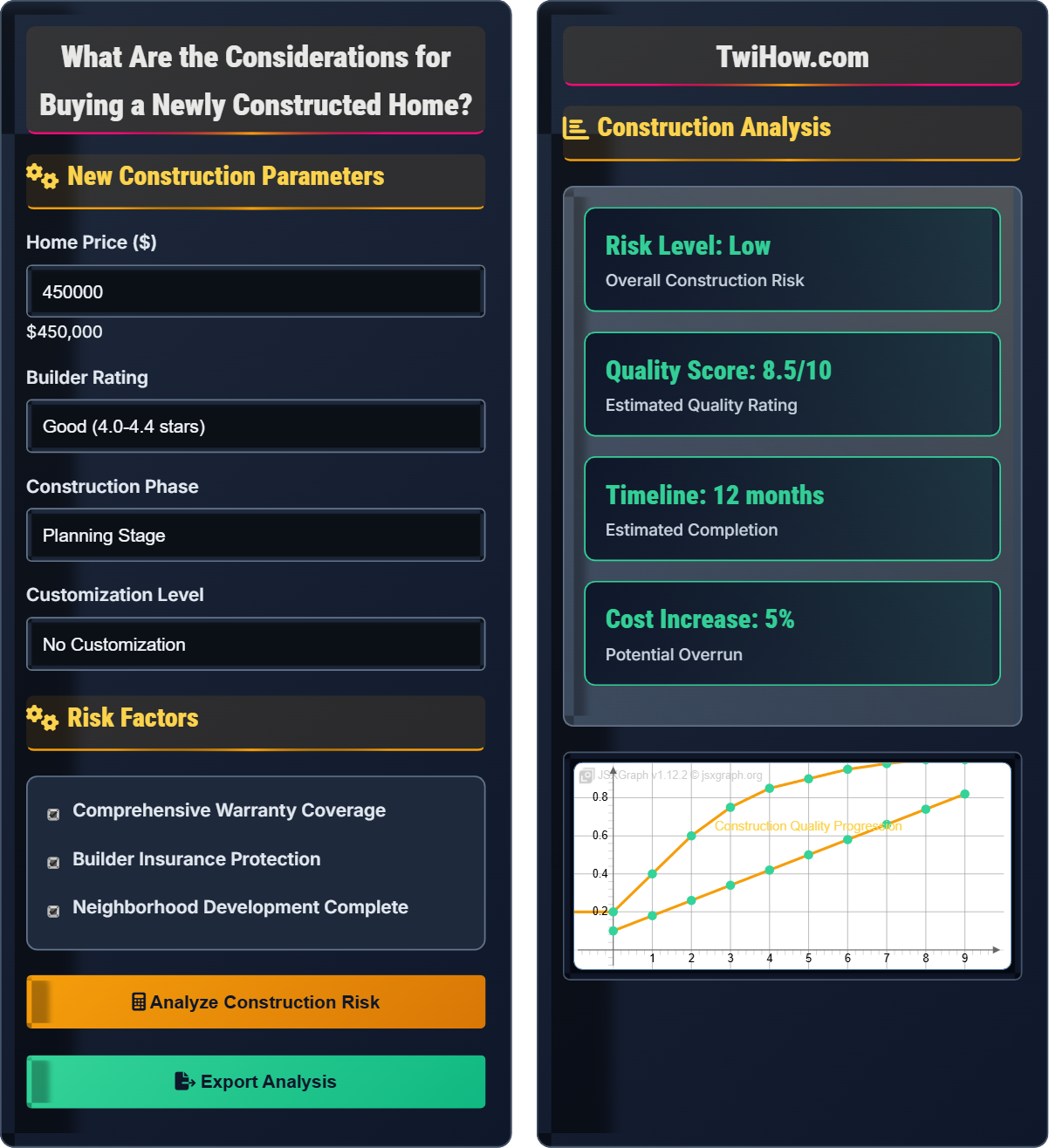
New Construction Parameters
Risk Factors
Construction Analysis
| Consideration | Score | Status | Recommendation |
|---|---|---|---|
| Builder Reputation | 8.5/10 | Excellent | Proceed with confidence |
| Warranty Coverage | 9/10 | Strong | Standard protection |
| Construction Quality | 8/10 | Good | Standard build |
Understanding New Construction Considerations
Buying a newly constructed home differs significantly from purchasing an existing home. Instead of buying a finished product, you're investing in a project that's in progress or planned. This means you'll work with a builder rather than a seller, and your purchase agreement will include different terms and protections.
When buying a newly constructed home, consider these critical factors:
- Builder Selection: Research the builder's reputation, financial stability, and past projects
- Warranty Coverage: Understand what's covered and for how long
- Customization Options: Know when you can make changes and associated costs
- Construction Timeline: Be aware of potential delays and milestones
- Location Development: Consider surrounding infrastructure and amenities
- Appraisal Challenges: New homes may face appraisal issues due to lack of comparables
Benefits of buying new construction include:
- Energy Efficiency: Modern insulation, windows, and appliances
- Minimal Maintenance: Everything is new and under warranty
- Customization: Choose finishes, layouts, and features
- Modern Amenities: Latest technology and design trends
- Lower Utility Costs: Efficient systems save money long-term
- Peace of Mind: Comprehensive warranty protection
Consider these potential challenges:
- Construction Delays: Weather, supply shortages, labor issues
- Cost Overruns: Change orders and upgrade selections
- Subdivision Issues: Ongoing construction in neighborhood
- Appraisal Problems: Difficulty finding comparable sales
- Limited Location Options: New builds in developing areas
- Settlement Date Uncertainty: Hard to predict exact move-in
New Construction Fundamentals
Builder reputation, warranty coverage, customization options, construction timeline, neighborhood development, appraisal challenges.
Risk = (Builder Risk × Construction Phase × Customization Level) / Warranty Protection
Where Builder Risk considers reputation and financial stability, and Warranty Protection evaluates coverage scope.
- Always research builder reputation thoroughly
- Understand warranty terms and exclusions
- Make customizations within allowed timeframes
- Prepare for potential construction delays
Management Strategies
Builder research, warranty review, timeline planning, customization management, financing preparation.
- Research builder's license status and complaints
- Visit previous completed projects
- Read warranty documents carefully
- Plan temporary housing if needed
- Prepare for potential delays
- Builder reputation significantly impacts quality
- Warranty coverage varies widely between builders
- Customization options decrease as construction progresses
- Construction timelines are estimates, not guarantees
New Construction Quiz
What is the most important factor to consider when selecting a builder for your new home?
While price, timeline, and customization are important, a builder's reputation and past work quality are paramount. A reputable builder with proven quality work will deliver a better home and stand behind their work with reliable warranty service. Price alone is not a reliable indicator of quality, and the fastest timeline means nothing if the work is substandard.
The answer is B) Builder's reputation and past work quality.
When selecting a builder, you're not just choosing a contractor—you're choosing a partner for a significant investment. A builder's reputation reflects their commitment to quality, customer service, and warranty support. Researching past projects, reading reviews, checking licensing status, and verifying insurance coverage are essential steps that protect your investment. The old adage "you get what you pay for" often applies in construction, where cutting corners can lead to costly problems later.
Builder Reputation: Track record of quality, timeliness, and customer satisfaction
Quality Assurance: Processes to ensure construction meets standards
Warranty Service: Post-completion support and repairs
• Research builder's license status and complaints
• Visit completed projects and speak with previous clients
• Verify insurance and bonding coverage
• Check online reviews and testimonials
• Ask for references from recent customers
• Visit multiple builder showrooms to compare
• Choosing builder based solely on price
• Not researching builder's history
• Failing to verify licensing and insurance
Explain the different types of warranties typically provided with new construction homes and why understanding them is crucial for homeowners.
Major System Warranty: Covers HVAC, plumbing, electrical, and appliances for 1-2 years. These systems are expensive to repair or replace.
Structural Warranty: Typically covers major structural defects for 5-10 years, protecting against foundation, load-bearing wall, and roof structure issues.
General Warranty: Usually covers workmanship and materials for 1 year, including items like doors, windows, flooring, and paint.
Appliance Warranties: Manufacturer warranties on included appliances, often 1-5 years depending on the appliance.
Understanding these warranties is crucial because they define what will be repaired or replaced at the builder's expense versus what you'll pay for. It's important to know what's covered, for how long, what constitutes a valid claim, and the process for filing claims. Some warranties cover labor and parts, while others only cover parts.
Warranty coverage serves as a safety net for new homeowners, protecting against defects in materials and workmanship. However, warranties have limitations, exclusions, and specific procedures that must be followed. Many homeowners discover too late that their warranty doesn't cover certain issues or that they missed the deadline for reporting problems. Understanding warranty terms before problems arise helps ensure you can take advantage of these protections when needed.
Warranty Period: Duration during which warranty is valid
Workmanship Warranty: Covers defects in construction technique
Material Defect: Issues with supplied materials
• Read warranty documents carefully before signing
• Document all issues with photos and dates
• Keep all warranty documents in a safe place
• Establish good communication with builder's service team
• Not reading warranty terms carefully
• Missing deadlines for reporting issues
• Assuming all problems are covered
Sarah is purchasing a new home from a builder with an estimated completion date of June 15th. The builder has had positive reviews, but construction is running 2 weeks behind schedule due to material shortages. Sarah needs to move out of her rental by July 1st. What should Sarah consider and what steps should she take to protect herself?
Timeline Assessment: Sarah should ask for updated timeline projections and understand the reasons for delays. Material shortages are common in today's market, so this may not reflect poor planning.
Contract Terms: Review the purchase agreement to understand penalties for late delivery, force majeure clauses, and Sarah's rights if completion is delayed.
Contingency Planning: Sarah should arrange temporary housing options and potentially negotiate rent-back agreements with her landlord.
Communication: Establish regular communication with the builder for updates on progress and revised timeline.
Documentation: Keep records of all communications and timeline changes for potential claims if the delay causes additional expenses.
This scenario highlights the reality that construction timelines are estimates subject to many variables beyond the builder's control. Material shortages, weather, labor availability, and permit delays can all impact schedules. The key is distinguishing between reasonable delays (like material shortages affecting the entire industry) and poor project management. Good builders communicate proactively about delays and provide realistic updated timelines. Buyers should always plan for some schedule flexibility when purchasing new construction.
Force Majeure: Unforeseeable circumstances preventing fulfillment of contract
Timeline Milestones: Key dates in construction process
Change Orders: Modifications to original construction plans
• Construction timelines are estimates, not guarantees
• Distinguish between reasonable and unreasonable delays
• Plan for schedule flexibility in new construction
• Build buffer time into your move schedule
• Ask about the builder's track record with timelines
• Negotiate penalty clauses for excessive delays
• Treating construction completion dates as firm commitments
• Not planning for temporary housing
• Failing to document timeline changes
Mark and Lisa are purchasing a new home and have a choice between selecting upgrades now during the framing stage (which would cost $15,000) or waiting until the home is complete and making the same changes (which would cost $25,000). They have the funds for either option. What factors should they consider in making this decision?
Cost Analysis: The immediate savings of $10,000 by choosing now is substantial. The earlier selection costs 40% less than post-completion changes.
Construction Impact: Changes during framing are easier to implement than after walls are closed, painted, and finished.
Financing Considerations: Early upgrades can often be financed as part of the mortgage, while later changes require separate financing or cash.
Certainty of Decision: Mark and Lisa should be confident in their choices since post-completion changes become much more expensive.
Timeline Impact: Post-completion changes may delay occupancy and require additional coordination.
Based on these factors, they should select upgrades now if they're confident in their choices, saving $10,000 and avoiding future complications.
This problem demonstrates the economic principle that making changes during construction is far more cost-effective than after completion. During early phases, modifications can be made relatively easily—electrical and plumbing can be rerouted, walls can be repositioned, and materials can be substituted. Once construction advances, changes require demolition, reconstruction, and often affect multiple trades. This is why builders offer specific windows for customization, and why taking advantage of these opportunities can result in significant savings.
Change Order: Formal modification to construction specifications
Customization Window: Period when changes can be made cost-effectively
Value Engineering: Process of optimizing cost vs. benefit
• Customize early to minimize costs
• Changes become exponentially more expensive later
• Consider financing implications of timing
• Research options thoroughly before selection windows
• Budget for potential upgrade costs
• Consider long-term value of upgrades
• Procrastinating on customization decisions
• Underestimating post-completion change costs
• Not considering financing impact of timing
Why might a newly constructed home face appraisal challenges that an existing home wouldn't?
Newly constructed homes face appraisal challenges primarily due to the lack of comparable sales in the area. Appraisers rely on recent sales of similar properties to determine value, but in new subdivisions or developments, there may be few or no comparable sales. This makes it difficult to validate the purchase price, potentially leading to a low appraisal that could complicate financing.
The answer is B) Lack of comparable sales in the area.
Appraisal challenges are a significant concern in new construction because the valuation process relies heavily on comparable sales data. In established neighborhoods, appraisers have numerous recent sales to reference, making valuations more straightforward. In new developments, however, appraisers may need to look farther away or use different methodologies, potentially resulting in lower valuations. This can create financing issues if the appraisal comes in below the purchase price, requiring buyers to bring additional cash to closing or renegotiate with the builder.
Comparable Sales: Recent sales of similar properties used for valuation
Appraisal Gap: Difference between purchase price and appraised value
Market Valuation: Determination of property worth
• New construction may face appraisal challenges
• Appraisers need comparable sales for accurate valuation
• Appraisal gaps can complicate financing
• Research comparable sales in surrounding area
• Consider builder's experience with appraisals
• Prepare for potential appraisal gap
• Not anticipating potential appraisal issues
• Failing to research local comparable sales
• Not preparing for appraisal gap financing
FAQ
Q: What's the difference between a new construction home and a pre-owned home in terms of maintenance?
A: New construction homes typically require significantly less maintenance in the first few years because everything is brand new and under warranty. Appliances, roofing, HVAC systems, and other components are fresh and haven't experienced wear and tear. However, new homes may have settling issues in the first year or two, leading to minor drywall cracks or door adjustments. Pre-owned homes have established maintenance needs that are immediately apparent, while new construction may reveal issues over time as systems are tested.
Q: How do new construction homes compare to existing homes in terms of resale value appreciation?
A: New construction homes often appreciate more slowly initially compared to existing homes in established neighborhoods. Existing homes in mature neighborhoods tend to have stronger immediate appreciation due to neighborhood amenities, schools, and community development. However, new construction homes in growing areas may catch up over time. The location and neighborhood development trajectory are more important factors than whether the home is new or existing. Energy efficiency and modern features of new homes can contribute to long-term value.