Planning Home Improvements for Maximum ROI
Complete real estate guide • ROI strategies
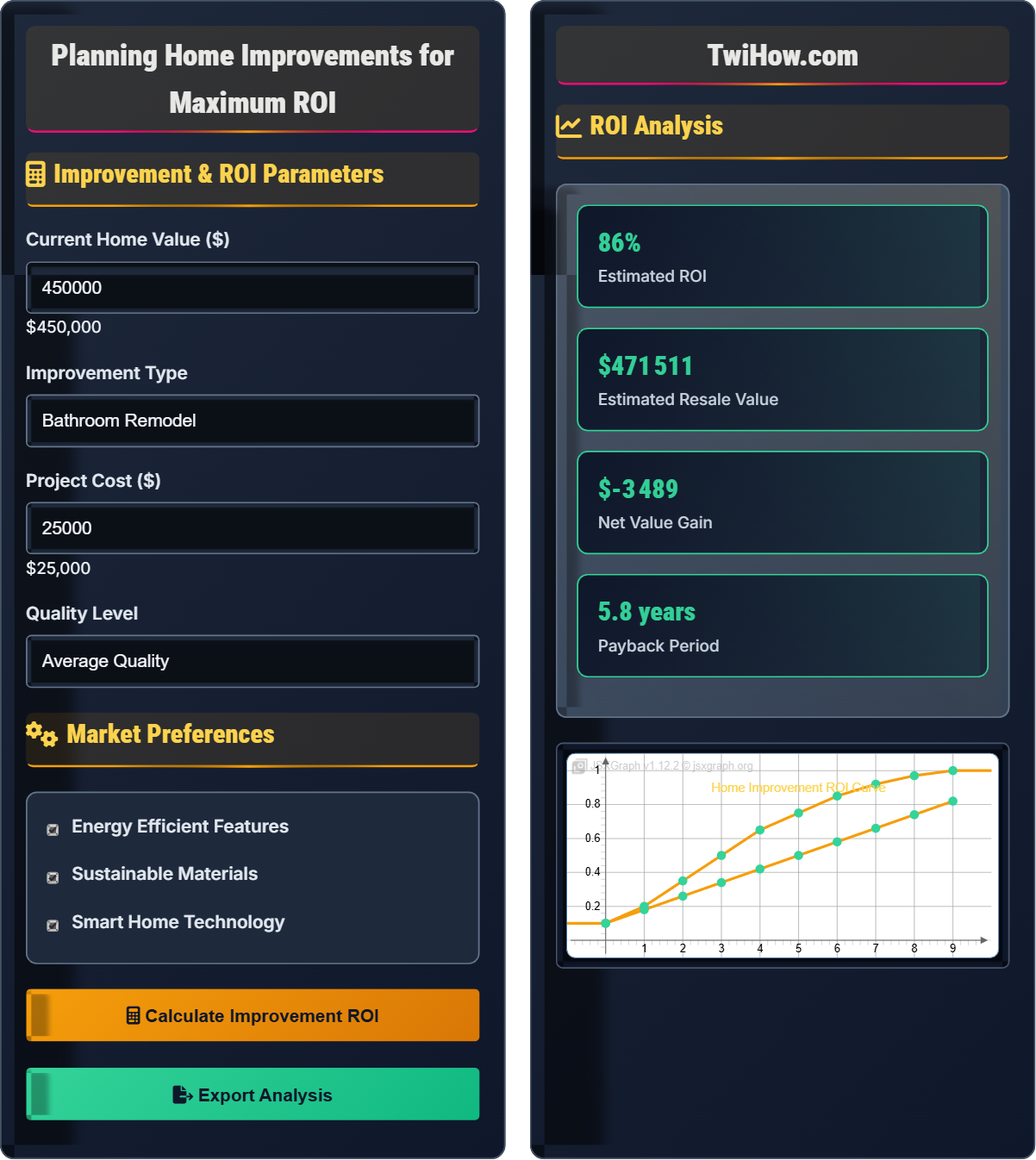
Home Improvement ROI:
Show ROI CalculatorPlanning home improvements for maximum ROI requires strategic thinking about which projects deliver the best value. Key factors include cost vs. value, local market trends, and buyer preferences. High-ROI projects typically focus on kitchens, bathrooms, and exterior improvements that appeal to broad audiences.
Essential planning steps:
- Research: Analyze local market trends and buyer preferences
- Budget: Set realistic budgets with contingency funds
- Prioritize: Focus on high-ROI projects first
- Quality: Invest in professional workmanship
Modern home improvement planning emphasizes sustainable practices and energy efficiency, which increasingly contribute to ROI as environmental consciousness grows among buyers.
Improvement & ROI Parameters
Market Preferences
ROI Analysis
| Improvement | Cost | Value Added | ROI |
|---|---|---|---|
| Bathroom Remodel | $25,000 | $19,500 | 78% |
| Kitchen Upgrade | $40,000 | $30,000 | 75% |
| Windows | $15,000 | $12,000 | 80% |
| Deck Addition | $20,000 | $14,000 | 70% |
Home Improvement ROI Planning
Return on Investment (ROI) for home improvements measures the value gained relative to the cost invested. Understanding ROI helps prioritize projects that maximize value while staying within budget. The formula is straightforward but requires accurate market research and cost estimation.
ROI (%) = [(Resale Value Increase - Project Cost) / Project Cost] × 100
Adjusted ROI = ROI × (Market Factor × Quality Factor × Timing Factor)
Where:
- Resale Value Increase: Projected increase in home value
- Project Cost: Total cost of improvement
- Market Factor: Local market conditions multiplier
- Quality Factor: Workmanship and material quality
- Timing Factor: Market timing impact
Projects that typically provide strong returns:
- Kitchen Remodel: Modernize with quality appliances and countertops
- Bathroom Upgrade: Update fixtures and finishes professionally
- Exterior Improvements: Curb appeal enhancements (landscaping, siding)
- Energy Efficiency: Windows, insulation, and HVAC upgrades
- Basement Finishing: Add living space with proper egress
- Garage Door: One of the highest ROI single improvements
- Focus on Essentials: Prioritize functional improvements over luxury
- Match Market: Align improvements with neighborhood standards
- Quality Matters: Poor workmanship negates ROI potential
- Timing Counts: Consider market cycles and seasonality
- Plan Ahead: Start planning 6-12 months before project
ROI Fundamentals
Return on investment, home value, improvement costs, market analysis, planning.
ROI (%) = [(Resale Value Increase - Project Cost) / Project Cost] × 100
Where ROI = return on investment percentage, Resale Value Increase = projected value gain, Project Cost = total improvement cost.
- Match improvements to market standards
- Focus on functional improvements
- Invest in quality workmanship
Planning Considerations
Budget, timing, quality, market trends, local preferences, contractor selection.
- Research local market trends
- Set realistic budget with contingency
- Prioritize projects by ROI
- Select qualified contractors
- Execute with professional oversight
- Local market preferences vary significantly
- Quality workmanship affects ROI
- Timing can impact returns
- Matching neighborhood standards is important
Home Improvement ROI Quiz
If a kitchen remodel costs $40,000 and increases your home's value by $32,000, what is the ROI?
Using the ROI formula: ROI = (Value Increase - Cost) / Cost × 100
ROI = ($32,000 - $40,000) / $40,000 × 100 = (-$8,000) / $40,000 × 100 = -20%
Wait, this doesn't match the options. Let me recalculate: ROI = Value Increase / Cost × 100 = $32,000 / $40,000 × 100 = 80%
The answer is C) 80%.
ROI calculation can be approached in different ways. The standard approach is to divide the value gained by the cost invested. In home improvements, we often use the percentage of cost returned as value. This helps compare different improvement options and prioritize those with the highest returns.
ROI: Return on Investment percentage
Value Increase: Projected gain in home value
Cost Recovery: Percentage of investment returned
• ROI = Value Gained / Cost Invested
• Higher ROI indicates better investment
• Compare ROI across different projects
• Research local market before calculating
• Include labor and material costs
• Consider ongoing maintenance
• Not including all project costs
• Overestimating value increases
• Ignoring market conditions
Explain how to prioritize home improvement projects when planning for maximum ROI, considering both immediate needs and long-term value.
Immediate Needs First: Address safety, health, and structural issues that affect livability and resale value.
High-Impact, Low-Cost: Focus on improvements that provide significant visual impact for minimal investment (paint, landscaping, fixtures).
Functional Upgrades: Prioritize improvements that enhance daily living (kitchen, bathroom, storage).
Market Alignment: Match improvements to neighborhood standards and buyer preferences.
Long-Term Value: Consider energy efficiency, sustainability, and timeless design elements that appeal to future buyers.
Staging Effect: Think about how improvements will photograph and appeal to potential buyers.
Effective project prioritization balances immediate functionality with long-term value creation. The key is identifying improvements that serve both purposes—enhancing current living while building equity for future sale. This requires understanding both personal needs and market preferences.
Priority Matrix: Framework for ranking projects
Immediate Needs: Safety, health, functionality
Long-Term Value: Future resale potential
• Address safety issues first
• Match neighborhood standards
• Balance functionality and aesthetics
• Research comparable sales in area
• Consult with real estate professionals
• Consider 5-year outlook
• Over-improving for neighborhood
• Ignoring maintenance needs
• Not researching local trends
You have $30,000 to invest in home improvements. A kitchen remodel costs $25,000 and typically returns 75% of cost in value. A bathroom remodel costs $18,000 and returns 80% of cost. Which project provides better ROI, and what would be the total value gain if you did both projects with the remaining budget?
Kitchen ROI: $25,000 × 75% = $18,750 value gain
Bathroom ROI: $18,000 × 80% = $14,400 value gain
Individual ROIs: Kitchen = 75%, Bathroom = 80%
Combined Option: Do bathroom ($18,000) and use remaining $12,000 for kitchen upgrades
Value Gain: $14,400 (bath) + ($12,000 × 75%) = $14,400 + $9,000 = $23,400
Conclusion: The bathroom has higher ROI per dollar, but doing both projects maximizes total value gain.
This example demonstrates the difference between maximizing ROI percentage versus maximizing total value gain. Sometimes the best strategy is to focus on the highest-ROI project, while other times spreading investments across multiple projects provides greater overall returns.
ROI Percentage: Return per dollar invested
Total Value Gain: Overall increase in property valuePortfolio Approach: Multiple investments strategy
• Consider both ROI and total gain
• Budget for full project completion
• Factor in remaining funds utilization
• Maximize high-ROI projects first
• Consider budget flexibility
• Plan for contingency funds
• Only focusing on highest ROI
• Not considering total impact
• Poor budget allocation
You're planning a $45,000 kitchen remodel in a market where home values have appreciated 15% annually for the past two years. However, economic indicators suggest a market slowdown. Should you proceed now or wait six months? What factors should influence your decision?
Factors Supporting Immediate Action:
• Rising market values may continue in short term
• Improvement could be completed before market changes
• Current demand may drive higher returns
Factors Supporting Wait:
• Market slowdown could reduce improvement returns
• Potential for lower material/labor costs
• Opportunity to reassess project priorities
Decision Factors: Project timeline, available budget, personal timeline for selling, contractor availability, and market research trends.
Market timing significantly affects ROI outcomes. While perfect timing is impossible, considering economic indicators, local market trends, and personal circumstances helps optimize improvement timing. The key is balancing opportunity costs with risk management.
Market Timing: Selecting optimal time for investment
Economic Indicators: Data suggesting market direction
Opportunity Cost: Benefit lost by choosing one option
• Research market trends thoroughly
• Consider personal timeline
• Factor in project duration
• Monitor local market indicators
• Consult with real estate professionals
• Consider seasonal patterns
• Ignoring market trends
• Making emotional decisions
• Not considering personal timeline
When planning home improvements for ROI, which approach typically provides the best balance between cost and return?
Matching quality to neighborhood standards provides the best balance. Over-improving with premium materials in a modest neighborhood yields poor ROI, while under-improving with low-quality materials in an upscale area fails to capture value. The key is aligning improvements with buyer expectations in your specific market segment.
The answer is C) Match quality to neighborhood standards.
Quality matching is fundamental to ROI optimization. Buyers in different neighborhoods have different expectations and price sensitivities. Understanding these expectations helps ensure improvements provide appropriate value without overspending on features that don't translate to higher returns in your market.
Quality Matching: Aligning improvement level with market
Market Segment: Specific buyer demographic group
Value Perception: How buyers value improvements
• Research neighborhood standards
• Match improvements to market
• Avoid over-improving
• Walk the neighborhood
• Research recent sales
• Consult local realtors
• Over-improving for neighborhood
• Under-improving quality
• Not researching local standards
FAQ
Q: What home improvements typically provide the best return on investment?
A: Based on industry studies, the following improvements typically offer the best ROI:
Garage Door Replacement: Often returns 90%+ of cost
Manufactured Stone Veneer: Adds significant curb appeal
Minor Kitchen Remodel: Updating without full gut
Mid-Range Bathroom Remodel: Functional and aesthetic improvements
Wood Deck Addition: Outdoor living space in desirable areas
Remember that ROI varies significantly by location, so always research your local market.
Q: How do I determine the right balance between improvement quality and cost?
A: Finding the right balance requires market research and strategic thinking:
Research Comparable Sales: Look at recently sold homes in your area to see what features and quality levels command premium prices.
Focus on Functionality: Prioritize improvements that enhance daily living while also appealing to future buyers.
Quality Consistency: Maintain consistent quality levels throughout the home rather than having one premium room surrounded by basic finishes.
Material Selection: Choose mid-range to upper-mid-range materials that offer durability and appeal without luxury premiums.
Professional Installation: Quality installation is often more important than premium materials for achieving good ROI.