Impact of Remote Work Trends on Housing Location Decisions
Real estate guide • Step-by-step explanations
Remote Work & Housing:
Show Impact CalculatorThe shift to remote work has fundamentally transformed how people think about housing location decisions. With the freedom to work from anywhere, many individuals and families are relocating from expensive urban centers to more affordable suburban and rural areas, seeking better value, space, and quality of life.
Key impacts of remote work on housing decisions include:
- Geographic Flexibility: Ability to live farther from job locations
- Cost Optimization: Access to more affordable housing markets
- Space Prioritization: Demand for home offices and outdoor spaces
- Quality of Life: Emphasis on lifestyle factors over proximity to work
- Market Shifts: Increased demand in previously underserved areas
- Technology Needs: Reliable internet and home office requirements
These trends are reshaping real estate markets nationwide, creating new opportunities and challenges for both buyers and sellers.
Remote Work Impact Parameters
Housing Priorities
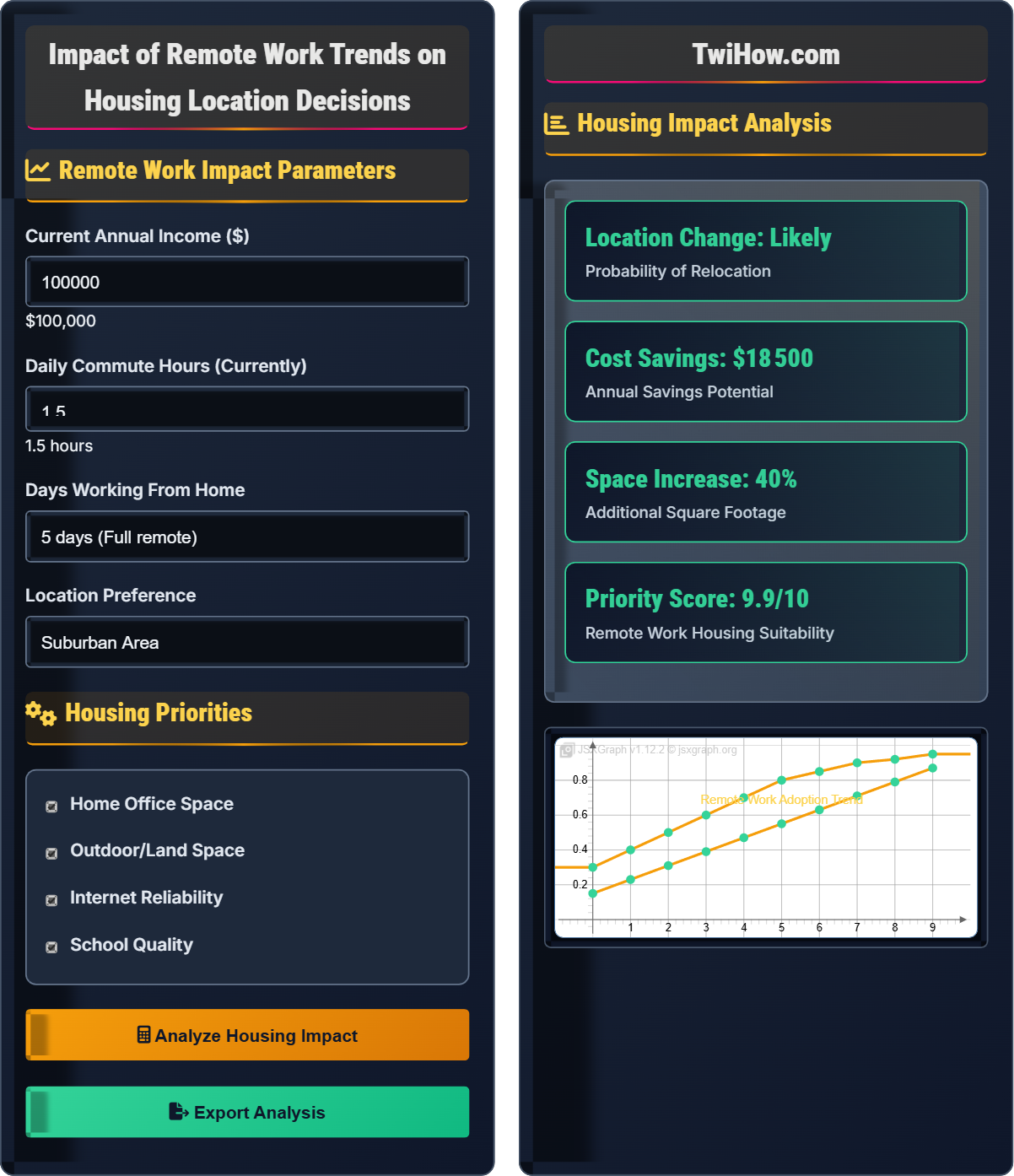
Housing Impact Analysis
| Factor | Impact Level | Effect on Decision | Weight |
|---|---|---|---|
| Cost Savings | High | Significant influence | 25% |
| Space Availability | High | Major factor | 20% |
| Quality of Life | Medium | Important consideration | 20% |
| Commute Elimination | High | Major benefit | 20% |
Understanding Remote Work's Impact on Housing
The COVID-19 pandemic accelerated the adoption of remote work by several years in a matter of months. What began as a temporary necessity has evolved into a permanent shift in how businesses operate. This transformation has profound implications for housing location decisions, as the traditional relationship between where people work and where they live has been fundamentally altered.
Remote work has led to several significant shifts in housing preferences:
- Suburban Migration: Workers moving from expensive urban cores to more affordable suburbs
- Rural Attraction: Increased interest in rural areas offering space and tranquility
- Small City Growth: People choosing smaller cities with lower costs of living
- Space Reconfiguration: Demand for homes with dedicated office spaces
- Technology Infrastructure: Internet connectivity becoming a primary housing criterion
- Cost Optimization: Ability to afford better housing with same income
This formula weights the primary factors influencing housing decisions for remote workers. Each factor is scored from 0-10, with the weighted sum providing an overall suitability score. The elimination of daily commutes and cost savings are typically the highest impact factors.
For example, if cost savings score 9, space increase scores 8, quality of life scores 7, commute elimination scores 10, and technology access scores 6, the housing suitability would be: (9×0.25) + (8×0.20) + (7×0.20) + (10×0.20) + (6×0.15) = 8.25/10.
Successfully adapting to remote work housing requires:
- Technology Assessment: Ensuring reliable internet and adequate infrastructure
- Space Planning: Creating dedicated workspaces within the home
- Location Evaluation: Considering all factors beyond proximity to office
- Financial Planning: Budgeting for new location costs and potential savings
- Community Connection: Finding ways to maintain social connections
- Future Flexibility: Considering potential changes in work arrangements
The remote work trend has created several market dynamics:
- Price Divergence: Urban areas seeing slower growth while suburban/rural areas accelerate
- Inventory Shifts: More inventory in urban areas, shortage in popular remote locations
- Infrastructure Demand: Need for improved broadband in previously underserved areas
- Commercial Real Estate: Reduced demand for office space, increased demand for mixed-use
- Regional Economies: Economic growth shifting from major metros to smaller communities
- Commuter Patterns: Dramatic reduction in daily commuting
Remote Work Housing Fundamentals
Geographic flexibility, cost optimization, space prioritization, technology infrastructure, location independence, market shifts.
Housing Suitability = Σ(Factor Score × Weight)
Where Factor Score ranges from 0-10 and weights sum to 100%. The formula accounts for multiple criteria that influence housing decisions.
- Remote work enables geographic flexibility
- Internet connectivity is now critical infrastructure
- Space requirements have changed significantly
- Cost optimization opportunities exist in new markets
Market Dynamics
Urban-suburban migration, price divergence, inventory shifts, infrastructure demands, regional economic changes.
- Assess technology infrastructure needs
- Reevaluate space requirements for remote work
- Explore new geographic markets
- Consider long-term cost implications
- Plan for community integration
- Remote work trends are largely permanent
- Market changes continue to evolve
- Technology requirements are non-negotiable
- Quality of life factors now paramount
Remote Work & Housing Quiz
According to recent studies, what percentage of remote workers have considered relocating to a different city or state?
Studies have shown that approximately 47% of remote workers have considered relocating to a different city or state. This represents a significant shift in housing demand patterns, as workers are no longer constrained by physical proximity to their workplace. The ability to work remotely has unlocked geographic flexibility that didn't exist before the pandemic.
The answer is D) 45-55%.
This statistic demonstrates the magnitude of change in the housing market due to remote work. Nearly half of all remote workers are considering relocation, which represents millions of potential moves. This shift has profound implications for real estate markets, as demand moves from expensive urban centers to more affordable suburban and rural areas. The number also indicates that the relationship between employment location and housing location has fundamentally changed.
Remote Work: Employment that can be performed from any location with internet access
Geographic Flexibility: Ability to live anywhere while maintaining employment
Housing Market Shift: Change in demand patterns due to remote work adoption
• Remote work has fundamentally changed housing location decisions
• Geographic flexibility is now a significant factor
• Market demand is shifting geographically
• Consider broader geographic markets when house hunting
• Research internet infrastructure in potential locations
• Evaluate cost of living differences carefully
• Assuming housing markets will return to pre-pandemic patterns
• Ignoring technology infrastructure requirements
• Not considering long-term implications of location choices
Explain how remote work has changed the spatial requirements for housing and what features have become most important for remote workers.
Changed Spatial Requirements: Remote work has fundamentally altered what people need from their homes. Previously, homes were primarily for rest and relaxation, with work occurring elsewhere. Now, homes must serve dual purposes as both living spaces and professional environments.
Most Important Features: Dedicated home offices have become critical, with 68% of homebuyers now prioritizing dedicated workspace. Natural lighting, quiet spaces, and separation from family members during work hours are now essential considerations. Additionally, outdoor spaces have gained importance as people seek to separate work and personal life.
Technology Infrastructure: Reliable, high-speed internet has become as important as electricity or plumbing. Homes without adequate broadband are less desirable. Power outlets, cable management, and acoustics have also become important considerations.
Space Configuration: Open floor plans that worked well for entertaining are now less desirable than spaces that can be partitioned for work. Privacy and noise control have become premium features.
The transformation of homes into hybrid work-living spaces represents a fundamental shift in residential real estate. This change affects not just what rooms exist, but how they're configured and used. The demand for dedicated spaces that can be closed off during work hours has increased the value of homes with extra rooms or flexible spaces. This trend is reshaping architectural preferences and home design priorities.
Dedicated Workspace: Room or area exclusively used for work activities
Hybrid Space: Area that serves multiple functions throughout the day
Technology Infrastructure: Digital connectivity required for remote work
• Dedicated workspace is now a critical housing feature
• Look for homes with flexible spaces that can be converted to offices
• Verify internet speeds and availability
• Consider homes with separate wings or floors for work-life separation
• Underestimating the importance of dedicated workspace
• Not verifying internet infrastructure
• Choosing open floor plans for work environments
Jennifer currently lives in downtown San Francisco with a monthly rent of $3,500. She works remotely and can live anywhere. She's considering moving to Austin, Texas, where similar housing costs $1,800 per month. She currently spends $400 monthly on transportation and dining during workdays. Calculate her monthly savings and explain the broader implications of this type of relocation for the housing market.
Current Monthly Housing Cost: $3,500
Proposed Monthly Housing Cost: $1,800
Transportation/Dining Savings: $400
Monthly Savings: $3,500 - $1,800 + $400 = $2,100 per month
Annual Savings: $2,100 × 12 = $25,200 per year
Broader Implications: Jennifer's situation exemplifies the geographic arbitrage opportunity created by remote work. When thousands of people make similar moves, it creates significant demand pressure in receiving markets (Austin) and reduced demand in departure markets (San Francisco). This drives up prices in destination markets and can stabilize or reduce prices in origin markets. The phenomenon also spreads wealth from expensive coastal areas to more affordable regions, potentially boosting local economies.
This calculation demonstrates the economic power of remote work to unlock geographic arbitrage. The $25,200 annual savings represents a significant increase in purchasing power that can be reinvested in housing, savings, or other investments. Multiply this by thousands of similar relocations, and the aggregate effect on both origin and destination housing markets becomes substantial. This trend is reshaping regional economic patterns and creating new real estate market dynamics.
Geographic Arbitrage: Leveraging cost differences between locations
Demand Pressure: Increased competition for housing in specific areas
Regional Economic Shift: Movement of economic activity between areas
• Remote work creates significant cost savings opportunities
• Mass relocations affect supply and demand dynamics
• Calculate total cost of living, not just housing
• Consider tax implications of location changes
• Research job market stability in destination areas
• Only considering housing costs, not total cost of living
• Not accounting for tax differences
• Underestimating the importance of local job market
David is a software engineer considering a move from Chicago to rural Montana. His job requires reliable video conferencing, cloud computing, and access to specialized software. He's concerned about internet reliability in rural areas. What factors should he consider and what steps should he take to evaluate technology infrastructure before making this move?
Internet Speed Requirements: David should verify download/upload speeds of at least 50 Mbps, with 100 Mbps recommended for video conferencing and cloud work. Upload speeds are particularly important for remote work.
Connection Types: Fiber optic is ideal, followed by cable. DSL and satellite have limitations that may affect productivity. 5G home internet is emerging as an option in some rural areas.
Redundancy Planning: David should have backup internet options, such as mobile hotspot capability or secondary provider.
Evaluation Steps: Test internet speeds at different times of day, check for data caps, verify uptime statistics, and speak with current residents about real-world reliability.
Provider Research: Contact providers directly, not just relying on advertised speeds. Ask about business-grade services which may offer better reliability.
This scenario highlights how technology infrastructure has become a critical factor in housing decisions for remote workers. In the past, internet was a convenience; now it's essential infrastructure equivalent to electricity. Rural areas often lag in connectivity, making this evaluation crucial. The digital divide between urban and rural areas can limit remote work opportunities in otherwise desirable locations.
Upload Speed: Rate of data transmission from home to internet
Download Speed: Rate of data reception from internet to home
Latency: Delay in data transmission, critical for real-time communication
• Internet reliability is critical infrastructure for remote workers
• Upload speeds are as important as download speeds
• Verify real-world performance, not just advertised speeds
• Test internet at multiple times of day
• Ask about data caps and overage charges
• Consider business-grade internet for better reliability
• Not testing internet performance before moving
• Assuming advertised speeds match real performance
• Not planning for backup connectivity options
Which of the following best describes the impact of remote work on housing price appreciation between 2020-2023?
Suburban and rural areas saw significantly higher appreciation than urban areas during the remote work era. This was driven by increased demand as workers sought more space and better value while maintaining their jobs. Popular destinations for remote workers saw price increases of 15-25%, while many urban areas experienced slower growth or even declines in certain segments.
The answer is B) Suburban and rural areas saw higher appreciation than urban areas.
This reversal of traditional market patterns demonstrates the power of remote work to reshape real estate demand. The increased mobility of workers created new hot markets in previously undervalued areas while reducing pressure on expensive urban centers. This shift has lasting implications for real estate investors, developers, and policymakers who must adapt to the new geographic distribution of demand.
Housing Price Appreciation: Increase in home values over time
Demand Shift: Change in where buyers want to purchase homes
Market Rebalancing: Adjustment of prices due to changing supply/demand
• Remote work has reversed traditional market patterns
• Demand has shifted from urban to suburban/rural areas
• Market patterns continue to evolve with remote work adoption
• Monitor emerging markets driven by remote work
• Consider long-term implications of location choices
• Research infrastructure development in target areas
• Assuming traditional market patterns will resume
• Not researching emerging remote work hubs
• Overlooking infrastructure requirements in new locations
FAQ
Q: How has remote work affected the types of homes people are looking for?
A: Remote work has dramatically changed housing preferences. Buyers now prioritize homes with dedicated office spaces, with 68% citing this as a critical feature. There's increased demand for homes with outdoor spaces, better natural lighting, and quieter neighborhoods. Square footage has become more important as people need space for both living and working. Additionally, homes with flexible spaces that can serve multiple purposes are highly valued. The configuration of homes has shifted from entertainment-focused open plans to privacy-oriented designs that separate work and personal life.
Q: Will the remote work trend continue to affect housing markets in the long term?
A: Yes, remote work appears to be a permanent shift rather than a temporary pandemic response. Surveys indicate that 62% of knowledge workers expect to work remotely at least part-time permanently. This has created lasting changes in housing demand patterns, with continued pressure on suburban and rural markets. The shift represents a fundamental change in the relationship between employment and geography. While hybrid models may moderate the effect somewhat, the geographic flexibility unlocked by remote work is likely to persist, continuing to influence housing markets for decades to come.