What is the Process and Timeline for Closing on a Home Purchase?
Complete home buying guide • Step-by-step explanations
Home Buying Process:
Show Closing TimelineThe home buying process involves multiple stages from offer acceptance to final closing, typically taking 30-45 days. The closing process itself involves finalizing financing, completing inspections, reviewing documents, and transferring ownership. Understanding the timeline helps buyers prepare and avoid delays.
Key stages include:
- Mortgage Pre-approval: Securing financing before house hunting
- Offer Acceptance: Negotiating purchase terms
- Home Inspection: Professional evaluation of property condition
- Appraisal: Lender's property valuation
- Closing: Finalizing paperwork and transferring ownership
The timeline can vary based on local market conditions, financing complexity, and buyer preparation. Proper planning and understanding of the process helps ensure a smooth transaction.
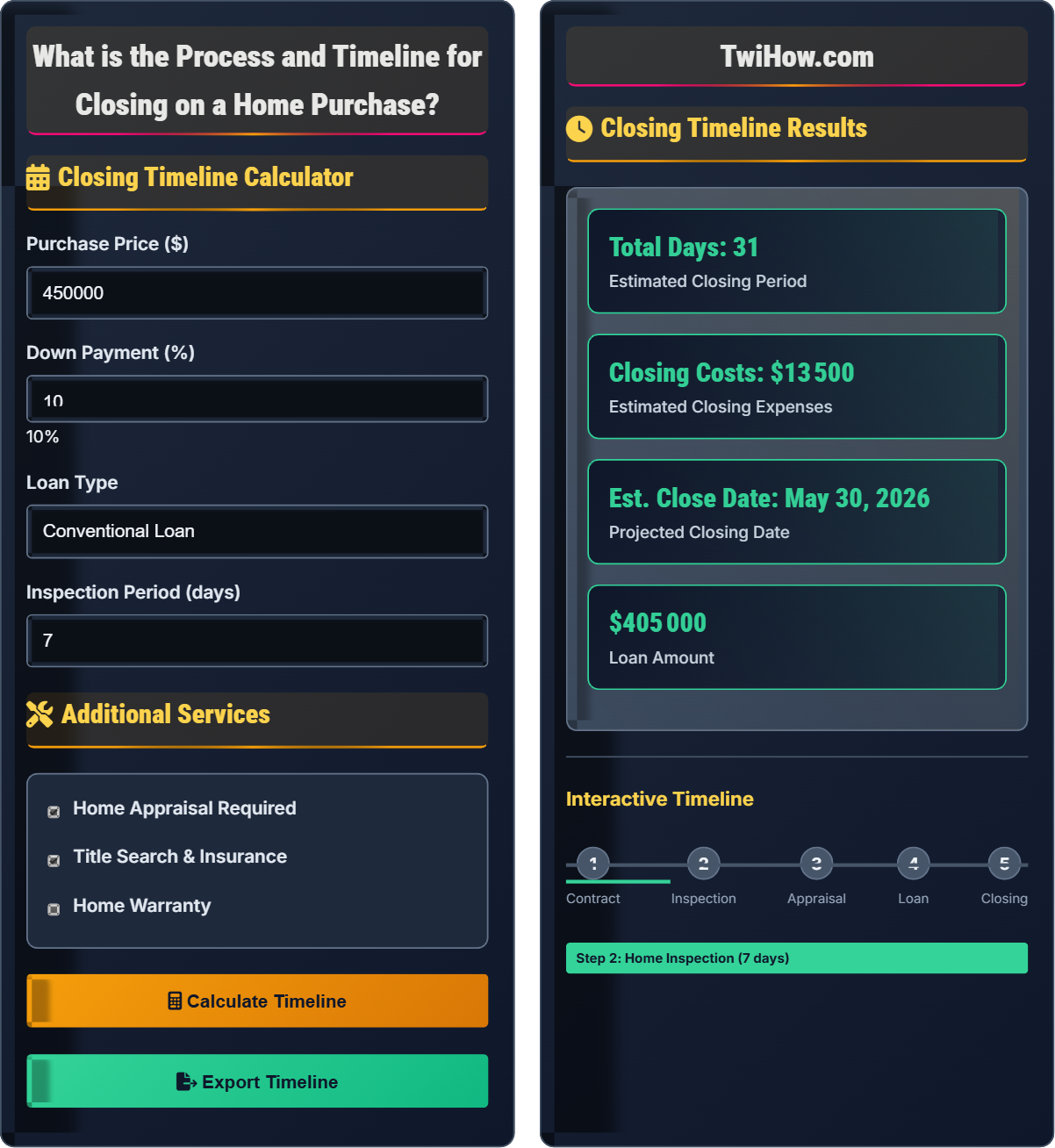
Closing Timeline Calculator
Additional Services
Closing Timeline Results
Interactive Timeline
Home Purchase Closing Process Explained
The closing process is the final stage of a home purchase where the buyer and seller execute the sale agreement and transfer ownership. It involves signing numerous legal documents, paying closing costs, and receiving the keys to the property. The process typically takes 30-45 days from the acceptance of the purchase agreement to the actual closing day.
The closing timeline varies depending on the type of loan and local market conditions. Here's a standard breakdown:
Where:
- Inspection Period: 7-10 days for professional inspection and repair negotiations
- Appraisal/Lending: 14-21 days for property appraisal and loan underwriting
- Documentation: 5-7 days for title work and insurance
- Final Steps: 1-3 days for final walk-through and closing
Essential documents signed during closing include:
- Settlement Statement (HUD-1): Itemized breakdown of all closing costs
- Mortgage/Deed of Trust: Document securing the loan with the property
- Promissory Note: Legal promise to repay the loan
- Deed: Document transferring ownership from seller to buyer
- Escrow Account Information: Details of funds for taxes and insurance
- Financing Type: Conventional loans often faster than government loans
- Property Type: Single-family homes vs. condos/co-ops have different requirements
- Market Conditions: Busy markets may extend timelines
- Buyer Preparation: Prompt document submission speeds process
- Local Customs: Different regions have varying practices
Closing Essentials
Contingencies, earnest money, title insurance, escrow, settlement statement, deed.
Total Closing Time = Inspection Period + Appraisal/Lending + Documentation + Final Steps
Where each component has standard durations but can vary based on circumstances.
- Always review closing disclosure 3 days before closing
- Bring valid ID and certified funds to closing
- Conduct final walk-through before closing
Preparation Checklist
Home Buying Process Quiz
What is the typical duration for the home purchase closing process from contract acceptance to closing day?
The typical home purchase closing process takes 30-45 days from the acceptance of the purchase agreement to the actual closing day. This timeframe allows for the necessary steps including home inspection, appraisal, loan underwriting, and title work. While some closings may happen faster or take longer depending on various factors, 30-45 days is the industry standard.
The answer is B) 30-45 days.
Understanding the typical closing timeline is crucial for home buyers to set realistic expectations and plan accordingly. The 30-45 day period is designed to accommodate all necessary due diligence activities while allowing lenders and title companies to properly process the transaction. This timeframe provides enough time for inspections, appraisals, and loan approval without unnecessarily extending the process.
Closing: The final step in the home buying process where ownership transfers
Due Diligence: The period for inspections, appraisals, and verification of property details
Underwriting: The process by which lenders evaluate loan applications
• Standard closing timeline is 30-45 days
• Timeline can be negotiated in the purchase agreement
• Extensions may be granted for legitimate reasons
• Start gathering financial documents early
• Respond quickly to lender requests
• Schedule inspections promptly
• Expecting immediate closing after offer acceptance
• Not preparing documents in advance
• Missing deadlines during the process
Explain the purpose of the HUD-1 Settlement Statement and list five other essential documents signed at closing.
HUD-1 Settlement Statement: This document provides a detailed breakdown of all closing costs for both buyer and seller. It itemizes all fees, charges, and credits associated with the transaction, ensuring transparency in the financial aspects of the closing. Buyers must receive this document at least 3 days before closing to review the terms.
Five other essential closing documents:
1. Mortgage/Deed of Trust: Creates a lien on the property as security for the loan
2. Promissory Note: The borrower's promise to repay the loan according to specified terms
3. Deed: Transfers ownership from seller to buyer
4. Title Insurance Policy: Protects against ownership disputes
5. Bill of Sale: Transfers ownership of fixtures and personal property included in sale
Understanding closing documents is critical for protecting your interests as a buyer. The HUD-1 Settlement Statement is particularly important as it shows exactly what you're paying for and helps identify any unexpected charges. Each document serves a specific legal purpose in transferring ownership and establishing the rights and obligations of all parties involved.
HUD-1 Settlement Statement: Itemized breakdown of all closing costs
Mortgage: Legal document securing debt with real property
Promissory Note: Unsecured promise to repay borrowed money
• Review HUD-1 carefully before signing
• Ask questions about any unclear items
• Keep copies of all documents
• Bring a pen to closing (sometimes provided)
• Take photos of documents for records
• Verify all figures match expectations
• Not reviewing documents carefully
• Signing without understanding obligations
• Forgetting to bring required identification
Sarah signed a purchase agreement on January 15th with a 30-day closing contingency. She scheduled a home inspection on January 17th, which took 2 days. The appraisal was ordered on January 20th and took 5 days to complete. The lender's underwriting process began on January 25th and took 10 business days. The title company needed 3 business days to prepare documents. Sarah conducted her final walk-through on the day before closing. On what date did Sarah close on her new home?
Let's break down the timeline:
• Contract signing: January 15th
• Inspection: January 17-18 (2 days)
• Appraisal: January 20-24 (5 days)
• Underwriting: January 25-February 8 (10 business days)
• Title prep: February 9-13 (3 business days)
• Final walk-through: February 14th
• Closing: February 15th
Therefore, Sarah closed on February 15th, exactly 30 days after signing the contract.
Calculating closing dates requires understanding how different activities fit together in the timeline. The process typically runs sequentially with each step depending on the completion of the previous one. Understanding these dependencies helps buyers plan appropriately and anticipate potential delays. Business days are typically Monday-Friday, excluding holidays.
Closing Contingency: The agreed-upon timeframe for completing the purchase
Business Days: Weekdays excluding weekends and holidays
Sequential Process: Steps that must be completed in order
• Activities often run concurrently when possible
• Delays in one area affect the entire timeline
• Contingency periods can be extended
• Track all deadlines carefully
• Communicate regularly with your agent and lender
• Build in buffer time for unexpected delays
• Confusing calendar days with business days
• Not accounting for holiday schedules
• Expecting all steps to happen simultaneously
During a home inspection, significant foundation issues were discovered that would cost $15,000 to repair. The buyer has a 10-day inspection contingency and needs 3 days to negotiate repairs with the seller. The seller offers a credit of $7,500 toward repairs. The buyer accepts but now needs to verify with their lender that the home is still appraised at sufficient value for the loan. How should the buyer manage this situation to avoid losing their earnest money deposit?
Immediate Actions:
1. Document Everything: Get all repair negotiations in writing and signed by both parties
2. Request Extension: If the 10-day inspection contingency expires before all negotiations are complete, request a contract extension in writing
3. Verify Appraisal Impact: Contact the lender immediately to confirm if the foundation issues affect the appraisal value
4. Re-inspection Option: If repairs are made before closing, schedule a re-inspection to verify completion
Protection Strategy: As long as all actions are completed within the contingency periods (or extended periods), the buyer maintains their right to cancel the contract and receive their earnest money back if issues cannot be resolved satisfactorily.
Contingencies are protective clauses in purchase agreements that allow buyers to exit the contract under specific conditions. Managing these contingencies properly is crucial for protecting your earnest money deposit. When issues arise during contingency periods, prompt action and clear documentation are essential. Communication with your real estate agent is vital to navigate these situations successfully.
Contingency: A clause allowing contract cancellation under certain conditions
Earliest Money: Deposit showing good faith, returned if contingencies aren't metContract Extension: Amendment extending contingency deadlines
• All contingency removals must be in writing
• Extensions require mutual agreement
• Documentation protects your interests
• Keep detailed records of all communications
• Work closely with experienced professionals
• Don't rush through contingency periods
• Missing contingency deadlines
• Not documenting negotiations properly
• Failing to communicate with lender
Which factor has the MOST significant impact on the total closing costs for a home purchase?
The purchase price of the home has the most significant impact on closing costs because many closing expenses are calculated as a percentage of the purchase price. These include loan origination fees, title insurance premiums, and transfer taxes. Higher purchase prices directly increase these proportional costs. While other factors like location and timing can influence specific fees, the purchase price is the primary driver of total closing costs.
The answer is B) Purchase price of the home.
Closing costs typically range from 2-5% of the home's purchase price, with the percentage often decreasing slightly for higher-priced homes. Many closing costs are calculated as percentages of the purchase price, making this the primary factor affecting total costs. Understanding this relationship helps buyers budget appropriately and anticipate their total investment in the home purchase.
Closing Costs: Fees paid at closing to finalize the home purchase
Proportional Costs: Fees calculated as a percentage of purchase price
Fixed Costs: Fees that don't change with purchase price
• Closing costs typically 2-5% of purchase price
• Higher prices mean higher proportional costs
• Some costs are fixed regardless of price
• Get estimates based on your specific purchase price
• Factor closing costs into your total budget
• Compare costs across different price ranges
• Underestimating closing costs
• Not considering price impact on costs
• Forgetting to budget for these expenses
FAQ
Q: What exactly happens during the closing meeting, and how long does it typically take?
A: During closing, you'll meet with the seller, real estate agents, and representatives from the title company or attorney's office. The process typically takes 1-2 hours and involves:
1. Document Review: You'll review and sign numerous documents including the deed, mortgage, promissory note, and settlement statement
2. Financial Exchange: You'll provide certified funds for closing costs and down payment
3. Key Transfer: Once all documents are signed and funds transferred, you'll receive the keys to your new home
It's important to arrive prepared with proper identification and certified funds. Take time to read each document before signing, and don't hesitate to ask questions about anything you don't understand.
Q: What are the main differences between closing on a conventional home versus a foreclosure or short sale?
A: The main differences between closing types are:
Foreclosure Closings: Typically cash-only transactions with shorter timelines. Banks want quick sales, so inspections and repairs are usually limited. Financing options are more restricted, and the property is sold "as-is."
Short Sale Closings: Often take much longer (3-6 months) because they require lender approval of the sale price. The original lender must agree to accept less than the outstanding loan amount. Documentation is more complex.
Traditional Closings: Standard timeline of 30-45 days with normal inspection and appraisal processes. Full financing options available and sellers typically responsible for repairs.
Each type carries different risks and opportunities, so understanding the process beforehand is crucial.
Q: Can we get out of the contract after the inspection period if we find something we don't like?
A: Generally, no. Once you've passed the inspection contingency deadline, you lose the right to cancel the contract based on inspection findings. However, there are some exceptions:
1. New Issues: If significant problems arise after the inspection that weren't visible at the time
2. Unresolved Negotiations: If repair negotiations were pending past the contingency date
3. Other Contingencies: Financing or appraisal contingencies may still be in effect
It's crucial to address all concerns during the specified contingency periods. After these deadlines, backing out typically means forfeiting your earnest money deposit unless there's a valid reason allowed by the contract terms. Always consult with your real estate agent or attorney about your specific situation.