What Is the Role of an Appraisal and What If It Comes In Low?
Complete appraisal guide • Process & outcomes
Appraisal Process:
Show Appraisal CalculatorA real estate appraisal is a professional assessment of a property's value conducted by a licensed appraiser. The appraisal plays a crucial role in mortgage lending, ensuring the loan amount is appropriate for the property's actual value. If an appraisal comes in low, it can significantly impact the transaction, potentially requiring renegotiation of the purchase price or additional cash from the buyer.
Key considerations include:
- Purpose: Protect lenders from over-lending, establish fair market value
- Process: Professional inspection, comparable sales analysis
- Low Appraisal: Can halt or delay transactions, require price adjustments
- Resolution: Negotiation, appeal, or alternative financing options
- Timing: Typically ordered after contract acceptance
Understanding the appraisal process helps buyers and sellers navigate potential challenges.
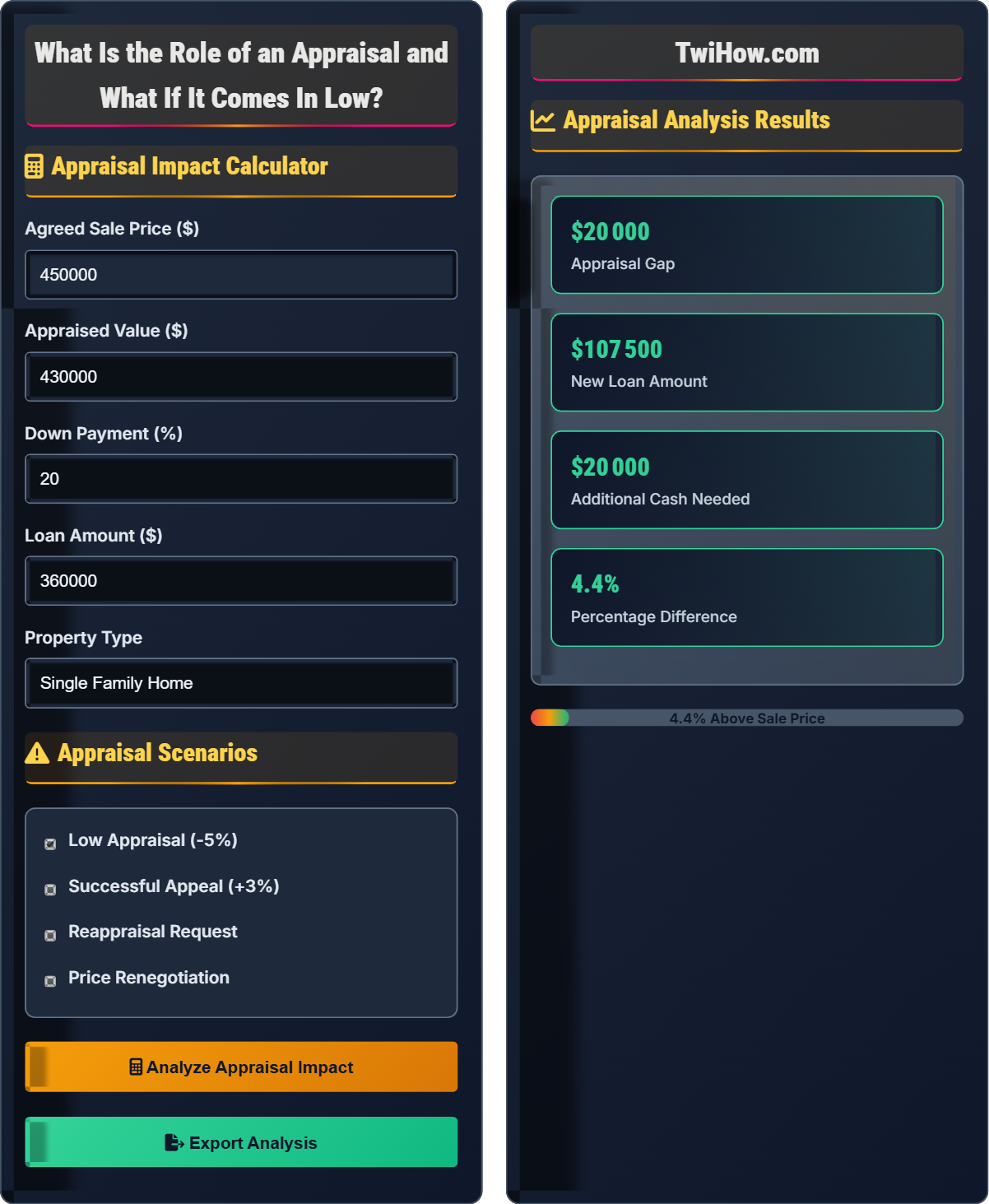
Appraisal Impact Calculator
Appraisal Scenarios
Appraisal Analysis Results
Step 1: Review appraisal report for errors or omissions
Step 2: Gather comparable sales data that supports higher value
Step 3: Submit formal appeal request with documentation
Step 4: Wait for lender review and potential second appraisal
Step 5: Receive revised appraisal or decision on original
Timeline: 1-3 weeks for review, additional time for new appraisal
Real Estate Appraisal Process Explained
Real estate appraisals serve as an independent assessment of property value to protect lenders from over-lending. The appraisal ensures the loan amount is appropriate for the property's actual market value. Appraisals are ordered by the lender and conducted by licensed professionals who have no stake in the transaction outcome.
Key Purposes:
- Protect Lenders: Ensure loan amount doesn't exceed property value
- Verify Value: Confirm purchase price aligns with market value
- Secure Investment: Protect the lender's collateral
- Regulatory Compliance: Meet federal and state requirements
Appraisers use multiple approaches to determine value:
Primary Methods:
- Sales Comparison: Analysis of similar properties sold recently
- Cost Approach: Replacement cost minus depreciation
- Income Approach: Potential rental income (for investment properties)
When an appraisal comes in low, several options are available:
- Negotiate Price: Buyer and seller agree to lower purchase price
- Pay the Difference: Buyer pays the gap in cash
- Appeal Appraisal: Challenge the appraisal with additional evidence
- Cancel Transaction: Exercise appraisal contingency clause
- Seek Alternative Financing: Explore different loan options
- Comparable Sales: Recent sales of similar properties in the area
- Property Condition: Age, maintenance, and needed repairs
- Location: Neighborhood desirability and amenities
- Market Conditions: Supply and demand in the area
- Property Features: Size, layout, and unique characteristics
Appraisal Essentials
Appraisal, comparable sales, market value, loan-to-value ratio, appraisal contingency, licensed appraiser.
Property Value = Median of Comparable Sales ± Adjustments for Differences
Where adjustments account for size, condition, location, and features.
- Appraisals are ordered by the lender, not the buyer
- Appraisers must be licensed and independent
- Loan amount cannot exceed appraised value
Appraisal Timeline
Low appraisals can significantly impact buyers and sellers. For buyers, it may require additional cash or renegotiation. For sellers, it might mean accepting a lower price or potentially losing the sale. The financial impact depends on the gap between sale price and appraised value.
Appraisal Process Quiz
What is the primary purpose of a real estate appraisal?
The primary purpose of a real estate appraisal is to protect the lender by ensuring the loan amount is appropriate for the property's actual market value. The appraisal serves as an independent assessment to confirm that the property can serve as adequate collateral for the loan amount. If the appraisal comes in low, the lender won't loan more than the appraised value, protecting them from over-lending.
The answer is B) To protect the lender by ensuring the loan amount is appropriate for the property value.
Understanding the lender's perspective is crucial for real estate transactions. Appraisals are ordered by lenders to protect their investment, not to benefit buyers or sellers directly. This protection mechanism ensures that if a borrower defaults, the property can be sold to recover the loan amount. The appraisal process is a safeguard in the lending system.
Appraisal: Professional assessment of property value
Collateral: Asset pledged as security for a loan
Market Value: Price property would sell for in open market
• Appraisals protect lenders, not buyers/sellers
• Loan amount cannot exceed appraised value
• Appraisers must be independent
• Research comparable sales before contract
• Understand appraisal contingency
• Budget for potential appraisal gap
• Confusing appraised value with purchase price
• Not understanding contingency options
• Assuming appraisal will match sale price
Explain the options available when a home appraisal comes in below the agreed purchase price, and discuss the pros and cons of each option.
Options for Low Appraisal:
1. Renegotiate Price:
Pros: Maintains original loan terms, both parties share the burden
Cons: Seller may be unwilling to lower price, transaction may fall apart
2. Pay the Difference:
Pros: Keeps original purchase price, transaction continues
Cons: Buyer needs additional cash, reduces equity
3. Appeal Appraisal:
Pros: May result in higher value, no immediate cash needed
Cons: Time-consuming, no guarantee of success, may still face gap
4. Cancel Transaction:
Pros: No financial penalty if contingency exists, opportunity to find better deal
Cons: Lose time and effort invested, may miss out on property
5. Increase Down Payment:
Pros: Maintains purchase price, may still get loan
Cons: Requires additional cash, reduces liquidity
Low appraisals create challenging situations that require careful consideration of all options. The best choice depends on market conditions, the size of the gap, financial resources, and both parties' motivation to complete the transaction. Understanding these options helps buyers and sellers make informed decisions during difficult moments.
Appraisal Gap: Difference between sale price and appraised value
Contingency Clause: Contract provision allowing cancellation
Loan-to-Value Ratio: Percentage of loan relative to property value
• Loan amount cannot exceed appraised value
• Appraisal contingency provides protection
• Both parties must agree to price changes
• Negotiate contingency clauses carefully
• Research comps thoroughly before offering
• Have backup plans ready
• Not having contingency protection
• Overbidding without appraisal risk consideration
• Panicking without exploring all options
Tom and Jane agreed to purchase a home for $500,000 with a 20% down payment. The home appraised for $475,000. Their lender requires a maximum loan-to-value ratio of 80%. Calculate the appraisal gap, the maximum loan amount, and the additional cash they would need to bring to closing to maintain their original loan terms.
Step 1: Calculate Appraisal Gap
Gap = Sale Price - Appraised Value = $500,000 - $475,000 = $25,000
Step 2: Calculate Maximum Loan Amount
Maximum Loan = Appraised Value × Loan-to-Value Ratio = $475,000 × 0.80 = $380,000
Step 3: Calculate Original Loan Amount
Original Loan = Sale Price × Loan-to-Value Ratio = $500,000 × 0.80 = $400,000
Step 4: Calculate Additional Cash Needed
Additional Cash = Original Loan - Maximum Loan = $400,000 - $380,000 = $20,000
Alternatively: Additional Cash = Gap × Loan-to-Value Ratio = $25,000 × 0.80 = $20,000
Tom and Jane would need an additional $20,000 in cash to maintain their original loan terms.
The loan-to-value ratio directly affects how much additional cash is needed when an appraisal comes in low. The larger the gap and the higher the LTV ratio, the more cash the buyer needs to bring. This calculation is essential for buyers to understand their financial exposure in case of a low appraisal.
Loan-to-Value (LTV): Percentage of loan relative to property value
Appraisal Gap: Difference between sale price and appraised value
Down Payment: Initial payment toward purchase price
• Loan amount based on appraised value, not sale price
• LTV ratio limits maximum loan amount
• Gap affects required cash contribution
• Calculate potential gap before contract
• Budget for worst-case scenario
• Understand LTV requirements
• Not accounting for LTV ratio impact
• Forgetting to budget for gap
• Assuming loan will be based on sale price
Sarah's home appraised for $380,000, which is $20,000 below the $400,000 purchase price. She believes the appraisal is incorrect because the appraiser used outdated comparable sales. What steps should Sarah take to appeal the appraisal, and what evidence would strengthen her case?
Steps to Appeal Appraisal:
1. Review Appraisal Report: Carefully examine the report for errors, omissions, or outdated information
2. Gather Evidence: Collect recent comparable sales that better reflect current market conditions
3. Document Property Features: Provide photos and documentation of unique features not properly accounted for
4. Submit Formal Appeal: Work with your lender to submit a formal request for review
5. Present Case: Provide a detailed argument with supporting evidence
6. Wait for Decision: Allow time for lender review and potential second appraisal
Strengthening Evidence:
• Recent comparable sales within last 6 months
• Sales of similar properties in same neighborhood
• Photos showing property condition and upgrades
• Documentation of unique features or improvements
• Professional appraisal if needed
Successful appraisal appeals require strong evidence and proper procedure. The key is demonstrating that the original appraisal was based on incorrect or outdated information. Recent comparable sales data is often the most persuasive evidence, as it reflects current market conditions more accurately than older sales.
Comparable Sales: Recent sales of similar properties
Appraisal Appeal: Formal request to review appraisal value
Supporting Evidence: Documentation supporting higher value
• Submit appeal promptly after receiving appraisal
• Provide strong comparable evidence
• Follow lender's procedures exactly
• Research recent sales before contract
• Document property features
• Work with experienced real estate team
• Missing appeal deadlines
• Weak comparable evidence
• Not following proper procedures
Who typically orders a real estate appraisal?
The lender typically orders the real estate appraisal to ensure independence and objectivity. This protects the lender's interest by ensuring the appraiser has no financial incentive to inflate or deflate the property value. The appraiser works for the lender, not the buyer or seller, maintaining neutrality in the transaction. The buyer usually pays for the appraisal as part of closing costs.
The answer is C) The lender.
Appraiser independence is crucial for the integrity of the lending process. When the lender orders the appraisal, it ensures the appraiser remains neutral and focused on accurate valuation rather than satisfying either party's desires. This independence protects both the lender's investment and the overall financial system.
Appraiser Independence: Appraiser has no financial stake in transaction
Lender Interest: Protecting loan collateral value
Neutrality: Objective assessment without bias
• Lenders order appraisals for independence
• Appraisers must remain neutral
• Buyers pay for appraisal costs
• Understand appraisal costs are buyer responsibility
• Recognize lender's perspective
• Prepare for potential outcomes
• Expecting appraiser to favor buyer or seller
• Not understanding who pays for appraisal
• Confusing appraiser with inspector
FAQ
Q: How long does the appraisal process typically take?
A: The appraisal process typically takes 7-14 days from order to completion. The timeline includes:
1. Order Processing: 1-2 days for lender to assign appraiser
2. Inspection: 3-7 days for appraiser to inspect property
3. Report Writing: 2-5 days for appraiser to complete report
4. Delivery: 1-2 days for report to reach lender
During busy periods, the process may take longer. Some lenders offer expedited services for additional fees.
Q: Can I influence the appraisal value by making improvements before the inspection?
A: Minor improvements before appraisal inspection can potentially influence value, but the impact is limited:
Positive Impact: Fresh paint, minor repairs, cleaning, and staging can make a good impression
Limitations: Appraisers focus on permanent improvements and structural elements
Major Changes: Significant improvements like additions or major renovations typically don't affect current appraisal
Documentation: Improvements should be documented and disclosed to appraiser
While presentation matters, appraisers primarily rely on comparable sales and measurable property characteristics.
Q: What happens if I get multiple low appraisals?
A: Multiple low appraisals suggest the property may genuinely be overpriced or have issues affecting value:
1. Market Reality: The property may be priced above current market value
2. Property Issues: Structural, location, or condition problems may be affecting value
3. Comparable Issues: Difficulty finding appropriate comparable sales in the area
4. Options: Renegotiate price, cancel contract, or bring additional cash
At this point, it's important to reassess the purchase decision based on current market conditions and property value.