Building Real Estate Portfolio with Limited Capital
Complete guide to portfolio building • Step-by-step explanations
Portfolio Building:
Show Portfolio CalculatorBuilding a real estate investment portfolio with limited capital requires strategic thinking, creative financing, and patient growth. Success comes from leveraging various strategies to maximize returns while minimizing initial investment requirements.
Key strategies include:
- Partnerships: Pooling resources with other investors
- Financing Options: Creative financing and leverage strategies
- Property Selection: Finding value-add opportunities
- Phased Growth: Gradual portfolio expansion
- Reinvestment: Compounding returns through reinvestment
With proper planning and execution, even small investors can build substantial real estate portfolios over time.
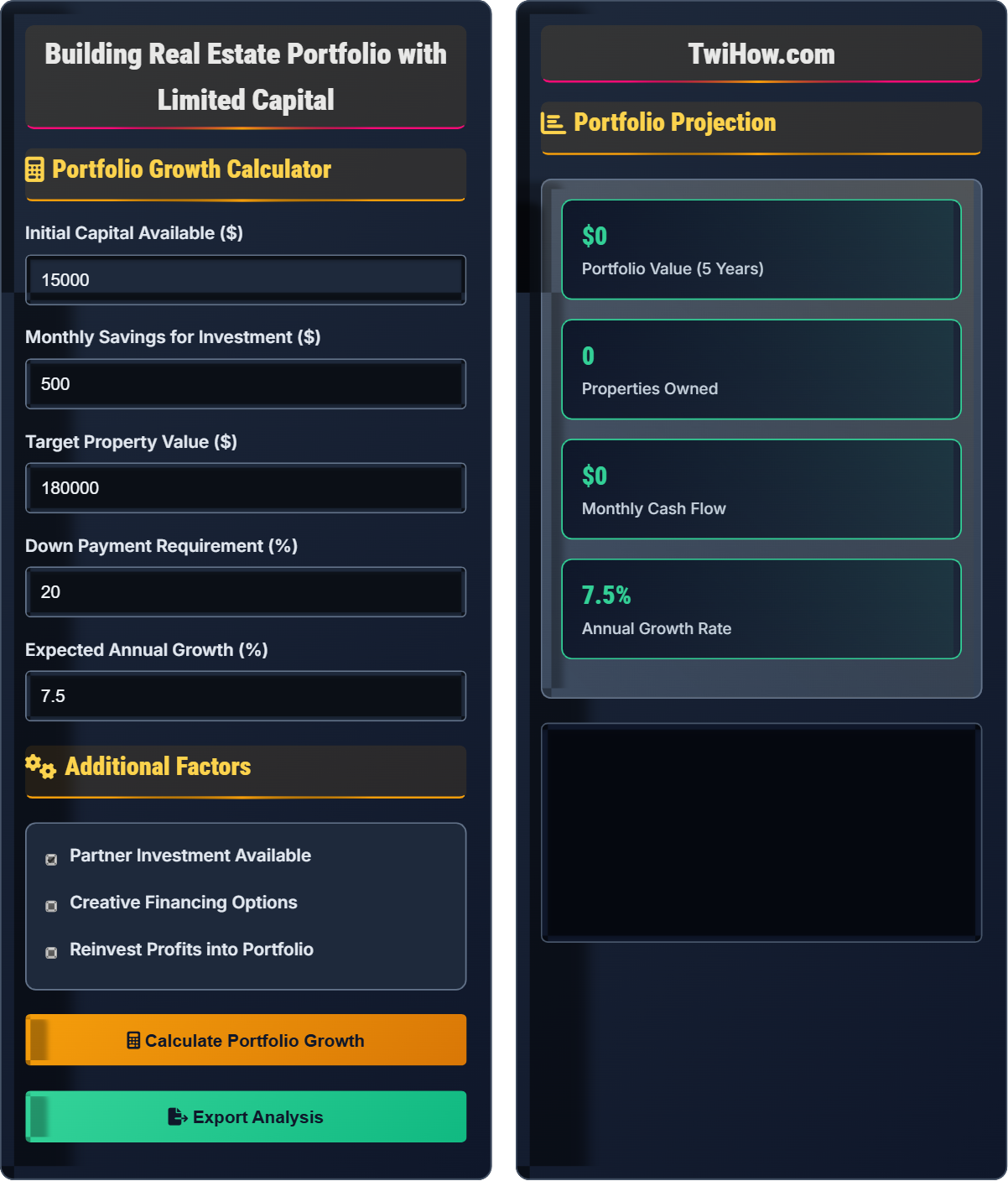
Portfolio Growth Calculator
Additional Factors
Portfolio Projection
| Year | Portfolio Value | Properties |
|---|---|---|
| 1 | $18,000 | 1 |
| 2 | $25,000 | 1 |
| 3 | $32,500 | 2 |
| 4 | $40,000 | 2 |
| 5 | $45,000 | 3 |
Recommended Strategy
- Start with small property in growing area
- Reinvest rental income into next property
- Consider partnerships for larger purchases
- Use creative financing when possible
Understanding Limited Capital Portfolio Building
Building a real estate portfolio with limited capital involves using creative strategies, partnerships, and gradual growth to accumulate properties over time. This approach focuses on maximizing leverage and returns while minimizing initial investment requirements.
Key principles include:
- Start Small: Begin with one property and grow systematically
- Leverage Partnerships: Pool resources with other investors
- Creative Financing: Utilize non-traditional funding methods
- Value-Add Focus: Target properties with improvement potential
- Reinvestment: Use cash flow to fund additional investments
Several strategies can help build capital for real estate investment:
Building a portfolio with limited capital requires careful attention to:
- Market Selection: Choose areas with strong growth potential
- Property Type: Focus on properties with positive cash flow
- Financing: Maintain good credit for future loans
- Management: Develop property management skills or systems
- Patience: Allow time for gradual portfolio growth
Managing risk is crucial when building with limited capital:
- Maintain adequate reserves for unexpected expenses
- Start with properties in familiar markets
- Focus on properties with strong rental demand
- Don't over-leverage early in the process
- Build a network of professionals and mentors
Capital Building Strategies
Partnerships, creative financing, value-add opportunities, phased growth, reinvestment.
Portfolio Growth = (Monthly Savings + Rental Income + Appreciation) × Time × Leverage Factor
Where leverage factor represents the multiplier effect of financing.
- Start with one property and grow systematically
- Maintain 6-month emergency reserves
- Focus on positive cash flow properties
Growth Strategy
Initial property acquisition, cash flow generation, reinvestment, portfolio expansion.
- Acquire first property with available capital
- Generate positive cash flow
- Save cash flow for next down payment
- Acquire second property
- Continue compounding returns
- Patience is key to sustainable growth
- Quality over quantity in early stages
- Maintain good credit for future financing
- Focus on cash flow positive properties
Portfolio Building Quiz
What is the most effective way to build capital for real estate investment with limited initial funds?
The most effective approach is to start with one property and reinvest returns. This allows for gradual portfolio growth while learning the business. Starting small reduces risk and allows for mistakes to be corrected without major consequences.
The answer is B) Start with one property and reinvest returns.
Compounding returns through reinvestment is the foundation of wealth building. Starting with one property allows investors to learn the business while generating returns that can fund future acquisitions.
Compounding: Earning returns on previous returns
Reinvestment: Using returns to fund additional investments
Phased Growth: Gradual portfolio expansion over time
• Start small and grow systematically
• Reinvest returns for compounding
• Learn from each investment
• Focus on cash flow positive properties
• Build an emergency fund
• Maintain good credit
• Trying to start too big
• Not reinvesting returns
• Over-leveraging early
Explain the benefits and risks of partnerships in real estate investing when starting with limited capital.
Benefits of Partnerships:
Increased Capital: Pooling resources allows for larger investments and more properties.
Risk Sharing: Distribute financial and operational risks among partners.
Complementary Skills: Combine different expertise (finance, renovation, management).
Shared Responsibilities: Divide management and operational duties.
Risks of Partnerships:
Conflict Potential: Disagreements over strategy, management, or distributions.
Reduced Control: Must agree on decisions with other partners.
Financial Entanglement: Partners' financial situations may affect the partnership.
Legal Complexity: Requires proper agreements and legal structures.
Partnerships can be powerful tools when structured properly with clear agreements and aligned goals.
Partnerships allow investors to overcome capital limitations by combining resources. Success depends on selecting compatible partners with complementary skills and clear legal agreements.
Partnership: Joint venture between two or more investors
Risk Sharing: Distributing investment risks among parties
Complementary Skills: Different expertise contributing to success
• Establish clear agreements upfront
• Choose partners with aligned goals
• Define roles and responsibilities
• Start with small partnership deals
• Use legal counsel for agreements
• Document all decisions
• Not having written agreements
• Partnering with friends without legal structure
• Not defining exit strategies
Mark has $20,000 in savings and wants to start building a real estate portfolio. He's considering either buying a $200,000 property with 10% down ($20,000) or partnering with a friend who has $30,000 to buy a $250,000 property with 20% down ($50,000). The friend would own 60% and Mark would own 40%. Which option is better for Mark's portfolio growth?
Option 1 Analysis:
• Purchase Price: $200,000
• Down Payment: $20,000 (100% of Mark's capital)
• Mortgage: $180,000
• Monthly Payment: ~$1,000 (estimated)
• Monthly Rent: $1,800 (estimated)
• Monthly Cash Flow: $800 (after expenses)
Option 2 Analysis:
• Purchase Price: $250,000
• Mark's Share: 40% = $100,000
• Mark's Down Payment: $20,000 (same as Option 1)
• Mark's Mortgage Share: $150,000 × 40% = $60,000
• Mark's Monthly Payment: ~$330
• Mark's Rent Share: $1,800 × 40% = $720
• Mark's Monthly Cash Flow: ~$390 (after expenses)
Recommendation: Option 1 is better for Mark's growth. While Option 2 gives him ownership in a larger property, Option 1 provides better cash flow ($800 vs $390) and allows him to maintain 100% ownership of the equity. The higher cash flow can be reinvested more quickly into additional properties.
This example demonstrates the importance of cash flow in portfolio building. While partnerships can allow access to larger properties, individual ownership of smaller, cash-flow-positive properties often provides better long-term growth potential through reinvestment.
Cash Flow: Income remaining after all expenses
Equity Ownership: Percentage of property value owned
Portfolio Growth: Gradual increase in investment holdings
• Focus on cash flow positive properties
• Consider total return, not just property size
• Plan for reinvestment opportunities
• Calculate cash flow per dollar invested
• Consider reinvestment potential
• Factor in management complexity
• Focusing only on property size
• Not calculating total returns
• Overlooking management complexity
How can creative financing options help investors with limited capital build their portfolio faster?
Creative Financing Options:
Owner Financing: Seller acts as bank, allowing lower down payment requirements.
Lease Options: Option to buy while renting, building equity before purchase.
Subject-to: Taking over existing mortgage, avoiding new loan requirements.
Hard Money Loans: Short-term financing for value-add properties.
Private Money: Individual investors providing financing.
Benefits of Creative Financing:
• Reduced down payment requirements
• Faster property acquisition
• Ability to purchase properties others can't finance
• Potential for better deals through seller motivation
Creative financing allows investors to overcome traditional lending barriers and build portfolios faster, though it may come with higher interest rates or shorter terms.
Creative financing expands investment opportunities by bypassing traditional lending requirements. This allows investors with limited capital to access properties that might otherwise be unavailable.
Creative Financing: Non-traditional funding methods
Owner Financing: Seller providing loan to buyer
Subject-to: Assuming existing loan obligation
• Understand all terms and risks
• Verify seller's authority
• Consider long-term financing plans
• Build relationships with creative lenders
• Understand due-on-sale clauses
• Plan exit strategies
• Not understanding financing terms
• Ignoring legal implications
• Failing to plan for refinancing
What is the most effective reinvestment strategy for portfolio growth?
Using cash flow to buy additional properties is the most effective strategy for portfolio growth. This creates a compounding effect where each property generates income that funds the next purchase, accelerating portfolio expansion.
The answer is B) Use cash flow to buy additional properties.
Reinvestment creates exponential growth through compounding. Each property acquired with cash flow generates additional income that can fund the next property, creating a self-accelerating growth cycle.
Reinvestment: Using returns to fund additional investments
Compounding: Earning returns on previous returns
Self-Funding: Portfolio growth through internal cash flow
• Reinvest cash flow for growth
• Maintain emergency reserves
• Balance growth with stability
• Track cash flow per property
• Set aside 20% for reserves
• Plan reinvestment timeline
• Not reinvesting returns
• Over-leveraging too quickly
• Failing to maintain reserves
Frequently Asked Questions
Q: How much capital do I need to start investing in real estate?
A: You can start with as little as $5,000-10,000, though $15,000-25,000 provides more options. The key is to:
Start Small: Focus on affordable properties in growing markets
Use Creative Financing: Consider partnerships, owner financing, or lease options
Build Reserves: Maintain 6 months of expenses for emergencies
Reinvest Returns: Use cash flow to fund additional properties
Many successful investors started with minimal capital and grew systematically through smart reinvestment.
Q: What are the best property types for beginners with limited capital?
A: Best property types for beginners:
Single-Family Homes: Easier to manage and finance
Small Multifamily: Duplexes and triplexes provide multiple income streams
Mobile Homes: Lower entry costs with potential for appreciation
Small Apartment Buildings: Once you have experience
Focus on properties that generate positive cash flow and are in growing markets with strong rental demand.
Q: How long does it typically take to build a substantial real estate portfolio?
A: Building a substantial portfolio typically takes 5-10 years:
Years 1-2: Acquire first 1-2 properties
Years 3-5: Expand to 3-5 properties using reinvestment
Years 6-10: Build to 10+ properties through compounding
Success depends on market conditions, financing availability, and reinvestment discipline. Patience and systematic growth are key to sustainable portfolio building.