How to Build a Team of Professionals for Real Estate Investing
Complete guide • Step-by-step explanations
Professional Team Building:
Show Team BuilderBuilding a professional team for real estate investing is crucial for success. A well-assembled team of agents, contractors, attorneys, and other specialists can help you identify opportunities, navigate legal complexities, manage properties effectively, and maximize returns. The right team members bring expertise, networks, and resources that complement your own skills.
Essential team members include:
- Real Estate Agent: Market knowledge and deal sourcing
- Contractors: Renovation and maintenance expertise
- Attorney: Legal guidance and contract review
- Accountant: Tax strategy and financial planning
- Property Manager: Day-to-day operations management
Building relationships with trusted professionals early in your investing journey will provide long-term benefits and competitive advantages.
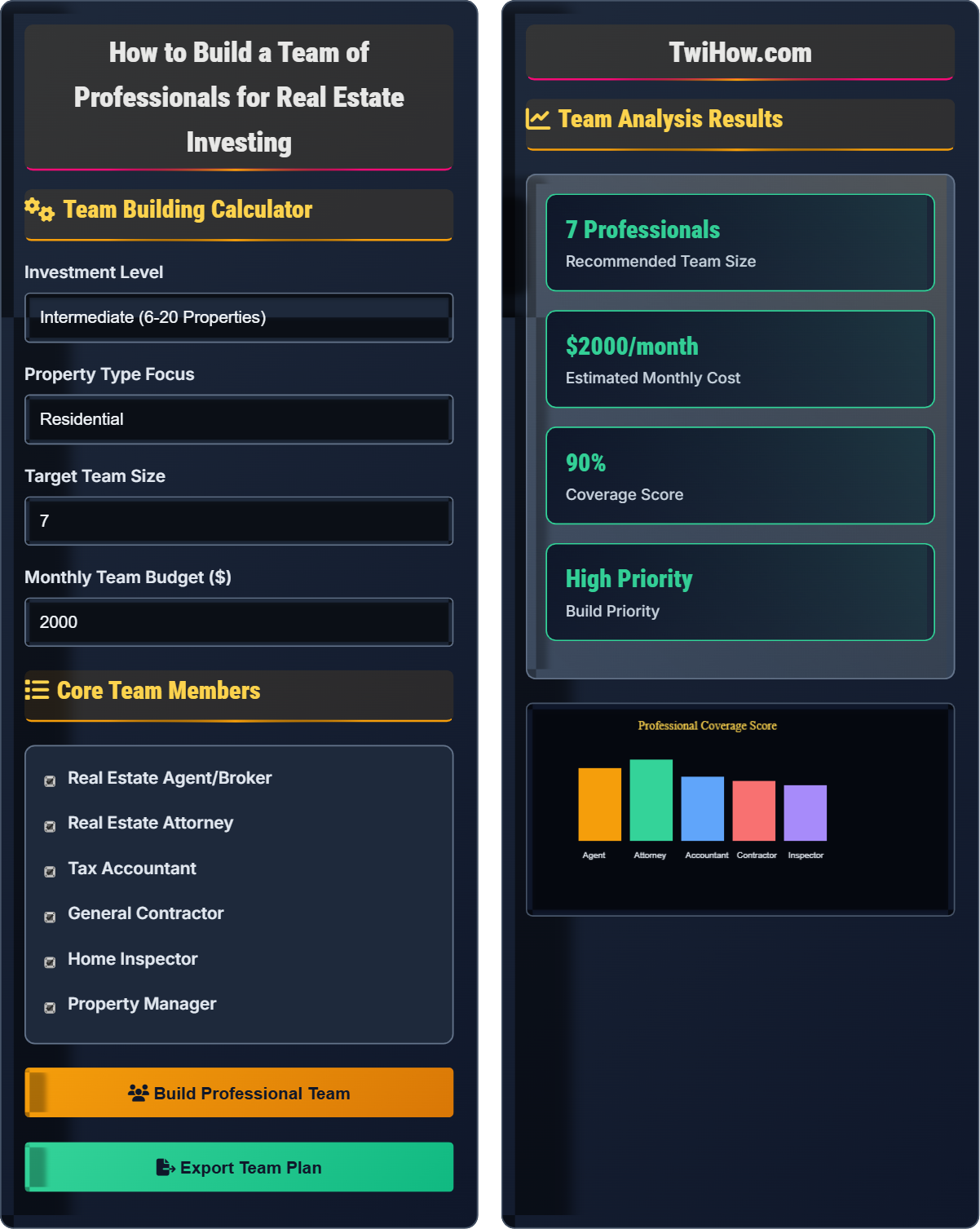
Team Building Calculator
Core Team Members
Team Analysis Results
| Role | Importance | Priority | Monthly Cost |
|---|---|---|---|
| Real Estate Agent | High | 1 | $300-500 |
| Real Estate Attorney | High | 2 | $200-400 |
| Tax Accountant | High | 3 | $150-300 |
| General Contractor | Medium | 4 | $200-600 |
| Home Inspector | Medium | 5 | $100-200 |
Real Estate Attorney: Essential for legal protection and contract review
Real Estate Agent: Critical for deal flow and market knowledge
Tax Accountant: Vital for tax optimization and compliance
General Contractor: Important for renovation projects
Property Manager: Needed for hands-off management
Home Inspector: Valuable for due diligence
Insurance Agent: Protection and coverage expertise
Appraiser: Valuation and financing support
Financing Specialist: Creative financing solutions
Building Your Professional Real Estate Team
Every real estate investor needs a core team of professionals to support their activities:
- Real Estate Agent/Broker: Provides market knowledge, deal flow, and negotiation expertise
- Real Estate Attorney: Handles contracts, legal issues, and due diligence
- Tax Accountant: Manages tax strategy, depreciation, and compliance
- General Contractor: Handles renovations, repairs, and maintenance
- Home Inspector: Conducts thorough property inspections for due diligence
- Property Manager: Manages day-to-day operations for rental properties
- Insurance Agent: Provides appropriate coverage for properties and investments
Investing in professional services should provide measurable returns:
For example, if a real estate attorney helps you avoid a $10,000 legal issue for a $1,000 retainer, the ROI is 900%. Similarly, a contractor who adds $20,000 in value for $15,000 in labor provides a 33% ROI.
Where:
- Value Added: Financial benefit from professional service
- Professional Costs: Fees and expenses paid to professional
- ROI: Return on investment percentage
Team size and specialization should match your investment scale:
- Beginner (1-5 Properties): Minimal team focusing on core roles (attorney, agent, accountant)
- Intermediate (6-20 Properties): Expanded team including contractors and property managers
- Advanced (20+ Properties): Full-service team with specialists and multiple providers
- Institutional (100+ Properties): Dedicated staff and external professional services
- Communication: Establish regular check-ins and clear communication channels
- Trust: Build relationships gradually and verify credentials thoroughly
- Reciprocity: Provide referrals and business to team members when appropriate
- Flexibility: Be prepared to adjust team composition as your needs evolve
- Backup Plans: Have secondary contacts for critical roles to avoid disruptions
Core Team Members
Real estate agent, attorney, accountant, contractor, inspector, property manager, insurance agent.
ROI = (Value Added - Professional Costs) / Professional Costs × 100
Where Value Added = Financial benefit from professional service, Professional Costs = Fees and expenses.
- Hire professionals before you need them
- Verify credentials and references
- Start with smaller engagements
- Establish clear expectations
Team Management
Communication protocols, performance evaluation, relationship maintenance, backup planning.
- Establish regular communication schedules
- Set clear performance metrics
- Provide feedback and recognition
- Address issues promptly
- Plan for contingencies
- Trust takes time to build
- Compatibility matters
- Cost vs. value trade-offs
- Availability during critical periods
Professional Team Building Quiz
When building a professional team as a beginner real estate investor, which professional should you prioritize first?
For a beginner investor, a real estate attorney should be prioritized first because they provide essential legal protection for all transactions. Without proper legal guidance, investors risk costly mistakes, contract issues, and compliance problems that could result in significant financial losses. While other professionals are important, the attorney provides foundational protection for all other investments.
The answer is B) Real Estate Attorney.
The priority of team members should align with the risks and legal requirements of your investment activities. Legal protection is fundamental to all real estate transactions, making the attorney the most critical first hire. This approach ensures that all subsequent professional relationships and transactions are properly structured and protected from the beginning.
Legal Protection: Safeguards against contractual and regulatory risks
Due Diligence: Thorough investigation of property and legal issues
Contract Review: Legal examination of transaction documents
• Legal protection comes first
• Establish foundations early
• Seek attorneys experienced in real estate
• Ask about flat-rate vs. hourly fees
• Establish retainer agreements
• Starting without legal representation
• Choosing cheapest option over qualified
• Delaying legal consultation
Explain the complete process for building a professional real estate team, including how to identify needs, research candidates, evaluate compatibility, and establish working relationships.
Step 1 - Needs Assessment: Identify your current skill gaps and anticipated needs based on your investment strategy. Consider factors like property types, geographic focus, and growth plans. Determine which professional services you'll need regularly versus occasional support.
Step 2 - Research and Networking: Seek recommendations from other investors, attend real estate meetups, join professional associations, and ask for referrals from existing team members. Research candidates' credentials, certifications, and reputation in the local market.
Step 3 - Evaluation Process: Interview multiple candidates for each role, checking references and verifying licenses. Assess communication style, availability, fee structures, and compatibility with your business approach. Consider scheduling trial projects for critical roles.
Step 4 - Relationship Establishment: Negotiate terms, establish expectations, and create formal agreements. Set up communication protocols and regular check-in schedules. Define scope of work, response times, and performance metrics.
Step 5 - Ongoing Management: Regularly evaluate performance, provide feedback, and adjust relationships as needed. Maintain backup contacts for critical roles and continuously expand your network of potential team members.
Building a professional team is a strategic process that requires careful planning and execution. The approach should be systematic, starting with self-assessment and ending with ongoing relationship management. Each step builds upon the previous one, creating a foundation for long-term success. The process emphasizes the importance of compatibility and trust in professional relationships.
Needs Assessment: Evaluation of required professional services
Networking: Building relationships within the industry
Performance Metrics: Standards for evaluating service quality
• Start with self-assessment
• Research thoroughly before hiring
• Test before committing long-term
• Join local real estate investor groups
• Ask for detailed proposals
• Establish retainer agreements
• Hiring too quickly without research
• Focusing only on price
• Not establishing clear expectations
A new investor plans to purchase 3-5 rental properties in the next year, focusing on single-family homes. They have $50,000 in capital and expect to keep monthly expenses under $2,000. They want to build a team that covers legal protection, property management, and maintenance. Calculate the recommended team size and monthly costs, then explain the hiring priority and why.
Recommended Team Size: 4-5 professionals
Monthly Cost Estimate:
- Real Estate Attorney: $200-400 (flat retainer for multiple transactions)
- Tax Accountant: $150-300 (quarterly reviews and annual filing)
- Property Manager: $600-1,200 (8-10% of monthly rent collected)
- General Contractor: $200-600 (as-needed basis)
- Insurance Agent: $50-100 (annual policy review)
Total Monthly Range: $1,200-$2,600
Hiring Priority:
1. Real Estate Attorney: Essential for all transactions, legal protection
2. Tax Accountant: Critical for tax strategy and compliance
3. Insurance Agent: Required before closing, ongoing coverage needs
4. Property Manager: Needed after acquiring rental properties
5. General Contractor: Required for renovations and ongoing maintenance
Justification: The attorney and accountant provide foundational services for all transactions. Insurance is mandatory before closing. Property management becomes critical after acquisition, and contractors are needed for maintenance and improvements. This sequence ensures legal compliance and protection while managing costs effectively.
This scenario demonstrates how to match team composition to investment scale and strategy. The approach considers both immediate needs (transactions) and ongoing requirements (management). The priority sequence ensures that critical legal and financial protections are established before proceeding with acquisitions. The cost analysis helps ensure that professional expenses align with budget constraints while providing comprehensive coverage.
Foundational Services: Essential professionals for all transactions
Ongoing Requirements: Professionals needed after acquisition
Budget Alignment: Matching costs to available capital
• Establish legal protection first
• Match team to investment strategy
• Consider both immediate and ongoing needs
• Negotiate package deals for multiple services
• Consider flat-fee arrangements
• Plan for seasonal expense variations
• Underestimating professional service costs
• Delaying critical professional hires
• Not budgeting for ongoing professional fees
You have been working with a property manager for 6 months who has handled 4 properties for you. They charge 10% of monthly rent plus $100 per repair over $300. Average monthly rent is $1,500, and you've had 2 repairs requiring their coordination. Evaluate their performance and determine if they provide good value. Should you continue the relationship or seek alternatives?
Cost Analysis:
Monthly management fees: $1,500 × 10% = $150 per property
For 4 properties: $150 × 4 = $600 per month
Repair coordination: 2 repairs × $100 = $200 total
Total 6-month cost: ($600 × 6) + $200 = $3,800
Value Assessment:
Benefits provided:
- Tenant screening and placement
- Rent collection and accounting
- Maintenance coordination
- Emergency response
- Property inspections
Performance Evaluation:
Consider factors: Response time to issues, tenant retention rates, maintenance quality, communication frequency, financial reporting accuracy, and property condition.
Alternative Analysis:
Typical management fees range from 8-12% of monthly rent. The 10% fee is within normal range, but the $100 repair coordination fee is above average. Consider negotiating terms or finding alternatives if performance doesn't justify the cost.
Recommendation: Continue the relationship if performance meets expectations, but negotiate the repair coordination fee or cap it at a reasonable amount. If performance is subpar, begin searching for alternatives while maintaining the current relationship until replacement is secured.
This problem demonstrates the importance of ongoing team member evaluation. The analysis combines quantitative cost-benefit assessment with qualitative performance evaluation. The approach considers both the explicit costs and the value provided by professional services. Regular evaluation ensures that professional relationships remain beneficial and aligned with your investment goals.
Performance Evaluation: Assessment of service quality and value
Cost-Benefit Analysis: Quantitative assessment of value received
Relationship Continuity: Maintaining service during transitions
• Regular performance reviews
• Compare costs to market rates
• Consider both quantitative and qualitative factors
• Establish performance metrics upfront
• Document all interactions and results
• Maintain backup providers for critical roles
• Not tracking professional service costs
• Failing to evaluate performance regularly
• Staying with poor performers too long
What is the most important factor when evaluating compatibility with a potential team member?
Communication style and responsiveness are the most critical factors for team compatibility. Even the most experienced professional is ineffective if they don't communicate well or respond promptly to your needs. Good communication ensures that expectations are clear, issues are addressed quickly, and information flows smoothly between team members. Poor communication can lead to missed opportunities, delayed transactions, and costly mistakes.
The answer is B) Communication style and responsiveness.
While experience and fees are important considerations, communication forms the foundation of all professional relationships. Effective communication ensures that all team members are aligned on goals, timelines, and expectations. It enables quick problem-solving and prevents misunderstandings that could be costly in real estate transactions. The quality of communication often determines the overall success of professional relationships.
Communication Style: How information is conveyed and received
Responsiveness: Speed and quality of response to inquiries
Team Compatibility: How well professionals work together
• Communication is foundational
• Test responsiveness during interviews
• Establish communication protocols early
• Ask for communication preferences upfront
• Test response time during initial contact
• Establish emergency contact procedures
• Focusing only on price
• Not testing communication during interviews
• Assuming good communication exists without verification
FAQ
Q: How do I find reliable professionals in my local market?
A: Start by networking with other local investors through real estate investment groups, meetups, and online forums. Ask for specific referrals and reasons why people recommend particular professionals. Check online reviews, but also verify credentials directly with licensing boards. Interview multiple candidates for each role and ask for references from recent clients. Consider reaching out to professionals who serve investors in adjacent markets or similar investment strategies. Local real estate brokerages, title companies, and banks often have extensive networks of trusted professionals.
Q: How often should I evaluate and potentially replace team members?
A: Conduct formal evaluations annually and informal assessments quarterly. Review performance metrics, cost-effectiveness, and service quality regularly. Replace team members when they fail to meet agreed-upon standards, become unreliable, or when you find significantly better alternatives. However, maintain stable relationships with proven performers. Consider that building new professional relationships takes time, so don't change unnecessarily. For critical roles like attorneys and accountants, aim for longer-term relationships (3-5 years minimum) unless there are compelling reasons to change.