How to Evaluate Economic Cycles Impact on Real Estate Values
Real estate investing guide • Economic indicators • Market analysis
Economic Cycles & Real Estate:
Show Economic Cycle SimulatorEconomic cycles significantly influence real estate values through various channels including interest rates, employment levels, inflation, consumer confidence, and credit availability. Understanding these relationships is crucial for real estate investors to make informed decisions.
Key economic factors affecting real estate:
- Interest Rates: Higher rates reduce affordability and demand
- Employment Levels: Job growth drives housing demand
- Inflation: Affects construction costs and rental income
- Consumer Confidence: Influences buying behavior
- Credit Availability: Determines financing accessibility
During expansion periods, real estate values typically rise due to increased demand and economic optimism. During recessions, values often decline due to reduced demand and tighter lending standards.
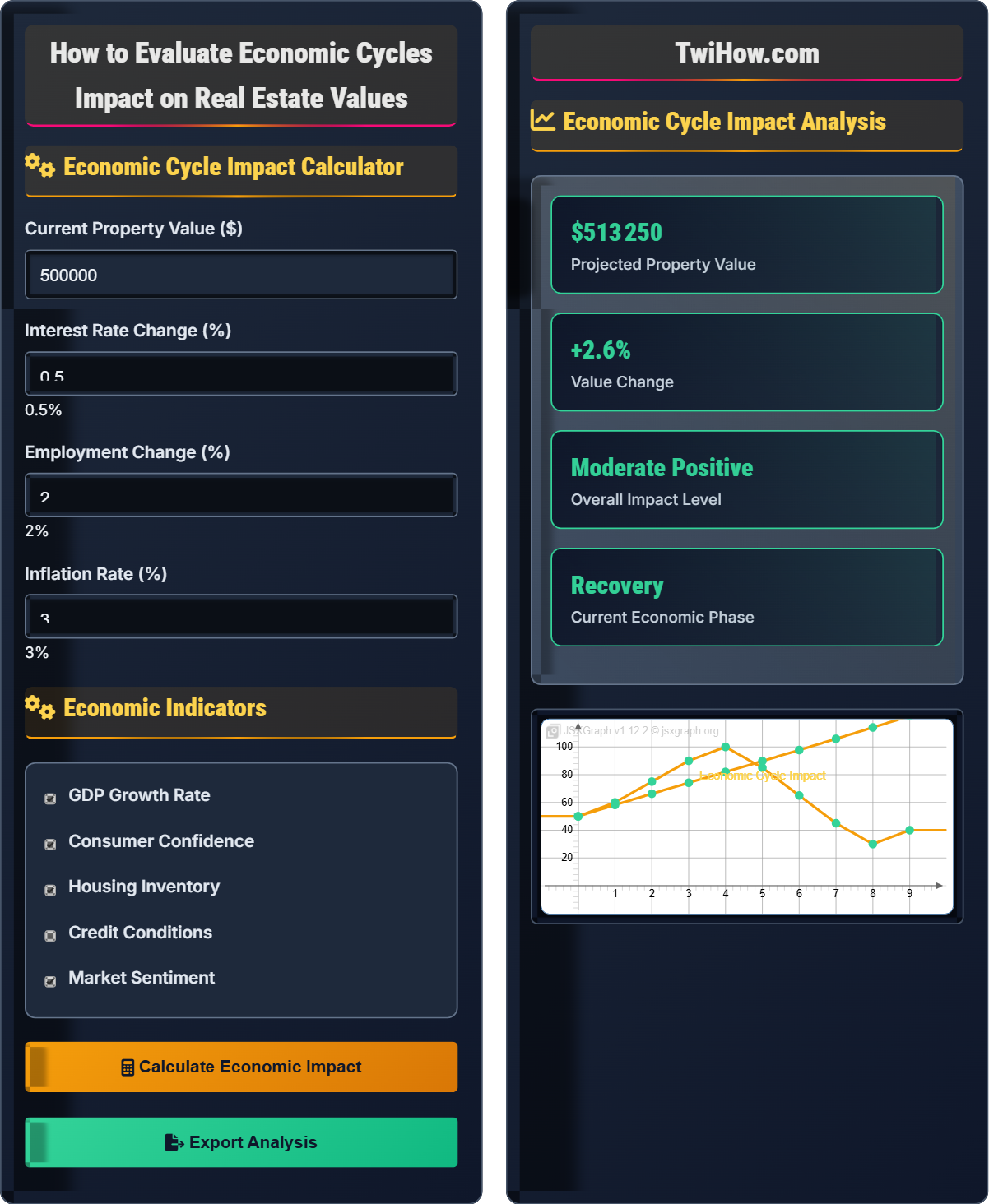
Economic Cycle Impact Calculator
Economic Indicators
Economic Cycle Impact Analysis
| Factor | Change | Impact on Value | Weight |
|---|---|---|---|
| Interest Rates | +0.5% | -2.5% | 30% |
| Employment | +2% | +4.0% | 25% |
| Inflation | 3% | +1.5% | 20% |
| GDP Growth | +2.5% | +3.0% | 15% |
| Consumer Confidence | +5% | +1.5% | 10% |
Economic Cycles Impact on Real Estate
Economic cycles are recurring periods of expansion and contraction in economic activity. These cycles significantly impact real estate values through multiple channels including interest rates, employment levels, consumer confidence, and credit availability. Understanding these relationships is essential for real estate investors to make informed decisions.
The impact of economic cycles on real estate values can be estimated by:
Where:
- Factor Impact: Effect of each economic indicator on property values
- Weight: Relative importance of each factor
- Sum: Combined effect on property values
Key phases and their real estate impacts:
- Expansion: Rising employment, falling interest rates, increasing values
- Peak: Maximum economic activity, potential overheating risks
- Contraction/Recession: Falling employment, rising rates, declining values
- Trough: Lowest economic activity, potential buying opportunity
- Expansion Phase: Buy before peak, focus on appreciation potential
- Peak Phase: Exercise caution, consider selling appreciated assets
- Contraction Phase: Wait for opportunities, focus on cash flow
- Recovery Phase: Early buying opportunities, prepare for growth
- Long-term: Diversify across cycles and property types
Economic Fundamentals
Interest rates, employment levels, inflation, consumer confidence, GDP growth.
Value Change = Σ(Factor Impact × Weight)
Where Value Change = property value fluctuation, Factor Impact = individual effect.
- Interest rates inversely affect real estate demand
- Employment growth drives housing demand
- Inflation affects construction costs and rents
Analysis Framework
Indicator monitoring, correlation analysis, weighting, scenario planning.
- Monitor key economic indicators
- Analyze historical correlations
- Weight factors by importance
- Project value changes
- Local market variations
- Property type sensitivity
- Timing of economic shifts
- Lag effects in real estate
Economic Cycles Learning Quiz
How do rising interest rates typically affect real estate values during an economic expansion?
Rising interest rates increase the cost of borrowing, making mortgages more expensive and reducing purchasing power. This decreases demand for real estate, leading to lower values regardless of the economic expansion phase. Higher borrowing costs reduce the number of qualified buyers and decrease their purchasing capacity.
The answer is B) Decrease values due to higher borrowing costs.
Interest rates have an inverse relationship with real estate demand. When rates rise, monthly mortgage payments increase for the same loan amount, making homes less affordable. This reduces the pool of potential buyers and can cause prices to decline. Even during economic expansions, rising rates can counteract positive economic factors and put downward pressure on real estate values.
Interest Rates: Cost of borrowing money, affecting mortgage affordability
Real Estate Demand: Number of buyers seeking to purchase properties
Purchasing Power: Amount of property a buyer can afford given their budget
• Interest rates inversely affect real estate demand
• Higher rates reduce affordability
• Borrowing costs impact purchase decisions
• Monitor Federal Reserve policy changes
• Consider rate-lock strategies for purchases
• Factor rates into investment calculations
• Assuming economic expansion always increases values
• Ignoring interest rate impacts during growth periods
• Not considering borrowing costs in analysis
Explain how to quantify the impact of employment changes on real estate values. Include the formula and explain each component.
Employment Impact Formula: Value Impact = Employment Change × Elasticity Coefficient × Base Value
Components:
Employment Change: Percentage point change in employment rate (e.g., from 4% to 6% = +2 percentage points)
Elasticity Coefficient: Estimated relationship between employment and real estate demand (typically ranges from 0.5 to 1.5)
Base Value: Current property value used as reference point
Example: If employment increases by 2%, elasticity is 1.0, and property value is $500,000, then value impact = 2% × 1.0 × $500,000 = $10,000 increase.
The relationship between employment and real estate values is quantified through elasticity coefficients that represent how responsive property demand is to employment changes. Employment growth increases household formation and purchasing power, driving demand for housing. The elasticity coefficient captures the strength of this relationship, which can vary by location, property type, and market conditions.
Elasticity Coefficient: Measure of responsiveness between two variables
Household Formation: Creation of new households driving housing demand
Purchasing Power: Financial capacity to buy property
• Employment directly affects housing demand
• Elasticity varies by market conditions
• Consider lag effects in employment impact
• Monitor job creation reports
• Track employment by sector
• Consider wage growth alongside employment
• Using static elasticity coefficients
• Ignoring wage growth effects
• Not considering sector diversity
You own a portfolio of rental properties in a city experiencing a recession with 15% unemployment, rising interest rates to 8%, and negative GDP growth. The local real estate market has declined 20% in the past year. How would you assess the economic cycle impact on your portfolio and develop a strategic response?
Assessment: The combination of high unemployment (15%), elevated interest rates (8%), and negative GDP growth indicates a severe recession. The 20% market decline reflects reduced demand due to job losses, higher borrowing costs, and reduced consumer confidence.
Portfolio Impact: Rental properties face dual challenges: reduced tenant demand and potential rent defaults. Property values likely declining, but rental income may provide stability if tenants remain employed.
Strategic Response: Focus on cash flow preservation by maintaining occupancy rates, offering flexible lease terms, and targeting essential workers. Consider refinancing existing loans before rates rise further. Postpone major capital expenditures and evaluate which properties to hold vs. sell.
Opportunity Planning: Begin identifying potential buying opportunities at later stages of the downturn when values reach attractive levels.
During recessions, multiple economic factors work together to depress real estate values. The severity of the recession (indicated by high unemployment) suggests a prolonged recovery period. Rental properties offer some protection through steady income streams, but tenant quality becomes critical. Successful navigation requires balancing immediate cash flow needs with longer-term positioning for recovery.
Recession: Significant decline in economic activity lasting several months
Employment Elasticity: Responsiveness of real estate demand to job changes
Cash Flow Preservation: Maintaining positive income streams
• Multiple factors compound recession effects
• Focus on cash flow during downturns
• Plan for recovery opportunities
• Maintain strong tenant screening
• Build emergency reserves
• Monitor market bottoms
• Selling during market bottoms
• Not adjusting tenant criteria
• Overleveraging during downturns
You're considering purchasing a commercial property during an economic expansion with 3.5% GDP growth, 4% unemployment, and 4% interest rates. However, leading economic indicators suggest the expansion may be approaching its peak. How would you evaluate the timing and determine your investment strategy?
Timing Assessment: With low unemployment (4%) and moderate interest rates (4%), the economy appears healthy. However, if leading indicators suggest peak conditions, property values may be near their high point for this cycle.
Strategy Options: Consider a balanced approach: proceed with purchase if the property meets long-term investment criteria but at a price that allows for some downside protection. Alternatively, wait for early signs of the next downturn to potentially acquire at better prices.
Due Diligence: Focus on properties with strong fundamentals (quality tenants, good locations, stable cash flows) that can weather a potential downturn. Evaluate sensitivity to rising rates and economic slowdown.
Risk Management: Structure financing to handle potential rate increases and maintain adequate reserves for possible vacancies during a downturn.
Timing investments at cycle peaks requires balancing FOMO (fear of missing out) with risk management. Properties purchased at peak valuations face the risk of decline during the next downturn. However, well-selected properties with strong fundamentals can still provide returns even if purchased near peak values. The key is ensuring the investment thesis remains valid under various economic scenarios.
Leading Indicators: Economic measures that predict future changes
Peak Conditions: Maximum point in economic expansion
Downside Protection: Investment structure to limit losses
• Consider cycle position in investment decisions
• Focus on property fundamentals
• Plan for potential downturns
• Monitor yield curves and consumer sentiment
• Consider longer-term holding periods
• Evaluate financing flexibility
• Buying at peak valuations without safeguards
• Ignoring leading economic indicators
• Overleveraging near cycle peaks
How does moderate inflation (3-4%) typically affect real estate values during an economic expansion?
Moderate inflation (3-4%) typically increases real estate values during expansion because real estate serves as a hedge against inflation. As prices rise, rental incomes and property values tend to increase, preserving purchasing power. Additionally, the cost of replacing properties rises with inflation, supporting current values. Real estate investors benefit from both appreciation and income growth that keeps pace with rising costs.
The answer is C) Increases values as real estate serves as inflation hedge.
Real estate's value as an inflation hedge comes from its tangible nature and income-generating capacity. As inflation erodes the purchasing power of money, real assets like property maintain their value. Rental income typically adjusts upward with inflation over time, and property replacement costs increase, supporting current valuations. This makes real estate attractive during inflationary periods compared to fixed-income investments that lose value.
Inflation Hedge: Asset that maintains value during price increases
Real Assets: Physical assets with intrinsic value
Replacement Cost: Cost to rebuild or replace property
• Real estate typically benefits from moderate inflation
• Rental income adjusts with inflation over time
• Replacement costs support current valuations
• Consider inflation-adjusted rent clauses
• Evaluate property appreciation potential
• Compare to other inflation hedges
• Assuming all inflation is bad for real estate
• Not considering rental income adjustments
• Ignoring inflation protection benefits
FAQ
Q: How far in advance can I predict economic cycle changes?
A: Economic cycle turning points are notoriously difficult to predict precisely, but leading indicators can provide signals 6-18 months in advance. Key leading indicators include:
• Yield curve inversions (when short-term rates exceed long-term rates)
• Consumer confidence indices and spending patterns
• Manufacturing activity and new orders
• Credit spreads and lending standards
• Housing permits and construction activity
While perfect timing is impossible, combining multiple indicators can improve prediction accuracy. Focus on trend changes rather than precise timing, and always maintain a margin of safety in your investment decisions.
Q: Are commercial and residential real estate affected equally by economic cycles?
A: Commercial and residential real estate respond differently to economic cycles:
Residential Real Estate: More sensitive to interest rates and employment changes. Typically experiences sharper declines during recessions but often recovers faster due to fundamental housing demand.
Commercial Real Estate: More sensitive to business conditions and corporate earnings. Office properties are particularly vulnerable during economic downturns when companies downsize. Retail properties depend heavily on consumer spending patterns.
Industrial/warehouse properties often show resilience during economic cycles due to e-commerce growth and supply chain needs. Location and tenant quality become even more critical for commercial properties during economic stress.