Property Manager Selection & Vetting Guide
Complete guide to finding reliable managers • Step-by-step explanations
Property Management:
Show Vetting ToolFinding and vetting reliable property managers is crucial for successful real estate investing. A good property manager handles day-to-day operations, tenant relations, maintenance, and financial management, directly impacting your investment returns.
Key considerations include:
- Experience & Track Record: Years in business and portfolio performance
- Services Offered: Full-service vs. specific management functions
- Communication Style: Responsiveness and reporting frequency
- Fee Structure: Transparent pricing aligned with performance
- Local Market Knowledge: Understanding of area rental trends
- Licensing & Credentials: Professional certifications and compliance
Thorough vetting helps ensure you partner with a manager who will protect and enhance your investment value.
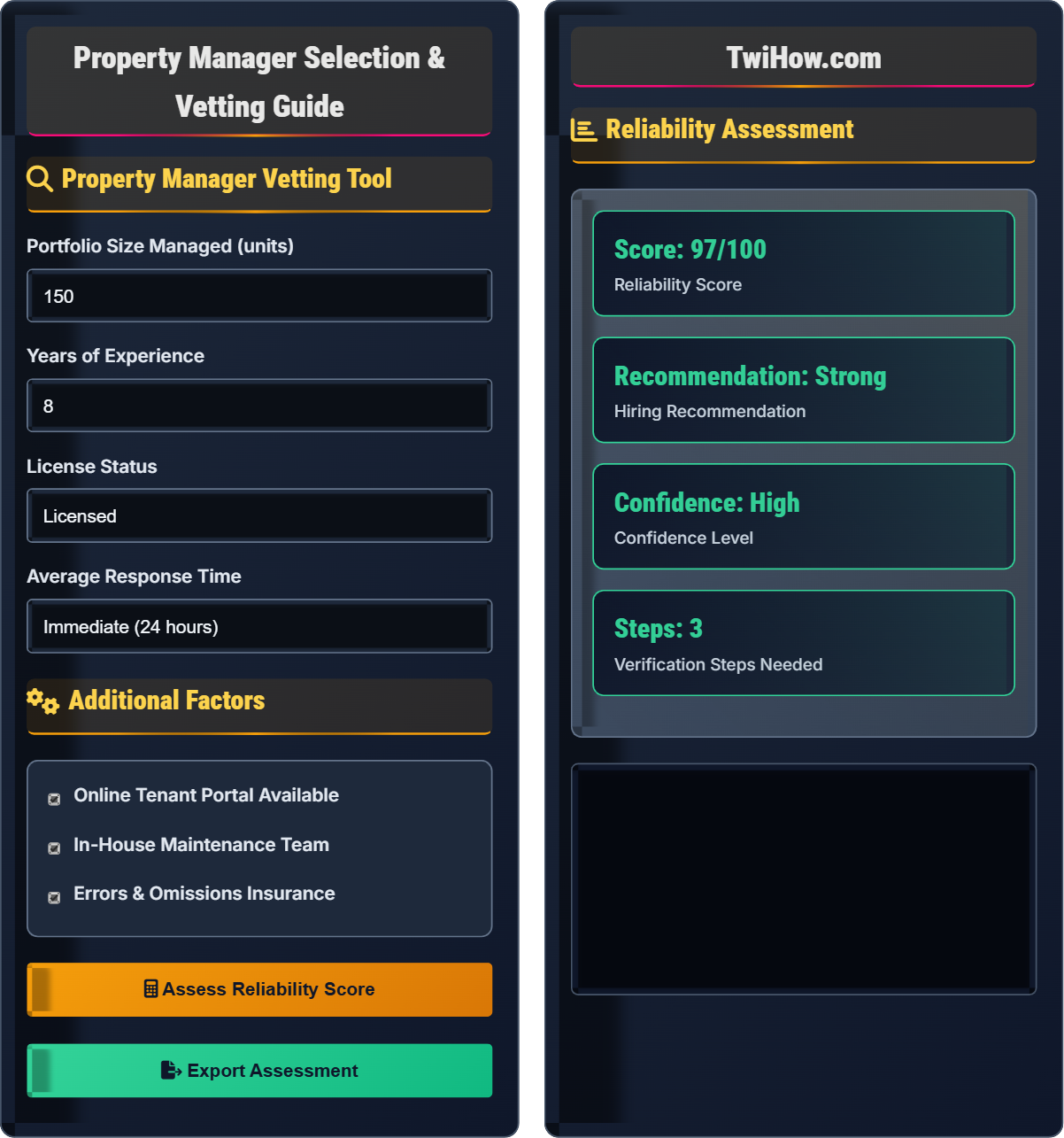
Property Manager Vetting Tool
Additional Factors
Reliability Assessment
| Factor | Assessment | Status |
|---|---|---|
| Experience | 8 years | Good |
| Portfolio Size | 150 units | Adequate |
| Licensing | Professional | Compliant |
| Response Time | Fast | Excellent |
Verification Steps
- Check references from current clients
- Verify license with state board
- Review insurance certificates
- Check Better Business Bureau rating
- Interview management team
Understanding Property Manager Selection
A reliable property manager combines professional expertise with practical operational skills. They serve as the bridge between property owners and tenants, ensuring smooth operations while maximizing investment returns.
Key qualities include:
- Professional Licensing: Proper credentials and industry certifications
- Market Knowledge: Understanding of local rental trends and regulations
- Operational Efficiency: Systems for maintenance, tenant screening, and financial reporting
- Communication Skills: Clear, regular updates to property owners
Effective property manager vetting involves multiple verification steps:
Warning signs that may indicate unreliable management:
- License Issues: Unlicensed operation or suspended credentials
- Communication Problems: Slow response times or inconsistent updates
- Financial Concerns: Hidden fees or unclear accounting practices
- Legal Issues: History of tenant or landlord disputes
- High Turnover: Frequent tenant complaints or staff changes
Effective property manager selection strategies:
- Interview multiple candidates before deciding
- Request detailed service agreements
- Verify all licenses and insurance
- Check references thoroughly
- Start with a small property initially
Selection Process
Experience, licensing, communication, services, fees, references.
Reliability Score = (Experience × 20%) + (Licensing × 15%) + (Communication × 25%) + (Services × 20%) + (References × 20%)
Where scores are weighted based on importance to your investment strategy.
- Never skip reference checks
- Verify all licenses and insurance
- Test communication responsiveness
Vetting Process
License verification, reference checks, insurance verification, financial review.
- Check professional licensing with state board
- Verify insurance coverage and E&O policies
- Contact provided client references
- Review financial stability and reputation
- Meet key personnel and tour operations
- Independent verification is essential
- Check multiple reference sources
- Verify all credentials personally
- Trust but verify all claims
Property Manager Selection Quiz
What is the most important licensing verification step when vetting a property manager?
The most important verification step is to verify their property management license with the state board. Many states require specific property management licensing, which includes background checks, education requirements, and ongoing compliance. This ensures the manager meets state standards and operates legally.
The answer is B) Verify their property management license with state board.
Property management licensing is distinct from real estate sales licensing and often has different requirements. State licensing boards maintain records of active licenses, disciplinary actions, and compliance history, providing reliable verification of professional standing.
Property Management License: Professional credential for managing real estate
State Board: Government agency overseeing professional licensing
Compliance Verification: Confirmation of legal operating status
• Always verify license status directly with state board
• Check for any disciplinary actions
• Confirm license is active and current
• Use state board's official website for verification
• Note license expiration dates
• Check for any restrictions or probation
• Accepting verbal confirmation only
• Not checking for disciplinary history
• Confusing different license types
Explain the importance of checking references when vetting property managers. What specific questions should you ask reference clients?
Importance of Reference Checking: References provide real-world insights into a property manager's performance that marketing materials won't reveal. They offer perspectives on reliability, communication, and actual results.
Specific Questions to Ask:
Performance Metrics: Occupancy rates, time to fill vacancies, rent collection success
Communication: Response times, update frequency, transparency in reporting
Problem Handling: How they handle maintenance issues, tenant disputes, and emergencies
Financial Management: Accuracy of accounting, handling of security deposits, fee transparency
Overall Satisfaction: Would you hire them again? What would you change?
Ask for references from both satisfied and former clients to get balanced perspectives.
Reference checking is the most reliable way to validate claims made by property managers. Former clients often provide honest feedback about weaknesses, while current clients share positive experiences. This dual perspective provides a comprehensive view of performance.
Reference Check: Verification of claims through third-party feedback
Performance Metrics: Quantifiable measures of effectiveness
Client Satisfaction: Measure of service quality from customer perspective
• Contact at least 3 recent references
• Ask open-ended questions for detailed responses
• Verify contact information independently
• Document all feedback for comparison
• Only contacting provided references
• Asking leading questions
• Not following up on concerns
You're evaluating two property management companies for your 20-unit apartment building. Company A has 12 years of experience, licensed, charges 8% of rent, and responds to inquiries within 2 hours. Company B has 5 years of experience, unlicensed, charges 6% of rent, but has excellent references. Which company should you choose and why?
Recommended Choice: Company A
Analysis:
Company A Advantages:
• Licensed operation ensures legal compliance
• Quick response time indicates good communication
• More experience suggests greater stability
Company B Concerns:
• Operating without proper license is illegal in most states
• Unlicensed operation exposes you to legal risks
• Potential insurance and liability issues
While Company B has excellent references and lower fees, operating without proper licensing creates unacceptable legal and financial risks. Company A's higher cost is justified by legal compliance and operational reliability.
This scenario demonstrates that compliance and legal operation take precedence over cost savings. Unlicensed property management can expose property owners to significant liability, insurance coverage issues, and legal problems that far outweigh fee savings.
Legal Compliance: Adherence to state and local licensing requirements
Liability Exposure: Potential financial risks from non-complianceInsurance Coverage: Protection against operational risks
• Never hire unlicensed property managers
• Compliance takes priority over cost
• Verify all credentials independently
• Always verify license status first
• Check for disciplinary history
• Confirm insurance coverage
• Prioritizing cost over compliance
• Not verifying license status
• Accepting unlicensed operation
Your property generates $2,400/month in rent. Property Manager A charges 10% of gross rent plus $200 per new tenant placement. Property Manager B charges 8% of gross rent plus $150 per tenant placement. If you expect 2 turnovers per year, calculate the annual cost difference and determine which is more cost-effective.
Property Manager A:
• Monthly fee: $2,400 × 10% = $240
• Annual fee: $240 × 12 = $2,880
• Tenant placement: $200 × 2 = $400
• Total annual cost: $2,880 + $400 = $3,280
Property Manager B:
• Monthly fee: $2,400 × 8% = $192
• Annual fee: $192 × 12 = $2,304
• Tenant placement: $150 × 2 = $300
• Total annual cost: $2,304 + $300 = $2,604
Cost Difference: $3,280 - $2,604 = $676
Property Manager B is more cost-effective by $676 annually. However, also consider service quality, responsiveness, and performance metrics when making the final decision.
This example illustrates the importance of calculating total costs, including all fees and charges. While percentage-based fees might seem straightforward, additional charges can significantly impact total cost. Always calculate the complete annual cost to make accurate comparisons.
Fee Structure: Pricing model for property management services
Total Cost Analysis: Comprehensive calculation of all expenses
Value Comparison: Cost versus service quality evaluation
• Calculate total annual costs
• Include all fees and charges
• Consider value beyond cost
• Request detailed fee breakdown
• Calculate costs for your specific situation
• Consider volume discounts
• Focusing only on percentage fees
• Not including additional charges
• Ignoring volume considerations
Which communication practice is most important when evaluating a property manager's reliability?
Responding to emergency calls within 2 hours is most important for reliability. Property emergencies (leaks, break-ins, safety issues) require immediate attention to prevent damage and liability. A reliable property manager prioritizes emergency response and maintains 24/7 availability for urgent situations.
The answer is B) Responding to emergency calls within 2 hours.
While all communication practices are valuable, emergency response directly impacts property safety, tenant satisfaction, and legal liability. Property managers who prioritize emergency response demonstrate reliability and proper operational procedures that protect your investment.
Emergency Response: Immediate action for property threats
24/7 Availability: Round-the-clock accessibility
Liability Protection: Safeguards against legal exposure
• Emergency response is critical priority
• Establish clear response time expectations
• Test emergency procedures during vetting
• Ask about emergency protocols
• Test response during vetting process
• Confirm backup systems
• Overlooking emergency response capabilities
• Not testing communication systems
• Assuming all managers are available 24/7
Frequently Asked Questions
Q: How much should I expect to pay for property management services?
A: Property management fees typically range from 6% to 12% of monthly rental income, depending on services provided:
Full-Service Management: 8-12% including tenant placement, maintenance, and financial management
Basic Management: 6-8% for rent collection and basic oversight
Additional Fees: $100-500 per tenant placement, maintenance markups, and special services
Higher fees often include comprehensive services that justify the cost through better tenant quality and property maintenance.
Q: What questions should I ask during property manager interviews?
A: Essential interview questions include:
Operational Questions:
• What's your average time to fill vacancies?
• How do you screen potential tenants?
• What's your process for handling maintenance requests?
Communication Questions:
• How often do you provide financial reports?
• What's your emergency response procedure?
• How do you handle tenant complaints?
Financial Questions:
• What's your complete fee structure?
• How do you handle security deposits?
• What's your policy on maintenance markups?
Ask for specific examples and follow up on any concerns raised during the interview.
Q: How do I verify a property manager's insurance and licensing?
A: Verification steps:
Licensing Verification:
• Contact your state's real estate commission
• Use the state's official license lookup system
• Verify license status, expiration date, and any disciplinary actions
Insurance Verification:
• Request certificate of insurance naming you as additional insured
• Contact the insurance company directly to confirm coverage
• Verify Errors & Omissions (E&O) and General Liability coverage
Additional Verification:
• Check Better Business Bureau rating
• Search court records for any litigation
• Verify business registration with Secretary of State
Always verify these credentials independently rather than relying solely on information provided by the property manager.