Real Estate Investment Financing Options
Complete guide to financing strategies • Step-by-step explanations
Financing Options:
Show Financing CalculatorReal estate investors have numerous financing options available, each with distinct advantages and considerations. Understanding these options helps investors choose the best funding strategy for their investment goals and risk tolerance.
Primary financing categories include:
- Conventional Loans: Traditional bank financing with competitive rates
- Hard Money Loans: Short-term financing for quick transactions
- Private Lenders: Alternative financing from individuals or groups
- Owner Financing: Seller-provided financing arrangements
- Partnerships: Joint ventures with other investors
- Self-Directed IRA: Retirement account funding for real estate
Selecting the right financing option depends on your investment strategy, credit profile, and market conditions.
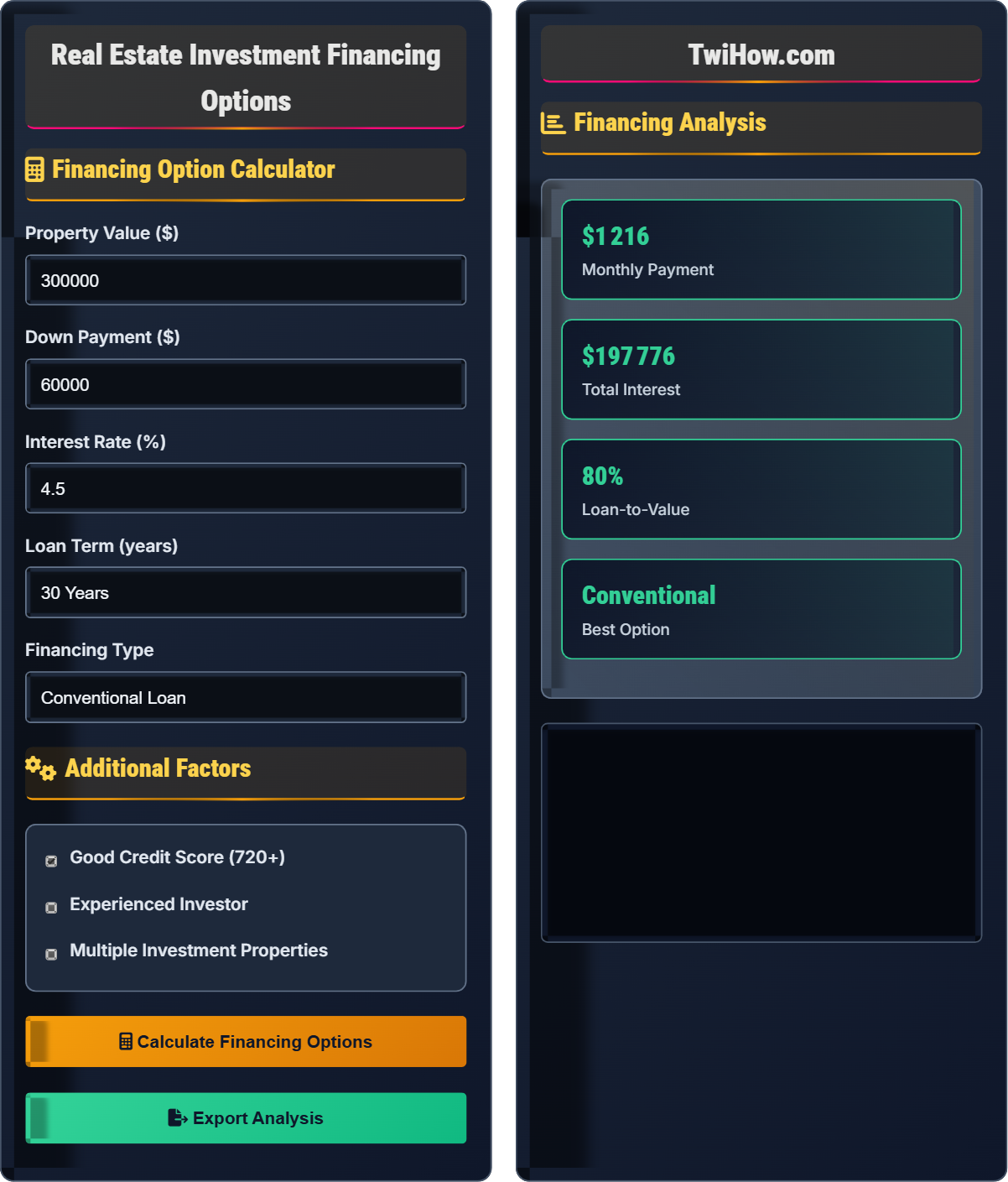
Financing Option Calculator
Additional Factors
Financing Analysis
| Financing Type | Rate | Pros |
|---|---|---|
| Conventional | 4.5% | Low Rate, Stable |
| Hard Money | 8-12% | Quick Funding |
| Private Lender | 6-10% | Flexible Terms |
| Owner Fin. | 5-8% | Seller Motivated |
Financing Comparison
- Conventional: Best for long-term holds
- Hard Money: Ideal for flips
- Private: Flexible terms
- Owner: Negotiable rates
Understanding Real Estate Financing Options
Real estate financing options are various methods investors can use to fund property purchases. Each option has different requirements, costs, and benefits that align with specific investment strategies and financial situations.
Key financing categories include:
- Traditional Bank Loans: Conventional mortgages with standard requirements
- Alternative Financing: Hard money, private lenders, owner financing
- Investment Vehicles: Self-directed IRAs, partnerships
- Creative Strategies: Lease options, seller carry-backs
Financing options vary based on several criteria:
Each financing option carries different risks:
- Interest Rate Risk: Variable rates and market fluctuations
- Prepayment Penalties: Fees for early loan payoff
- Due-on-Sale Clauses: Acceleration of loan upon property sale
- Relationship Risk: Private lenders and partnership issues
Choose financing based on your investment goals:
- Long-term rental properties: Conventional loans
- Fix-and-flip projects: Hard money or private lenders
- Portfolio expansion: Creative financing options
- Retirement investing: Self-directed IRA
Financing Options Overview
Conventional loans, hard money, private lenders, owner financing, partnerships.
Best Option = (Investment Strategy × Risk Tolerance × Financial Profile) / Total Cost
Where different factors are weighted based on investor priorities.
- Match financing to investment strategy
- Consider total cost including fees
- Understand all terms and conditions
Financing Strategy
Investment timeline, cash flow requirements, risk tolerance, market conditions.
- Define investment strategy and goals
- Assess financial profile and creditworthiness
- Research available financing options
- Compare total costs and terms
- Consider exit strategy and liquidity needs
- Consider impact on cash flow
- Understand prepayment penalties
- Evaluate relationship with lender
- Plan for refinancing opportunities
Real Estate Financing Knowledge Quiz
What is the typical minimum down payment required for a conventional investment property loan?
Conventional investment property loans typically require a minimum down payment of 20%. This is higher than primary residence loans due to the increased risk associated with investment properties. Lenders view investment properties as riskier because they're not owner-occupied and rental income may fluctuate.
The answer is C) 20%.
Investment properties require higher down payments because lenders consider them riskier than primary residences. The 20% threshold helps ensure borrowers have sufficient equity to weather market fluctuations and maintain payments during vacancy periods.
Investment Property: Real estate purchased to generate income
Down Payment: Initial cash contribution toward purchase
Risk Premium: Higher requirements due to increased risk
• Investment properties require 20%+ down
• Higher rates than primary residences
• Stricter qualification requirements
• Build extra cash reserves for investment properties
• Maintain excellent credit for better rates
• Consider portfolio lending for multiple properties
• Assuming same requirements as primary residence
• Not preparing for higher down payment
• Underestimating qualification challenges
Explain the advantages and disadvantages of hard money loans for real estate investors. When are they most appropriate to use?
Advantages of Hard Money Loans:
• Quick funding (often within 1-2 weeks)
• Less stringent credit requirements
• Based primarily on property value (LTV ratio)
• Flexible terms and faster approval process
Disadvantages:
• Much higher interest rates (typically 8-12%)
• Higher origination fees
• Shorter loan terms (usually 1-3 years)
• Requires substantial down payment (typically 20-30%)
Best Use Cases:
• Fix-and-flip projects where speed is crucial
• Properties that don't qualify for conventional financing
• Investors with credit issues but strong property equity
• Situations requiring immediate purchase
Hard money loans are ideal for short-term investments where speed and flexibility outweigh higher costs.
Hard money loans serve as a bridge financing option for investors who need quick access to capital or don't meet conventional lending criteria. They're essentially secured by the property's value rather than borrower creditworthiness.
Hard Money Loan: Asset-based financing secured by property value
Loan-to-Value (LTV): Ratio of loan to property value
Bridge Financing: Short-term funding to bridge gaps
• Use for short-term investments only
• Have exit strategy before borrowing
• Plan for refinancing or sale
• Research multiple hard money lenders
• Negotiate terms and rates
• Have refinancing plan ready
• Using for long-term holdings
• Not having exit strategy
• Ignoring total cost implications
Sarah wants to purchase a $400,000 rental property. She has $80,000 cash available for down payment and closing costs. She has excellent credit (780+) and a stable income. Her goal is to hold the property for 20+ years. What financing option would be most appropriate and why?
Recommended Option: Conventional investment property loan
Analysis:
Down Payment: $80,000 represents 20% of $400,000, meeting conventional loan requirements.
Credit Profile: Excellent credit score of 780 qualifies for best rates.
Investment Strategy: 20+ year hold period aligns with conventional loan terms.
Benefits:
• Competitive interest rates (likely 4.5-5.5%)
• Stable 30-year fixed rate
• Predictable monthly payments
• Long-term financing that matches investment horizon
Conventional financing provides the lowest cost and most stable financing for Sarah's long-term investment strategy.
This scenario demonstrates the importance of matching financing to investment strategy. Sarah's long-term hold, strong financial profile, and adequate down payment make conventional financing the optimal choice for minimizing total cost over the investment period.
Investment Horizon: Planned holding period for property
Financing Match: Aligning loan terms with strategyTotal Cost of Capital: All financing expenses over time
• Match loan term to investment strategy
• Consider total cost over entire period
• Ensure adequate down payment
• Shop multiple lenders for best rates
• Consider portfolio lending programs
• Negotiate closing cost credits
• Choosing financing that doesn't match strategy
• Not considering total cost implications
• Failing to shop around for rates
Mike is considering a private lender offering 7% interest with flexible terms for a $250,000 property. The lender requires 25% down payment and charges 2 points. Compare this to a conventional loan at 4.5% with 20% down and no points. Calculate the total cost difference over 5 years and advise Mike.
Conventional Loan:
• Down Payment: $50,000 (20% of $250,000)
• Loan Amount: $200,000
• Monthly Payment: $1,013 (4.5% for 30 years)
• Total Payments (5 years): $60,780
Private Lender:
• Down Payment: $62,500 (25% of $250,000)
• Points: $4,500 (2 points on $187,500 loan)
• Loan Amount: $187,500
• Monthly Payment: $1,246 (7% for 30 years)
• Total Payments (5 years): $74,760
Total Cost Difference: $74,760 - $60,780 = $13,980 higher with private lender
Advice: Unless Mike needs the flexible terms or has credit issues preventing conventional financing, the conventional loan saves $13,980 over 5 years. The private lender option costs significantly more.
This example illustrates the importance of calculating total costs when comparing financing options. The higher interest rate and points significantly increase the cost of the private loan, even with slightly better terms.
Points: Fees paid upfront to reduce interest rate
Total Cost Analysis: Comprehensive cost comparison
Financing Trade-offs: Balancing terms vs. cost
• Calculate total cost over relevant period
• Consider both rate and fees
• Factor in all associated costs
• Use APR to compare loans
• Calculate total interest paid
• Consider opportunity cost of higher payments
• Focusing only on monthly payment
• Not considering total cost
• Ignoring all associated fees
Which of the following is the biggest advantage of owner financing for a real estate investor?
The biggest advantage of owner financing is the flexibility in terms and negotiation. Since the seller controls the financing terms, they can customize interest rates, payment schedules, balloon payments, and other conditions to meet both parties' needs. This flexibility is not available with institutional lenders.
The answer is B) Most flexible terms and negotiation.
Owner financing creates a direct relationship between buyer and seller, allowing for creative deal structures that institutional lenders cannot offer. This flexibility can be invaluable for investors with unique circumstances or needs.
Owner Financing: Seller provides financing to buyer
Flexible Terms: Customizable payment and interest arrangements
Direct Negotiation: Buyer-seller relationship
• Verify seller's motivation and financial position
• Ensure proper legal documentation
• Understand seller's exit strategy
• Research seller's motivations
• Negotiate favorable terms
• Ensure clear title transfer
• Not verifying seller's authority
• Poor legal documentation
• Assuming seller is always motivated
Frequently Asked Questions
Q: What financing options are available for first-time real estate investors?
A: First-time investors have several options:
Conventional Loans: Best for buy-and-hold strategies with good credit and 20% down.
Hard Money: Useful for fix-and-flip projects but requires higher down payment.
Private Lenders: May offer more flexible terms for new investors.
Partner with Experienced Investors: Share costs and expertise.
Owner Financing: Can work if seller is motivated and investor has good credit.
Start with conventional financing if you have good credit and sufficient down payment. Build relationships with lenders and consider creative options as you gain experience.
Q: How do interest rates vary between different financing options?
A: Interest rates vary significantly by financing type:
Conventional Loans: 4.0-6.0% for qualified investors
Portfolio Lenders: 4.5-6.5% (for multiple properties)
Hard Money: 8-12% (short-term, asset-based)
Private Lenders: 6-10% (varies by relationship)
Owner Financing: 5-8% (depends on seller's needs)
Rates depend on risk factors, loan term, property type, and borrower profile. Conventional loans typically offer the lowest rates, while hard money has the highest due to risk and speed factors.
Q: What are the key factors that lenders consider for investment property loans?
A: Lenders evaluate several key factors for investment property loans:
Credit Score: Minimum 620-680, with better rates for 720+
Debt-to-Income Ratio: Typically 43% or lower
Down Payment: 20-25% minimum for investment properties
Reserves: 6-12 months of mortgage payments in reserves
Rental Income: Must demonstrate ability to cover expenses
Property Type: Single-family homes are preferred
Experience: Lenders may consider previous real estate experience
Investment properties face stricter requirements than primary residences due to perceived higher risk.