Best Strategies for Scaling a Real Estate Investment Business
Complete guide • Step-by-step explanations
Scaling Real Estate Business:
Show Growth CalculatorScaling a real estate investment business requires strategic planning, systematic approaches, and sustainable growth practices. Success depends on building systems, leveraging capital efficiently, and creating scalable operational structures. The key to sustainable growth lies in balancing expansion with operational excellence.
Core scaling strategies include:
- Systematization: Creating repeatable processes and procedures
- Capital Leverage: Utilizing various financing strategies
- Team Building: Assembling skilled professionals
- Technology Integration: Automating routine tasks
- Market Expansion: Diversifying geographically and by property type
Successful scaling requires patience, discipline, and a focus on sustainable growth rather than rapid expansion.
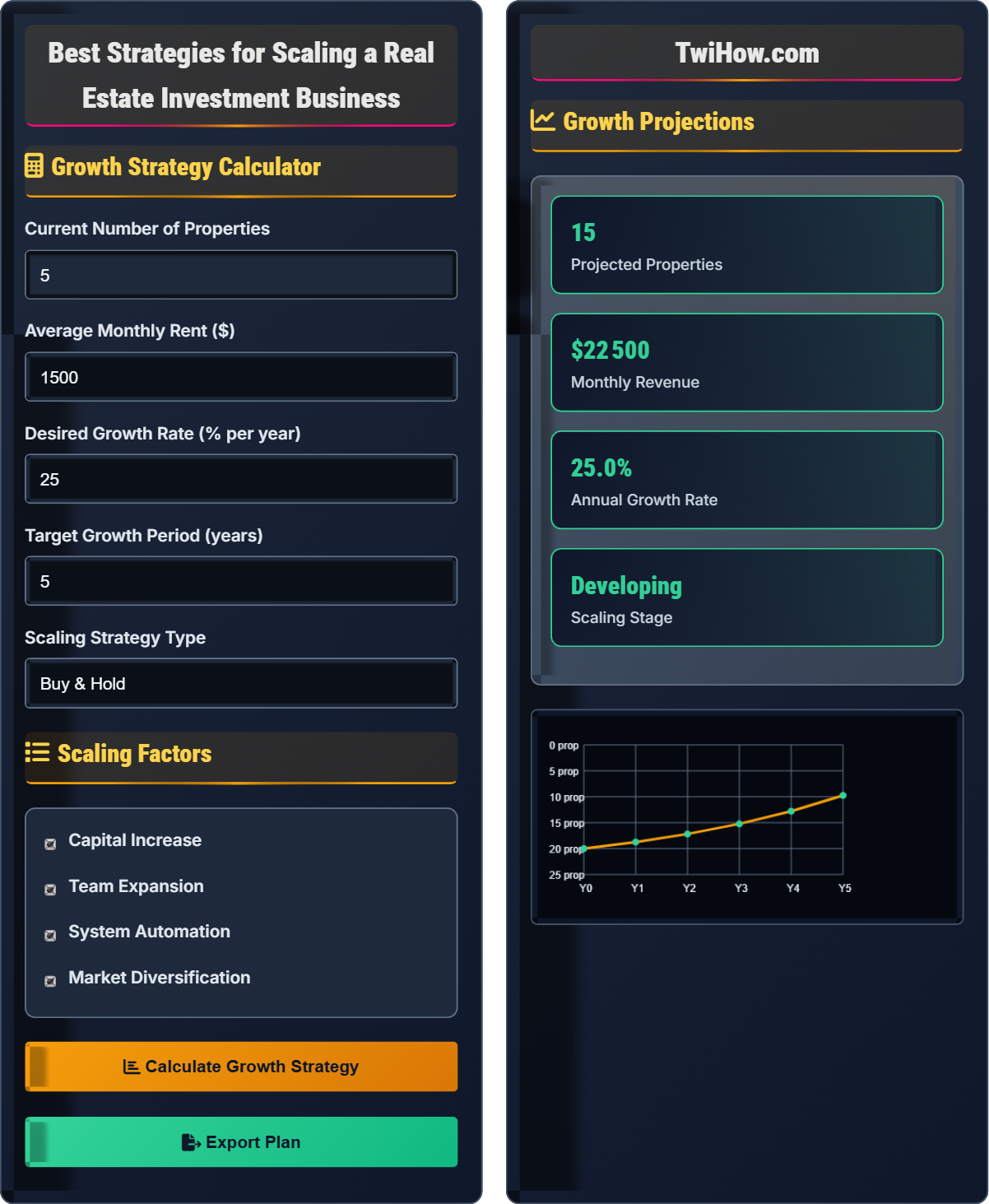
Growth Strategy Calculator
Scaling Factors
Growth Projections
| Year | Properties | Revenue | Strategy |
|---|---|---|---|
| Year 1 | 6 | $9,000 | Buy & Hold |
| Year 2 | 8 | $12,000 | Buy & Hold |
| Year 3 | 10 | $15,000 | Buy & Hold |
| Year 4 | 15 | $22,500 | Buy & Hold |
| Year 5 | 25 | $37,500 | Buy & Hold |
Focus: Process development and team building
Properties: 6-8 units
Revenue: $9,000-$12,000/month
Focus: Capital leverage and market expansion
Properties: 10-15 units
Revenue: $15,000-$22,500/month
Focus: Optimization and diversification
Properties: 25+ units
Revenue: $37,500+/month
Understanding Real Estate Business Scaling
Business scaling in real estate refers to the systematic expansion of your investment operations while maintaining or improving profit margins and operational efficiency. Scaling involves:
- Process Standardization: Creating repeatable workflows
- System Implementation: Building operational infrastructure
- Team Development: Recruiting and training personnel
- Capital Optimization: Efficiently deploying resources
- Market Expansion: Geographic and product diversification
True scaling creates exponential growth potential while maintaining control and profitability.
The compound growth formula for real estate scaling:
For property count projections:
Where:
- Future Value: Projected revenue or property count
- Current Value: Starting revenue or property count
- Growth Rate: Annual growth percentage
- Time Period: Number of years
Proven strategies for scaling real estate businesses:
- Vertical Integration: Control more aspects of the business (management, rehab, financing)
- Horizontal Expansion: Increase property count in current markets
- Geographic Diversification: Enter new markets and regions
- Product Diversification: Add different property types (residential, commercial, industrial)
- Technology Leverage: Use software and automation to handle more volume
- Partnership Development: Form strategic alliances with other investors
- Strong Foundation: Solid systems before attempting to scale
- Capital Adequacy: Sufficient funding to support growth
- Team Quality: Skilled professionals to execute at scale
- Market Research: Understanding of target markets
- Risk Management: Systems to manage increased complexity
- Continuous Learning: Adaptation to changing market conditions
Scaling Fundamentals
Business scaling, compound growth, operational leverage, market expansion, capital efficiency.
Future Properties = Current Properties × (1 + Growth Rate)^Years
Where Growth Rate = Annual growth percentage, Years = Time period for projection.
- Build systems before scaling
- Ensure adequate capital
- Focus on operational efficiency
- Maintain quality standards
Growth Strategy
Buy & hold, fix & flip, wholesaling, syndication, rental arbitrage, development.
- Choose appropriate strategy type
- Develop execution plan
- Secure necessary resources
- Implement systematic approach
- Monitor and adjust
- Match strategy to market conditions
- Align with risk tolerance
- Consider capital requirements
- Factor in time commitments
Real Estate Scaling Quiz
What should be the first priority when preparing to scale a real estate investment business?
Building standardized systems and processes should be the first priority when preparing to scale. Without proper systems in place, adding more properties or expanding the team will only create chaos and inefficiency. Systems provide the foundation for consistent operations, quality control, and efficient scaling. Once systems are established, they can be replicated and scaled without proportional increases in complexity or management overhead.
The answer is B) Building standardized systems and processes.
The principle of "systems before scale" is fundamental to sustainable business growth. Without proper systems, each additional property or employee exponentially increases complexity and management burden. Systems create predictable, repeatable processes that can be executed consistently regardless of scale. This approach ensures that growth is manageable and profitable rather than chaotic and stressful.
Standardized Systems: Consistent, documented processes for business operations
Process Documentation: Written procedures for consistent execution
Operational Efficiency: Maximizing output while minimizing input
• Systems before scale
• Document everything
• Test before expanding
• Create checklists for all processes
• Use technology to automate routine tasks
• Establish clear accountability
• Adding properties before systems are in place
• Scaling too quickly without proper foundation
• Not documenting processes
Explain how to effectively leverage capital for scaling a real estate investment business, including financing strategies and risk management.
Traditional Financing Strategies:
Conventional Mortgages: Primary financing for single-family homes and small multifamily properties. Typically require 20% down payment but offer lower interest rates.
Portfolio Loans: Lender keeps loans on their books rather than selling them. Often available to investors with existing portfolios and can offer better terms.
Hard Money Loans: Short-term financing from private lenders, typically for 6-18 months. Higher interest rates but faster approval for fix-and-flip projects.
Alternative Financing Strategies:
Private Money: Funding from individuals, often friends, family, or local investors. Can offer flexible terms and faster approval.
Owner Financing: Seller finances the purchase directly. Allows for creative deal structures and may not require traditional down payments.
Partnerships: Joint ventures with other investors to pool capital and share risk.
Capital Management:
Reinvest Profits: Plow back cash flow and profits into new acquisitions to compound growth.
Refinance Equity: Use increased property values to pull cash out for new purchases.
Line of Credit: Establish revolving credit facilities for quick access to capital.
Risk Management:
Limit debt-to-income ratios, maintain adequate reserves, diversify property types and locations, and ensure proper insurance coverage.
Capital leverage is the engine of real estate business scaling, but it must be managed carefully to avoid over-leveraging. The key is to match financing strategies to investment strategies and market conditions. Different financing options have varying costs, terms, and requirements, so understanding the trade-offs is crucial for sustainable growth. Risk management is equally important to protect against market downturns and unexpected expenses.
Capital Leverage: Using borrowed funds to increase investment capacity
Debt-to-Income Ratio: Measure of financial leverage
Hard Money Loan: Short-term financing from private lenders
• Match financing to investment strategy
• Maintain adequate reserves
• Diversify funding sources
• Build relationships with multiple lenders
• Maintain good credit scores
• Keep detailed financial records
• Over-leveraging the portfolio
• Not having backup financing
• Ignoring cash flow requirements
An investor owns 8 rental properties generating $2,000/month each in rent. They want to scale to 25 properties within 4 years while maintaining their current profit margins. Their current properties average 65% gross rent yield after expenses. Calculate the growth rate needed and suggest a systematic approach to achieve this goal.
Current Situation:
Current properties: 8
Target properties: 25
Time period: 4 years
Growth Rate Calculation:
Using the compound growth formula: Future Value = Current Value × (1 + r)^n
25 = 8 × (1 + r)^4
(1 + r)^4 = 25/8 = 3.125
1 + r = (3.125)^(1/4) = 1.335
r = 0.335 or 33.5% annual growth rate
Revenue Projections:
Current monthly revenue: 8 × $2,000 = $16,000
Target monthly revenue: 25 × $2,000 = $50,000
Annual revenue: $50,000 × 12 = $600,000
Systematic Approach:
Year 1: Acquire 4-5 additional properties (12-13 total)
Year 2: Acquire 4-5 additional properties (17-18 total)
Year 3: Acquire 4-5 additional properties (21-23 total)
Year 4: Acquire remaining 2-4 properties (25 total)
Implementation Strategy:
1. System Development: Create acquisition, management, and maintenance systems
2. Team Building: Hire property managers and maintenance coordinators
3. Capital Planning: Secure financing for 17 additional properties
4. Market Research: Identify target markets with favorable conditions
5. Deal Pipeline: Build relationships with realtors, wholesalers, and lenders
Resource Requirements:
Assuming average property value of $200,000 and 20% down payment: $200,000 × 17 × 0.2 = $680,000 in additional equity needed over 4 years.
This scenario demonstrates the mathematical reality of scaling goals and the importance of systematic planning. The 33.5% annual growth rate is aggressive but achievable with proper systems and resources. The calculation shows that scaling requires not just ambition but careful planning, resource allocation, and systematic execution. The approach balances growth with operational capacity, ensuring that systems can handle the increased volume.
Gross Rent Yield: Annual rent as percentage of property value
Compound Growth: Exponential increase through reinvestmentSystematic Approach: Structured, methodical growth plan
• Calculate realistic growth rates
• Plan resource requirements
• Build systems before adding properties
• Use the Rule of 72 for quick growth estimates
• Build in buffer time for unexpected delays
• Focus on quality over quantity
• Setting unrealistic growth targets
• Not planning for capital requirements
• Adding properties without systems
You manage 15 rental properties and want to scale to 40 within 3 years. Currently, you spend 20 hours per week managing properties manually. Calculate the time savings potential from technology integration and create a technology adoption plan that scales with your growth.
Current Time Investment:
15 properties: 20 hours/week
40 properties at same rate: (40/15) × 20 = 53.3 hours/week
Time increase: 53.3 - 20 = 33.3 hours/week
Technology Savings Potential:
Property Management Software: 60-70% reduction in administrative tasks
Online Tenant Screening: 50-60% reduction in screening time
Automated Rent Collection: 80-90% reduction in collection tasksMaintenance Apps: 40-50% reduction in coordination time
Virtual Tours: 30-40% reduction in showing time
Total Potential Savings:
With comprehensive technology adoption: 60-70% reduction in management time
Time with technology: 53.3 × (1 - 0.65) = 18.7 hours/week
Net time increase: 18.7 - 20 = -1.3 hours/week (actually saves time!)
Technology Adoption Plan:
Phase 1 (Months 1-6): Implement property management software and online rent collection
Phase 2 (Months 7-12): Add tenant screening and maintenance coordination tools
Phase 3 (Months 13-18): Integrate marketing tools and virtual tour capabilities
Phase 4 (Months 19-24): Add advanced analytics and reporting tools
Phase 5 (Months 25-36): Optimize and integrate all systems
ROI Calculation:
Assuming $30/hour time value: 33.3 hours saved × $30 = $1,000/week
Annual savings: $1,000 × 52 = $52,000
Software costs: $200/month × 12 = $2,400/year
ROI: ($52,000 - $2,400) / $2,400 = 2,067%
This problem demonstrates how technology can actually reduce time requirements even as property counts increase. The key insight is that technology scales much better than manual processes. The phased approach allows for gradual adaptation and system integration. The ROI calculation shows that technology investments for scaling businesses are typically highly profitable, justifying the upfront costs through time savings and efficiency gains.
Technology Integration: Systematic adoption of software tools
Time Leverage: Using technology to accomplish more with less time
ROI: Return on investment percentage
• Technology should scale with growth
• Implement gradually to avoid disruption
• Calculate ROI before investing
• Start with highest-impact tools first
• Train staff thoroughly on new systems
• Integrate systems for maximum efficiency
• Implementing too many tools at once
• Not training staff properly
• Choosing tools that don't scale
Which risk management strategy is most critical when scaling a real estate investment business?
All of the listed strategies are equally critical when scaling a real estate investment business. Diversification reduces concentration risk across markets and property types. Adequate cash reserves provide liquidity for emergencies and opportunities. Comprehensive insurance protects against various risks including liability, property damage, and business interruption. When scaling, risks multiply and compound, so a comprehensive risk management approach is essential. Each strategy addresses different types of risks that become more significant as the business grows.
The answer is D) All of the above are equally critical.
Scaling amplifies all business risks, making comprehensive risk management essential rather than optional. Diversification spreads risk across different markets and property types, protecting against localized downturns. Cash reserves provide operational stability during challenging periods and enable opportunistic purchases. Insurance protects against catastrophic losses that could devastate a growing portfolio. The key insight is that risk management must scale alongside the business, not be an afterthought.
Risk Management: Processes to identify, assess, and mitigate business risks
Diversification: Spreading investments across different areas
Cash Reserves: Liquid funds for emergencies and opportunities
• Scale risk management with business growth
• Maintain diversification as portfolio expands
• Keep adequate reserves for emergencies
• Review insurance coverage annually
• Maintain 3-6 months of expenses in reserves
• Diversify across multiple markets
• Ignoring risk management during rapid growth
• Concentrating properties in one market
• Not maintaining adequate reserves
FAQ
Q: How do I know if I'm ready to scale my real estate business?
A: You're ready to scale when: 1) Your current systems are running smoothly and consistently, 2) You have positive cash flow from existing properties, 3) You've identified replicable deal flow sources, 4) You have adequate capital reserves, 5) You can delegate daily operations effectively, and 6) You have a clear understanding of your target markets. Before scaling, ensure your current business model is profitable and repeatable. Scaling a broken system will only magnify problems. Focus on optimizing your current operations first, then gradually increase volume while maintaining quality and profitability.
Q: What's the biggest mistake people make when trying to scale?
A: The biggest mistake is trying to scale without proper systems and infrastructure. Many investors think they can simply buy more properties without considering how they'll manage the increased workload. This leads to chaos, poor tenant relations, missed maintenance, and ultimately losses. Another common mistake is not having adequate capital reserves for scaling operations. Scaling requires more than just acquiring more properties - it requires systems, team, capital, and market knowledge to handle the increased complexity. Focus on building a solid foundation first, then expand systematically.