What Are the Considerations for Investing in Emerging or Secondary Markets?
Complete guide • Step-by-step explanations
Emerging Markets Investing:
Show Market AnalyzerInvesting in emerging or secondary real estate markets presents unique opportunities and challenges. These markets offer potential for higher returns but come with increased risks and complexities. Success requires careful analysis of local fundamentals, growth drivers, and market dynamics.
Key considerations when investing in emerging or secondary markets include:
- Market Fundamentals: Population growth, employment trends, and economic stability
- Risk Assessment: Liquidity concerns, volatility, and regulatory environment
- Infrastructure Development: Transportation, utilities, and urban planning
- Competition Analysis: Supply and demand dynamics, market saturation
Strategic investing in these markets requires patience, thorough due diligence, and a long-term perspective.
Market Analysis Tool
Investment Factors
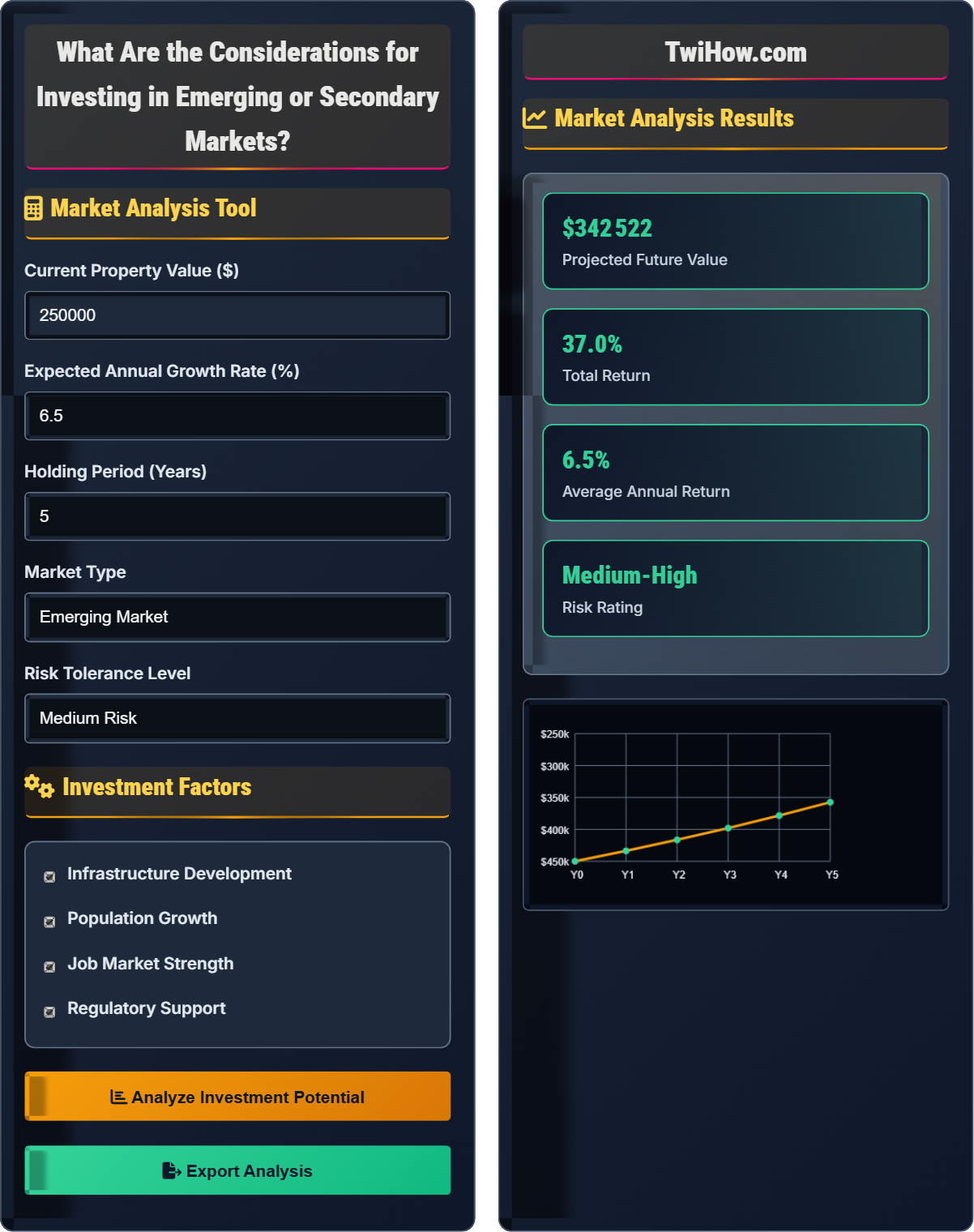
Market Analysis Results
| Year | Value | Growth | Market Type |
|---|---|---|---|
| Year 1 | $266,250 | +6.5% | Emerging |
| Year 2 | $283,556 | +6.5% | Emerging |
| Year 3 | $301,987 | +6.5% | Emerging |
| Year 4 | $321,616 | +6.5% | Emerging |
| Year 5 | $341,168 | +6.5% | Emerging |
Liquidity Risk: Difficulty selling assets quickly
Volatility: Greater price fluctuations
Information Gaps: Limited market data
Policy Changes: Regulatory shifts affecting value
Infrastructure Delays: Projected growth not realized
Employment Shocks: Job losses impacting demand
Management Quality: Local market expertise needed
Local Knowledge: Understanding cultural factors
Transaction Costs: Higher due diligence expenses
Understanding Emerging and Secondary Markets
Real estate markets are typically classified based on size, liquidity, and development stage:
- Primary Markets: Major metropolitan areas with high liquidity and transparency
- Secondary Markets: Smaller metropolitan areas with growing populations and economies
- Emerging Markets: Undeveloped areas with high growth potential but limited infrastructure
- Tertiary Markets: Rural or remote areas with minimal development
- Transitioning Markets: Areas shifting from one classification to another
Key calculations for evaluating emerging market investments:
For compound growth projections:
Where:
- Future Value: Projected property value
- Growth Rate: Expected annual appreciation
- Years: Holding period
- CAGR: Compound Annual Growth Rate
- n: Number of years
Metrics to evaluate emerging and secondary markets:
- Population Growth Rate: >1.5% annually indicates strong demand potential
- Job Growth Rate: >2% annually suggests economic expansion
- Median Income Growth: Rising wages support rental increases
- Infrastructure Investment: Government/private sector spending signals growth
- Supply-to-Demand Ratio: Low supply relative to demand creates scarcity value
- Timing: Enter before major infrastructure announcements
- Location: Focus on areas with development corridors
- Asset Type: Consider rental properties for steady income
- Exit Strategy: Plan for liquidity constraints
- Local Partnerships: Engage with local experts and brokers
Market Fundamentals
Emerging markets, secondary markets, market classification, growth drivers, infrastructure development, population trends.
Future Value = Current Value × (1 + Growth Rate)^Holding Years
Where Growth Rate = Annual appreciation percentage, Holding Years = Investment duration.
- Research local economic fundamentals
- Understand infrastructure timelines
- Assess regulatory environment
- Plan for longer holding periods
Risk Assessment
Liquidity risk, volatility, regulatory risk, infrastructure delays, market information gaps.
- Identify potential risk factors
- Assess probability of occurrence
- Calculate potential impact
- Determine risk mitigation strategies
- Adjust expected returns accordingly
- Higher returns require higher risk tolerance
- Liquidity constraints affect exit timing
- Local knowledge is crucial for success
- Infrastructure projects may face delays
Emerging Markets Investment Quiz
Which of the following characteristics best defines an emerging real estate market?
Emerging markets are characterized by rapid population growth, economic expansion, and developing infrastructure. These markets typically have lower liquidity, less mature systems, and higher growth potential compared to primary markets. They represent areas transitioning from secondary to primary status, often driven by infrastructure investments and job creation.
The answer is B) Rapid population growth with developing infrastructure.
Understanding market classifications is fundamental to real estate investment strategy. Emerging markets represent the sweet spot between opportunity and risk. They offer potential for significant appreciation but require more due diligence and patience than primary markets. The key is identifying markets with strong fundamentals that are poised for growth but haven't yet reached their peak valuations.
Emerging Market: Developing area with growth potential
Liquidity: Ease of buying/selling assets
Infrastructure: Physical systems supporting economic activity
• Emerging markets have higher growth potential
• Infrastructure development drives value
• Longer holding periods are typical
• Look for government development plans
• Monitor population migration patterns
• Track major employers entering the area
• Confusing emerging with declining markets
• Ignoring infrastructure timelines
• Expecting primary market liquidity
Explain the optimal investment strategy for emerging markets, including timing considerations, asset selection, and risk management approaches.
Timing Strategy: Enter emerging markets before major infrastructure announcements or when development plans become public but before prices reflect this information. The optimal entry point is when fundamentals are strong but market awareness is still limited.
Asset Selection: Focus on land or properties with development potential rather than fully developed assets. Rental properties in emerging areas can provide steady income while waiting for appreciation. Consider mixed-use developments that serve growing communities.
Risk Management: Diversify across multiple emerging markets to reduce concentration risk. Maintain larger cash reserves for unexpected expenses. Establish local partnerships for market knowledge. Plan for longer holding periods (7-10 years) to ride out volatility.
Monitoring Approach: Track leading indicators like permit approvals, employment announcements, and infrastructure funding. Regularly reassess market fundamentals and adjust strategy based on changing conditions.
Successful emerging market investment requires a fundamentally different approach than primary market strategies. The key is recognizing that these markets operate on longer timelines and require more patience. The strategy should balance potential rewards with the increased risks inherent in less developed markets. Success depends on staying ahead of market awareness while managing the uncertainties of development timelines.
Leading Indicators: Metrics that predict future trends
Development Potential: Capacity for improvement and value addition
Market Awareness: Degree of investor attention and pricing
• Enter before market awareness peaks
• Focus on development potential
• Plan for extended holding periods
• Build relationships with local officials
• Monitor municipal planning meetings
• Track major construction permits
• Expecting quick returns
• Ignoring local market dynamics
• Underestimating infrastructure delays
An investor is considering purchasing a $300,000 property in an emerging market with projected 8% annual growth. The area is expected to receive a major transportation hub announcement within 2 years, which could boost growth to 12% annually thereafter. However, the investor needs liquidity within 5 years for retirement. The current market has limited transaction history and high price volatility. Calculate the potential returns and analyze the investment's suitability given the liquidity requirements.
Scenario 1 - Consistent 8% Growth:
Year 5 Value = $300,000 × (1.08)^5 = $441,000
Total Return = (($441,000 - $300,000) / $300,000) × 100 = 47%
Average Annual Return = 8%
Scenario 2 - Transportation Hub Impact:
Years 1-2: $300,000 × (1.08)^2 = $349,920
Years 3-5: $349,920 × (1.12)^3 = $491,140
Total Return = (($491,140 - $300,000) / $300,000) × 100 = 63.7%
Effective Annual Return = (491,140/300,000)^(1/5) - 1 = 10.3%
Risk Analysis:
Liquidity concerns: Emerging markets have lower transaction volumes, making it difficult to sell quickly when needed for retirement.
Volatility: Price swings could result in negative returns if sold at the wrong time.
Uncertainty: Transportation hub announcement is not guaranteed.
Recommendation: This investment may not be suitable for retirement liquidity needs due to uncertainty and liquidity constraints. The investor should consider diversifying across multiple emerging markets or extending the investment horizon.
This scenario illustrates the tension between potential returns and liquidity requirements in emerging market investing. The calculation shows the power of compounding growth, but the risk analysis reveals the fundamental mismatch between investment characteristics and investor needs. This demonstrates why matching investment profiles to personal financial goals is crucial for success.
Liquidity Mismatch: When asset liquidity doesn't match investor needs
Compounding Growth: Exponential increase due to reinvested returns
Investment Horizon: Planned holding period for assets
• Align investment timeline with needs
• Consider liquidity constraints
• Factor in volatility for retirement funds
• Use emerging markets for long-term portions of portfolio
• Maintain liquid reserves for short-term needs
• Consider phased investment approach
• Using illiquid investments for short-term needs
• Ignoring liquidity requirements
• Overestimating growth certainty
You are evaluating three emerging markets for investment: Market A has 5% annual population growth but limited infrastructure plans; Market B has 3% population growth but announced $2B infrastructure project; Market C has 4% population growth and growing tech sector with new university campus planned. Create a scoring framework to evaluate these markets and recommend which offers the best investment opportunity.
Scoring Framework (Max 10 points each):
Market A Score:
- Population Growth (5%): 8 points
- Infrastructure Development: 3 points (limited plans)
- Economic Diversification: 5 points (unknown)
- Liquidity: 6 points (emerging market average)
- Risk Level: 7 points (moderate, growth without infrastructure)
Total: 29/50
Market B Score:
- Population Growth (3%): 5 points
- Infrastructure Development: 10 points ($2B project)
- Economic Diversification: 7 points (major investment)
- Liquidity: 7 points (likely to improve)
- Risk Level: 6 points (infrastructure success uncertain)
Total: 35/50
Market C Score:
- Population Growth (4%): 7 points
- Infrastructure Development: 8 points (university campus)
- Economic Diversification: 9 points (tech + education)
- Liquidity: 8 points (attractive to investors)
- Risk Level: 5 points (lower risk with diversified economy)
Total: 37/50
Recommendation: Market C offers the best combination of sustainable growth drivers, economic diversification, and lower risk profile. The tech sector and university provide stable demand for real estate while driving long-term appreciation.
This problem demonstrates the importance of holistic market evaluation rather than focusing on single metrics. The scoring framework accounts for multiple factors that influence long-term value creation. Market C exemplifies the ideal emerging market characteristics: population growth, infrastructure development, economic diversification, and sustainable demand drivers. This approach helps investors make more informed decisions based on comprehensive analysis.
Economic Diversification: Multiple sources of economic growth
Sustainable Demand: Long-term drivers of property demandInfrastructure Catalyst: Projects that drive value appreciation
• Evaluate multiple market factors
• Look for sustainable growth drivers
• Consider economic diversification
• Create standardized evaluation criteria
• Assign weights based on investment goals
• Consider synergistic market factors
• Focusing on single metrics only
• Ignoring economic sustainability
• Overlooking infrastructure impact
Which risk factor is typically the greatest concern when investing in emerging real estate markets?
Limited liquidity is typically the greatest concern in emerging markets because these markets have fewer buyers and sellers, making it difficult to transact quickly or at desired prices. This is especially problematic for investors who may need to exit positions unexpectedly or have shorter investment horizons. The lack of market participants means wider bid-ask spreads and potentially significant discounts to sell quickly.
The answer is B) Limited liquidity and difficulty selling.
Liquidity risk is fundamental to emerging market investing and often overlooked by investors focused on growth potential. In primary markets, investors can typically sell assets within days or weeks. In emerging markets, the same transaction might take months or require significant price concessions. This liquidity constraint directly impacts investment strategy and requires careful planning of exit scenarios and holding periods.
Liquidity Risk: Risk of inability to buy/sell quickly
Bid-Ask Spread: Difference between buying and selling prices
Market Depth: Number of buyers and sellers available
• Plan for longer holding periods
• Maintain liquid reserves
• Consider liquidity needs before investing
• Invest only excess capital in illiquid markets
• Build relationships with local brokers
• Consider partial exit strategies
• Assuming emerging markets have primary market liquidity
• Ignoring exit strategy planning
• Underestimating transaction timeframes
FAQ
Q: How much of my portfolio should I allocate to emerging markets?
A: Emerging market allocations typically range from 5-20% of a diversified real estate portfolio, depending on your risk tolerance and investment timeline. Conservative investors should limit exposure to 5-10%, while aggressive investors with 10+ year horizons might allocate up to 20%. The key is ensuring you have sufficient liquid assets to cover expenses during the holding period, as emerging markets require longer investment horizons due to liquidity constraints.
Q: What are the key indicators that an emerging market is ready to transition to secondary status?
A: Key transition indicators include: sustained population growth (>2% annually), establishment of major employers or corporate headquarters, completion of significant infrastructure projects (transportation hubs, highways), development of institutional-grade properties, increased institutional investor interest, and improved market transparency. Additionally, observe whether the local government has professionalized planning and zoning processes. These markers suggest the market is moving from speculative growth to sustainable, institutional-grade development.