Emerging Proptech Trends and How to Leverage Them
Real estate investing guide • Technology trends • Strategic insights
Proptech Fundamentals:
Show Proptech SimulatorProperty technology (Proptech) is revolutionizing the real estate industry through innovative digital solutions. It encompasses technologies that streamline property transactions, enhance property management, optimize investments, and improve the overall property experience.
Key Proptech trends include:
- AI-Powered Analytics: Predictive modeling for market trends and property valuations
- Blockchain Integration: Secure, transparent property transactions and smart contracts
- IoT Solutions: Smart buildings and connected property management systems
- Virtual/Augmented Reality: Immersive property viewing and remote transactions
- Big Data & Analytics: Comprehensive market insights and investment optimization
These technologies are transforming traditional real estate practices by increasing efficiency, reducing costs, improving transparency, and enhancing user experiences for both investors and tenants.
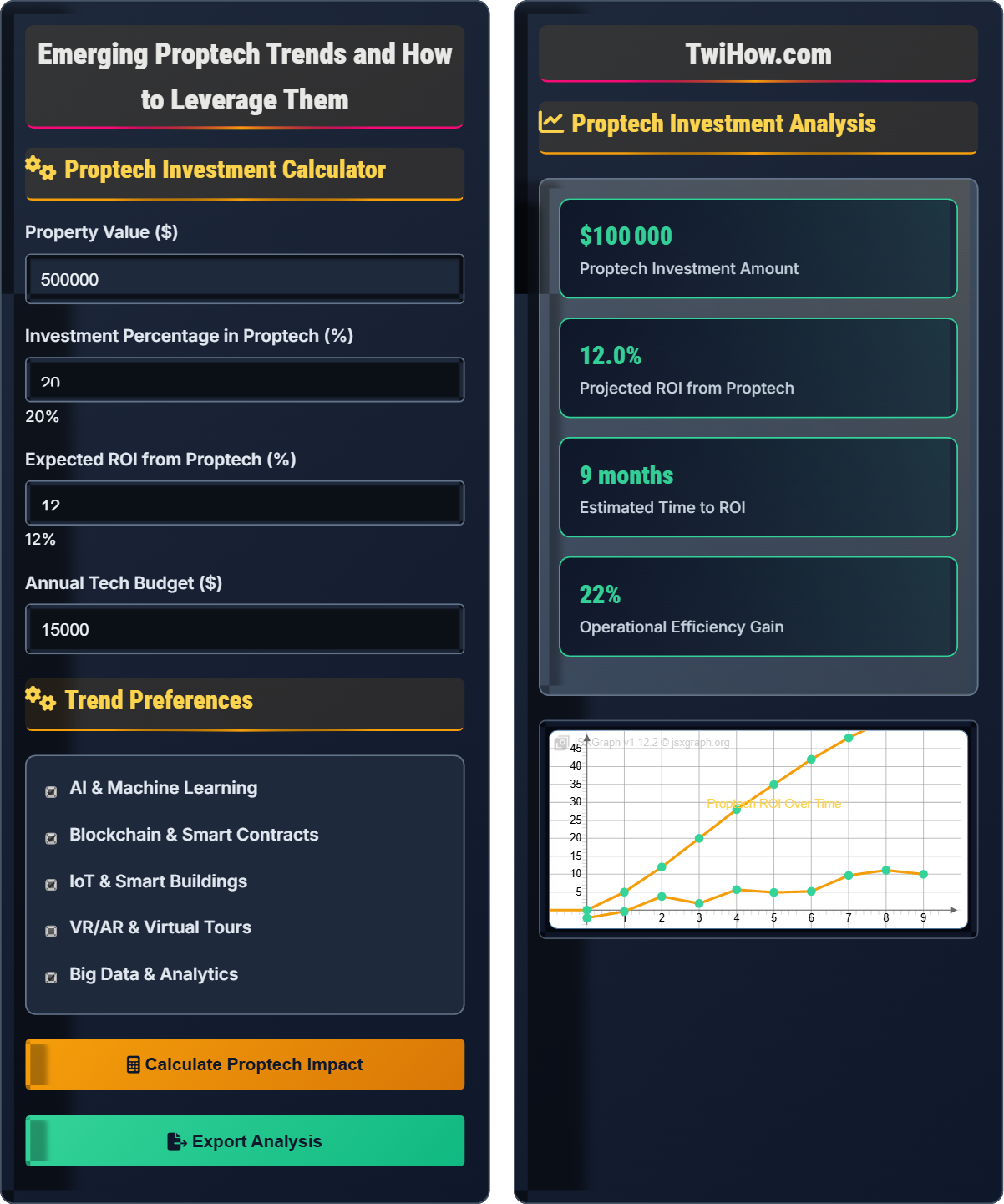
Proptech Investment Calculator
Trend Preferences
Proptech Investment Analysis
| Trend | Impact Level | Investment Required | ROI Potential |
|---|---|---|---|
| AI Analytics | High | $25,000 | 15% |
| Smart Building | Medium | $15,000 | 10% |
| Virtual Tours | Low | $5,000 | 5% |
| Blockchain | Medium | $20,000 | 12% |
| Data Analytics | High | $30,000 | 18% |
Proptech Trends Explained
Proptech (Property Technology) refers to the integration of technology into real estate markets to improve efficiency, transparency, and profitability. It encompasses a wide range of innovations including artificial intelligence, blockchain, Internet of Things (IoT), virtual reality, and big data analytics applied to property-related activities.
The impact of Proptech on real estate investments can be measured by:
Where:
- Cost Savings: Reduced operational expenses through automation
- Revenue Growth: Increased property values and rental income
- Total Proptech Investment: Initial and ongoing tech costs
Major trends transforming real estate investing:
- AI-Powered Analytics: Predictive modeling for market trends and property valuations
- Blockchain Integration: Secure, transparent property transactions and smart contracts
- IoT Solutions: Smart buildings and connected property management systems
- Virtual/Augmented Reality: Immersive property viewing and remote transactions
- Big Data & Analytics: Comprehensive market insights and investment optimization
- Early Adoption: Gain competitive advantage through first-mover benefits
- Data-Driven Decisions: Use analytics for better investment choices
- Operational Efficiency: Reduce costs through automation and optimization
- Enhanced Experience: Attract and retain tenants with modern amenities
- Scalability: Implement solutions that grow with your portfolio
Proptech Fundamentals
AI analytics, blockchain transactions, IoT sensors, VR/AR experiences, big data insights.
ROI = (Cost Savings + Revenue Growth) / Total Proptech Investment × 100
Where ROI = return on investment, Cost Savings = reduced operational expenses.
- Technology adoption increases property value
- Data drives better investment decisions
- Efficiency gains translate to profit
Leverage Strategies
Early adoption, data analytics, operational efficiency, tenant experience enhancement.
- Assess current operations
- Identify relevant technologies
- Develop implementation plan
- Deploy and monitor
- Initial investment costs
- Staff training requirements
- ROI timeline expectations
- Integration complexity
Proptech Learning Quiz
Which of the following is NOT a major Proptech trend transforming real estate investing?
Proptech encompasses digital innovations that improve real estate processes. Traditional paper-based transactions represent the old way of doing business and are being replaced by digital solutions. Major Proptech trends include AI analytics, blockchain for secure transactions, IoT for smart building management, and other digital technologies.
The answer is D) Traditional Paper-Based Transactions.
Understanding Proptech requires recognizing that it's fundamentally about digitizing and optimizing real estate processes. The "proptech" term itself combines "property" and "technology," indicating that traditional real estate practices are being enhanced or replaced by technological solutions. The goal is to increase efficiency, transparency, and profitability across all aspects of real estate.
Proptech: Technology applied to real estate to improve efficiency and profitability
AI Analytics: Artificial intelligence used to analyze real estate data
Blockchain: Distributed ledger technology for secure transactions
• Proptech is about digital transformation
• Traditional methods are being replaced
• Technology aims to increase efficiency
• Focus on digital solutions in Proptech
• Look for technologies that automate processes
• Consider how technology improves outcomes
• Including outdated traditional methods
• Confusing Proptech with general technology
• Not focusing on real estate applications
Explain how to calculate the return on investment (ROI) for implementing Proptech solutions in a real estate portfolio. Include the formula and explain each component.
Proptech ROI Formula: ROI = (Cost Savings + Revenue Growth) / Total Proptech Investment × 100
Components:
Cost Savings: Operational expenses reduced through automation (e.g., reduced management fees, lower utility costs through smart systems, decreased maintenance costs).
Revenue Growth: Additional income generated (e.g., higher rents due to tech amenities, increased property values, faster lease-up rates).
Total Proptech Investment: Initial setup costs plus ongoing operational costs for technology solutions.
Example: If Proptech investment is $50,000, cost savings are $15,000/year, and revenue growth is $10,000/year, then ROI = ($15,000 + $10,000) / $50,000 × 100 = 50%.
Calculating Proptech ROI requires considering both direct cost reductions and indirect revenue enhancements. The investment pays off when the combined benefits exceed the costs. This formula helps investors evaluate whether the technology investment is financially worthwhile. It's important to consider both immediate and long-term impacts when calculating returns.
ROI: Return on investment percentage measure
Cost Savings: Reduced expenses through technology
Revenue Growth: Increased income from tech improvements
• Include both cost savings and revenue growth
• Account for total investment including ongoing costs
• Consider long-term benefits beyond immediate returns
• Track both direct and indirect benefits
• Consider tenant retention value
• Factor in time value of money
• Only counting direct cost savings
• Ignoring ongoing maintenance costs
• Not accounting for intangible benefits
You're managing a portfolio of 200 rental units and want to implement Proptech solutions to improve efficiency and tenant satisfaction. Describe your implementation strategy, including which technologies to prioritize, the expected timeline, and the anticipated financial impact over 3 years.
Phase 1 (Months 1-6): Implement property management software and online rent payment systems. Expected cost: $25,000. Benefits: Reduced administrative costs, faster rent collection.
Phase 2 (Months 7-12): Install IoT sensors for utilities monitoring and predictive maintenance. Expected cost: $50,000. Benefits: 15% reduction in maintenance costs, improved tenant satisfaction.
Phase 3 (Years 2-3): Deploy AI-powered analytics for market analysis and dynamic pricing. Expected cost: $75,000. Benefits: Optimized rental rates, better investment decisions.
Financial Impact: Total investment of $150,000 with projected annual savings of $45,000 and revenue increases of $30,000, achieving positive ROI by year 2.
Successful Proptech implementation requires a phased approach that starts with foundational systems before advancing to sophisticated analytics. The strategy should prioritize solutions that address the most significant pain points first, ensuring quick wins that justify further investment. Measuring success through concrete metrics helps validate the investment and guide future decisions.
Property Management Software: Digital platform for managing rentals
IoT Sensors: Connected devices for monitoring building systemsAI Analytics: Machine learning for market insights
• Start with foundational technologies
• Measure and track ROI
• Prioritize tenant experience
• Implement gradually to minimize disruption
• Train staff thoroughly
• Communicate benefits to tenants
• Implementing too many changes simultaneously
• Underestimating training needs
• Not tracking financial impact
Your competitors have started implementing comprehensive Proptech solutions, and you're losing tenants to newer, tech-enabled properties. How would you assess the situation and develop a response strategy that leverages Proptech to regain your competitive advantage?
Assessment: Conduct a competitive analysis to identify which Proptech features competitors offer and which ones tenants value most. Survey current and lost tenants to understand their preferences.
Response Strategy: Prioritize high-impact, low-cost implementations first (online portal, mobile app access). Then focus on differentiation opportunities like smart home features or energy efficiency systems.
Implementation: Create a rapid deployment plan with quick wins (3-month timeline) followed by comprehensive upgrades. Focus on tenant communication to highlight new features.
Long-term Positioning: Establish Proptech as a core competency with continuous innovation and improvement processes.
Competitive pressures in Proptech often require reactive implementation, but the best approach turns defensive actions into strategic advantages. The key is to not simply match competitors but to identify unique value propositions that differentiate your properties. This requires understanding tenant needs, market trends, and technological possibilities.
Competitive Analysis: Evaluation of competitor offerings
Quick Wins: Rapid implementations with immediate benefits
Differentiation: Unique value proposition
• Respond quickly to competitive threats
• Focus on tenant value
• Differentiate rather than just compete
• Survey tenants regularly
• Monitor competitor moves
• Implement in phases
• Copying competitors instead of innovating
• Overcomplicating solutions
• Not measuring tenant satisfaction
Which of the following represents the most significant long-term benefit of Proptech adoption for real estate investors?
While all options provide benefits, enhanced data-driven decision making creates the most significant long-term advantage. Proptech generates valuable insights about market trends, tenant preferences, property performance, and investment opportunities that lead to better strategic decisions. This capability compounds over time, creating sustained competitive advantages and improved investment returns.
The answer is B) Enhanced data-driven decision making.
The most valuable aspect of Proptech is the information and insights it provides. While immediate benefits like cost reduction and improved satisfaction are important, the ability to make better investment decisions based on comprehensive data has compounding effects. Better decisions lead to better property selection, optimal pricing, improved timing, and strategic portfolio expansion.
Data-Driven Decision Making: Using analytics to inform investment choices
Compounding Advantage: Benefits that grow over time
Strategic Insights: Information for long-term planning
• Information creates lasting advantages
• Data insights compound over time
• Strategic decisions have long-term impact
• Invest in analytics capabilities
• Track key performance metrics
• Use data for strategic planning
• Focusing only on immediate benefits
• Not leveraging data insights
• Treating Proptech as expense not investment
FAQ
Q: How much should I invest in Proptech for my property portfolio?
A: The amount to invest in Proptech depends on your portfolio size, property types, and goals. As a general guideline:
For small portfolios (1-10 units): Start with 2-5% of property value on foundational technologies like property management software and online payment systems.
For medium portfolios (11-100 units): Invest 3-8% of property value, including IoT sensors and basic analytics.
For large portfolios (100+ units): Allocate 5-15% of property value for comprehensive Proptech solutions including AI analytics and integrated systems.
Always conduct a ROI analysis before investing, and prioritize solutions that address your biggest operational challenges first.
Q: What's the difference between PropTech and CRETech?
A: While the terms are often used interchangeably, there are subtle differences:
PropTech: A broader term encompassing all property technology applications, including residential, commercial, industrial, and retail real estate. It covers the entire real estate lifecycle from buying/selling to management and operations.
CRETech: Commercial Real Estate Technology, which specifically focuses on office buildings, retail centers, warehouses, and other commercial properties. CRETech often emphasizes B2B solutions and enterprise-level applications.
Both aim to digitize and optimize real estate processes, but CRETech typically deals with more complex transactions and larger-scale implementations.