REITs vs Physical Properties Investment Analysis
Complete guide to real estate investment comparison • Step-by-step explanations
Investment Comparison:
Show Comparison ToolReal estate investment can be approached through publicly traded REITs (Real Estate Investment Trusts) or direct property ownership. Both methods offer unique advantages and challenges that suit different investment goals and risk tolerances.
Key comparison factors:
- REITs: Liquidity, diversification, professional management, dividend income
- Physical Properties: Direct control, tangible assets, potential appreciation, tax benefits
- Market Exposure: Public markets vs. local markets
- Management: Hands-off vs. hands-on approaches
- Capital Requirements: Fractional vs. full property ownership
Understanding both options helps investors choose the approach that best aligns with their financial goals and risk tolerance.
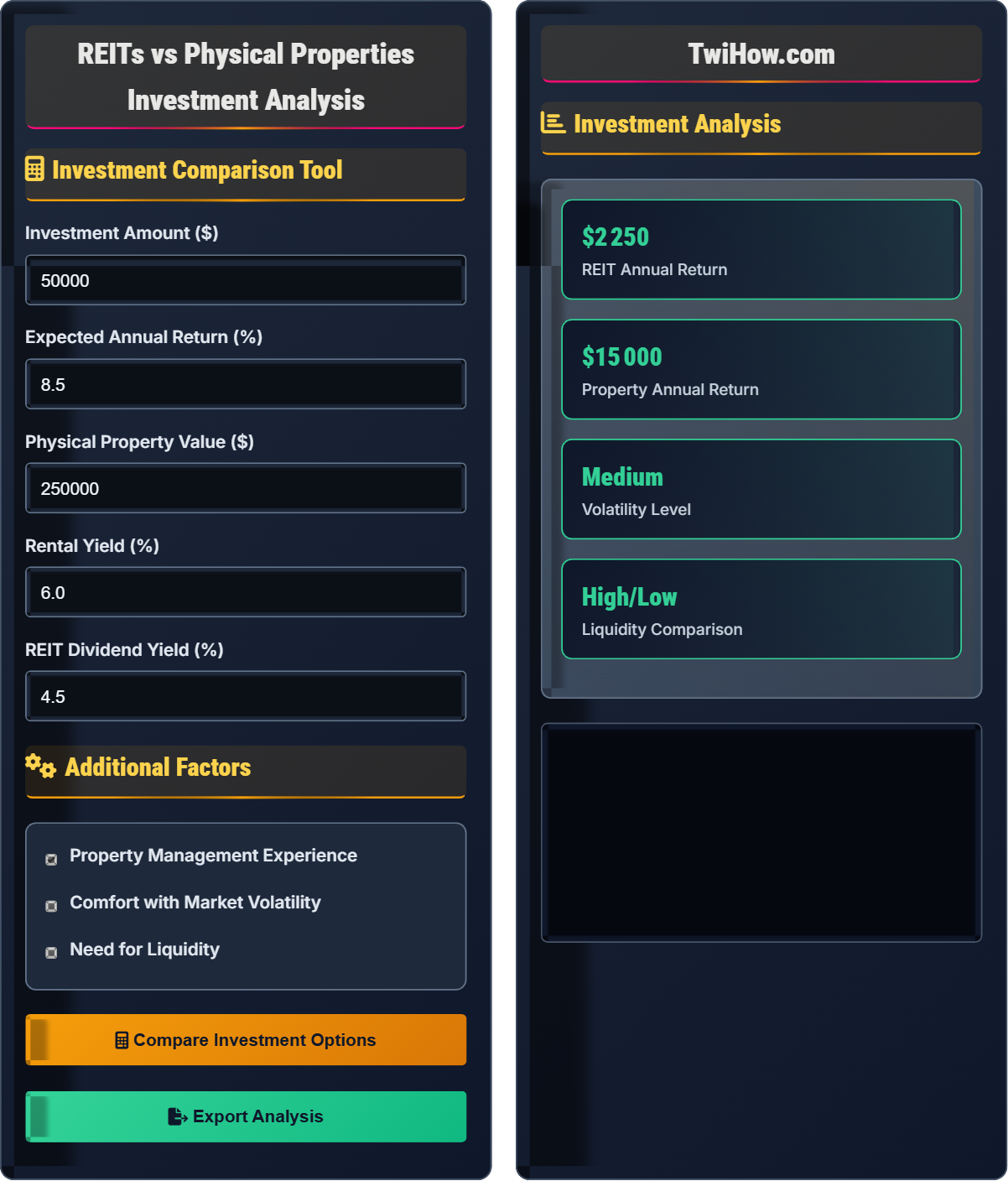
Investment Comparison Tool
Additional Factors
Investment Analysis
| Aspect | REITs | Physical Properties |
|---|---|---|
| Annual Return | 8.5% | 6.0% + appreciation |
| Volatility | High | Low-Medium |
| Liquidity | High | Low |
| Management | Professional | Personal |
Investment Strategy
- REITs: Good for diversification and liquidity
- Physical: Better for control and appreciation
- Hybrid: Consider both for balanced portfolio
- Time horizon: Long-term for properties, short-medium for REITs
Understanding REITs vs Physical Property Investment
Real estate investment can be pursued through two primary methods: publicly traded REITs (Real Estate Investment Trusts) and direct ownership of physical properties. Each approach offers distinct advantages and challenges.
REITs are companies that own, operate, or finance income-generating real estate. Physical property investment involves direct ownership of residential, commercial, or industrial real estate.
- Liquidity: Easily buy and sell shares on stock exchanges
- Diversification: Access to multiple property types and locations
- Professional Management: Experienced operators managing properties
- Dividend Income: Regular distributions required by law
- Low Barrier to Entry: Small initial investment required
- Direct Control: Make decisions about improvements and tenants
- Tangible Asset: Physical property you can see and touch
- Appreciation Potential: Direct benefit from market appreciation
- Tax Benefits: Depreciation, deductions, and 1031 exchanges
- Cash Flow: Direct rental income without intermediaries
Both investment types carry risks:
- REIT Risks: Market volatility, interest rate sensitivity, management risk
- Property Risks: Vacancy periods, maintenance costs, local market changes, tenant issues
Investment Strategy Framework
Time horizon, risk tolerance, capital availability, management preference, liquidity needs.
Optimal Choice = (Investment Goals × Risk Tolerance × Capital Availability) / (Management Effort + Liquidity Needs)
Where higher values indicate better fit for physical properties, lower values indicate better fit for REITs.
- Match investment to personal goals
- Consider total portfolio allocation
- Factor in time and management requirements
REIT vs Property Analysis
REITs offer liquidity and diversification, properties offer control and appreciation potential.
- Evaluate liquidity needs
- Assess management capabilities
- Analyze risk tolerance
- Consider tax implications
- Plan for diversification
- REITs are sensitive to interest rates
- Properties require active management
- Both can coexist in portfolios
- Market conditions affect both differently
REIT vs Property Investment Quiz
Which investment type offers the highest liquidity?
Publicly traded REITs offer significantly higher liquidity than physical properties. REIT shares can be bought or sold instantly on stock exchanges during market hours, while physical properties typically take 30-90 days to sell and involve complex transactions.
The answer is B) Publicly traded REITs.
Liquidity refers to how quickly and easily an investment can be converted to cash. REITs behave like stocks, offering instant liquidity, while physical real estate requires time-consuming sales processes.
Liquidity: Ease of converting investment to cash
REIT: Real Estate Investment Trust
Market Hours: Times when stock exchanges are open
• REITs trade like stocks
• Property sales take time
• Liquidity affects investment strategy
• Consider liquidity needs before investing
• REITs for short-term needs
• Properties for long-term holdings
• Assuming property sales are instant
• Not considering liquidity in planning
• Misunderstanding REIT trading
Compare the tax implications of REITs vs physical property investments.
REIT Tax Implications:
• REIT dividends are typically taxed as ordinary income
• No depreciation benefits for REIT investors
• Capital gains apply to REIT share sales
• Some REIT income may qualify for pass-through deduction
Physical Property Tax Implications:
• Depreciation deductions reduce taxable income
• Interest on mortgages is tax-deductible
• Operating expenses are deductible
• 1031 exchanges allow deferring capital gains
• Potential for lower long-term tax rates
Physical properties generally offer more favorable tax treatment through deductions and deferrals.
Tax considerations play a significant role in investment decisions. Physical properties provide numerous tax benefits that can significantly reduce taxable income, while REITs are taxed more like traditional stocks.
Depreciation: Tax deduction for property value decline
Pass-through Deduction: Special tax deduction for certain income
1031 Exchange: Tax-deferred property swap
• Consult tax professionals
• Understand local tax laws
• Track all expenses
• Maximize property tax deductions
• Consider REIT tax efficiency
• Plan for 1031 exchanges
• Not maximizing property tax benefits
• Forgetting REIT dividend taxation
• Not planning for capital gains
Sarah has $100,000 to invest in real estate. She's a busy professional with no property management experience. She wants to generate income but is concerned about market volatility. She's considering either investing in a diversified REIT portfolio or buying a rental property. Which option would be most suitable and why?
Analysis:
Time Constraints: Sarah's busy schedule makes property management challenging
Experience: Lack of property management experience favors REITs
Volatility Concerns: REITs offer more predictable income
Capital Allocation: $100K allows for diversified REIT investment
Recommendation: REITs would be more suitable for Sarah's situation. She can achieve real estate exposure without management responsibilities. However, she should consider a hybrid approach with a portion in REITs and a portion in professionally managed properties.
Investment selection should align with personal circumstances. Sarah's situation (time constraints, lack of experience, risk concerns) perfectly matches the benefits of REIT investment.
Hybrid Approach: Combining multiple investment strategies
Professional Management: Hiring experts to manage investments
Real Estate Exposure: Investment in real estate assets
• Match investment to personal situation
• Consider time requirements
• Factor in experience level
• Diversify across investment types
• Consider your lifestyle
• Plan for future needs
• Not considering time requirements
• Ignoring personal experience level
• Failing to match investment to goals
How would rising interest rates affect REITs vs physical properties differently?
REIT Impact:
• REITs typically decline as interest rates rise
• Higher borrowing costs for REITs
• Investors move to higher-yielding bonds
Physical Property Impact:
• Higher mortgage rates increase property costs
• Property values may decline
• Rental demand may increase (people can't buy)
Relative Impact: REITs are generally more sensitive to interest rate changes than individual properties.
Interest rate sensitivity differs between investment types. REITs behave more like bonds (inversely related to rates) while physical properties have more complex relationships with interest rates.
Interest Rate Sensitivity: How investments react to rate changes
Bond-like Behavior: Inverse relationship with interest rates
Rental Demand: Number of people seeking rentals
• Monitor interest rate trends
• Understand investment sensitivity
• Plan for rate changes
• Diversify during rate changes
• Consider interest rate hedging
• Plan for market cycles
• Not understanding rate sensitivity
• Ignoring market conditions
• Failing to plan for changes
Which investment type offers better geographic diversification?
REITs offer better geographic diversification because they typically own properties across multiple markets and regions. A single REIT can provide exposure to properties in dozens of cities across different states, while physical property ownership is geographically concentrated.
The answer is B) REITs.
Geographic diversification reduces risk by spreading exposure across different markets. REITs naturally provide this through their portfolio approach, while individual property owners must purchase multiple properties in different locations.
Geographic Diversification: Spreading investments across locations
Market Concentration: Risk from single location exposure
Portfolio Approach: Diversified asset management
• Diversify across markets
• Reduce location risk
• Spread geographic exposure
• Use REITs for geographic exposure
• Consider regional economic factors
• Balance local and national exposure
• Concentrating in one market
• Not diversifying geographically
• Overlooking location risks
Frequently Asked Questions
Q: Should I invest in REITs or physical properties first?
A: Consider starting with REITs if you have limited capital, time, or experience. REITs allow you to learn about real estate investment without management responsibilities. Once you have more capital and experience, you can transition to physical properties.
REITs provide:
• Diversification with small amounts
• Professional management
• Liquidity for changes
Physical properties offer:
• Direct control and benefits
• Better long-term appreciation
• Superior tax advantages
Many investors use both approaches in their portfolios.
Q: How do I evaluate REIT performance?
A: Key metrics for REIT evaluation:
Dividend Yield: Annual dividends divided by share price
FFO (Funds From Operations): Cash flow measure for REITs
Debt-to-Equity Ratio: Financial leverage and risk indicator
Property Portfolio Quality: Location, occupancy, tenant quality
Management Track Record: Historical performance and strategy
Compare these metrics to similar REITs in the same property sector.
Q: What are the minimum investment requirements?
A: Investment requirements vary significantly:
REITs: Can start with as little as one share (typically $10-50)
Physical Properties: Requires 20-25% down payment plus closing costs and reserves
Example: For a $200,000 property, you'd need $40,000-50,000 plus additional funds
REITs allow fractional investment with much lower barriers to entry, making them accessible for smaller investors.