BRRRR Method Real Estate Investing Guide
Complete guide to buy, rehab, rent, refinance, repeat • Step-by-step explanations
BRRRR Strategy:
Show BRRRR CalculatorThe BRRRR method (Buy, Rehab, Rent, Refinance, Repeat) is a popular real estate investment strategy that allows investors to build a portfolio using leverage and cash flow. This strategy enables investors to acquire properties with minimal cash outlay while building long-term wealth.
Key components of the BRRRR method:
- Buy: Purchase below market value with cash or conventional loan
- Rehab: Add value through renovations and improvements
- Rent: Lease the property to generate cash flow
- Refinance: Extract equity through cash-out refinance
- Repeat: Use extracted equity for next investment
Successful implementation requires careful property selection, renovation planning, and market analysis.
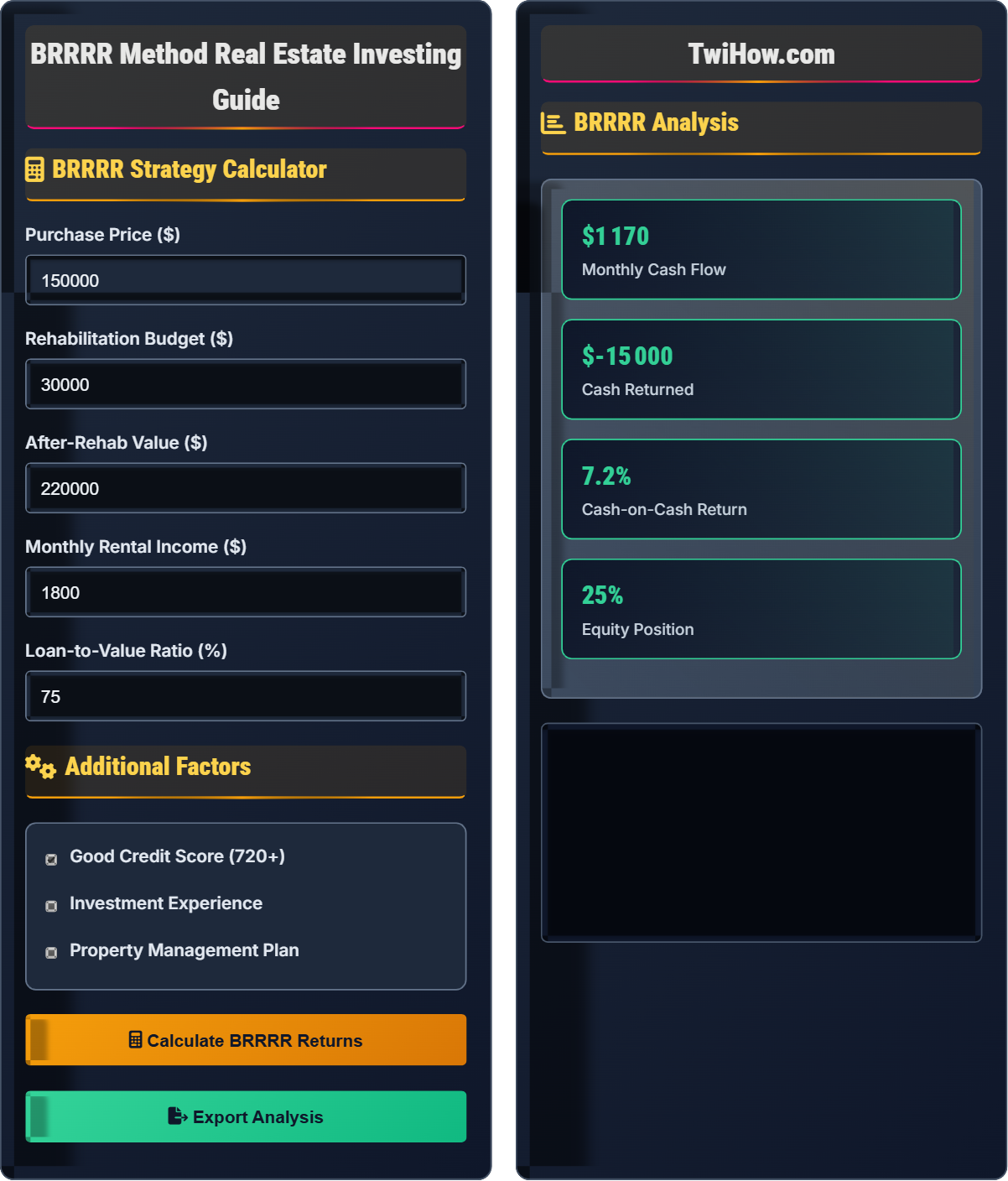
BRRRR Strategy Calculator
Additional Factors
BRRRR Analysis
| Metric | Amount | Status |
|---|---|---|
| Total Investment | $180,000 | Initial Outlay |
| Refinance Loan | $165,000 | 75% LTV |
| Cash Returned | $45,000 | Available for Next Deal |
| Remaining Equity | $55,000 | Property Appreciation |
Strategy Recommendations
- Property is viable for BRRRR strategy
- Good cash flow potential
- Strong refinance opportunity
- Consider market timing for purchase
Understanding the BRRRR Method
The BRRRR method is a real estate investment strategy that stands for Buy, Rehab, Rent, Refinance, Repeat. It's designed to build a real estate portfolio using leverage and cash flow while minimizing initial cash outlay.
The five steps include:
- Buy: Purchase a property below market value with cash or conventional financing
- Rehab: Improve the property to increase its value and rental potential
- Rent: Lease the property to generate positive cash flow
- Refinance: Use the increased value to refinance and pull out equity
- Repeat: Use the extracted equity to fund the next BRRRR deal
The BRRRR method follows a specific financial sequence:
Success with the BRRRR method requires careful attention to:
- Property Selection: Finding properties with significant value-add potential
- Rehabilitation: Managing renovation costs and timelines
- Market Timing: Understanding local market conditions
- Financing: Maintaining good credit and qualifying for loans
- Property Management: Effective tenant screening and maintenance
Benefits of the BRRRR method:
- Builds portfolio with minimal cash outlay
- Generates positive cash flow
- Creates forced appreciation through improvements
- Provides tax advantages
- Builds long-term wealth
Risks to consider:
- Renovation costs exceeding budget
- Market downturns affecting property values
- Difficulty qualifying for subsequent loans
- Refinance market changes
- Extended vacancy periods
BRRRR Strategy Steps
Buy, Rehab, Rent, Refinance, Repeat - each step builds on the previous one.
Success = (Property Value Increase × Loan-to-Value) - (Total Investment + Closing Costs)
Where positive results indicate successful equity extraction.
- Always buy below market value
- Keep renovation costs under 20% of ARV
- Achieve positive cash flow after refinance
Is BRRRR Right For Me?
Good credit, sufficient capital, renovation experience, property management skills.
- Do you have access to capital for initial purchase?
- Can you qualify for multiple loans?
- Are you comfortable with renovation projects?
- Do you have property management experience?
- Can you handle market fluctuations?
- Requires significant initial capital
- Dependent on credit score
- Market conditions affect success
- Time-intensive process
BRRRR Method Knowledge Quiz
What does the "R" stand for in the second "R" of BRRRR?
The BRRRR method stands for Buy, Rehab, Rent, Refinance, Repeat. The second "R" stands for Rent, which is the third step in the process. After purchasing and renovating the property, the investor leases it to tenants to generate cash flow before refinancing.
The answer is C) Rent.
Understanding the sequence of the BRRRR method is crucial for successful implementation. Each step builds upon the previous one, and skipping steps or misordering them can prevent the strategy from working effectively.
BRRRR Method: Buy, Rehab, Rent, Refinance, Repeat strategy
Cash Flow: Positive income from rental property
Equity Extraction: Recovering investment through refinance
• Follow the sequence in order
• Achieve positive cash flow before refinancing
• Maintain good credit for multiple loans
• Memorize the acronym and sequence
• Plan each step carefully
• Build relationships with lenders early
• Skipping the rental step before refinancing
• Not achieving positive cash flow
• Underestimating renovation costs
Explain why loan qualification is critical for the BRRRR method and what factors lenders consider when evaluating BRRRR investors.
Importance of Loan Qualification: The BRRRR method relies heavily on refinancing to extract equity and fund subsequent investments. Without the ability to qualify for loans, the "repeat" part of the strategy fails.
Lender Considerations:
Credit Score: Typically requires 620-720+ for investment properties, with better rates for higher scores.
Debt-to-Income Ratio: Usually must be below 43% for conventional loans.
Reserves: Lenders often require 6-12 months of mortgage payments in reserves.
Experience: Some lenders prefer investors with previous rental property experience.
Property Performance: Lenders review rental income and property cash flow.
Investors must maintain good financial standing and build relationships with lenders who understand the BRRRR strategy.
Loan qualification is the foundation of the BRRRR method's repeatability. Unlike other investment strategies, BRRRR requires frequent access to capital markets, making creditworthiness and lender relationships essential for long-term success.
Debt-to-Income Ratio: Monthly debt payments relative to gross income
Reserves: Liquid assets maintained for mortgage payments
Investment Property: Real estate purchased for income generation
• Maintain excellent credit score
• Work with portfolio lenders familiar with BRRRR
• Maintain separate business entities
• Keep detailed financial records
• Not maintaining credit standards
• Underestimating reserve requirements
• Not building lender relationships
Sarah purchases a property for $180,000 and spends $40,000 on renovations. After improvements, the property appraises for $280,000. She rents it for $2,200/month. If she refinances with a 75% LTV loan, how much cash does she get back and what's her ongoing investment?
Calculations:
Total Investment: $180,000 + $40,000 = $220,000
Refinance Loan Amount: $280,000 × 75% = $210,000
Cash Returned: $210,000 - $220,000 = -$10,000
Correction: Sarah would need to bring an additional $10,000 to close the refinance, not get cash back. This shows the importance of ensuring the after-rehab value supports the desired LTV ratio.
Required ARV for 75% LTV: $220,000 ÷ 0.75 = $293,333
To achieve positive cash extraction, the property would need to appraise at $293,333 or higher.
This example demonstrates why property selection and renovation planning are critical. The after-rehab value must be sufficient to support the desired loan-to-value ratio. If the value isn't high enough, the investor may need to contribute additional capital.
After-Rehab Value (ARV): Projected value after renovations
Loan-to-Value (LTV): Loan amount as percentage of property valueEquity Extraction: Cash obtained through refinancing
• ARV must exceed total investment
• Plan for sufficient value increase
• Consider renovation costs as percentage of ARV
• Use comparable sales to estimate ARV
• Keep renovation costs under 20% of ARV
• Plan for 10% buffer on estimates
• Overestimating ARV
• Underestimating renovation costs
• Not accounting for carrying costs
During a market downturn, property values decline by 15%. If you're mid-way through a BRRRR deal with a property that appraised at $250,000 before the decline, how does this affect your ability to refinance? What should you do?
Market Impact:
Original Appraisal: $250,000
Post-Decline Value: $250,000 × (1 - 0.15) = $212,500
75% LTV Loan: $212,500 × 0.75 = $159,375
Scenario: If total investment was $200,000, refinancing would only return $159,375, leaving $40,625 of cash at risk.
Strategic Response:
1. Continue Operating: Hold the property and wait for market recovery
2. Minimize Losses: Focus on maintaining positive cash flow
3. Monitor Closely: Track market conditions for improvement
4. Adjust Strategy: Consider refinancing when market recovers
Market downturns test the long-term viability of the BRRRR strategy.
This scenario illustrates the market risk inherent in the BRRRR method. Property values can decline during the renovation and stabilization period, affecting the ability to extract equity. Successful BRRRR investors must be prepared for market fluctuations.
Market Downturn: Period of declining property values
Carrying Costs: Expenses during renovation and vacancy
Market Risk: Risk from property value fluctuations
• Plan for market volatility
• Maintain adequate reserves
• Focus on cash flow sustainability
• Build in market buffers
• Focus on long-term trends
• Maintain emergency reserves
• Not planning for market declines
• Over-leveraging during good times
• Failing to maintain reserves
After refinancing a BRRRR property, if your monthly rental income is $2,000 and monthly expenses (including mortgage) are $1,600, what is your monthly cash flow?
Monthly cash flow is calculated by subtracting total monthly expenses from monthly rental income.
Cash Flow = Rental Income - Monthly Expenses
Cash Flow = $2,000 - $1,600 = $400
The answer is C) $400.
Positive cash flow is essential for the sustainability of rental properties. The BRRRR method relies on properties generating positive cash flow to support the investment and provide returns to the investor.
Cash Flow: Income remaining after all expenses
Positive Cash Flow: Income exceeds expenses
Operating Expenses: All costs to operate the property
• Positive cash flow is essential
• Include all expenses in calculations
• Plan for vacancy and repairs
• Include reserves for repairs
• Plan for 5-10% vacancy
• Factor in property management
• Not including all expenses
• Ignoring vacancy periods
• Underestimating maintenance costs
Frequently Asked Questions
Q: How much money do I need to start the BRRRR method?
A: The amount needed varies significantly based on your market, but generally:
Conservative Start: $50,000-100,000 for initial purchase, down payment, and rehab budget
Minimum Down Payment: 20% for investment properties (higher than primary residence)
Rehab Budget: $20,000-50,000 depending on property condition
Reserves: 6-12 months of expenses in reserves
Many investors start with one property and use the cash-out refinance to fund subsequent deals. Consider starting with a smaller market to reduce initial capital requirements.
Q: What are the tax implications of the BRRRR method?
A: The BRRRR method has several tax implications:
Depreciation: You can depreciate the building portion of your property over 27.5 years, reducing taxable income.
Expense Deductions: Repairs, maintenance, insurance, and property management fees are deductible.
Refinance: Cash-out refinancing is not taxable income since it's borrowed money.
Refinance Costs: Closing costs from refinancing can be amortized over the loan term.
Appreciation: Property appreciation is not taxed until sale (subject to capital gains).
Always consult with a tax professional familiar with real estate investing to maximize tax benefits and ensure compliance.
Q: How do I find good BRRRR properties?
A: Finding good BRRRR properties requires multiple strategies:
Wholesalers: Connect with wholesalers who find distressed properties
Foreclosure Lists: Check pre-foreclosure and auction lists
Direct Marketing: Send letters to probate, absentee owners, and distressed property owners
Online Platforms: Use BiggerPockets, LoopNet, and local MLS
Networking: Join local real estate investment groups
Criteria: Look for properties that can be bought 20-30% below market value with clear path to value-add improvements.
Focus on markets with strong rental demand and appreciation potential.