What is the Role of Due Diligence in Avoiding Bad Investments?
Complete guide • Step-by-step explanations
Due Diligence Guide:
Show DD CalculatorDue diligence is the critical process of investigating and evaluating a potential investment before making a commitment. In real estate, due diligence serves as a protective mechanism that helps investors identify risks, validate opportunities, and make informed decisions. Through systematic investigation, investors can uncover hidden issues, verify property conditions, and assess market realities.
Key components of due diligence include:
- Physical Inspection: Evaluating property condition and structural integrity
- Financial Analysis: Verifying income, expenses, and cash flow projections
- Legal Review: Examining titles, deeds, and regulatory compliance
- Market Research: Analyzing local market trends and competition
- Environmental Assessment: Identifying potential environmental hazards
Proper due diligence transforms unknown risks into manageable factors and helps avoid costly investment mistakes.
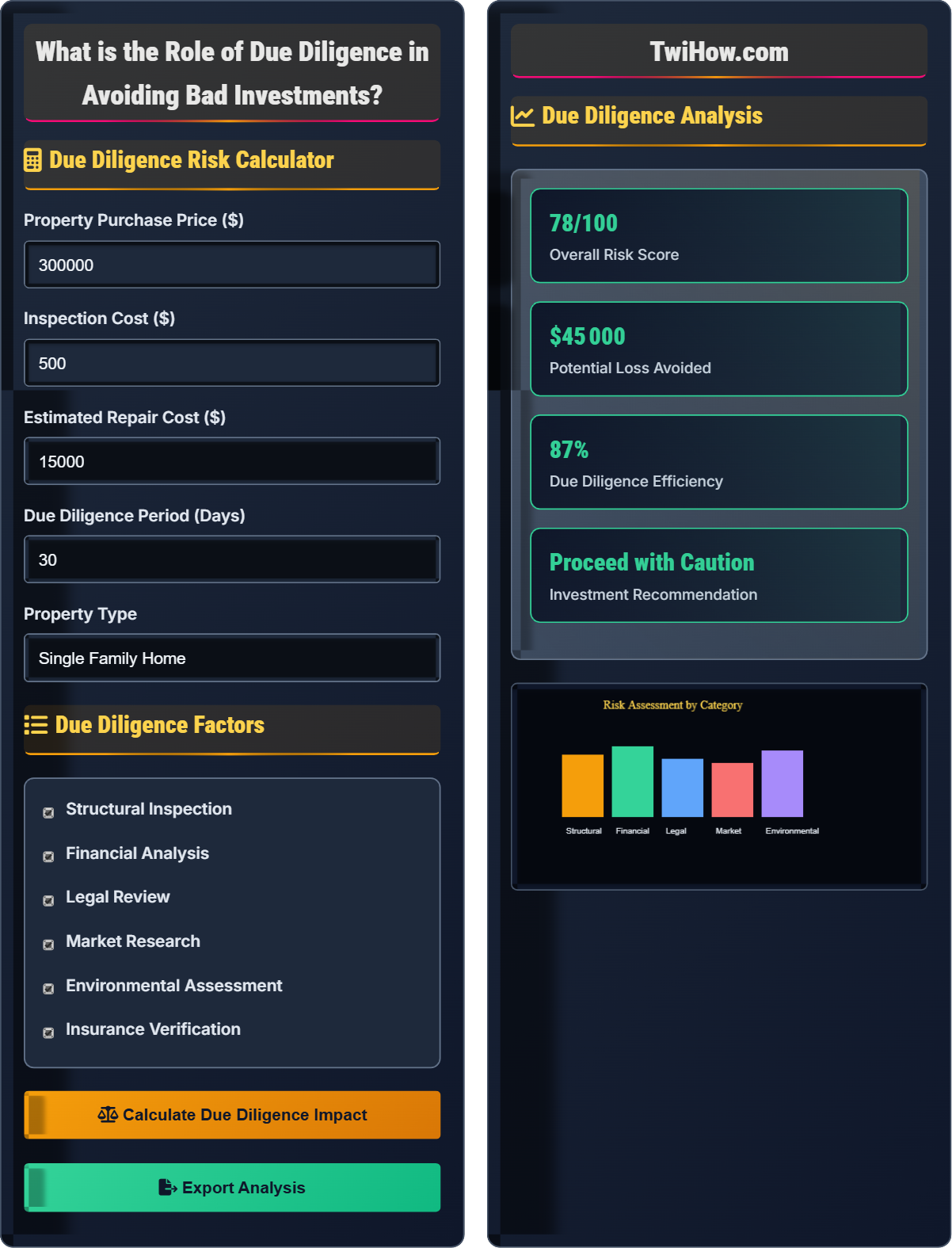
Due Diligence Risk Calculator
Due Diligence Factors
Due Diligence Analysis
| Factor | Risk Level | Impact | Mitigation |
|---|---|---|---|
| Structural Issues | Medium | $5,000 | Thorough inspection |
| Financial Misrepresentation | High | $20,000 | Verification |
| Legal Complications | Medium | $8,000 | Legal review |
| Market Misalignment | Low | $3,000 | Research |
| Environmental Hazards | Medium | $9,000 | Assessment |
Structural: Foundation, roof, walls, framing
Mechanical: HVAC, electrical, plumbing systems
Environmental: Mold, asbestos, radon, lead
Income Verification: Rent rolls, occupancy rates
Expense Analysis: Operating costs, reserves
Cash Flow: NOI calculations, cap rates
Title Search: Ownership, liens, encumbrances
Zoning: Compliance, permitted uses
Regulations: Local codes, HOA rules
Understanding Due Diligence in Real Estate Investing
Due diligence is the systematic investigation and evaluation of a property or investment opportunity before making a purchase decision. It involves verifying all aspects of the investment to ensure that:
- All representations are accurate and complete
- Hidden risks and liabilities are identified
- Financial projections are realistic and verifiable
- Legal and regulatory requirements are satisfied
- The property meets your investment criteria
Due diligence serves as the foundation for informed investment decisions and risk management.
Due diligence effectiveness can be measured by its impact on risk mitigation:
For example, if due diligence reveals $50,000 in potential repair costs that were not disclosed, and the total investment risk was $200,000, then due diligence reduced risk by 25%.
Where:
- Potential Loss Avoided: Amount of damage prevented through due diligence
- Total Investment Risk: Overall risk exposure without due diligence
- Risk Reduction: Percentage decrease in risk through investigation
Due diligence helps identify various types of risks that could turn good investments into bad ones:
- Physical Risks: Structural issues, environmental hazards, system failures
- Financial Risks: Misrepresented income, hidden expenses, cash flow problems
- Legal Risks: Title defects, zoning violations, regulatory issues
- Market Risks: Declining demand, oversupply, economic downturns
- Operational Risks: Tenant issues, management challenges, maintenance costs
- Never Skip Steps: Complete all due diligence components thoroughly
- Independent Verification: Verify all information independently
- Professional Help: Engage qualified professionals for complex issues
- Document Everything: Keep detailed records of all findings
- Time Management: Allocate sufficient time for comprehensive review
- Walk Away Option: Be prepared to walk away if issues are significant
Due Diligence Fundamentals
Due diligence, risk mitigation, property inspection, financial verification, legal review, market analysis.
Risk Reduction = (Potential Loss Avoided / Total Investment Risk) × 100
Where Potential Loss Avoided = Damage prevented through due diligence, Total Investment Risk = Overall risk without due diligence.
- Never rely solely on seller representations
- Verify all financial information independently
- Engage qualified professionals
- Complete all due diligence steps
Risk Assessment
Physical risks, financial risks, legal risks, market risks, operational risks.
- Identify potential risks
- Assess likelihood and impact
- Develop mitigation strategies
- Implement risk controls
- Monitor and adjust
- Cost vs. benefit of investigation
- Time constraints and market conditions
- Professional expertise requirements
- Documentation and record keeping
Due Diligence Quiz
Which of the following is the most important aspect of due diligence that is often overlooked by new investors?
Independent financial verification is often the most overlooked aspect of due diligence. New investors tend to accept seller-provided financial statements without independent verification, which can lead to discovering misrepresented income, hidden expenses, or unrealistic cash flow projections after purchase. Independent verification of rent rolls, operating expenses, and vacancy rates is crucial for accurate investment analysis.
The answer is B) Independent financial verification.
Financial verification is fundamental because it validates the core premise of any investment: the income stream. Without accurate financial information, all other analysis becomes irrelevant. New investors often trust seller representations too readily, not realizing that sellers have incentives to present properties in the best possible light. Independent verification protects against this bias and provides a realistic foundation for investment decisions.
Independent Verification: Confirming information through third-party sources
Rent Rolls: Records of current and projected rental income
Operating Expenses: Ongoing costs to maintain and operate property
• Never accept financials without verification
• Request third-party documentation
• Request bank statements showing deposits
• Contact tenants directly for confirmation
• Review utility bills and maintenance records
• Accepting seller-provided financials
• Not verifying tenant information
• Overlooking hidden operating expenses
Explain the complete due diligence process for a multi-unit rental property, including the order of steps, key professionals to engage, and critical documents to review.
Step 1 - Initial Documentation Review: Obtain and review all seller-provided documents including rent rolls, operating statements, tax returns, insurance policies, and maintenance records. Begin preliminary market research.
Step 2 - Engage Professional Team: Hire a qualified property inspector, attorney, and accountant. Consider environmental specialists if warranted.
Step 3 - Physical Inspection: Conduct comprehensive inspection of structural elements, mechanical systems, electrical, plumbing, and safety features. Document all deficiencies and estimate repair costs.
Step 4 - Financial Verification: Independently verify all income sources, contact tenants for rent confirmation, review lease agreements, and verify operating expenses through vendor statements and receipts.
Step 5 - Legal Review: Attorney examines title, deed, survey, zoning compliance, HOA documents, and any pending litigation. Review lease assignments and tenant rights.
Step 6 - Market Analysis: Research comparable properties, rental rates, vacancy rates, and market trends in the area. Assess property's competitive position.
Step 7 - Final Assessment: Synthesize all findings, update financial projections with actual findings, and make final investment decision.
The due diligence process is systematic and comprehensive, designed to uncover all potential issues before commitment. Each step builds upon the previous one, creating a complete picture of the investment opportunity. The order is important because some discoveries may make later steps unnecessary. The process emphasizes verification over assumption, ensuring that all investment decisions are based on accurate, independently verified information.
Rent Rolls: Schedule of current tenants and rental amounts
Operating Statements: Records of property income and expenses
Due Diligence Period: Time frame for investigation before purchase
• Engage professionals early in process
• Verify all financial information
• Document all findings systematically
• Request access to all units during inspection
• Review lease terms and renewal options
• Check for pending legal issues
• Rushing through inspection process
• Not verifying tenant information
• Overlooking legal encumbrances
An investor is considering a $400,000 apartment building that generates $4,000/month in rent. The seller provides financial statements showing operating expenses of $1,200/month. The investor's due diligence reveals that the actual expenses are $2,000/month, and the building has $30,000 in needed repairs. Calculate the impact of due diligence on the investment analysis and explain how this prevents a bad investment.
Original Analysis (Seller's Numbers):
Annual Income: $4,000 × 12 = $48,000
Annual Expenses: $1,200 × 12 = $14,400
Net Operating Income: $48,000 - $14,400 = $33,600
Cap Rate: $33,600 / $400,000 = 8.4%
Corrected Analysis (Due Diligence Results):
Annual Income: $4,000 × 12 = $48,000
Annual Expenses: $2,000 × 12 = $24,000
Additional Repairs: $30,000
Adjusted NOI: $48,000 - $24,000 = $24,000
Adjusted Cap Rate: $24,000 / $400,000 = 6.0%
Impact of Due Diligence:
The due diligence revealed a $9,600 annual shortfall in cash flow ($33,600 - $24,000), representing a 28.6% reduction in projected returns. Additionally, the $30,000 in needed repairs represents a significant capital expenditure not accounted for in the original analysis.
Prevention of Bad Investment:
Without due diligence, the investor would have purchased a property with 6.0% lower returns than expected and an additional $30,000 in immediate capital needs. The due diligence process revealed that the property was actually generating 28.6% less cash flow than represented, which could have led to negative cash flow and financial distress for the investor.
This scenario demonstrates how due diligence can prevent catastrophic investment mistakes. The financial misrepresentation was substantial enough to completely change the investment profile. The example shows that due diligence doesn't just identify minor issues; it can reveal fundamental problems that make investments unviable. The mathematical analysis clearly shows the dramatic impact of inaccurate financial information on investment returns.
Net Operating Income (NOI): Income minus operating expenses
Cap Rate: NOI divided by purchase price
Due Diligence: Investigation to verify investment details
• Always verify financial statements independently
• Account for all operating expenses
• Consider immediate capital needs
• Request bank statements showing deposits
• Review utility bills and maintenance records
• Contact vendors for expense verification
• Accepting seller's expense figures
• Not accounting for repair costs
• Overlooking hidden operating expenses
You discover during due diligence that a property has foundation cracks, electrical issues, and a potential environmental hazard (asbestos). The seller offers to reduce the price by 10% to cover repairs. Evaluate this situation and explain whether you should proceed with the purchase, reject the offer, or negotiate differently.
Risk Assessment:
Foundation Cracks: Major structural issue that could indicate serious problems. Requires engineering assessment to determine severity and repair costs. Could affect financing and insurance.
Electrical Issues: Safety hazard that must be corrected. Could be costly depending on extent and age of system. May require complete rewiring.
Asbestos: Environmental hazard requiring professional abatement. Highly regulated process that can be extremely expensive and time-consuming. Creates potential liability issues.
Price Reduction Analysis:
A 10% reduction on a $300,000 property is $30,000. However, the combined costs of addressing these issues could easily exceed $100,000 or more, especially asbestos abatement which can cost $15,000-$30,000 alone.
Recommendation:
Reject the offer entirely. These issues represent serious risks that are not adequately addressed by a 10% price reduction. Foundation issues can be unpredictable, electrical problems pose safety risks, and asbestos creates long-term liability concerns. The property should be avoided due to the combination of structural, safety, and environmental risks.
Alternative Approach:
If the property had significant other positive attributes, consider walking away entirely rather than attempting to negotiate. The presence of multiple serious issues (structural, electrical, environmental) creates a high-risk scenario that is not suitable for most investors.
This problem demonstrates the importance of risk categorization and cumulative risk assessment. While individual issues might be manageable, the combination of structural, safety, and environmental hazards creates an unacceptable risk profile. The example shows how due diligence should consider not just individual risks but their interaction and cumulative effect. The lesson emphasizes that some properties are simply not worth pursuing regardless of price.
Cumulative Risk: Combined effect of multiple risk factors
Asbestos Abatement: Removal of hazardous asbestos materials
Environmental Liability: Legal responsibility for contamination
• Don't ignore multiple serious issues
• Consider cumulative risk effects
• Walk away when risks are too high
• Get multiple estimates for repairs
• Consult specialists for complex issues
• Consider long-term liability implications
• Underestimating repair costs
• Ignoring environmental hazards
• Trying to fix too many issues at once
When conducting due diligence on a commercial property, which factor should be evaluated first to avoid the most significant investment risks?
Zoning compliance and permitted uses should be evaluated first because if the property cannot be used for the intended purpose, all other due diligence efforts become irrelevant. A property that is not zoned for the intended use cannot be converted without lengthy and expensive rezoning processes, or may not be convertible at all. This fundamental issue would make the investment worthless regardless of favorable financials or excellent physical condition.
The answer is A) Zoning compliance and permitted uses.
This question emphasizes the importance of legal compliance as a foundational element of due diligence. While financial and physical factors are important, they are meaningless if the property cannot be legally used as intended. The example demonstrates that due diligence should be conducted in a logical sequence, starting with the most fundamental requirements and progressing to more detailed analysis. This approach prevents wasting time and money on detailed analysis of properties that cannot be used as intended.
Zoning Compliance: Property use conforms to local zoning laws
Permitted Uses: Activities allowed under zoning regulations
Rezoning: Process to change property's permitted uses
• Legal compliance comes first
• Verify permitted uses before detailed analysis
• Check zoning before assuming property potential
• Review zoning maps early in process
• Check for pending zoning changes
• Understand setback and density requirements
• Assuming property can be used as intended
• Not verifying zoning compliance
• Ignoring permitted use restrictions
FAQ
Q: How much should I budget for due diligence costs?
A: Budget 1-3% of the purchase price for due diligence costs. For a $300,000 property, this would be $3,000-$9,000. This typically covers home inspection ($400-800), attorney fees ($1,000-3,000), surveys ($300-1,000), environmental tests ($200-1,500), and other specialized inspections. Remember, due diligence costs are an investment in risk avoidance - it's far better to spend $5,000 on due diligence than lose $50,000 on a bad investment. The cost varies by property type and complexity, with commercial properties typically requiring more extensive investigation.
Q: What's the biggest mistake investors make during due diligence?
A: The biggest mistake is not verifying financial information independently. Too many investors accept seller-provided rent rolls, expense statements, and income projections without independent verification. This leads to discovering misrepresented income, hidden expenses, or unrealistic cash flow projections after purchase. Other common mistakes include rushing through property inspections, not reviewing legal documents thoroughly, ignoring market conditions, and failing to understand tenant rights and lease obligations. Due diligence should be comprehensive and methodical - the time spent investigating can save significant money and headaches later.