How to Document Rental Issues to Protect Yourself
Real estate guide • Step-by-step explanations
Rental Documentation:
Show Documentation ToolDocumenting rental issues is crucial for protecting your rights as a tenant and ensuring accountability from your landlord. Proper documentation serves as legal evidence in disputes, helps secure your security deposit return, and provides proof of property conditions. Effective documentation includes photographic evidence, written records, and communication logs.
Key documentation elements include:
- Photo Evidence: Before and after pictures of property conditions
- Written Records: Maintenance requests, lease violations, and property issues
- Communication Logs: Email exchanges, text messages, and repair requests
- Move-in/Out Inspections: Thorough documentation of property condition
- Witness Statements: Third-party confirmation of issues
- Receipts and Invoices: Proof of repairs made by tenant
Consistent documentation practices can prevent disputes and provide leverage in negotiations with landlords.
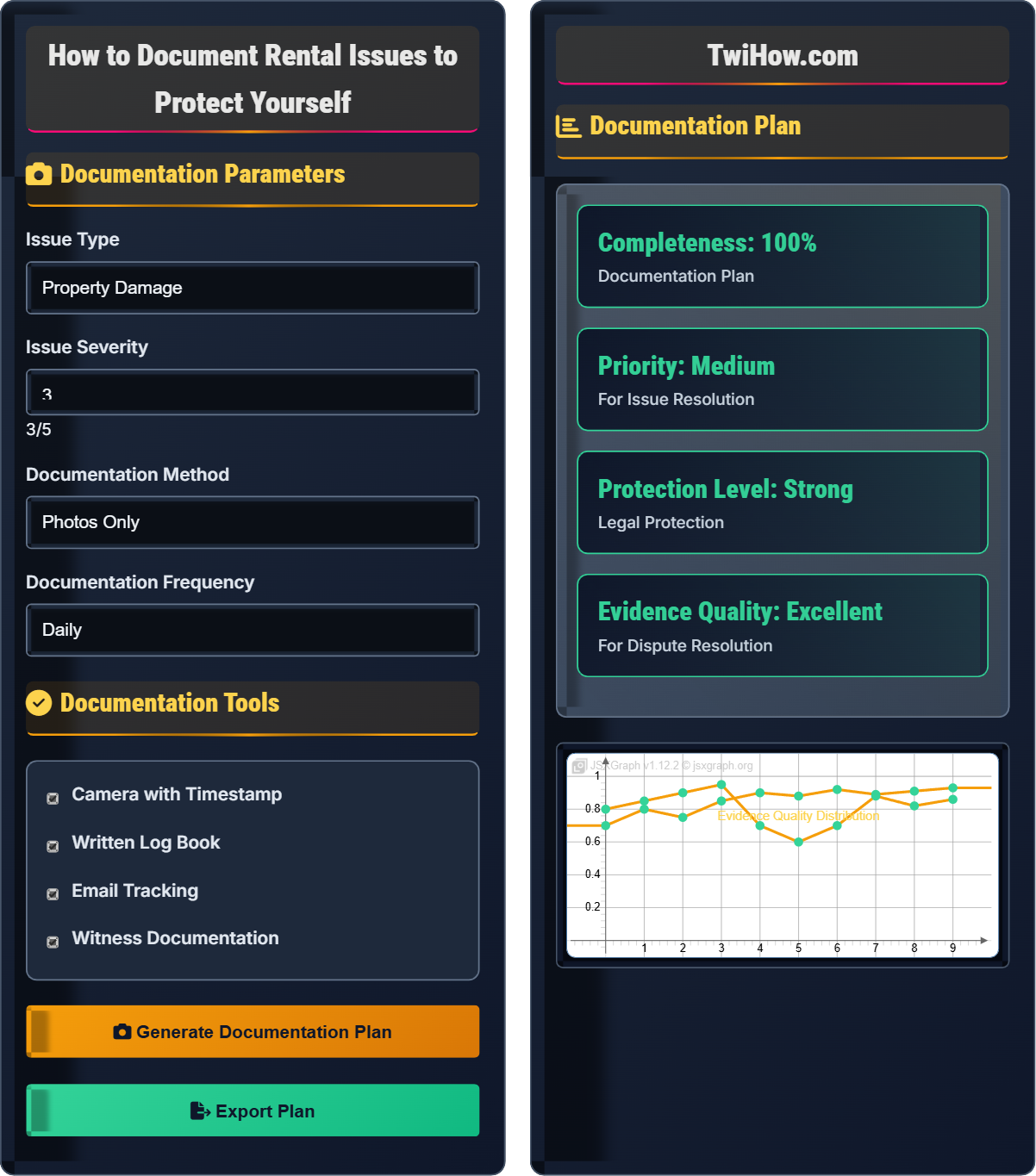
Documentation Parameters
Documentation Tools
Documentation Plan
| Step | Action | Priority | Timeline |
|---|---|---|---|
| 1 | Take before photos | High | Immediately |
| 2 | Write detailed description | High | Same day |
| 3 | Contact landlord in writing | High | Within 24 hrs |
| 4 | Document all communications | Medium | Ongoing |
Understanding Rental Documentation
Proper documentation serves as legal evidence in rental disputes and protects both tenant and landlord rights. When issues arise, having comprehensive documentation can mean the difference between winning and losing a case in court or small claims proceedings. Documentation provides objective evidence of property conditions and the timeline of events.
Photographs are the most powerful form of documentation because they provide visual evidence of conditions. When taking photos:
- Take Before Photos: Document property condition at move-in
- Multiple Angles: Capture issues from different perspectives
- Reference Objects: Include rulers or coins for scale
- Date Stamps: Ensure camera settings include timestamps
- Before/After: Document improvement or deterioration
- Wide Shots: Show context of the issue
This formula helps evaluate the strength of your documentation. Each factor is scored from 0-10, with the weighted sum providing an overall evidence strength score. Timeliness is crucial - documenting issues immediately after occurrence strengthens your case.
For example, if Photo Quality = 9, Written Detail = 8, Timeliness = 10, Communication Record = 7, and Witness Verification = 5, the Evidence Strength would be: (9×0.3) + (8×0.25) + (10×0.2) + (7×0.15) + (5×0.1) = 2.7 + 2.0 + 2.0 + 1.05 + 0.5 = 8.25/10.
Key tools for effective rental documentation include:
- Digital Camera/Smartphone: For high-quality photo evidence
- Written Log: Physical record of events and dates
- Email Account: For written communication with timestamps
- Cloud Storage: Secure backup of all documentation
- Measuring Tools: Rulers or tape measures for scale references
- Notebook: For immediate recording of incidents
There are specific times when documentation is especially critical:
- Move-in: Document existing property condition
- Move-out: Show property condition at departure
- Immediately After Discovery: Document issues as soon as noticed
- Before/After Repairs: Show improvement or lack thereof
- Communication Attempts: Record all contact with landlord
- Witness Observations: Document when others see the issue
Documentation Fundamentals
Photo evidence, written records, communication logs, witness statements, documentation timeline, legal protection.
Evidence Strength = Σ(Factor Score × Weight)
Where Factor Score ranges from 0-10 and weights sum to 100%. The formula accounts for multiple criteria that influence documentation effectiveness.
- Document everything immediately
- Keep copies of all communications
- Use written communication when possible
- Store documentation securely
Best Practices
Photo documentation, written logs, email communication, witness verification, cloud storage, regular updates.
- Take comprehensive move-in photos
- Create a written incident log
- Use email for all formal communications
- Document issues immediately after discovery
- Store all documentation securely
- Photos provide the strongest evidence
- Timeliness is crucial for credibility
- Written records create a timeline
- Communication logs show attempts to resolve
Rental Documentation Quiz
What is the most important element to include in photos documenting rental property damage?
Date stamps and scale references are crucial for establishing when damage occurred and the severity of the issue. Date stamps provide temporal context, while scale references (like coins, rulers, or known objects) show the actual size of damage. Without these elements, photos may be challenged as lacking context or authenticity.
The answer is B) Date stamps and scale references.
Effective photo documentation must establish three key elements: what the issue is, when it occurred, and the severity. Date stamps satisfy the "when" requirement, while scale references address the "severity" aspect. Good lighting and color accuracy are helpful but secondary to establishing timeline and context. The goal is to create irrefutable evidence that can withstand scrutiny in legal proceedings.
Scale Reference: Object of known size to show actual dimensions
Temporal Evidence: Proof of when something occurred
Authenticity: Verification that evidence is genuine
• Include date stamps on all photos
• Use scale references for size context
• Take photos from multiple angles
• Enable timestamp feature on your camera
• Place a coin or ruler next to damage
• Take wide shots to show location context
• Forgetting to enable date stamps
• Not including scale references
• Taking only close-up shots without context
Explain the key elements that should be included in written records of rental issues and why each element is important for legal protection.
Date and Time: Precise timing establishes the timeline of events and shows prompt reporting. This is crucial for proving when issues were discovered and reported to the landlord.
Detailed Description: Comprehensive details about the issue, including location, severity, and impact on living conditions. This provides context that photos alone cannot convey.
Landlord Communication: Records of all attempts to contact the landlord, including method of communication (email, phone, text) and response received. This demonstrates your efforts to resolve the issue.
Witness Information: Names and contact information of anyone who observed the issue. Independent witnesses strengthen your case by corroborating your observations.
Financial Impact: Documentation of any costs incurred due to the issue (temporary lodging, food spoilage, etc.). This supports claims for compensation.
Resolution Attempts: Details of any temporary fixes attempted by the tenant and the results. This shows good faith effort to mitigate problems.
Written records complement photo evidence by providing narrative context and establishing the timeline of events. Courts and arbitrators rely on comprehensive documentation to understand the sequence of events and the parties' actions. The written record should read like a story that clearly establishes the tenant's reasonable actions and the landlord's responses (or lack thereof). This narrative approach helps judges or arbitrators visualize the situation and understand the tenant's perspective.
Timeline: Chronological sequence of events
Causation: Link between issue and resulting problems
Mitigation: Efforts to minimize negative impacts
• Record details immediately after observation
• Use a dedicated notebook for rental issues
• Write entries in ink to prevent alterations
• Have witnesses sign records when possible
• Waiting too long to document issues
• Including emotional language instead of facts
• Failing to record landlord responses
Sarah discovers water damage in her rental apartment on Monday morning. The ceiling is sagging and water is dripping. She immediately takes photos with her phone showing the damage, including a ruler for scale. She emails her landlord at 10 AM describing the issue and requesting immediate repair. The landlord responds Tuesday evening saying they'll send someone "in a few days." Sarah documents the continued dripping and worsening damage with additional photos each day. On Thursday, she hires a contractor to fix the leak and pays $300. She keeps the receipt. What documentation did Sarah do correctly and what could she have improved?
Correct Actions: Sarah documented the issue immediately with dated photos including scale, contacted the landlord promptly in writing (email), documented the progression of damage with follow-up photos, and kept receipts for repairs.
Improvements Needed: Sarah could have taken "before" photos showing the ceiling's normal condition, documented the landlord's response in her written log, had a witness verify the damage, and possibly sent the repair request via certified mail for additional proof of delivery.
Legal Considerations: Sarah's documentation provides strong evidence of the issue's existence and the landlord's inadequate response time. The photos showing progression demonstrate that the problem worsened due to delay. The receipt supports her claim for reimbursement.
Additional Steps: Sarah should document the repair work completed by the contractor and continue monitoring for any recurrence of the issue.
This scenario demonstrates proper documentation practices in action. Sarah's immediate response with photos, written communication, and ongoing documentation created a strong paper trail. The key lesson is that documentation is most effective when started immediately and maintained consistently. Sarah's decision to hire a contractor after waiting several days shows she gave the landlord a reasonable opportunity to respond while protecting her property from further damage.
Mitigation: Tenant's duty to minimize property damage
Reasonable Response Time: Appropriate timeframe for landlord action
Self-Help Repair: Tenant fixing issues after landlord inaction
• Document issues immediately when discovered
• Give landlords reasonable time to respond
• Keep receipts for all expenses
• Take "before" photos to show normal condition
• Document landlord communication attempts
• Keep receipts for all related expenses
• Not giving landlord reasonable time to respond
• Failing to document the timeline
• Not keeping receipts for expenses
Tom needs to document his landlord's failure to address repeated heating system failures during winter. The landlord has verbally promised repairs multiple times but never follows through. Tom has text messages showing these promises but no written communication. What documentation strategy should Tom employ going forward, and why is written communication preferable to verbal agreements?
Documentation Strategy: Tom should immediately send a formal written notice via email summarizing all previous verbal agreements and repair promises. He should request written confirmation of repair schedules and deadlines. Going forward, Tom should only accept written commitments from the landlord.
Why Written Communication: Written communication provides verifiable evidence of agreements and timelines. Verbal agreements are difficult to prove and can be disputed. Emails and written notices create a clear paper trail that courts can review.
Implementation: Tom should compile all text messages into a summary email to the landlord, referencing specific dates and promises made. He should request a written response confirming repair plans and timelines.
Legal Benefits: Written documentation of broken promises strengthens Tom's case for rent abatement, habitability claims, or lease termination if necessary.
This problem highlights the fundamental principle that written communication is superior to verbal agreements in legal contexts. Courts rely on tangible evidence, and written records provide objective proof of what was agreed upon. Text messages can be useful but are often less formal than email and may be harder to organize systematically. The key is to convert verbal agreements into written form to create a clear, defensible record.
Verbal Agreement: Oral commitment without written evidence
Written Notice: Formal communication in writing
Verifiable Evidence: Documentation that can be authenticated
• Convert verbal agreements to written form
• Use email for all formal communications
• Request written confirmation of verbal promises
• Send follow-up emails summarizing verbal discussions
• Request written repair estimates and schedules
• Keep copies of all correspondence
• Relying solely on verbal agreements
• Not following up verbal promises in writing
• Failing to document broken commitments
What is the most critical aspect of move-in documentation for protecting tenant rights?
While all elements are valuable, completing a written checklist with photos provides the most comprehensive protection. The written checklist creates a detailed record of the property's condition, while photos provide visual evidence. Having both formats strengthens the documentation and provides multiple forms of evidence for security deposit disputes.
The answer is C) Completing written checklist with photos.
Effective move-in documentation combines multiple approaches to create redundant evidence. A written checklist provides detailed descriptions that photos cannot capture (like odors, sounds, or subtle issues), while photos provide visual evidence that words cannot describe (exact appearance of damage). Together, they create a comprehensive record that is difficult to dispute. The combination addresses both the quantitative aspects (measurements, locations) and qualitative aspects (condition descriptions) of property documentation.
Move-in Inspection: Documentation of property condition at beginning of lease
Security Deposit Protection: Evidence to support deposit return
Baseline Condition: Starting point for measuring changes
• Document move-in condition thoroughly
• Use both written and photographic evidence
• Complete documentation before moving in
• Take photos of every room and fixture
• Document both obvious and subtle issues
• Include exterior areas and common spaces
• Rushing through move-in inspection
• Only documenting obvious damage
• Forgetting to document pre-existing issues
FAQ
Q: How long should I keep rental documentation?
A: Keep rental documentation for at least 3-6 years after moving out, depending on your state's statute of limitations for landlord-tenant disputes. Some states have longer periods for security deposit disputes. It's better to keep documentation longer than you think necessary, as disputes can arise years later, especially regarding security deposits or damage claims. Store copies in multiple locations including cloud storage for safety.
Q: Should I document minor issues or just major problems?
A: Document everything, including minor issues. What starts as a minor problem can become major over time, and having a record of the progression is valuable. Minor issues can also indicate larger systemic problems with the property or landlord responsiveness. Additionally, multiple minor issues can add up to a habitability problem. Documenting everything creates a comprehensive record of the property's condition and your efforts to address problems.