Getting Your Security Deposit Back
Complete tenant rights guide • Move-out strategies
Security Deposit Return:
Show Deposit Return PlannerSuccessfully retrieving your security deposit requires proper preparation, documentation, and adherence to legal requirements. Key steps include pre-move-out inspections, thorough cleaning, proper notice, and documenting the condition of your rental. Understanding your rights and local laws significantly improves your chances of receiving the full deposit back.
Essential steps:
- Notice: Provide required advance notice to your landlord
- Pre-Inspection: Conduct a walk-through with landlord if possible
- Cleaning: Restore property to move-in condition
- Documentation: Take before/after photos and keep receipts
Modern tenant protection laws in many areas provide specific timeframes for deposit returns and penalties for landlords who fail to comply with legal requirements.
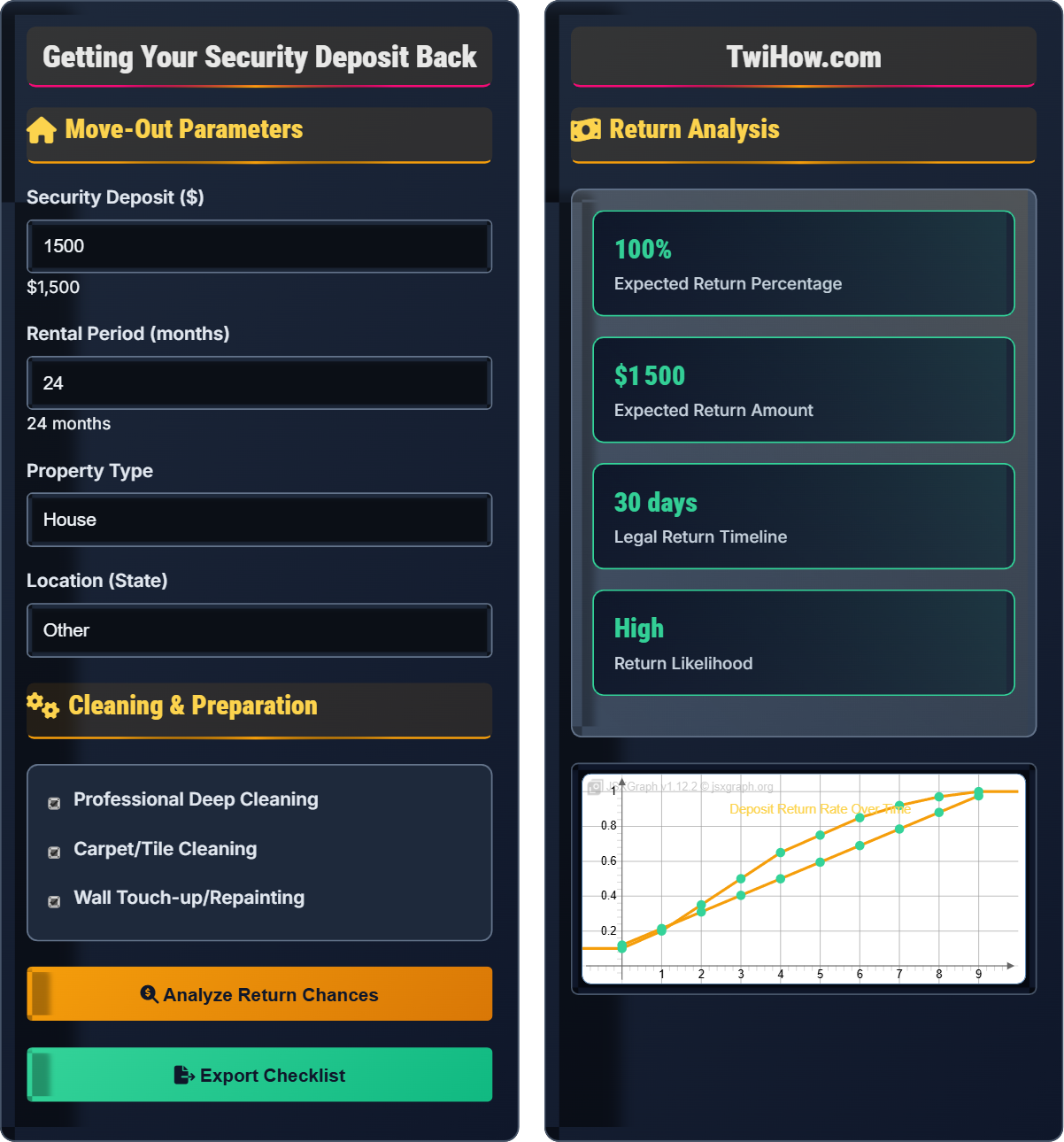
Move-Out Parameters
Cleaning & Preparation
Return Analysis
| Task | Status | Priority | Due Date |
|---|---|---|---|
| Provide Move-Out Notice | Completed | High | 30 days before |
| Pre-Move-Out Inspection | Pending | High | 14 days before |
| Deep Cleaning | In Progress | High | Day of move-out |
| Final Walk-Through | Not Started | High | Day of move-out |
Security Deposit Return Process
Security deposits are intended to cover potential damages beyond normal wear and tear. Understanding the legal requirements and best practices for move-out significantly improves your chances of receiving the full deposit back. Most states have specific laws governing how and when landlords must return deposits.
Return Percentage = (Base Percentage × Preparation Score × Legal Compliance Score) / 100
Expected Return = Deposit Amount × Return Percentage
Where:
- Base Percentage: Typical return rate in your state
- Preparation Score: Quality of move-out preparation
- Legal Compliance: Adherence to state requirements
Common legal requirements for deposit returns:
- Timeline: Most states require return within 14-30 days
- Itemized List: Many states require itemized deductions
- Written Notice: Some states require written notification
- Interest: Some states require interest on late returns
- Penalties: Some states impose penalties for non-compliance
- Storage: Some states require deposits to be held in interest-bearing accounts
- Document Everything: Take photos before and after cleaning
- Keep Receipts: Save receipts for cleaning supplies and services
- Follow Lease Terms: Ensure compliance with all lease requirements
- Communicate: Maintain good communication with your landlord
- Know Your Rights: Research local tenant protection laws
Deposit Return Fundamentals
Security deposit, normal wear and tear, move-out checklist, legal requirements, return timeline.
Return Percentage = (Base Percentage × Preparation Score × Legal Compliance Score) / 100
Where Return Percentage = expected return percentage, Base Percentage = typical return rate in state, Preparation Score = quality of preparation.
- Provide required advance notice
- Restore property to original condition
- Document property condition
Process Steps
Notice, inspection, cleaning, documentation, walk-through.
- Give required advance notice
- Request pre-move-out inspection
- Thoroughly clean the property
- Document condition with photos
- Complete final walk-through
- State laws vary significantly
- Timelines differ by jurisdiction
- Documentation is crucial
- Normal wear vs. damage distinction
Security Deposit Return Quiz
What is the typical legal timeframe for landlords to return security deposits after move-out?
Most states have laws requiring landlords to return security deposits within 14-30 days after move-out. The exact timeframe varies by state, with some requiring 14 days (like California) and others allowing up to 30 days (like Texas). This timeframe ensures tenants receive their deposits in a reasonable time.
The answer is B) 14-30 days.
Security deposit laws exist to protect tenants from landlords who might otherwise withhold deposits indefinitely. The specific timeframe varies by state because each state balances tenant rights with landlord needs for property inspection and repairs. Knowing your state's specific requirements is crucial for holding landlords accountable.
Security Deposit: Money held to cover potential damages
Move-Out: Date tenant vacates property
Legal Requirement: Mandatory timeframe by law
• State laws vary significantly
• Timelines range from 14-30 days
• Penalties may apply for delays
• Research your state's specific laws
• Mark the deadline on your calendar
• Follow up if deposit is delayed
• Not knowing state-specific requirements
• Failing to follow up on delays
• Assuming all states have same rules
Explain the difference between normal wear and tear and damage that can justify deposit deductions.
Normal Wear and Tear: Gradual deterioration from ordinary use that doesn't require tenant responsibility. Examples include faded paint from sunlight, worn carpet from foot traffic, minor scuffs on walls, and aging appliances.
Damage: Tenant-caused destruction or neglect that requires repair or replacement. Examples include holes in walls, broken fixtures, pet stains on carpets, missing hardware, and cracked tiles.
Key Distinction: Normal wear is inevitable and expected; damage is avoidable and caused by misuse or negligence.
This distinction is crucial because landlords can only deduct for actual damage, not normal wear and tear. Understanding this helps tenants know their rights and argue against improper deductions. Courts typically consider the length of tenancy and the condition of the property when it was rented.
Normal Wear: Expected deterioration from ordinary use
Damage: Tenant-caused harm requiring repair
Deduction: Money subtracted from deposit
• Landlords cannot deduct for normal wear
• Only actual damage is deductible
• Take photos when moving in/out
• Compare to move-in condition
• Research what constitutes normal wear
• Confusing normal wear with damage
• Not documenting move-in condition
• Assuming all issues are deductible
You moved out of a $2,000 security deposit rental and received $1,200 back with an itemized list showing $800 in deductions for painting and carpet cleaning. You lived there for 3 years, and the lease required you to leave it in original condition. The previous tenant moved out 6 months before you. The carpet was already stained when you moved in. What are your rights in this situation?
Your Rights: The landlord cannot charge you for pre-existing conditions. Since the carpet was already stained when you moved in, you shouldn't be responsible for replacing it. Normal wear from 3 years of occupancy might justify some carpet cleaning, but not full replacement.
What to Do: Reference your move-in inspection/photos showing the carpet condition. You may be entitled to partial refund for the portion of deductions that represent normal wear or pre-existing damage.
Legal Action: You can dispute the charges in small claims court if the landlord refuses to refund the improper deductions.
This scenario highlights the importance of move-in documentation. Without evidence of the property's condition when you moved in, it's difficult to prove which damages existed previously. Landlords cannot pass on the costs of pre-existing issues to subsequent tenants.
Pre-existing Condition: Damage present before tenant move-in
Itemized Deductions: Detailed list of charges
Small Claims Court: Legal venue for monetary disputes
• Cannot charge for pre-existing conditions
• Documentation is crucial evidence
• Itemized lists must be accurate
• Document move-in condition thoroughly
• Not documenting move-in condition
• Accepting improper deductions
• Failing to dispute inaccurate charges
Your state requires 30 days notice before move-out, and landlords have 21 days to return deposits. You plan to move out in 45 days but haven't told your landlord yet. Today, your apartment has several nail holes in the walls, a broken cabinet door, and needs deep cleaning. What should you do to maximize your deposit return?
Immediate Actions: 1) Give 30-day notice today (more than enough), 2) Schedule repairs for nail holes and cabinet door, 3) Plan professional cleaning, 4) Take current photos of all issues.
Timeline: With 45 days notice, you have time to address all issues. Fix the cabinet door, patch wall holes, and arrange for professional cleaning before move-out.
Documentation: Take before and after photos of all repairs. Keep receipts for materials and services.
Communication: Consider informing landlord of your plans to make repairs, which shows good faith.
Proactive preparation is key to maximizing deposit returns. Giving proper notice demonstrates responsibility, while addressing issues before they become deductions shows care for the property. Documentation proves you fulfilled your obligations under the lease.
Notice Period: Required advance warning of move-out
Good Faith: Honest intention to fulfill obligations
Proactive: Taking action before problems arise
• Provide required advance notice
• Address issues before move-out
• Document all repairs
• Start repairs early
• Keep all receipts
• Take detailed photos
• Not providing proper notice
• Failing to document repairs
Which of the following is NOT typically required of landlords when returning a security deposit?
While many states require landlords to return deposits within a specific timeframe, provide itemized deductions, and send the deposit to the correct address, only some states require landlords to pay interest on security deposits. This requirement is relatively uncommon and varies significantly by jurisdiction.
The answer is C) Paying interest on the entire deposit.
Landlord obligations vary by state, but the most common requirements are timely return, itemized deductions, and proper mailing. Interest requirements are less common and typically apply only in states with rent control or strong tenant protection laws. Knowing which requirements apply in your state is important for holding landlords accountable.
Itemized List: Detailed accounting of charges
Timeframe: Required time for action
Interest: Additional payment on deposit
• Requirements vary by state
• Research local laws
• Hold landlords accountable
• Know your state's specific requirements
• Verify landlord compliance
• Document all communications
• Assuming all states have same requirements
• Not researching local laws
• Failing to hold landlords accountable
FAQ
Q: Can my landlord keep my security deposit if I break my lease early?
A: Generally, no. Security deposits are meant to cover damages beyond normal wear and tear, not lease-breaking penalties. However, landlords may be able to keep some or all of the deposit if:
Actual Damages: You caused damage that exceeds normal wear
Unpaid Rent: You owe rent for the remaining lease term
Reletting Costs: Some states allow compensation for re-renting costs
Landlords must still follow legal requirements for deposit returns and provide itemized deductions. The deposit cannot be automatically forfeited for early termination.
Q: What if my landlord doesn't return my deposit after the legal deadline?
A: If your landlord fails to return the deposit within the legal timeframe:
Send Demand Letter: Send a certified letter demanding return of deposit
State Complaint: File a complaint with your state's tenant protection agency
Small Claims Court: Sue for the deposit plus penalties and interest
Legal Aid: Contact tenant rights organizations for assistance
Many states impose penalties for late deposit returns, which can be substantial. Document all attempts to retrieve your deposit and keep copies of all correspondence.