How to Handle Rent Payment Disputes & Late Fees
Complete guide • Step-by-step explanations
Rent Dispute Resolution:
Show Dispute CalculatorHandling rent payment disputes and late fees requires understanding your legal rights, maintaining proper documentation, and following established procedures. Whether you're a tenant facing unfair charges or a landlord dealing with payment issues, resolving disputes professionally and legally is crucial.
Key aspects of rent dispute resolution include:
- Communication: Open dialogue between parties
- Documentation: Maintaining records of all transactions
- Legal Compliance: Following state and local laws
- Resolution Methods: Mediation, arbitration, or court proceedings
Effective dispute resolution protects both tenant and landlord interests while maintaining professional relationships and ensuring fair outcomes.
Dispute Parameters
Resolution Options
Dispute Analysis
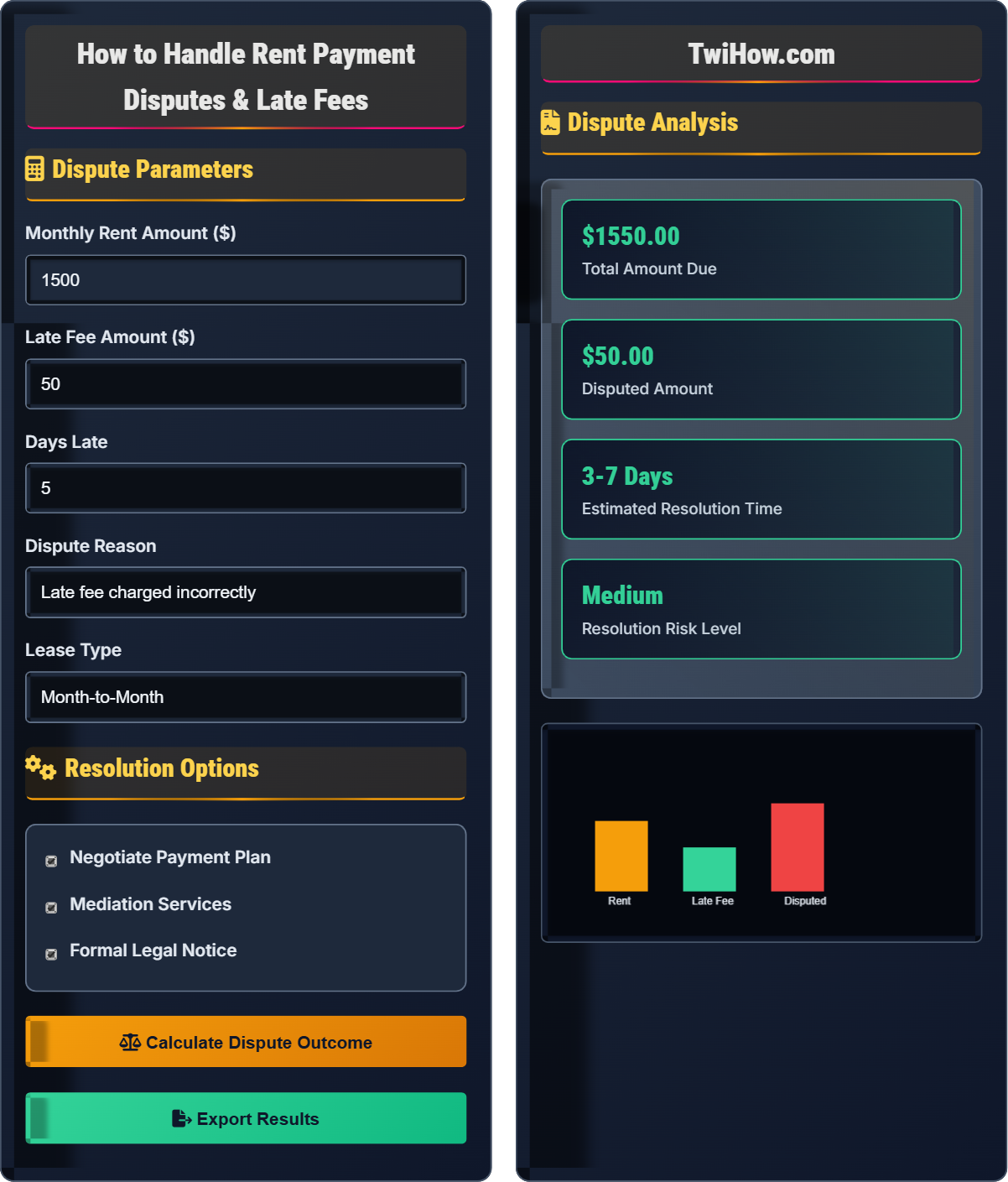
| Item | Amount | Status | Notes |
|---|---|---|---|
| Rent Amount | $1,500.00 | Due | Monthly rent payment |
| Late Fee | $50.00 | Disputed | Charged after 5 days |
| Total Due | $1,550.00 | Pending | Includes disputed fee |
Pros: Fast, cost-effective, maintains relationship
Cons: May not resolve complex issues
Timeline: 1-3 days
Pros: Neutral third party, binding if agreed
Cons: Costs money, takes longer
Timeline: 3-7 days
Pros: Legally binding outcome
Cons: Expensive, time-consuming, adversarial
Timeline: 2-8 weeks
Understanding Rent Disputes and Late Fees
Rent disputes arise when there's disagreement between landlords and tenants regarding rent payments, late fees, or other financial obligations. Common types of disputes include:
- Late Fee Disputes: Arguments over whether late fees were properly applied
- Payment Receipt Disputes: Claims that payments weren't received or recorded
- Amount Disputes: Disagreements over the correct amount owed
- Waiver Disputes: Disputes over whether late fees should have been waived
- Grace Period Disputes: Arguments about when late fees begin
Landlord-tenant laws vary by state but generally cover:
Where:
- Base Rent: Monthly rent amount specified in lease
- Late Fee Percentage: Usually 5-10% of monthly rent
- Fixed Amount: Set dollar amount (varies by jurisdiction)
Most states limit late fees to a percentage of rent (typically 5-10%) and require written notice before charging fees.
Prevent rent disputes with these best practices:
- Clear Lease Terms: Specify payment dates, late fees, and grace periods
- Automated Payments: Use electronic payment systems to track transactions
- Regular Communication: Maintain open lines of communication
- Detailed Records: Keep comprehensive records of all payments and notices
- Legal Compliance: Follow all state and local regulations
- State Laws: Late fee limits vary significantly by state
- Lease Terms: Contract provisions override default laws
- Documentation: Written evidence is crucial in disputes
- Professionalism: Maintain respectful communication throughout
- Timeliness: Address issues promptly to prevent escalation
Rent Dispute Fundamentals
Rent disputes, late fees, lease agreements, tenant rights, landlord obligations, grace periods, payment receipts.
Dispute Resolution = (Communication + Documentation + Legal Compliance) × Professional Approach
Where Communication = Direct dialogue, Documentation = Evidence gathering, Legal Compliance = Following regulations.
- Always document all communications
- Follow lease terms exactly
- Check state laws for fee limits
- Maintain professional conduct
Resolution Strategies
Negotiation, mediation, small claims court, tenant unions, legal representation.
- Negotiation: 1-3 days
- Mediation: 3-7 days
- Court proceedings: 2-8 weeks
- Legal action: 1-6 months
- Cost vs. benefit analysis
- Relationship preservation
- Legal precedents
- Time constraints
Rent Dispute Resolution Quiz
Which of the following statements about late fee limits is TRUE in most jurisdictions?
In most jurisdictions, late fees are regulated and typically limited to 5-10% of the monthly rent amount. This prevents landlords from imposing excessive penalties. Some states have specific caps (e.g., California limits fees to 5% of rent), while others follow the "reasonable" standard.
The answer is B) Late fees are typically limited to 5-10% of monthly rent.
Understanding late fee regulations is crucial for both landlords and tenants. These limits protect tenants from excessive penalties while allowing landlords to recoup costs associated with late payments. The percentage-based approach ensures fees remain proportional to rent amounts, preventing situations where a $50 late fee on a $300 studio apartment becomes a significant burden.
Late Fee: Penalty charged for missed payment deadlines
Percentage Cap: Maximum fee based on rent amount
Reasonable Standard: Fees must be proportionate to actual damages
• Late fees are regulated in most states
• Caps are typically 5-10% of rent
• Fees must be reasonable and documented
• Research your state's specific late fee laws
• Document all fee charges
• Compare fees to industry standards
• Assuming unlimited fee authority
• Charging fees without notice
• Ignoring state regulations
Explain the complete process for resolving a rent payment dispute, from initial communication to final resolution. Include key steps, documentation requirements, and timeline expectations.
Step 1 - Initial Communication (Day 1-2): Both parties should communicate directly to understand the issue. Document all conversations and emails.
Step 2 - Documentation Review (Day 2-3): Gather lease agreements, payment receipts, bank statements, and all correspondence related to the dispute.
Step 3 - Lease Analysis (Day 3-4): Review lease terms regarding payment dates, late fees, grace periods, and dispute resolution procedures.
Step 4 - Negotiation Attempt (Day 4-7): Propose reasonable solutions such as payment plans, partial payments, or fee waivers based on circumstances.
Step 5 - Mediation (Week 2-3): If direct negotiation fails, engage a neutral mediator to facilitate resolution.
Step 6 - Formal Action (Week 3+): As a last resort, pursue legal remedies through small claims court or other appropriate channels.
The dispute resolution process follows a graduated approach, starting with the least confrontational methods and escalating only when necessary. This preserves relationships while ensuring fair outcomes. Each step builds upon the previous one, with documentation becoming increasingly important as the process advances. The timeline allows for reasonable response periods while preventing indefinite delays.
Mediation: Neutral third-party facilitated negotiation
Documentation: Written evidence supporting positionsEscalation: Progressive increase in formality of resolution attempts
• Always attempt direct resolution first
• Document every interaction
• Follow lease procedures
• Keep detailed records from day one
• Respond promptly to communications
• Focus on solutions, not blame
• Jumping to legal action immediately
• Failing to document communications
• Ignoring lease terms
Sarah pays $1,800 per month for rent. Her lease states that a $75 late fee is charged after 5 days past the due date, with a 3-day grace period. She made her rent payment on the 8th of the month, though it's due on the 1st with a grace period until the 3rd. The landlord charged the $75 late fee. Sarah believes this is incorrect since she paid within 7 days of the due date. Calculate the correct late fee and explain the dispute resolution approach.
Timeline Analysis:
- Due Date: 1st of month
- Grace Period Ends: 3rd of month
- Payment Made: 8th of month
- Days Late: 8th - 3rd = 5 days after grace period
Correct Assessment: Sarah is correct. The late fee was improperly charged because:
1. The lease specifies late fees apply after 5 days past due date
2. With a 3-day grace period, fees start after 8th (5 days after grace period ends)
3. Since payment was made ON the 8th, it was technically still within the late fee threshold
Dispute Resolution Approach:
1. Gather lease agreement showing grace period and late fee terms
2. Document the payment date and method
3. Communicate with landlord citing lease terms
4. Request refund of incorrectly charged fee
This scenario demonstrates the importance of carefully reading lease terms and understanding grace periods. The key insight is that grace periods extend the due date for late fee purposes. Many disputes arise from misinterpretation of these timing elements. The resolution depends entirely on precise lease language interpretation.
Grace Period: Additional time allowed for payment without penalty
Due Date: Original payment deadline
Late Fee Threshold: Point at which penalties begin
• Grace periods extend the effective due date
• Timing calculations must be precise
• Lease terms override assumptions
• Calculate dates carefully
• Reference lease language exactly
• Use calendar to visualize timelines
• Confusing due date with late fee start date
• Ignoring grace period impact
• Making assumptions about timing
You are a tenant who recently disputed a $100 late fee for a $2,000 monthly rent payment. The landlord claims you were 10 days late, but you have proof of payment dated 6 days after the due date. Design a comprehensive documentation strategy to support your dispute, including what evidence to collect, how to organize it, and what legal precedents to research.
Evidence Collection:
1. Payment Proof: Bank statements, receipt confirmations, online banking screenshots
2. Communication Records: Text messages, emails, letters exchanged with landlord
3. Lease Documentation: Signed lease with payment terms and late fee clauses
4. Bank Records: Transaction confirmations with exact timestamps
Organization Strategy:
1. Create a chronological timeline of events
2. Compile all evidence in a single folder with clear labeling
3. Make copies of all documents for safekeeping
4. Prepare a summary document with key dates and facts
Legal Research:
1. Review state-specific landlord-tenant laws
2. Research local rent control ordinances
3. Study recent case law on late fee disputes
4. Consult tenant protection resources
Documentation is the foundation of successful dispute resolution. Strong documentation not only supports your position but often prevents disputes from escalating. The organization of evidence is as important as the evidence itself - judges and mediators appreciate well-organized presentations that make facts easy to understand. Proactive legal research helps anticipate counterarguments and strengthens your position.
Chronological Timeline: Events ordered by date
Proof of Payment: Evidence of transaction completion
Case Law: Previous judicial decisions on similar issues
• Document everything contemporaneously
• Organize evidence systematically
• Research applicable laws proactively
• Take screenshots of online transactions
• Keep digital and physical copies
• Use a dedicated folder for housing documents
• Waiting to gather evidence after dispute arises
• Poor organization of documents
• Ignoring legal research
According to studies on landlord-tenant disputes, which resolution method has the highest success rate and lowest cost?
Direct negotiation between parties has the highest success rate and lowest cost for resolving rent disputes. Studies consistently show that approximately 70-80% of disputes are resolved through direct communication, typically within 1-3 days and at minimal cost. This approach preserves relationships, avoids legal fees, and allows for flexible solutions tailored to both parties' needs.
The answer is B) Direct negotiation between parties.
The effectiveness of direct negotiation stems from both parties' shared interest in maintaining a positive landlord-tenant relationship. Most disputes involve misunderstandings or minor issues that can be quickly resolved through communication. The low cost and high success rate make direct negotiation the preferred first step in any dispute resolution process. More formal methods should only be pursued when direct communication fails.
Success Rate: Percentage of disputes resolved favorably
Cost-Benefit Analysis: Evaluation of expense versus outcome
Relationship Preservation: Maintaining positive ongoing interactions
• Start with least formal approach
• Consider cost-benefit of each method
• Preserve relationships when possible
• Communicate promptly when issues arise
• Approach discussions collaboratively
• Document resolution agreements
• Skipping direct communication
• Approaching discussions adversarially
• Failing to document agreements
FAQ
Q: Can my landlord charge me a late fee if I pay on the due date but after business hours?
A: Generally, if you pay on the due date, you have met your obligation under the lease. However, many leases specify "by close of business" or include a grace period. Courts typically interpret these provisions strictly against the landlord if ambiguous. If your lease doesn't specify a time, paying on the date (including online payments processed that day) should be sufficient. However, to avoid disputes, it's wise to pay before business closes on the due date.
Q: What's the best way to handle a tenant who consistently pays rent a few days late?
A: For consistent late payers, address the issue early with a clear warning letter documenting the pattern. Consider implementing a consistent late fee policy and enforcing it uniformly. If the pattern continues, evaluate whether to offer a slight rent increase in exchange for on-time payment guarantees, or begin eviction proceedings if the lease allows. Always document all communications and ensure your actions comply with local laws. Sometimes, a brief conversation about budgeting challenges can lead to a payment plan that works for both parties.