Handling Key Return Disputes After Moving Out
Complete guide to tenant rights • Step-by-step explanations
Key Return Rights:
Show Dispute CalculatorDisputes over key returns and access after moving out can affect your security deposit and create ongoing obligations. Understanding your rights and responsibilities helps ensure a smooth transition and protects your financial interests.
Key concepts:
- Lease Requirements: Specific terms about key return procedures
- Security Deposit: How key return affects your deposit
- Access Rights: Post-move-out access for retrieving items
- Legal Consequences: Potential penalties for non-compliance
Proper handling of key return ensures you fulfill all lease obligations while protecting your security deposit and avoiding ongoing liability.
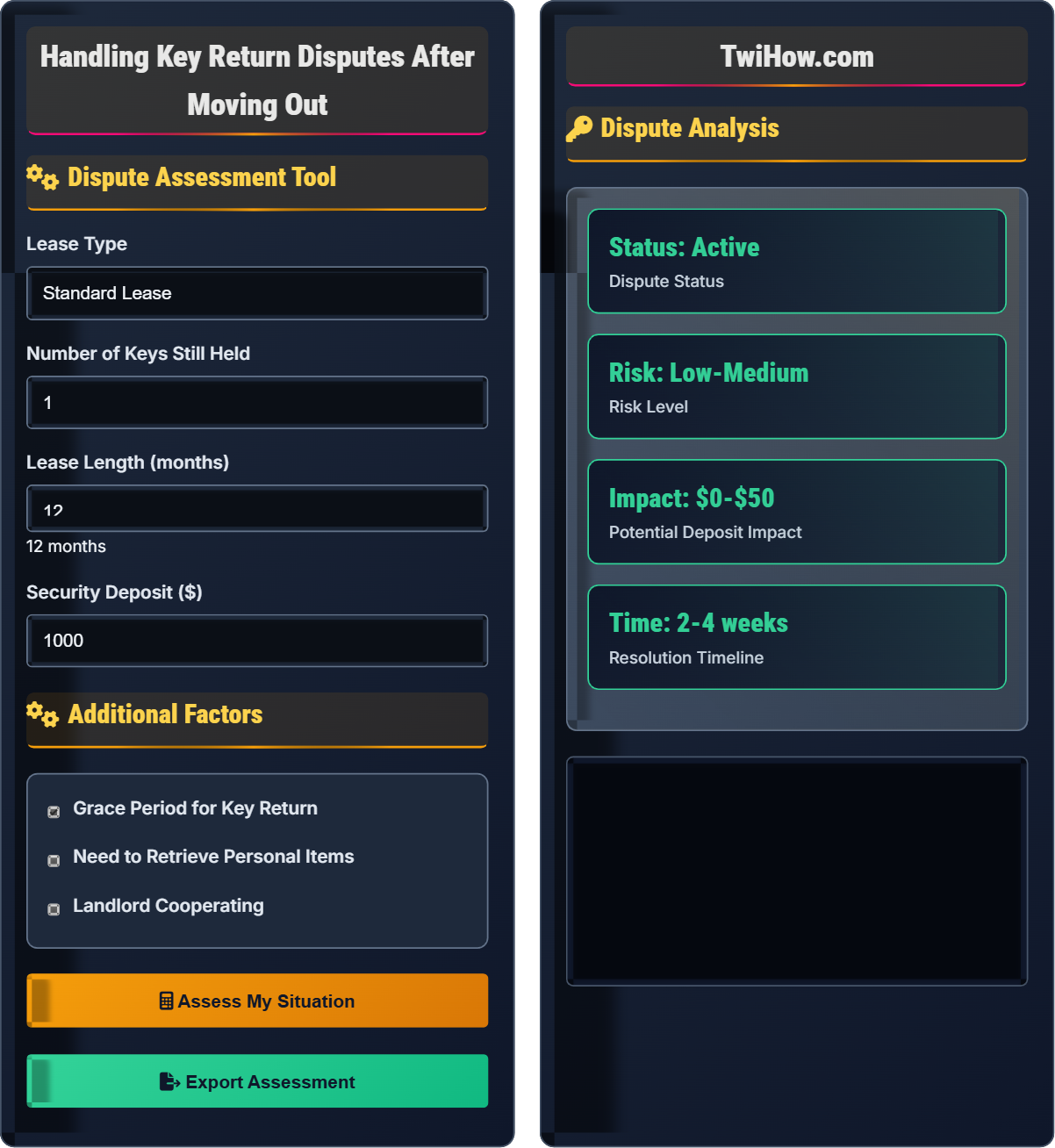
Dispute Assessment Tool
Additional Factors
Dispute Analysis
| Factor | Assessment | Status |
|---|---|---|
| Lease Compliance | Review Required | Pending |
| Key Return Deadline | Due Soon | Active |
| Security Deposit | $1000 | Protected |
| Documentation | Basic | Improve |
Recommended Procedures
- Return keys immediately
- Request receipt confirmation
- Document the return process
- Follow up in writing
Understanding Key Return Obligations
Key return obligations are legal and contractual requirements that tenants must fulfill when ending a lease. These obligations ensure property security and allow landlords to re-lease the property without delay.
Key obligations include:
- Timely Return: Returning all keys by the specified deadline
- Complete Return: Providing all keys, fobs, and access devices
- Documentation: Recording the return with receipts or confirmations
- Final Inspection: Coordinating with landlord for property review
Key return obligations are governed by:
Failure to comply with key return obligations can result in:
- Security Deposit Retention: Landlords may retain deposits for key replacement
- Additional Charges: Fees for locksmith services and key cutting
- Ongoing Liability: Responsibility for property until keys are returned
- Legal Action: Potential lawsuits for damages caused by access issues
- Eviction Records: Negative entries affecting future rentals
When disputes arise, consider these resolution approaches:
- Direct negotiation with the landlord
- Mediation services
- Small claims court for deposit recovery
- Legal consultation for complex disputes
- Consumer protection agencies
Key Return Procedures
Timely return, complete inventory, documentation, final inspection, receipt confirmation.
Success = (Compliance × Documentation × Communication) / Delays
Where higher values indicate better outcomes.
- Return all keys by the lease deadline
- Get written confirmation of return
- Document the condition of returned items
Resolution Steps
Negotiation, mediation, legal action, consumer protection, documentation.
- Review lease terms and local laws
- Attempt direct negotiation with landlord
- Document all communications
- Seek mediation if needed
- Consider legal action for significant amounts
- Know your local security deposit laws
- Maintain detailed records
- Act within applicable statutes of limitations
- Consider the cost-benefit of pursuing action
Key Return Dispute Knowledge Quiz
Which of the following is TRUE regarding tenant obligations for key return?
Tenants are typically obligated to return all keys, fobs, and access devices specified in the lease. This includes main entrance keys, mailbox keys, gate access fobs, and any other access devices provided by the landlord. Failure to return all access items can result in charges for replacement and rekeying.
The answer is B) All keys, fobs, and access devices must be returned.
Key return obligations are comprehensive to ensure property security. Landlords need to secure the property immediately after move-out to prevent unauthorized access and prepare for new tenants. The obligation extends to all access devices, not just primary keys.
Access Devices: All keys, fobs, cards, or codes providing property access
Comprehensive Return: Returning all access items provided during tenancy
Security Obligation: Duty to prevent unauthorized property access
• Return all access devices provided during tenancy
• Check lease for specific requirements
• Document all returned items
• Create an inventory of all access devices at move-in
• Keep a copy of the original inventory
• Return items before the deadline
• Forgetting secondary access devices
• Not returning mailbox keys
• Assuming only main keys matter
Explain how failing to return keys can affect your security deposit. What charges can landlords legally impose for unreturned keys?
Security Deposit Impact: Failure to return keys can significantly impact your security deposit:
Key Replacement Costs: Landlords can charge for replacing lost keys, including labor costs for locksmith services.
Rekeying Expenses: If security is compromised, landlords may rekey entire property, charging tenant for these costs.
Lost Rental Income: Property cannot be shown to new tenants until secured, potentially reducing rental income.
Legal Charges: Landlords may pursue additional legal fees if disputes arise.
Legally Permissible Charges:
• Cost of new keys and fobs
• Professional locksmith services
• Rekeying if security is compromised
• Actual documented expenses only
Charges must be reasonable and documented, varying by state law.
Security deposits serve as protection for landlords against tenant-caused damages and unpaid obligations. Key return failures create security vulnerabilities requiring immediate action, justifying replacement costs. However, charges must be reasonable and documented.
Security Deposit: Funds held to cover potential damages or unpaid obligations
Reasonable Charges: Costs that are justified and documented
Security Vulnerability: Risk created by unauthorized access possibility
• Charges must be reasonable and documented
• Landlords must provide itemized deductions
• Excessive charges may be challenged
• Research local security deposit laws
• Document key return process
• Challenge excessive charges
• Not understanding local deposit laws
• Failing to document key return
• Accepting unreasonable charges
Sarah moved out of her apartment 2 weeks ago but forgot to return the spare key she had given to her friend. The landlord sent a letter stating that she hasn't completed move-out procedures and is holding her $1200 security deposit pending key return. Sarah's lease required all keys to be returned within 5 days of move-out. Analyze Sarah's situation and recommend the best course of action.
Analysis: Sarah is in violation of her lease terms by failing to return all keys within the specified timeframe. The landlord has legitimate grounds to hold the security deposit pending key return.
Recommended Course of Action:
1. Immediate Action: Contact the friend to retrieve the spare key immediately.
2. Direct Delivery: Return the key directly to the landlord or designated agent with proof of delivery.
3. Written Confirmation: Request written confirmation of key receipt and expected deposit return timeline.
4. Apology and Explanation: Provide a brief, honest explanation for the oversight while accepting responsibility.
5. Documentation: Keep copies of all communications and the receipt of key return.
While Sarah violated the lease, prompt resolution of the issue should result in deposit release once the landlord completes their inspection.
This scenario demonstrates the importance of accounting for all access devices, including those given to friends or family. Lease terms are binding regardless of the reason for non-compliance. Prompt resolution shows good faith and increases the likelihood of favorable treatment.
Lease Violation: Failure to comply with lease terms and conditions
Good Faith Resolution: Prompt, honest attempt to correct violationsProof of Delivery: Documentation confirming item return
• Lease terms must be followed precisely
• Prompt resolution helps preserve relationships
• Documentation protects both parties
• Account for all keys before moving out
• Return keys before lease deadline
• Get receipts for all returns
• Forgetting secondary keys given to others
• Not following lease procedures precisely
• Failing to document resolution efforts
After returning all keys on time, Mike received his security deposit statement showing a $300 deduction for "key replacement and rekeying services." His lease had no mention of key return fees, and he has photographic evidence of returning all keys. The landlord charged $150 for new keys and $150 for "security consultation." Evaluate the legitimacy of these charges and suggest Mike's options.
Legitimacy Evaluation: The charges appear questionable based on the facts:
Problematic Elements:
1. "Security Consultation" Fee: This is not a standard charge and likely not justified by key return alone.
2. Lease Terms: Absence of key return fees in lease suggests unauthorized charges.
3. Documentation: Photographic evidence contradicts claims of incomplete return.
Mike's Options:
1. Direct Negotiation: Request detailed documentation of charges and negotiate reduction.
2. Legal Consultation: Contact tenant rights organization for guidance.
3. Small Claims Court: File suit for return of improperly withheld deposit.
4. Consumer Protection: File complaint with local consumer protection agency.
Mike has strong grounds to challenge these charges given the evidence of proper key return.
This case highlights the importance of lease review and documentation. Legitimate charges must be reasonable, documented, and authorized by lease terms or law. "Security consultation" fees are typically not justified by routine key return procedures.
Itemized Deductions: Detailed breakdown of security deposit charges
Reasonable Charges: Costs that are justified and customary
Improper Deductions: Unauthorized or excessive charges
• Charges must be authorized by lease or law
• Landlords must provide itemized statements
• Documentation supports charge justification
• Review lease before signing
• Document all key returns
• Challenge questionable charges
• Not reading lease terms carefully
• Failing to document key returns
• Accepting unauthorized charges
Which of the following is TRUE regarding tenant access rights after moving out but before key return?
Access rights after move-out depend on specific lease terms and local laws. Some jurisdictions allow grace periods for retrieving items, while others require immediate key return. The lease agreement typically specifies the exact terms and timeline for key return and associated access rights.
The answer is D) Access rights depend on lease terms and local laws.
Post-move-out access is not universally standardized. Lease agreements and local laws determine the exact timeline and conditions. Some areas provide grace periods for retrieving forgotten items, while others require immediate surrender of access. Tenants must know their specific lease terms.
Grace Period: Limited time frame for post-move-out access
Access Rights: Permission to enter property after lease ends
Lease Termination: End of rental agreement obligations
• Review lease for post-move-out access terms
• Know local laws regarding access rights
• Plan retrieval of items before move-out
• Read lease terms carefully
• Research local tenant rights
• Plan ahead for forgotten items
• Assuming unlimited post-move-out access
• Not reading lease terms about access
• Forgetting to retrieve items before move-out
Frequently Asked Questions
Q: Can my landlord keep my entire security deposit if I lose one key?
A: No, landlords cannot keep your entire security deposit for losing one key. They can only charge for the actual cost of replacing the key and any reasonable rekeying expenses if security is compromised. The charge must be proportional to the actual expense incurred. However, the specific amount and circumstances vary by state law.
Most states require landlords to provide an itemized list of deductions from the security deposit. If the key replacement cost is only $50, they cannot deduct $1,000 from a $1,200 deposit for that single key.
Q: What should I do if I gave a key to someone and now can't get it back immediately?
A: If you gave a key to someone and can't retrieve it immediately, take these steps:
1. Contact Your Landlord Immediately: Explain the situation honestly and provide a timeline for key return.
2. Get It Back ASAP: Coordinate with the person to return the key as quickly as possible.
3. Offer a Solution: Propose paying for a temporary lock change if needed for security.
4. Document Everything: Keep records of all communications about the situation.
Most landlords appreciate honest communication and will work with responsible tenants who are actively resolving the issue.
Q: How can I protect myself from disputes over key return?
A: To protect yourself from key return disputes, follow these best practices:
1. Create an Inventory: Document all keys, fobs, and access devices when you receive them.
2. Photograph Everything: Take photos of all access devices and store them securely.
3. Plan Ahead: Collect all keys before the deadline and arrange for return.
4. Get Receipts: Obtain written confirmation when returning keys to the landlord.
5. Follow Up: Send a follow-up email confirming key return and requesting deposit timeline.
6. Know Your Rights: Research local security deposit laws and timelines.
Proactive documentation and timely return are the best ways to avoid disputes.