How to Handle Disputes Over Utilities or Shared Expenses
Real estate guide • Step-by-step explanations
Utility & Shared Expense Disputes:
Show Dispute CalculatorDisputes over utilities and shared expenses are common among roommates and can strain relationships and financial arrangements. Proper handling requires clear communication, documentation, and understanding of rights and responsibilities. Whether dealing with uneven utility usage, forgotten payments, or unclear expense splits, resolving these disputes fairly and efficiently is crucial for maintaining positive living arrangements.
Common utility and expense disputes include:
- Unequal Usage: One person using significantly more utilities
- Payment Delays: Late or forgotten expense payments
- Unclear Splits: Ambiguous expense division agreements
- Missing Bills: Forgotten or lost utility notifications
- Usage Disputes: Disagreement about actual consumption
- Service Charges: Disputes over utility service fees
Proactive communication and clear agreements can prevent most disputes from escalating.
Dispute Parameters
Resolution Options
Dispute Analysis
| Step | Action | Priority | Timeline |
|---|---|---|---|
| 1 | Open Communication | High | Immediate |
| 2 | Review Agreement | High | Same Day |
| 3 | Propose Solution | High | Within 2 Days |
| 4 | Document Resolution | Medium | Within Week |
Understanding Utility & Shared Expense Disputes
Utility and shared expense disputes arise when roommates disagree about the division, payment, or usage of shared costs. These disputes can range from simple misunderstandings to more complex disagreements about fairness and responsibility. The key to resolution is clear communication, documentation, and a fair approach that considers everyone's circumstances.
Common disputes include:
- Unequal Usage: One roommate consuming significantly more utilities
- Payment Delays: Late or forgotten expense payments
- Unclear Agreements: Ambiguous expense division arrangements
- Bill Management: Disagreement over who handles billing
- Usage Monitoring: Disputes about actual consumption levels
- Service Selection: Disagreement over utility service choices
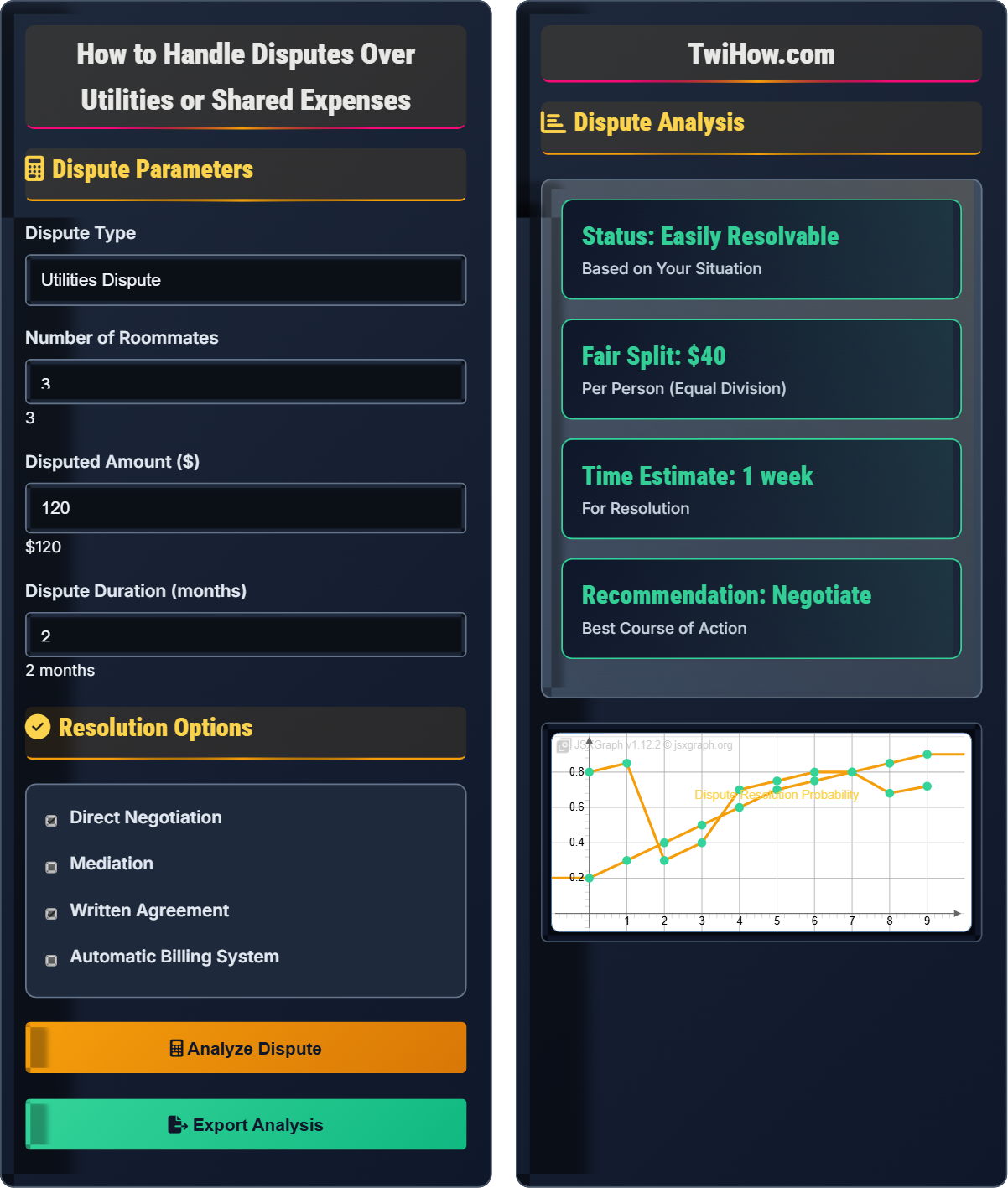
This formula evaluates the likelihood of successfully resolving a utility dispute. Each factor is scored from 0-10, with the weighted sum indicating the overall probability of resolution. Communication carries the highest weight as it's essential for understanding perspectives and finding solutions.
For example, if Communication = 8, Documentation = 7, Fairness = 9, Agreement Clarity = 6, and Relationship Preservation = 7, the Resolution Success would be: (8×0.3) + (7×0.25) + (9×0.25) + (6×0.15) + (7×0.05) = 2.4 + 1.75 + 2.25 + 0.9 + 0.35 = 7.65/10.
Effective strategies for resolving utility disputes include:
- Direct Communication: Address issues openly and respectfully
- Documentation: Keep records of all communications and agreements
- Fair Allocation: Consider usage patterns and financial situations
- Written Agreements: Formalize expense arrangements in writing
- Mediation: Use neutral third-party if needed
- Payment Systems: Implement consistent payment methods
Preventing disputes is more effective than resolving them:
- Clear Agreements: Define responsibilities before moving in together
- Usage Monitoring: Track utility usage and expenses
- Regular Reviews: Periodic check-ins on expense arrangements
- Automated Systems: Set up automatic bill payments
- Budget Planning: Plan shared expenses in advance
- Communication Protocols: Establish how to discuss financial matters
Dispute Resolution Fundamentals
Utility disputes, shared expenses, roommate agreements, mediation, communication, documentation.
Resolution Success = Σ(Factor Score × Weight)
Where Factor Score ranges from 0-10 and weights sum to 100%. The formula accounts for multiple criteria that influence dispute resolution success.
- Address disputes early before they escalate
- Document all agreements and communications
- Consider fairness and individual circumstances
- Preserve relationships when possible
Prevention Strategies
Written agreements, usage monitoring, automated payments, regular check-ins, budget planning, communication protocols.
- Establish clear agreements before moving in
- Set up automated payment systems
- Monitor usage and expenses regularly
- Hold periodic financial check-ins
- Document all arrangements in writing
- Prevention is more effective than resolution
- Clear communication prevents most disputes
- Written agreements provide legal protection
- Regular reviews help adjust arrangements
Utility Dispute Quiz
What is the most effective way to prevent utility and shared expense disputes?
Establishing clear written agreements upfront is the most effective prevention strategy. This creates mutual understanding, sets expectations, and provides a reference point if disputes arise. Written agreements cover payment methods, division of costs, and procedures for handling changes in circumstances.
The answer is B) Establish clear written agreements upfront.
This question emphasizes the importance of proactive communication and documentation. Assuming everyone will act fairly without clear guidelines often leads to disputes when interpretations differ. Written agreements provide objectivity and reduce ambiguity. They serve as a contract that all parties can reference, making it easier to resolve disagreements based on agreed-upon terms rather than subjective interpretations of fairness.
Roommate Agreement: Written contract outlining shared responsibilities
Preventive Communication: Discussing arrangements before problems occur
Financial Transparency: Clear understanding of shared costs
• Establish agreements before moving in together
• Put everything in writing
• Discuss financial arrangements early
• Create a roommate agreement before moving in
• Discuss payment methods and schedules
• Plan for changes in circumstances
• Assuming everyone has the same expectations
• Not discussing financial arrangements upfront
• Relying on verbal agreements only
How should roommates handle situations where one person uses significantly more utilities (electricity, water, internet) than others?
Assessment: First, determine if the usage difference is due to lifestyle differences, work-from-home requirements, or other legitimate reasons. Some roommates may legitimately use more utilities due to remote work, medical equipment, or different living patterns.
Communication: Openly discuss the usage patterns without judgment. Understanding the reasons can lead to fair solutions.
Possible Solutions: 1) Individual metering where possible 2) Tiered payment system based on usage 3) Equal split with additional payment for excess usage 4) Roommate agreement that accounts for different lifestyles
Compromise: Consider factors like room size, usage patterns, and financial situations when determining fair arrangements.
Documentation: Record the agreed-upon arrangement to prevent future disputes.
This scenario highlights the complexity of shared living arrangements. Fairness isn't always about equal division—it should consider actual usage and individual circumstances. The key is finding a solution that all parties can accept while maintaining harmony. This requires empathy, open communication, and creative problem-solving to accommodate different lifestyles and needs.
Individual Metering: Separate utility meters for each unit
Tiered Payment: Payment based on actual usage levels
Lifestyle Differences: Varied daily living patterns
• Consider legitimate reasons for usage differences
• Install sub-meters if possible
• Track usage with smart devices
• Consider different work arrangements
• Assuming all usage should be equal
• Not considering legitimate usage differences
• Making judgments without understanding
Sarah and two roommates share an apartment with utilities totaling $300/month. Sarah works from home and uses significantly more electricity and internet than her roommates. Her roommates want to split utilities equally ($100 each), but Sarah feels this is unfair given her higher usage. The utility bills show Sarah's portion is roughly $150, while each roommate uses about $75. How should they resolve this fairly?
Current Situation: Total utilities = $300/month. Equal split = $100 each. Actual usage: Sarah = $150, each roommate = $75.
Option 1 - Usage-Based Split: Sarah pays $150, each roommate pays $75. This accurately reflects actual usage but may seem inequitable for shared services.
Option 2 - Hybrid Approach: Split base costs equally ($75 each) and charge excess usage to the heavy user. Base costs = $225 ($75 each), Sarah pays extra $75 for excess usage = $150 total.
Option 3 - Compromise: Sarah pays $125, others pay $87.50 each. This partially accounts for usage differences while maintaining some equality.
Recommendation: Option 2 (hybrid approach) balances fairness with practicality. It ensures shared costs are distributed equally while holding the heavy user accountable for excess consumption. All parties should agree and document the arrangement.
This problem demonstrates the challenge of balancing equity with practicality in shared living. Pure equality ignores usage differences, while pure usage-based charging may be difficult to implement and could strain relationships. The hybrid approach represents a compromise that acknowledges both shared responsibility and individual usage. The key is finding a solution that all parties can accept while maintaining fairness and harmony.
Base Costs: Fixed utility costs shared by all residents
Excess Usage: Consumption beyond standard levelsHybrid Approach: Combination of equal and usage-based splits
• Consider actual usage patterns
• Install smart meters to track usage
• Consider different work arrangements
• Find compromise solutions
• Ignoring legitimate usage differences
• Not tracking actual consumption
• Forcing solutions without consensus
A group of four roommates wants to implement a system for managing shared expenses that prevents disputes. They have different pay schedules (weekly, bi-weekly, monthly) and varying financial situations. What payment system would be most effective for preventing disputes and ensuring everyone contributes fairly?
Automated Payment System: Set up automatic monthly payments from each person's account on the same date. This ensures consistency and removes the burden of remembering payment dates.
Centralized Account: Create a joint account where everyone contributes their share monthly. One person manages bill payments from this account, with full transparency of all transactions.
Payment Rotation: Rotate the responsibility of paying bills each month, with other roommates reimbursing the designated payer.
Expense Tracking App: Use apps like Splitwise or Venmo to track expenses and ensure everyone pays their fair share.
Recommended Approach: Combine automated payments with an expense tracking system. Each person automatically contributes their share to a central account, and expenses are tracked digitally. This removes payment timing issues, provides transparency, and ensures consistent contributions regardless of individual pay schedules.
This problem highlights how different financial circumstances and pay schedules can complicate shared expense management. The key is removing human error and inconsistency from the equation. Automated systems ensure payments happen on time regardless of individual circumstances. Transparency is crucial—everyone should be able to see where money is going. The chosen system should accommodate different financial situations while maintaining fairness and accountability.
Automated Payments: Recurring payments set up in advance
Centralized Account: Joint account for shared expenses
Expense Tracking: Digital system for monitoring shared costs
• Automate payments when possible
• Maintain transparency in all transactions
• Accommodate different financial schedules
• Use expense tracking apps
• Set up automatic bank transfers
• Create clear payment schedules
• Relying on memory for payments
• Not tracking expenses consistently
• Failing to accommodate different pay schedules
When is mediation most appropriate for resolving utility or shared expense disputes?
Mediation is most appropriate when direct communication has failed and the parties cannot reach an agreement on their own. It's a structured process where a neutral third party helps facilitate discussion and find solutions. Mediation should be attempted before disputes escalate to more serious conflicts or legal action.
The answer is B) When direct communication has failed.
Mediation represents a middle ground between informal resolution and formal legal action. It's designed to preserve relationships while finding fair solutions. The process is voluntary and confidential, allowing parties to express concerns without fear of escalation. Mediation is most effective when both parties are willing to work toward a solution but need help facilitating productive dialogue. It's not appropriate for minor disagreements that can be resolved through direct communication.
Mediation: Neutral third-party facilitated dispute resolution
Direct Communication: Resolution through direct discussion
Structured Process: Guided approach to conflict resolution
• Try direct communication first
• Use mediation when direct communication fails
• Preserve relationships when possible
• Attempt direct resolution before mediation
• Choose mediator acceptable to all parties
• Focus on solutions, not blame
• Skipping direct communication steps
• Using mediation for minor issues
• Not approaching mediation with open mind
FAQ
Q: What should I do if my roommate refuses to pay their share of utilities?
A: First, attempt direct communication to understand why the payment is late. If the roommate has financial difficulties, consider a payment plan. Document all communications. If direct communication fails, refer to your written roommate agreement. You may need to pay the bill to avoid service interruption and then seek reimbursement. In severe cases, small claims court may be necessary. Always document everything and consider the impact on your credit if utilities are in your name. As a last resort, you may need to find a new roommate.
Q: How can we fairly split utilities when one roommate has a medical condition requiring special equipment?
A: Medical needs should be treated with empathy and understanding. The roommate with medical needs shouldn't be penalized for necessary equipment usage. Consider splitting base utility costs equally while the medical equipment user pays for the additional usage. Alternatively, roommates could agree to absorb the extra costs as a gesture of support. The key is open communication and finding a solution that accommodates the medical need while being fair to all parties. Document any special arrangements in your roommate agreement.