How to Prepare for a Rental Application and Improve Your Chances
Complete guide • Step-by-step explanations
Rental Application:
Show Application Preparation SimulatorPreparing for a rental application is crucial for securing your desired home. Landlords and property managers receive numerous applications and look for tenants who demonstrate financial stability, responsibility, and reliability. Success depends on presenting a compelling application package that addresses their concerns.
The rental application process typically evaluates your credit history, income stability, rental history, and personal references. By preparing thoroughly and addressing potential concerns proactively, you can significantly improve your approval odds.
Key aspects of rental application preparation include:
- Credit Score: Demonstrates financial responsibility
- Income Verification: Shows ability to pay rent consistently
- Rental History: Proves you're a responsible tenant
- References: Provides third-party validation of character
Understanding what landlords look for and how to present yourself favorably is essential for success in today's competitive rental market.
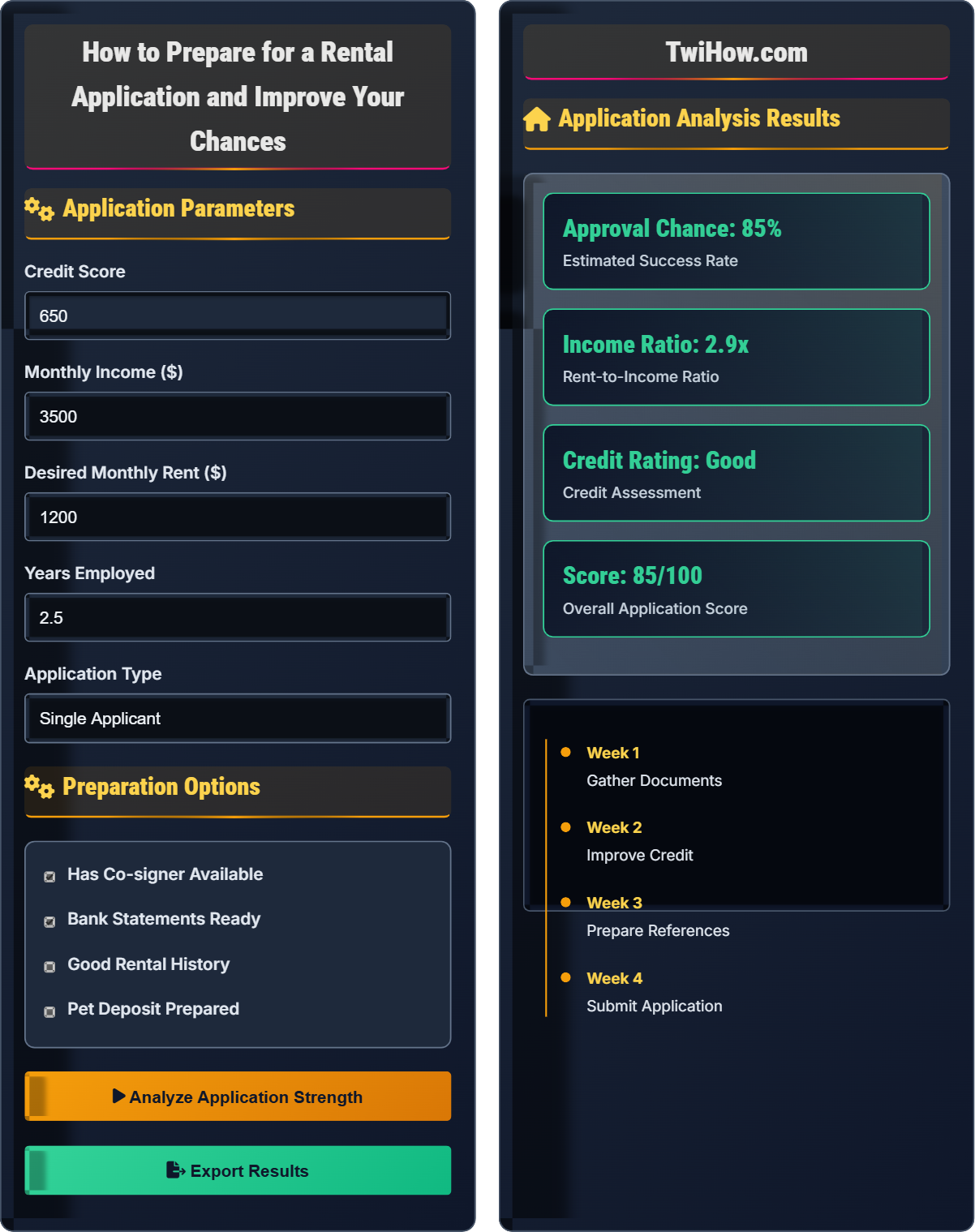
Application Parameters
Preparation Options
Application Analysis Results
| Factor | Score | Impact | Status |
|---|---|---|---|
| Credit Score | 75 | High | Good |
| Income | 85 | High | Strong |
| Employment | 70 | Medium | Average |
| References | 80 | Medium | Good |
How to Prepare for a Rental Application Explained
Landlords and property managers evaluate rental applications to assess risk and determine whether to accept or reject a potential tenant. The screening process typically examines your financial stability, rental history, and personal character. Understanding these criteria helps you prepare a stronger application.
Successful rental applications typically include several key elements:
- Credit Report: Demonstrates financial responsibility and debt management
- Income Verification: Pay stubs, tax returns, or employment letters
- Rental History: Previous landlord references and rental agreements
- Personal References: Character references from employers or colleagues
- Bank Statements: Shows financial stability and savings
- Identification: Government-issued photo ID
Most landlords require that your monthly income is at least 2.5 to 3 times the monthly rent. For example, if rent is $1,200 per month, you should earn at least $3,000 to $3,600 per month. Some luxury properties may require 4 times the rent. The formula is:
Rent-to-Income Ratio = Monthly Income ÷ Monthly Rent
A ratio of 3.0 or higher is generally considered strong, indicating you can comfortably afford the rent.
- Start Early: Begin gathering documents before you find a property
- Be Transparent: Address potential concerns upfront
- Offer More: Consider offering higher security deposit or longer lease
- Provide Explanations: Write cover letters for any negative items
- Find a Co-signer: If your qualifications are borderline
- Show Stability: Demonstrate consistent employment and residence
Application Preparation
Credit score, income verification, rental history, personal references, identification, and bank statements.
Rent-to-Income Ratio = Monthly Income ÷ Monthly Rent
Where Monthly Income = Gross income before taxes, Monthly Rent = Property rental rate.
- Income should be 2.5-3x monthly rent
- Credit score of 620+ is preferred
- Positive rental history is essential
Strategies
Co-signers, higher deposits, cover letters, quick applications, and thorough documentation.
- Address credit issues first
- Strengthen income verification
- Secure positive references
- Prepare comprehensive documentation
- Market conditions affect competition
- Property type influences requirements
- Location affects availability
- Timing can impact success
Rental Application Learning Quiz
What is the minimum credit score typically required for most rental applications?
Most landlords and property managers prefer a credit score of 620 or higher for rental applications. Scores below this threshold may still result in approval but often require additional requirements like co-signers or higher security deposits.
The answer is C) 620.
Credit scores are used by landlords as a predictor of financial responsibility. A score of 620 represents the threshold where most lenders consider a borrower to be subprime. While some landlords may accept lower scores, 620 is the standard benchmark. Scores above 700 are considered excellent and significantly improve approval chances.
Credit Score: Numerical expression of creditworthiness (300-850 scale)
Prime Borrower: Score typically 660+, low risk
Subprime Borrower: Score below 660, higher risk
• 620+ is standard minimum for most rentals
• Higher scores improve approval odds
• Some properties require 700+
• Check your score before applying
• Address credit issues proactively
• Provide explanations for negative items
• Applying without knowing credit score
• Not addressing credit issues
• Assuming all landlords have same requirements
Explain the rent-to-income ratio that landlords typically require and calculate the minimum monthly income needed for a $1,500 monthly rent. What factors might influence this requirement?
Rent-to-Income Ratio: Landlords typically require that monthly income be 2.5 to 3 times the monthly rent. This ensures tenants can comfortably afford rent even if unexpected expenses arise.
Calculation: For a $1,500 monthly rent, the minimum monthly income should be $1,500 × 2.5 = $3,750 to $1,500 × 3 = $4,500.
Factors Influencing Requirements: Luxury properties may require 4 times rent, competitive markets may be more flexible, properties in expensive areas may have higher ratios, and some landlords may consider total household income versus individual income.
The rent-to-income ratio serves as a safety net for landlords, ensuring tenants can afford rent consistently. The 2.5-3x standard provides buffer for other expenses. Some landlords also consider the debt-to-income ratio, which includes all monthly debts compared to income.
Rent-to-Income Ratio: Monthly rent divided by monthly income
Debt-to-Income Ratio: Total monthly debt payments divided by income
Gross Income: Income before taxes and deductions
• Standard ratio is 2.5-3x monthly rent
• Calculate before searching for properties
• Consider total household income
• Verify income requirements before applying
• Combine incomes for multiple applicants
• Have documentation ready
• Applying for rentals beyond income range
• Not having income verification ready
• Confusing gross vs. net income
You have a credit score of 580, monthly income of $2,800, and want to rent a property for $1,400/month. Your employment history is stable (5 years), but you have no previous rental history. What specific steps can you take to improve your application and increase your chances of approval?
Current Situation: Your rent-to-income ratio is 2.0x ($2,800 ÷ $1,400), which is below the preferred 2.5-3x range. Your credit score of 580 is below the typical 620 minimum. Lacking rental history creates additional uncertainty.
Improvement Steps:
1. Find a Co-signer: Have a financially stable person co-sign the lease
2. Offer Higher Deposit: Propose 2-3 months security deposit instead of 1
3. Provide Additional Documentation: Bank statements showing savings, investment accounts
4. Secure Strong References: Professional references from employers, colleagues
5. Write Cover Letter: Explain credit situation and demonstrate financial responsibility
6. Target More Flexible Properties: Look for properties managed by individuals or smaller companies
When facing multiple challenges in an application, addressing each weakness systematically strengthens the overall package. Co-signers and higher deposits offset financial risks, while strong references and documentation compensate for missing rental history. Transparency about challenges while demonstrating responsibility builds trust.
Co-signer: Person legally responsible for lease obligations
Security Deposit: Money held to cover damages or unpaid rentFirst-Time Renter: Person without prior rental history
• Address weaknesses proactively
• Provide compensating strengths
• Be honest about challenges
• Focus on strengths you can control
• Prepare extra documentation
• Research landlord preferences
• Applying for rentals beyond qualifications
• Not addressing known weaknesses
• Failing to offer alternatives
You need to provide rental references, but your previous landlord is difficult to reach and has had conflicts with tenants. You've been living with roommates for the past year. How should you approach the reference situation to maximize your chances of approval?
Reference Strategy:
1. Contact Previous Landlord: Attempt to reach them despite difficulties, explain your positive payment history
2. Provide Alternative References: Roommate references showing responsibility and cleanliness
3. Add Professional References: Employer, colleagues, professors to vouch for character
4. Offer Documentation: Bank statements showing rent payments to previous landlord
5. Write Explanation: Brief letter explaining any communication challenges with previous landlord while emphasizing positive traits
6. Propose Compromise: Offer to provide more frequent communication or additional references
Landlords appreciate proactive communication and alternative evidence of responsibility.
References serve to validate your reliability as a tenant. When traditional references are unavailable, creative alternatives can demonstrate similar qualities. The key is providing multiple sources that collectively paint a picture of responsibility, reliability, and good character. Transparency about challenges while showing initiative demonstrates maturity.
Rental Reference: Third-party confirmation of tenant behavior
Character Reference: Statement about personal integrity
Professional Reference: Workplace endorsement
• Always provide positive references
• Have backup references ready
• Communicate challenges proactively
• Contact references before listing them
• Prepare multiple reference types
• Have documentation as backup
• Listing unprepared or negative references
• Not having backup references
• Hiding reference challenges
When is the best time to submit a rental application to maximize approval chances?
In competitive rental markets, the best strategy is to submit your application immediately upon viewing the property and confirming it meets your needs. However, the optimal timing is B) Immediately upon listing publication, as properties in desirable locations receive multiple applications within hours of being listed. Having your documents prepared in advance allows for rapid submission.
The answer is B) Immediately upon listing publication.
Timing is crucial in rental applications, especially in competitive markets. Properties may receive dozens of applications within the first day of listing. Being prepared with all documents and submitting quickly demonstrates serious interest. However, ensure the property is truly suitable before rushing to apply, as multiple rejected applications can negatively impact your reputation.
Competitive Market: High demand, low supply of rentals
First-Come, First-Served: Priority given to earliest applications
Application Fee: Cost paid with rental application
• Prepare documents in advance
• Act quickly but carefully
• Don't rush to poor decisions
• Set up alerts for new listings
• Schedule viewings immediately
• Have documents ready to submit
• Delaying application submission
• Not having documents ready
• Applying to unsuitable properties
FAQ
Q: I'm a first-time renter with no rental history. How can I improve my application?
A: As a first-time renter, focus on these strategies:
1. Provide Strong Income Proof: Show stable employment and sufficient income
2. Find a Co-signer: Have parents or guardians co-sign the lease
3. Offer Higher Deposit: Provide 2-3 months security deposit
4. Provide Character References: From employers, professors, or mentors
5. Show Financial Responsibility: Bank statements, savings accounts
6. Write a Cover Letter: Explain your situation and demonstrate responsibility
Many landlords appreciate working with responsible first-time renters and may be more flexible with requirements.
Q: What documents should I prepare for a rental application?
A: Essential documents for rental applications include:
1. Photo ID: Driver's license, passport, or state ID
2. Income Verification: Recent pay stubs, tax returns, or employment letter
3. Bank Statements: Recent statements showing account activity
4. Rental History: Previous lease agreements, landlord contact information
5. References: Personal and professional reference contacts
6. Application Fee Payment: Check or money order for processing
Having these documents organized and ready to submit quickly demonstrates seriousness and preparedness.