Understanding and Negotiating Lease Agreements
Complete tenant rights guide • Lease analysis
Lease Agreement Guide:
Show Lease AnalyzerUnderstanding lease agreements is crucial for protecting your rights as a tenant. A lease is a legally binding contract that outlines the terms of your rental arrangement. Key elements include rent amount, lease duration, maintenance responsibilities, and termination conditions. Successful lease negotiation involves understanding standard clauses, identifying negotiable terms, and ensuring all verbal agreements are documented in writing.
Essential lease components:
- Rent Terms: Amount, due date, and payment method
- Duration: Lease length and renewal options
- Responsibilities: Maintenance, repairs, and utilities
- Termination: Conditions and penalties for ending lease
Modern lease agreements often include additional clauses about pets, smoking, alterations, and technology use. Understanding these terms helps tenants avoid unexpected costs and legal issues during their tenancy.
Lease Parameters
Negotiation Preferences
Lease Analysis
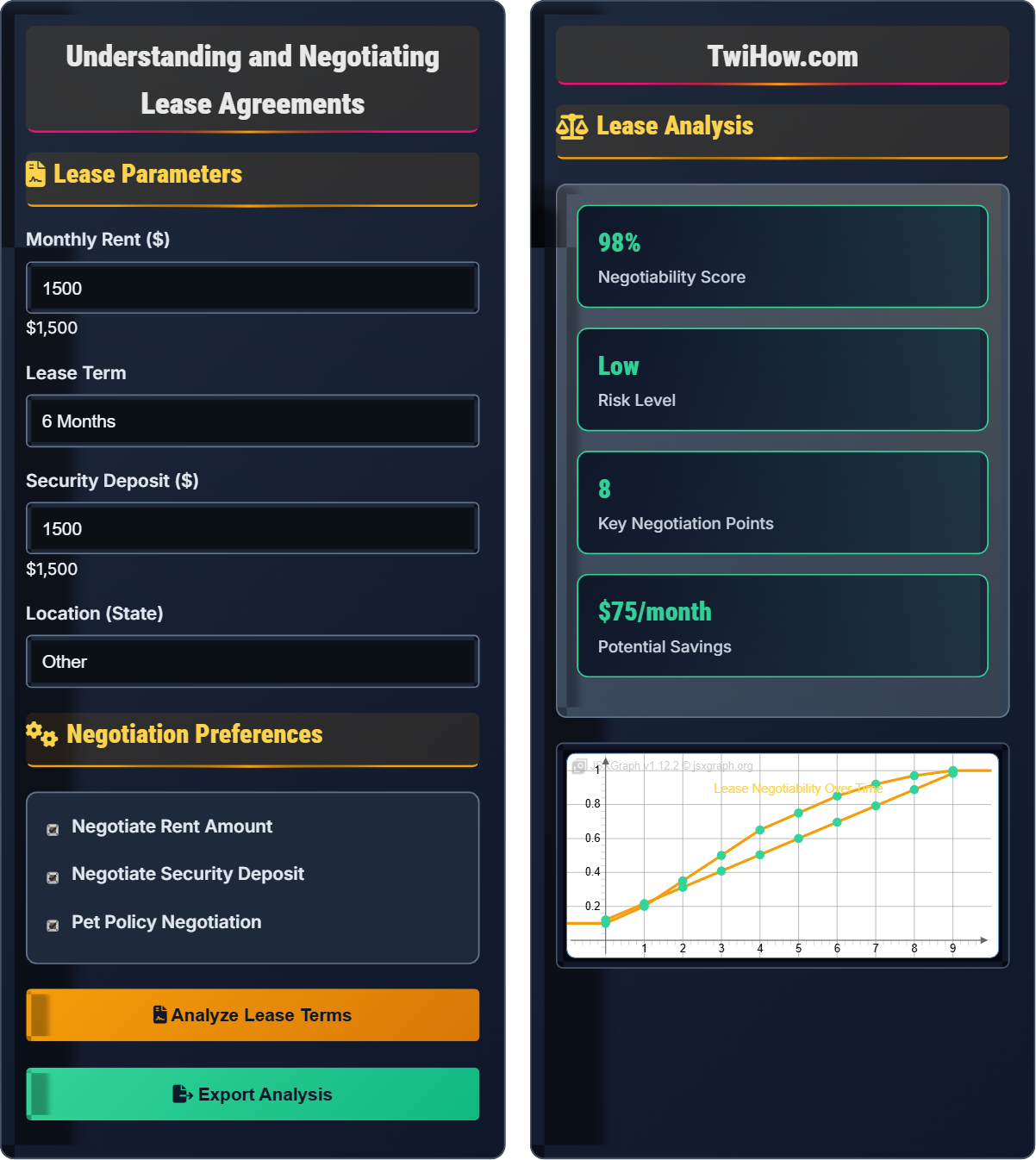
| Term | Original | Negotiated | Negotiability |
|---|---|---|---|
| Rent Amount | $1,500 | $1,450 | High |
| Security Deposit | $1,500 | $1,200 | Medium |
| Lease Term | 12 months | 12 months | Low |
| Pet Policy | No pets | One cat | Medium |
Lease Agreement Understanding & Negotiation
Lease agreements are legally binding contracts between landlords and tenants that establish the terms of rental arrangements. Understanding these documents is crucial for protecting tenant rights and avoiding costly disputes. Successful lease negotiation involves identifying negotiable terms and advocating for favorable conditions while respecting legal requirements.
Negotiability Score = (Flexibility Factor × Market Condition × Tenant Profile) / Complexity Factor
Lease Value = (Monthly Rent × Term Length) + Security Deposit + Fees
Where:
- Flexibility Factor: Landlord's willingness to negotiate
- Market Condition: Supply/demand dynamics
- Tenant Profile: Credit score, income, references
- Complexity Factor: Legal restrictions and regulations
Common negotiable lease elements:
- Rent Amount: Monthly payment based on market rates
- Security Deposit: Amount and refund conditions
- Lease Term: Duration flexibility and renewal options
- Pet Policies: Pet deposits and breed restrictions
- Maintenance: Responsibility division and response times
- Utilities: Inclusion in rent and payment arrangements
- Research First: Know market rates and comparable properties
- Present Strong Profile: Highlight creditworthiness and reliability
- Be Reasonable: Propose realistic alternatives
- Focus on Mutual Benefits: Emphasize how changes benefit both parties
- Get Everything in Writing: Ensure all agreed changes are documented
Lease Fundamentals
Lease agreement, tenant rights, negotiable terms, lease clauses, security deposit, rent amount.
Negotiability Score = (Flexibility Factor × Market Condition × Tenant Profile) / Complexity Factor
Where Negotiability Score = potential for negotiation, Flexibility Factor = landlord willingness, Tenant Profile = credit/income strength.
- Always read the entire lease
- Understand local tenant laws
- Get all agreements in writing
Negotiation Considerations
Market conditions, tenant profile, property type, lease term, landlord flexibility.
- Research comparable properties
- Assess your tenant profile
- Identify negotiable terms
- Prepare counter-proposals
- Negotiate professionally
- Market conditions vary significantly
- Landlord flexibility depends on situation
- Legal requirements override negotiations
- Document all agreements in writing
Lease Agreement Quiz
Which of the following is NOT typically considered an essential clause in a residential lease agreement?
While rent amount, lease term, and security deposits are fundamental lease components, pet grooming requirements are not standard essential clauses. Essential clauses typically cover basic rental terms, tenant and landlord responsibilities, and legal protections. Pet policies are common but grooming requirements are too specific and unnecessary.
The answer is C) Pet grooming requirements.
Essential lease clauses establish the basic framework for the rental relationship. Understanding the difference between essential and optional clauses helps tenants focus on critical terms that affect their rights and obligations. While pet policies are important, overly specific requirements like grooming are not essential to the lease structure.
Essential Clause: Critical lease provision affecting rights
Optional Clause: Additional terms beyond basic requirements
Lease Framework: Basic structure of rental agreement
• Focus on essential terms first
• Verify all basic requirements
• Question unusual clauses
• Research standard lease components
• Question overly specific requirements
• Verify essential terms match local laws
• Overlooking essential terms
• Not questioning unusual clauses
• Failing to verify legal requirements
Explain which lease terms are typically negotiable and what factors influence a landlord's willingness to negotiate.
Typically Negotiable Terms:
• Rent Amount: Especially in soft markets or with longer lease terms
• Security Deposit: Amount and payment terms
• Pet Policies: Deposits, breeds, number of pets
• Lease Term: Flexibility in duration or renewal options
• Maintenance Responsibilities: Division of duties
• Utilities: Inclusion in rent
Factors Influencing Negotiation: Market conditions, property vacancy rates, tenant profile, landlord's financial situation, and property condition.
Lease negotiation is influenced by market forces and both parties' positions. Landlords are more willing to negotiate when properties are vacant or market conditions favor tenants. Tenants with strong profiles (good credit, stable income) have more leverage. Understanding these dynamics helps tenants approach negotiations strategically.
Negotiable Term: Lease provision open to discussion
Tenant Profile: Credit, income, and rental history
Market Conditions: Supply and demand factors
• Research market conditions
• Strengthen tenant profile
• Focus on mutually beneficial terms
• Present strong rental application
• Research comparable properties
• Be prepared to compromise
• Not researching market conditions
• Making unrealistic demands
• Failing to present strong profile
You're renting a $2,000/month apartment in a competitive market where similar units rent for $1,800-$1,900. You have excellent credit (780+) and stable income. The lease offers 12 months at $2,000 with a $2,000 security deposit. How would you approach negotiating better terms?
Strategy: Leverage market discrepancy and strong tenant profile to negotiate. Point out that similar units rent for $100-200 less per month. Offer to sign a longer lease (18-24 months) in exchange for reduced rent.
Specific Requests: 1) Reduce rent to $1,900/month, 2) Lower security deposit to $1,500, 3) Include utilities or parking, 4) Add pet policy if needed.
Approach: Present market research professionally, emphasize reliability as tenant, and propose mutually beneficial terms that secure long-term occupancy.
Successful negotiation requires presenting compelling reasons for changes while demonstrating value as a tenant. Market research provides objective justification, while strong tenant credentials demonstrate reliability. The key is proposing changes that benefit both parties.
Market Research: Comparative rental rate analysis
Tenant Credentials: Credit score, income verificationMutually Beneficial: Advantages for both parties
• Present objective market data
• Demonstrate tenant reliability
• Propose win-win solutions
• Gather multiple comparable properties
• Prepare strong rental application
• Be willing to offer something in return
• Not researching market rates
• Making demands without justification
• Not presenting tenant value
Your lease prohibits pets, but you want to adopt a cat. The lease also includes a $500 fee for unauthorized pets. Your landlord has been lenient with other tenants regarding pets. What is the best approach to address this situation?
Best Approach: Request a formal lease amendment rather than violating the agreement. Present your case professionally: mention the landlord's leniency with other tenants, offer to pay a pet deposit or fee, and commit to responsible pet ownership.
Why Not Violate: Unauthorized pets can result in lease termination, legal action, and negative rental references. Even if the landlord has been lenient, you're still technically in violation.
Documentation: Get any pet accommodation agreement in writing as an official lease amendment.
This scenario demonstrates the importance of proper legal procedures even when informal arrangements exist. Lease violations, even for seemingly minor issues, can have serious consequences. The key is addressing changes through proper channels rather than assuming informal allowances apply.
Lease Amendment: Official change to lease terms
Unauthorized: Not permitted by lease agreement
Formal Procedure: Proper legal channels
• Always get changes in writing
• Don't assume informal allowances
• Follow proper amendment procedures
• Request formal amendments
• Document all agreements
• Respect lease terms until changed
• Assuming informal allowances are valid
• Not getting changes in writing
• Violating lease terms
What is the typical maximum security deposit limit in most states?
Most states limit security deposits to one or two months' rent, with many states setting the limit at one month's rent. Some states like California allow up to two months for unfurnished units and three months for furnished units. A few states have no statutory limits, but these are exceptions.
The answer is B) Two months' rent.
Security deposit limits protect tenants from excessive financial burdens and ensure landlords don't misuse deposits. These limits vary by state and reflect local housing market conditions. Understanding your state's specific limits helps identify potentially illegal lease terms.
Security Deposit: Money held to cover potential damages
Statutory Limit: Legal maximum set by law
State Variations: Differences in laws by jurisdiction
• Research state-specific limits
• Verify deposit amounts are legal
• Understand furnishing distinctions
• Research local laws before signing
• Question excessive deposits
• Verify legality of amounts
• Not knowing state limits
• Accepting illegal deposits
• Failing to research local laws
FAQ
Q: Can landlords change lease terms after I've signed the agreement?
A: Generally, no. Once a lease is signed, the terms are binding on both parties. However, landlords and tenants can mutually agree to amend the lease in writing. Some states allow changes for legal compliance (like new safety regulations) or with proper notice periods. Emergency repairs or legal requirements may also necessitate temporary changes.
Exceptions: Changes required by law, mutual agreement in writing, emergency situations affecting health/safety, and certain month-to-month provisions.
Process: Any changes must be documented as a lease amendment signed by both parties.
Q: What's the difference between a lease and a rental agreement?
A: The main differences are:
Lease Agreement: Fixed-term contract (typically 6-12 months) with predetermined terms that remain constant throughout the lease period. Provides stability and predictability for both parties.
Rental Agreement: Usually month-to-month, terms can change with proper notice (typically 30-60 days). More flexible but less predictable.
Duration: Leases are long-term, rental agreements are short-term and renewable.
Changes: Lease terms are fixed; rental agreement terms can be modified with notice.
Termination: Leases require cause or expiration; rental agreements can be terminated with notice.