How Do I Understand the Difference Between a Lease and a Month-to-Month Agreement?
Complete guide • Step-by-step explanations
Rental Agreements:
Show Comparison ToolUnderstanding the difference between a lease and a month-to-month rental agreement is crucial for making informed housing decisions. Both types of agreements have distinct terms, benefits, and obligations that affect your rights as a tenant and responsibilities as a renter.
A lease is a fixed-term contract that binds both parties for a predetermined period, typically 6 months to 2 years. A month-to-month agreement continues indefinitely until terminated by either party with proper notice, usually 30 days. Each type offers different levels of flexibility and stability.
Key differences between lease and month-to-month agreements include:
- Term Length: Fixed vs. ongoing
- Rent Stability: Locked in vs. subject to change
- Termination: Limited vs. flexible
- Renewal: Automatic vs. mutual consent
Choosing the right type depends on your personal circumstances, job stability, and housing needs.
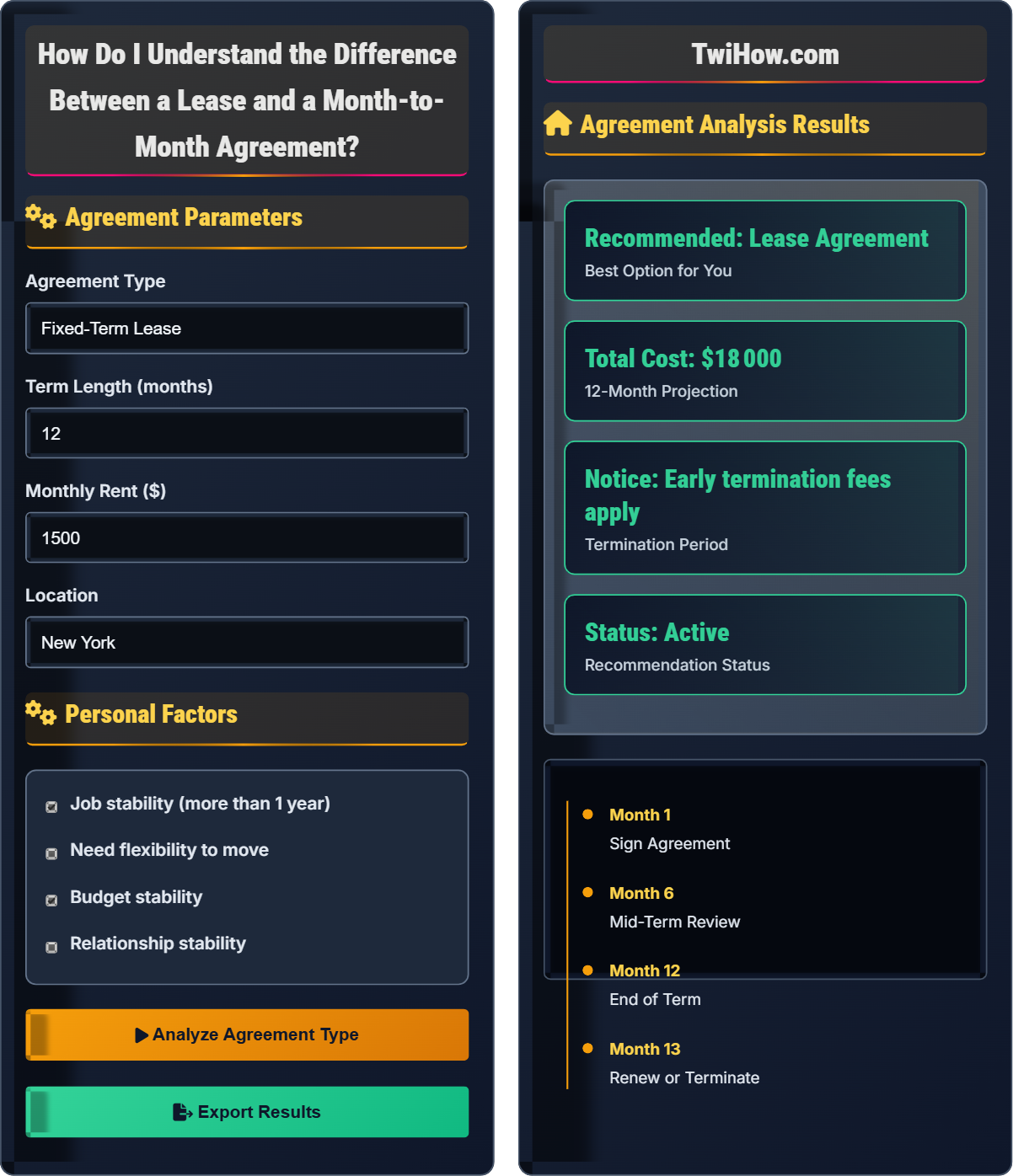
Agreement Parameters
Personal Factors
Agreement Analysis Results
| Feature | Lease | Month-to-Month | Comparison |
|---|---|---|---|
| Term Length | Fixed | Flexible | Lease offers stability |
| Rent Stability | Locked | Variable | Lease protects from increases |
| Termination | Difficult | Easy | Monthly offers flexibility |
| Cost Predictability | High | Low | Lease provides certainty |
Understanding Lease vs Month-to-Month Agreements Explained
A lease agreement is a legally binding contract between a landlord and tenant that specifies the terms and conditions for renting a property for a fixed period. A month-to-month agreement (also called a periodic tenancy) continues indefinitely until terminated by either party with proper notice. Understanding these fundamental differences helps you choose the right arrangement for your situation.
Major differences between lease and month-to-month agreements include:
- Term Length: Leases are fixed-term (usually 6-24 months), month-to-month continues indefinitely
- Rent Stability: Lease locks in rent for term, month-to-month allows rent changes
- Termination: Lease requires mutual agreement or lease terms, month-to-month requires 30-day notice
- Flexibility: Lease offers stability, month-to-month offers mobility
- Security: Lease provides guaranteed tenure, month-to-month offers uncertainty
- Renewal: Lease may renew automatically, month-to-month continues unless terminated
Both lease and month-to-month agreements are governed by state and local laws that define tenant and landlord rights:
Lease Agreements: Provide greater security but limit flexibility. Early termination may incur penalties or require subletting. Rent increases are typically prohibited during the lease term.
Month-to-Month Agreements: Offer maximum flexibility but less security. Either party can terminate with proper notice. Rent can be increased with appropriate notice periods as defined by local laws.
Both types of agreements must comply with fair housing laws and tenant protection statutes.
- Conversion Options: Many leases convert to month-to-month after expiration
- Renewal Negotiations: Use lease expiration as opportunity to negotiate better terms
- Market Timing: Consider seasonal rental market fluctuations
- Upgrade Opportunities: Month-to-month allows for property upgrades or moves
- Financial Benefits: Long-term leases may offer better rates or incentives
- Relationship Building: Longer commitments may improve landlord relationships
Agreement Types
Lease agreement: Fixed-term contract with predetermined terms. Month-to-month: Ongoing agreement renewable monthly.
Decision Factor = (Stability Need × Flexibility Need × Budget Predictability) ÷ (Risk Tolerance)
Where Stability Need = Preference for predictable tenure, Flexibility Need = Requirement for mobility.
- Lease terms are binding for fixed period
- Month-to-month requires proper notice to terminate
- Rent increases follow local law requirements
Benefits
Lease: Rent stability, security, predictability. Month-to-month: Flexibility, mobility, adaptability.
- Financial stability benefits
- Planning and security benefits
- Flexibility and mobility benefits
- Relationship and communication benefits
- State laws vary significantly
- Market conditions affect options
- Personal circumstances matter most
- Long-term vs. short-term goals
Agreement Type Learning Quiz
Which of the following is TRUE about a standard lease agreement compared to a month-to-month agreement?
A standard lease agreement locks in the rent for the entire lease term, typically 6-24 months. This provides financial predictability and protection from rent increases during the lease period. In contrast, month-to-month agreements allow rent changes with proper notice.
The answer is C) Locks in rent for the lease term.
The rent stability feature of lease agreements is one of their primary advantages. This predictability allows tenants to budget effectively and plan for future expenses. Landlords benefit from guaranteed income for the lease term. This contrasts with month-to-month agreements where rent can fluctuate based on market conditions.
Fixed Rent: Rent amount that remains constant for lease term
Market Rate: Current rental price based on market conditions
Rent Stabilization: Protection from excessive rent increases
• Lease rent is locked in for term length
• Month-to-month allows rent changes
• Notice requirements vary by state
• Negotiate rent increases before lease signing
• Budget for fixed expenses with lease
• Plan for potential increases with month-to-month
• Assuming lease rent can change anytime
• Not planning for month-to-month rent changes
• Confusing lease and month-to-month features
Explain the termination rights and notice requirements for both lease and month-to-month agreements. How do these rights differ between the two types?
Lease Agreement Termination: Generally requires mutual agreement or specific lease terms. Early termination may involve penalties, finding a replacement tenant, or paying remaining rent. Some leases allow early termination for military orders, job transfers, or domestic violence.
Month-to-Month Termination: Either party can terminate with proper notice, typically 30-60 days depending on state law. Landlords must provide valid reasons for termination in some jurisdictions.
Key Differences: Leases provide stability but limit flexibility, while month-to-month agreements offer maximum flexibility but less security. Lease termination often requires significant planning and potential financial penalties.
The termination process fundamentally defines the difference between lease and month-to-month agreements. Lease agreements prioritize stability and predictability, requiring significant commitment from both parties. Month-to-month agreements prioritize flexibility, allowing either party to end the relationship with appropriate notice. Understanding these differences helps tenants choose the arrangement that matches their lifestyle and circumstances.
Early Termination: Ending lease before agreed term
Notice Period: Required time before terminationValid Cause: Legally acceptable reason for termination
• Lease termination often requires penalties
• Month-to-month requires proper notice
• State laws govern notice requirements
• Read termination clauses carefully
• Understand penalty structures
• Know local notice requirements
• Assuming lease can be terminated easily
• Not understanding penalty costs
• Failing to give proper notice
You're starting a new job that requires you to relocate frequently for the first two years. You're unsure about your long-term career path and may need to move again after that. Your budget is stable but modest, and you want to avoid financial penalties. Which type of rental agreement would be most suitable for your situation and why?
Recommended Agreement: Month-to-month agreement
Reasoning:
1. Job Requirements: Frequent relocations require maximum flexibility
2. Uncertainty: Unknown career path makes long-term commitment risky
3. Financial Considerations: Avoiding early termination penalties is important
4. Stability: Month-to-month allows adaptation to changing circumstances
While month-to-month agreements may have higher rent or less stability, the flexibility aligns with your professional needs and reduces financial risk from early termination penalties.
The choice between lease and month-to-month agreements should align with your personal and professional circumstances. In this scenario, the primary need is flexibility to accommodate job requirements. While leases offer rent stability, the potential for early termination penalties far outweighs this benefit given the frequent relocations. The key is matching the agreement type to your life situation rather than choosing based on convention.
Life Circumstances: Personal factors affecting housing needs
Early Termination Penalty: Fee for ending lease early
Flexibility vs. Stability: Trade-off between adaptability and security
• Match agreement to life circumstances
• Consider penalty costs vs. flexibility
• Evaluate long-term vs. short-term needs
• Assess your situation honestly
• Consider worst-case scenarios
• Factor in potential costs
• Choosing based on convention rather than need
• Not considering penalty costs
• Assuming all situations require leases
You're looking for a rental in a competitive market where rents are rapidly increasing. You have a stable job and plan to stay in the area for at least 2 years. Current market rent is $1,800/month, but analysts predict 10-15% increases over the next year. What type of agreement should you pursue and what factors should you consider in your decision?
Recommended Approach: Pursue a fixed-term lease with 18-24 month term
Factors to Consider:
1. Rent Lock-In: Protect against predicted 10-15% increases
2. Market Conditions: Competitive market favors landlords, so negotiate aggressively
3. Stability: Aligns with your 2-year plan
4. Budget Protection: Ensures predictable housing costs
5. Negotiation Power: Longer lease may qualify for rent concessions or incentives
Consider negotiating rent escalation caps or renewal incentives to balance long-term commitment with potential market benefits.
Market conditions significantly impact the value of lease vs. month-to-month decisions. In rising rent markets, leases provide substantial financial protection. The key is evaluating whether the benefits of locking in current rates outweigh the flexibility of month-to-month agreements. In this scenario, the predictable rent savings likely exceed the cost of reduced flexibility.
Market Analysis: Evaluation of rental market trends
Rent Escalation: Gradual rent increases over time
Negotiation Power: Ability to influence lease terms
• Consider market trends in decision
• Evaluate long-term cost savings
• Negotiate favorable terms
• Research market trends before deciding
• Negotiate longer terms for savings
• Ask for rent concessions
• Ignoring market conditions
• Not negotiating lease terms
• Failing to consider long-term costs
What typically happens when a fixed-term lease expires and the tenant continues to occupy the property?
When a fixed-term lease expires and the tenant continues to occupy the property with the landlord's acceptance of rent, the agreement typically converts to a month-to-month tenancy. This is known as a "holdover tenancy" and continues under the same terms as the original lease except for the term length.
The answer is B) The agreement converts to month-to-month.
The conversion from lease to month-to-month upon expiration is an important concept that many tenants don't understand. This automatic conversion provides continuity but changes the termination rights and rent adjustment possibilities. Landlords and tenants should be aware of this transition and discuss renewal options before the lease expires.
Holdover Tenancy: Continued occupancy after lease expiration
Automatic Conversion: Legal transition to different agreement type
Lease Renewal: Extension of lease terms
• Leases typically convert to month-to-month
• Same terms usually continue
• Notice requirements change
• Discuss renewal options before expiration
• Understand conversion terms
• Plan for potential rent changes
• Assuming lease automatically extends
• Not planning for conversion
• Forgetting to negotiate new terms
FAQ
Q: Can I switch from a month-to-month to a lease agreement?
A: Yes, you can typically switch from a month-to-month to a lease agreement:
1. Initiate Discussion: Talk to your landlord about converting to a fixed-term lease
2. Negotiate Terms: Discuss rent, length, and other lease conditions
3. New Agreement: Sign a new lease that replaces the month-to-month arrangement
4. Proper Notice: Give appropriate notice if required by local law
Many landlords welcome the stability of lease agreements and may offer incentives to encourage conversion.
Q: What happens if I want to break a lease early?
A: Breaking a lease early has consequences that vary by state and lease terms:
• Penalties: You may owe remaining rent or early termination fees
• Subletting: Some states allow subletting to reduce financial impact
• Legal Exceptions: Military orders, domestic violence, uninhabitable conditions may allow early termination
• Landlord Obligation: Landlords must make reasonable efforts to re-rent the property
Before breaking a lease, review your agreement terms and consult with a tenant rights attorney in your area.