Local Housing Laws Impact: Tenant Rights Guide
Complete guide • Rent control, tenant protections, zoning
Local Housing Laws Overview:
Show Laws Impact AnalyzerLocal housing laws significantly impact your tenancy rights, obligations, and protections. These laws vary dramatically between cities and counties, creating a patchwork of protections that can be difficult to navigate. Understanding your local regulations is crucial for maximizing your rights and avoiding violations.
Key areas covered by local housing laws include:
- Rent Control: Limits on rent increases and rent stabilization
- Tenant Protections: Just cause eviction, security deposit limits
- Housing Standards: Habitability requirements and inspections
- Zoning Regulations: Property use restrictions and short-term rentals
- Anti-Discrimination: Additional protections beyond federal laws
Knowledge of these laws helps protect your housing stability and ensures you receive proper protections.
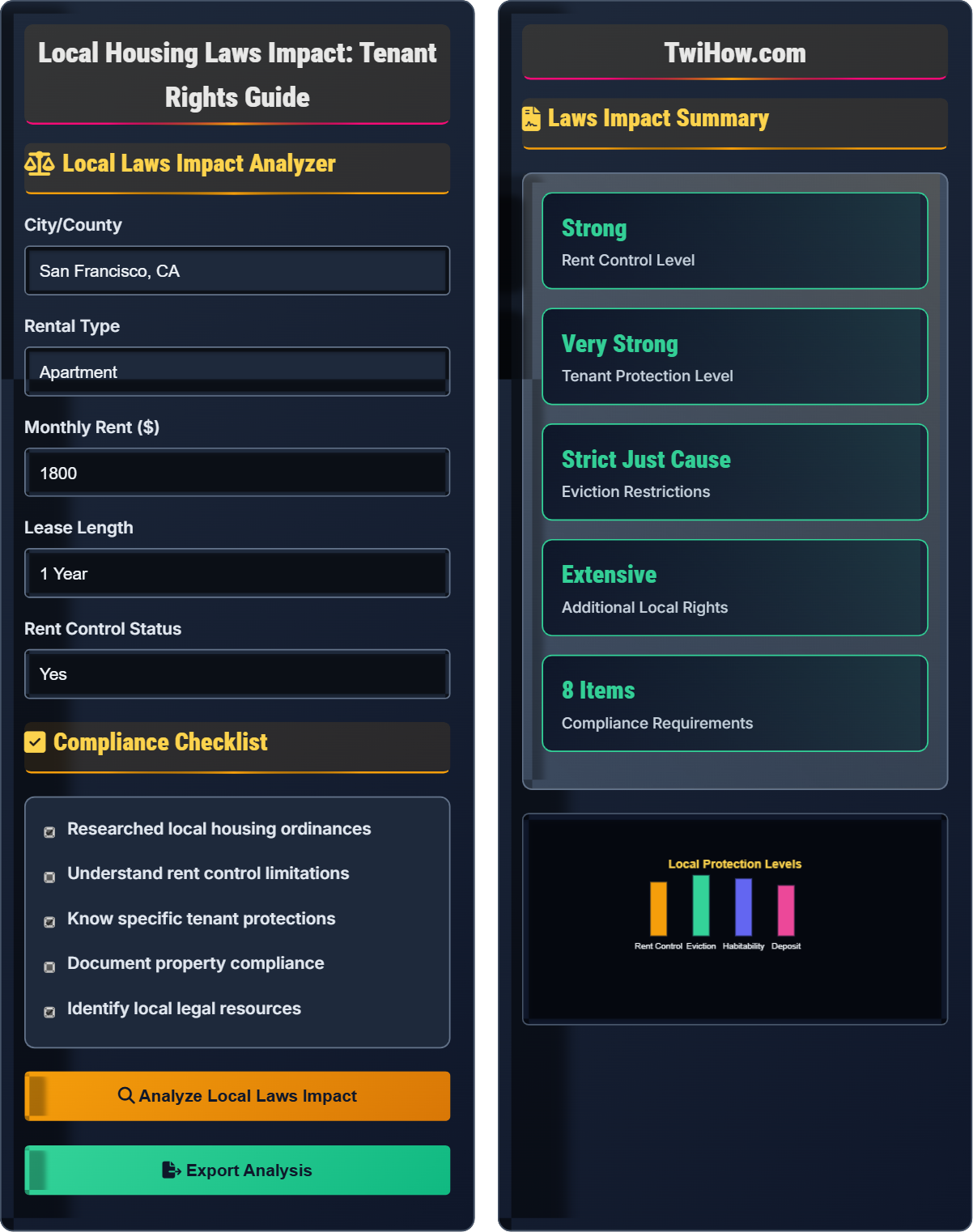
Local Laws Impact Analyzer
Compliance Checklist
Laws Impact Summary
Your Local Protection Levels
- Rent control limits on annual increases
- Just cause eviction requirements
- Security deposit protections
- Right to habitable housing
- Protection against retaliation
Detailed Impact Analysis
Local Ordinance Coverage: Your jurisdiction provides comprehensive tenant protections including rent stabilization, just cause eviction requirements, and enhanced security deposit protections.
Compliance Monitoring: Regular property inspections and tenant complaint procedures ensure habitability standards.
Legal Resources: Multiple organizations provide free or low-cost legal assistance for tenant issues.
Understanding Local Housing Laws Impact
Local housing laws operate within a multi-tiered legal framework:
Each level builds upon the previous, with local laws providing the most specific protections:
- Federal Laws: Fair Housing Act, Americans with Disabilities Act
- State Laws: General tenant protections, security deposit limits
- Local Laws: Rent control, just cause eviction, local ordinances
Different types of rent control affect your tenancy differently:
Types of rent control include:
- Rent Stabilization: Limits on annual rent increases
- Rent Ceiling: Maximum allowable rent for units
- Just Cause Eviction: Reasons landlords can terminate tenancy
- Conversion Controls: Restrictions on changing rental to ownership
Local laws typically provide protections in these areas:
- Rent Increases: Annual percentage limits, timing restrictions
- Security Deposits: Maximum amounts, return timeframes
- Evictions: Required reasons, notice periods
- Habitability: Maintenance standards, inspection requirements
- Discrimination: Additional protected classes beyond federal law
- Retaliation: Protection against landlord reprisals
- Know Your Local Rights: Research specific protections in your jurisdiction
- Document Rent History: Track all rent payments and increases
- Understand Lease Terms: Ensure lease complies with local laws
- Monitor Property Conditions: Report maintenance issues promptly
- Stay Informed: Follow local housing policy changes
- Build Community: Connect with other tenants facing similar issues
Local Rent Control Systems
Rent stabilization, just cause eviction, rent ceiling, conversion control, habitability standards.
Maximum Rent Increase = Current Rent × (1 + Local Allowable Percentage)
Where local percentage is determined by local rent control ordinance.
- Local laws can provide more protection than state law
- Preemption may limit local authority in some areas
- Older buildings may be exempt from some controls
- Owner-occupied units may have different rules
Tenant Protection Strategies
Local ordinances, tenant unions, legal aid, housing advocacy, community organizing.
- Visit city hall or official website
- Search for "tenant protection" or "housing" ordinances
- Check with local tenant rights organizations
- Review municipal code sections
- Attend city council meetings on housing issues
- Subscribe to local housing news updates
- Local laws change frequently
- Some protections apply retroactively
- Enforcement varies by jurisdiction
- Legal standing may depend on compliance history
Local Housing Laws Knowledge Quiz
What is the primary purpose of local rent control laws?
Local rent control laws are designed to limit rent increases and promote housing stability for tenants. These laws typically cap the percentage by which landlords can increase rent annually, helping to prevent displacement and maintain affordable housing in communities. The primary goal is to balance the interests of both tenants and landlords while promoting stable housing markets.
The answer is B) To limit rent increases and promote housing stability.
Rent control emerged in response to rapid rent increases that displaced long-term residents from neighborhoods. These laws serve as market interventions to preserve affordable housing and prevent gentrification-related displacement. Understanding this historical context helps explain why these laws exist and how they function.
Rent Stabilization: Limits on rent increase percentages per year
Just Cause Eviction: Required legal reasons for terminating tenancy
Gentrification: Process of neighborhood change leading to displacement
• Rent control limits annual increases
• Does not freeze rents at current levels
• Often includes exemptions for new construction
• Research your local rent control ordinance
• Track rent increases over time
• Understand exemption criteria
• Assuming rent control freezes all rent increases
• Not understanding exemption rules
• Failing to track rent history
Explain what "just cause eviction" means, how it protects tenants, and provide examples of acceptable just cause reasons.
Just Cause Definition: Just cause eviction laws require landlords to provide specific, legally acceptable reasons for terminating a tenancy. This prevents arbitrary or retaliatory evictions.
Tenant Protections:
1. Stability: Prevents random terminations of tenancy
2. Legal Process: Ensures proper procedures are followed
3. Retaliation Protection: Prevents punishment for asserting rights
4. Documentation: Requires written justification for evictions
Acceptable Just Cause Examples:
• Non-payment of rent
• Lease violations
• Illegal activity on premises
• Owner move-in (in some jurisdictions)
• Substantial rehabilitation requiring unit vacancy
• Ellis Act withdrawal from rental market
Just cause eviction laws vary by jurisdiction but generally provide stronger protections than at-will tenancies.
Just cause eviction laws shift the burden of proof from tenants to landlords, requiring specific reasons for termination. This creates accountability in the eviction process and prevents discriminatory or retaliatory actions. The concept balances property rights with housing stability.
Just Cause: Legally acceptable reason for terminating tenancy
No-Cause Eviction: Termination without required justification
Retaliation: Punishment for exercising tenant rights
• Landlords must specify legal cause
• Causes must be documented
• Some causes require specific procedures
• Know your local just cause list
• Document all communications
• Challenge invalid reasons
• Accepting vague eviction reasons
• Not challenging invalid causes
• Failing to document landlord actions
You live in a city with rent control that limits annual increases to 3%. Your current rent is $2,000 per month. Your landlord has notified you of a rent increase to $2,100 per month (a 5% increase). According to local law, what is the maximum legal rent increase, and what should you do?
Calculation:
• Current rent: $2,000
• Legal increase (3%): $2,000 × 0.03 = $60
• Legal maximum rent: $2,000 + $60 = $2,060
• Proposed rent: $2,100 (5% increase)
• Violation: $2,100 - $2,060 = $40 over legal limit
Actions to Take:
1. Document Violation: Keep written notice of illegal rent increase
2. Pay Legal Amount: Pay $2,060 instead of $2,100
3. Contact Landlord: Explain legal rent control limits
4. Seek Legal Help: Contact tenant rights organization
5. File Complaint: Report violation to local housing authority
The maximum legal rent is $2,060 per month. The landlord's proposed increase exceeds local rent control limits by $40 per month.
This scenario demonstrates how rent control laws provide concrete protections with specific dollar amounts. Tenants can use these calculations to verify rent increases and assert their rights. Understanding these calculations empowers tenants to identify violations and take appropriate action.
Rent Control Limit: Maximum percentage increase allowed by law
Legal Rent: Maximum rent permitted under local lawsViolation: Exceeding legal rent control limits
• Pay legal amount, not proposed amount
• Document all violations
• Seek legal help for persistent violations
• Calculate rent increases yourself
• Keep rent payment records
• Know your local rent control percentage
• Paying illegal rent increases
• Not calculating legal limits
• Failing to document violations
Your city has a local law limiting security deposits to one month's rent, but your lease agreement specifies a two-month deposit. Additionally, your landlord is asking for a "pet deposit" in addition to the regular security deposit. What are your rights under local law, and how should you respond?
Legal Analysis:
• Local law: Security deposit limited to one month's rent
• Lease agreement: Specifies two-month deposit (violates local law)
• Pet deposit: Additional deposit beyond legal limit
Your Rights:
1. Legal Deposit Limit: Maximum one month's rent
2. Invalid Clauses: Lease provisions exceeding local limits are unenforceable
3. Prohibited Surcharges: Additional deposits like pet deposits may be illegal
Recommended Actions:
• Pay only the legal one-month deposit
• Document the local law requirement
• Negotiate lease amendments to comply with local law
• Contact local tenant rights organization for guidance
• File complaint if landlord insists on illegal deposits
Local housing laws override conflicting lease terms, so you are only required to pay the legal limit.
This scenario illustrates how local laws override private contract terms when they conflict. Lease agreements cannot waive statutory protections or exceed legal limits. Understanding this principle helps tenants assert their rights even when faced with seemingly binding contract terms.
Statutory Override: Law takes precedence over contract terms
Security Deposit: Funds held to cover potential damages
Unenforceable Clause: Contract provision violating local law
• Local laws override lease terms
• Cannot waive statutory protections
• Pay only legal amounts required
• Research local deposit limits
• Don't sign leases with illegal terms
• Negotiate compliant lease terms
• Signing leases with illegal terms
• Paying amounts beyond legal limits
• Not researching local deposit laws
Which of the following is typically within the authority of local governments to regulate regarding rental housing?
Local governments have broad authority to regulate rental housing within their jurisdictions, including setting rent control policies and just cause eviction requirements. This authority stems from local government's police power to promote public welfare, health, and safety. Local ordinances commonly address rent increases, security deposits, habitability standards, and tenant protections.
The answer is B) Limiting rent increases and requiring just cause evictions.
Local governments have significant authority over rental housing regulation under their police powers, which allow them to enact laws promoting public welfare. This authority is balanced by state preemption laws that may limit local authority in certain areas. Understanding these jurisdictional boundaries helps tenants know which protections apply to them.
Police Power: Government authority to regulate for public welfare
Preemption: Higher law overriding local ordinances
Jurisdiction: Geographic area of legal authority
• Local authority varies by state
• State law may preempt local ordinances
• Local laws can provide more protection
• Research local government authority
• Check for state preemption
• Know your specific jurisdiction
• Assuming all areas have same protections
• Not understanding jurisdictional boundaries
• Failing to research local authority
FAQ
Q: How do I find out what local housing laws apply to my rental?
A: To find local housing laws that apply to your rental:
Official Sources:
1. City/County Website: Search for "housing," "tenant rights," or "rental regulations"
2. Municipal Code: Look for housing or rent control chapters
3. Housing Authority: Many cities have dedicated housing departments
Community Resources:
4. Tenant Organizations: Local tenant unions and advocacy groups
5. Legal Aid: Free legal services for housing issues
6. Public Meetings: Attend city council or housing commission meetings
Property-Specific Information:
7. Building Age: Older buildings may have different protections
8. Unit Type: Apartments vs. single-family homes may have different rules
Always verify information with official sources, as laws change frequently.
Q: Can local housing laws affect my ability to manage my rental property?
A: Yes, local housing laws significantly impact property management:
Rent Management:
• Rent control laws may limit how much you can charge or increase rent
• Rent stabilization may require justifications for increases
Tenant Relations:
• Just cause eviction requirements limit reasons for termination
• Tenant protection laws may restrict screening practices
Property Standards:
• Habitability requirements mandate specific maintenance standards
• Regular inspections may be required
Financial Aspects:
• Security deposit limits may be regulated
• Late fee amounts may be capped
Compliance Requirements:
• Licensing requirements for landlords
• Mandatory registration of rental units
• Reporting requirements for rent increases
It's essential to research and comply with all applicable local laws to avoid penalties and legal disputes.