Understanding Tenant Painting & Modification Rules
Complete guide to tenant rights • Step-by-step explanations
Tenant Modification Rights:
Show Modification CalculatorTenant painting and modification rules vary significantly based on your lease agreement, local laws, and property type. Understanding these rules is crucial for maintaining a positive relationship with your landlord while personalizing your living space.
Key modification concepts:
- Lease Agreement: Primary source of modification permissions
- Landlord Consent: Required for most permanent changes
- Restoration Obligations: Responsibility to return property to original condition
- Minor vs Major Changes: Different rules apply to temporary vs permanent modifications
Modern rental agreements often specify what tenants can and cannot do regarding painting, installing fixtures, or making structural changes. Always consult your lease and get written permission before making modifications.
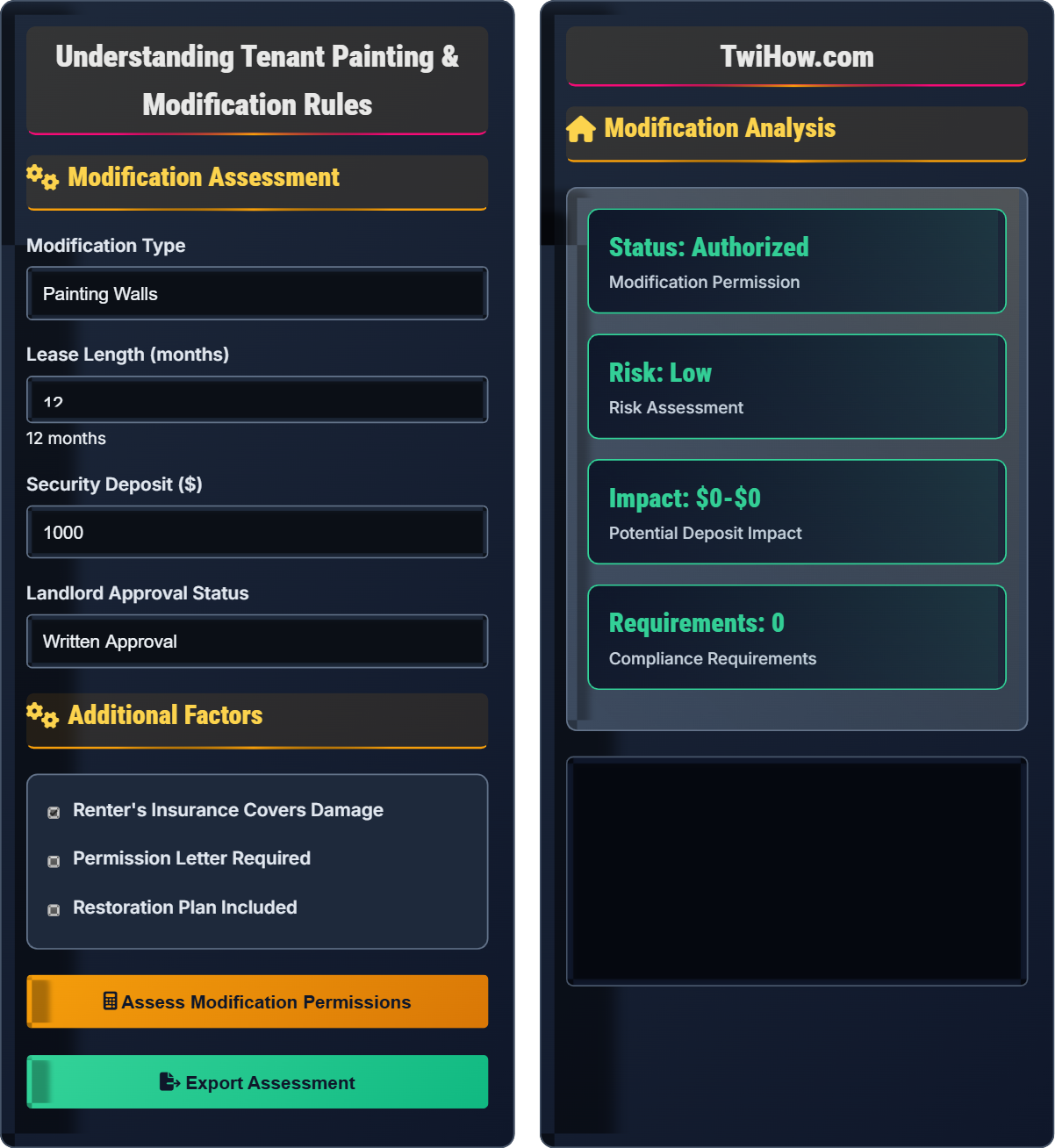
Modification Assessment
Additional Factors
Modification Analysis
| Factor | Assessment | Status |
|---|---|---|
| Lease Compliance | Review Required | Pending |
| Landlord Consent | Not Verified | Pending |
| Restoration Plan | Optional | OK |
| Insurance Coverage | Standard Policy | OK |
Modification Guidelines
- Always get written permission for permanent changes
- Document modifications with photos before and after
- Use paint colors that match original specifications when possible
- Maintain restoration capability for lease end
Understanding Tenant Modification Rights
Tenant modification rights refer to the permissions and restrictions that govern what changes a tenant can make to a rental property. These rights are typically defined in your lease agreement and governed by state and local laws.
Key considerations include:
- Lease Terms: Specific clauses that address modifications
- Landlord Consent: Whether approval is required
- Type of Change: Temporary vs. permanent modifications
- Restoration Obligations: Requirements to return property to original condition
Modifications are generally categorized as follows:
Landlord-tenant laws vary by jurisdiction but generally establish:
- Tenant's right to a habitable dwelling
- Landlord's right to control property modifications
- Requirements for returning property to original condition
- Procedures for obtaining modification permissions
Protect yourself as a tenant:
- Read your lease thoroughly before making any changes
- Get all permissions in writing
- Document the property condition before modifications
- Understand your restoration obligations
- Maintain insurance coverage for potential damages
Modification Categories
Minor changes, major alterations, temporary modifications, permanent installations.
Risk = (Modification Impact × Lease Violation Probability) / Protection Level
Where Risk > 0.5 suggests seeking explicit permission.
- Always check lease terms first
- Get written permission for permanent changes
- Document all modifications with photos
Legal Considerations
Lease agreements, state laws, local ordinances, security deposit protections.
- Review lease modification clauses
- Check local tenant rights laws
- Obtain written consent
- Document property condition
- Plan for restoration
- Security deposit implications
- Insurance coverage needs
- Restoration requirements
- Landlord communication
Tenant Modification Knowledge Quiz
Which of the following modifications would MOST likely constitute a lease violation without written consent?
Installing a ceiling fan involves electrical work and drilling holes in the ceiling, which constitutes a permanent modification that typically requires written consent. Most leases prohibit electrical modifications without permission due to safety concerns and potential property damage.
The answer is B) Installing a ceiling fan in the bedroom.
Understanding lease violations requires distinguishing between minor, temporary, and permanent modifications. Permanent changes that affect the structure or electrical systems almost always require explicit permission. Temporary modifications that don't alter the property permanently are usually allowed within reasonable limits.
Lease Violation: Breach of terms specified in the rental agreement
Permanent Modification: Changes that alter the property's structure or systems
Temporary Modification: Non-permanent changes that can be easily reversed
• Electrical modifications require written consent
• Structural changes are typically prohibited
• Safety-related modifications need special approval
• When in doubt, ask for written permission
• Document modifications before making them
• Keep receipts for materials used
• Assuming all modifications are allowed
• Making electrical changes without approval
• Not documenting the original condition
Explain the concept of "restoration obligations" in tenant modification agreements. Why are these important for both tenants and landlords?
Restoration Obligations: These are contractual duties that require tenants to return the rental property to its original condition upon lease termination, particularly after making approved modifications.
For Tenants: Restoration obligations protect security deposits and prevent disputes with landlords. They provide clear expectations about what modifications need to be undone and to what standard.
For Landlords: These obligations ensure the property maintains its value and is ready for the next tenant. They provide legal recourse if tenants don't restore the property properly.
These obligations are important because they balance tenant customization rights with landlord property preservation interests.
Restoration obligations serve as a bridge between tenant personalization desires and landlord property protection. They create accountability for modifications while allowing reasonable changes. Understanding these obligations helps tenants budget for potential restoration costs and plan modifications accordingly.
Restoration Obligation: Duty to return property to original condition
Security Deposit: Funds held to cover restoration costs
Original Condition: Property state at lease beginning
• Document original condition with photos
• Specify restoration timeline
• Define acceptable restoration standards
• Take detailed photos before modifications
• Get paint samples for matching colors
• Keep receipts for all materials used
• Not documenting original condition
• Using non-standard materials
• Assuming "like for like" is sufficient
Sarah has lived in her apartment for 18 months and wants to paint her bedroom walls from white to light blue. Her lease states: "Tenants may not make alterations to the premises without prior written consent." She plans to use premium paint that matches the original sheen and quality. Analyze Sarah's situation and recommend the best course of action.
Analysis: Sarah's lease explicitly prohibits alterations without written consent. Painting walls constitutes an alteration regardless of paint quality or color choice.
Recommended Course of Action:
1. Submit Written Request: Formally request permission to paint specific rooms with specific colors
2. Specify Details: Include paint brand, color code, finish, and quality
3. Propose Restoration Plan: Offer to repaint to original color at lease end if required
4. Document Condition: Photograph walls before painting
5. Secure Agreement: Get approval in writing before proceeding
This approach protects both parties and ensures compliance with lease terms.
This scenario illustrates the importance of following lease procedures even for seemingly minor changes. The quality of materials doesn't override lease requirements for written consent. Good faith efforts to maintain property value still require formal approval processes.
Alteration: Any change to the physical structure or appearance of the property
Written Consent: Formal approval documented in writingGood Faith Effort: Attempt to act reasonably and responsibly
• Follow lease procedures exactly
• Get written approval before acting
• Maintain property value standards
• Propose neutral colors for easier approval
• Offer to pay for professional painters
• Suggest a trial period for approval
• Proceeding without formal approval
• Assuming good intentions excuse procedural violations
• Not documenting the approval process
Mike painted his rental unit's walls without permission using high-quality paint in a color similar to the original. At lease end, the landlord deducted $400 from his $1200 security deposit for "unauthorized painting." Mike claims the paint was premium quality and matched the original finish. Evaluate the legality of this deduction and suggest steps Mike should take.
Legality Evaluation: The deduction is likely legal in most jurisdictions because Mike violated the lease by making unauthorized modifications, regardless of paint quality.
Steps Mike Should Take:
1. Review Lease Terms: Confirm specific language about modifications
2. Document Evidence: Gather photos showing paint quality and condition
3. Research Local Laws: Check security deposit regulations in his area
4. Negotiate: Request partial refund based on paint quality
5. Legal Consultation: Seek advice from tenant rights organization if necessary
While Mike made a good-faith effort with quality paint, he violated the fundamental lease requirement of obtaining permission.
This case demonstrates that good intentions and quality work don't override lease requirements. The principle of "no unauthorized modifications" serves to protect both parties' interests. Even beneficial changes must follow proper procedures to maintain legal compliance.
Security Deposit Deduction: Reduction of deposit for lease violations
Unauthorized Modification: Changes made without proper consent
Good Faith Defense: Argument based on reasonable intentions
• Procedure compliance matters more than outcome
• Quality doesn't excuse unauthorized changes
• Documentation helps resolve disputes
• Always follow lease procedures first
• Document everything for dispute resolution
• Research local tenant rights laws
• Believing quality work excuses procedural violations
• Not reading lease terms carefully
• Failing to document the work done
Which of the following temporary modifications is MOST likely to be allowed without explicit written permission in most standard leases?
Lightweight artwork hung with removable adhesive strips causes minimal damage and can be easily removed, making it the most likely to be allowed without explicit permission. This falls under normal wear and tear rather than modifications.
The answer is B) Hanging lightweight artwork with removable adhesive strips.
Distinguishing between modifications and normal use is crucial. Removable items that cause minimal damage are typically considered normal use rather than modifications. The key factors are reversibility, permanence, and damage potential.
Normal Wear and Tear: Deterioration from reasonable use
Modification: Alteration requiring permission
Reversible Change: Change that can be undone without damage
• Reversible = More likely to be allowed
• Minimal damage = Normal use
• Permanent changes = Require permission
• Choose easily reversible options
• Minimize hole sizes when necessary
• Use damage-free hanging solutions
• Confusing normal use with modifications
• Assuming all small holes are acceptable
• Not considering cumulative impact
Frequently Asked Questions
Q: Can I paint my rental unit walls without my landlord's permission if I promise to paint over it with the original color before moving out?
A: No, you cannot legally paint rental unit walls without your landlord's explicit permission, even with a promise to restore the original color. Here's why:
1. Lease Violation: Most leases prohibit alterations without written consent
2. Property Control: Landlords have the right to approve all modifications
3. Liability Concerns: Unauthorized work creates potential liability for both parties
4. Quality Standards: Landlords want to ensure work meets their standards
Instead, submit a formal written request with details about paint type, color, and your restoration plan. Many landlords approve reasonable painting requests when properly presented.
Q: What's the difference between "minor modifications" and "major modifications" in rental agreements?
A: The distinction between minor and major modifications typically depends on:
Minor Modifications: Usually don't require explicit permission and include:
- Hanging pictures with small nails (typically 1/4" or smaller)
- Using removable adhesive hooks
- Installing temporary decor like removable wall decals
- Small repairs using landlord-approved methods
Major Modifications: Always require written permission and include:
- Painting walls or changing colors
- Installing permanent fixtures or shelving
- Drilling large holes or structural changes
- Installing appliances or utility connections
The key factors are permanence, damage potential, and restoration difficulty.
Q: How can I personalize my rental space without violating my lease agreement?
A: You can personalize your rental space using these lease-compliant strategies:
1. Removable Decor: Use removable wall decals, fabric wall hangings, or tapestries
2. Freestanding Furniture: Arrange furniture to create personal spaces
3. Soft Furnishings: Add rugs, curtains, throw pillows, and blankets
4. Artwork Solutions: Use removable adhesive strips or command strips
5. Lighting: Enhance with lamps, string lights, or LED strips
6. Storage Solutions: Use bookshelves, storage boxes, and organizers
7. Plant Life: Add potted plants for natural beauty
These approaches allow personalization while maintaining easy restoration to original condition.