Landlord Common Area Maintenance Rights
Complete guide to tenant rights • Step-by-step explanations
Tenant Maintenance Rights:
Show Rights CalculatorWhen landlords fail to maintain common areas, tenants have specific rights and remedies available. Understanding these rights is crucial for ensuring safe, habitable living conditions and protecting your security deposit.
Key maintenance concepts:
- Common Areas: Lobbies, hallways, parking lots, laundry rooms, recreational facilities
- Maintenance Standards: Health, safety, and habitability requirements
- Complaint Procedures: Formal steps to address maintenance issues
- Legal Remedies: Available options when landlords don't respond
Landlords are legally obligated to maintain common areas to ensure tenant safety and property value. When these obligations aren't met, tenants have multiple pathways to address the issues.
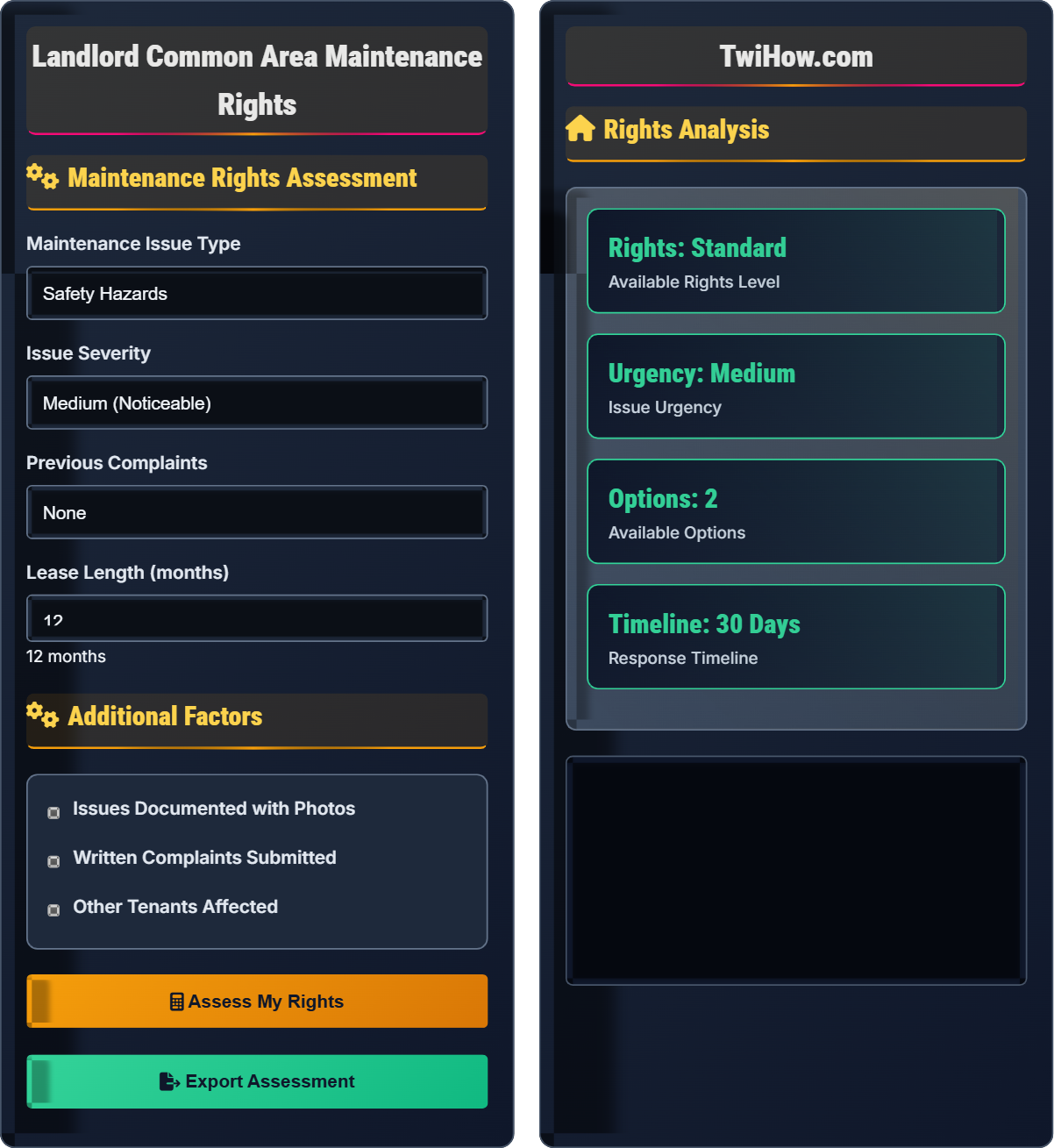
Maintenance Rights Assessment
Additional Factors
Rights Analysis
| Factor | Assessment | Status |
|---|---|---|
| Issue Severity | Medium | Active |
| Documentation | Basic | Improve |
| Complaint History | None | New |
| Legal Standing | Strong | Good |
Available Options
- Submit formal written complaint
- Contact local housing authority
- Withhold rent (in specific circumstances)
- Repair and deduct (where permitted)
Understanding Common Area Maintenance Rights
Common area maintenance rights are legal protections that ensure landlords maintain shared spaces in multi-unit residential properties. These rights guarantee tenants access to safe, clean, and functional common areas.
Common areas typically include:
- Hallways and stairwells: Proper lighting, cleanliness, and safety
- Parking areas: Adequate lighting, maintenance of surfaces
- Laundry facilities: Functioning equipment and cleanliness
- Recreation areas: Safe and maintained equipment
- Building exteriors: Roof, siding, windows, and grounds
Tenant rights regarding common area maintenance are established by:
Common area maintenance issues fall into several categories:
- Safety Issues: Broken locks, poor lighting, structural hazards
- Health Issues: Mold, pest infestations, water damage
- Security Issues: Inoperable entry systems, broken windows
- Cosmetic Issues: Peeling paint, worn carpeting, outdated fixtures
- Functional Issues: Malfunctioning elevators, HVAC systems
When landlords fail to maintain common areas, tenants may have several remedies:
- Formal complaint procedures
- Withholding rent (in specific circumstances)
- Repair and deduct (where legally permitted)
- Contacting housing authorities
- Legal action for damages
Maintenance Standards
Safe access, adequate lighting, cleanliness, structural integrity, security measures.
Rights Strength = (Issue Severity × Documentation Quality) / Response Time
Where higher values indicate stronger legal standing.
- Landlords must maintain habitable conditions
- Documentation strengthens your position
- Follow proper complaint procedures
Action Steps
Documentation, formal complaints, legal consultation, regulatory reporting.
- Document the issue with photos and dates
- Submit formal written complaint
- Follow up if no response received
- Contact housing authority if needed
- Consult attorney for serious violations
- Know your local laws
- Maintain detailed records
- Act reasonably and in good faith
- Consider group action with other tenants
Common Area Maintenance Knowledge Quiz
Which of the following is TRUE regarding landlord obligations for common area maintenance?
Landlords have a legal duty to proactively maintain habitable conditions in common areas. This obligation exists regardless of whether tenants report issues. The implied warranty of habitability requires landlords to maintain all areas of the property that affect tenant safety and welfare.
The answer is B) Landlords must proactively maintain habitable conditions.
Landlord obligations are proactive, not reactive. This means landlords must maintain properties to meet health and safety standards without waiting for tenant complaints. This prevents dangerous situations and ensures consistent living conditions for all residents.
Implied Warranty of Habitability: Legal requirement for livable conditions
Proactive Maintenance: Preventive upkeep without waiting for complaints
Common Areas: Shared spaces accessible to all tenants
• Landlords must maintain habitable conditions proactively
• Common areas are subject to habitability standards
• Tenant complaints accelerate but don't create obligations
• Document issues before they become complaints
• Report patterns of neglect early
• Understand your lease terms for common areas
• Assuming landlords only fix reported issues
• Not understanding habitability standards
• Failing to document ongoing problems
Explain why documentation is crucial when dealing with common area maintenance issues. What specific types of evidence should tenants collect?
Documentation Importance: Documentation serves multiple critical purposes in maintenance disputes:
Evidence Preservation: Creates an objective record of conditions that can be referenced later.
Timeline Establishment: Shows when issues were first noticed and how long they've persisted.
Communication Record: Demonstrates attempts to resolve issues through proper channels.
Legal Protection: Provides support for potential legal action or complaints to authorities.
Specific Evidence to Collect:
• Date-stamped photos showing the issue from multiple angles
• Written complaints submitted to the landlord with delivery confirmation
• Communication logs including dates, times, and participants
• Witness statements from other tenants experiencing similar issues
• Copies of lease provisions related to common area maintenance
Documentation transforms subjective complaints into objective evidence. It establishes credibility and provides a factual basis for legal claims. Without proper documentation, landlords may dispute the existence or severity of issues.
Objective Evidence: Factual proof that can be independently verified
Communication Log: Record of all interactions about the issue
Delivery Confirmation: Proof that communications were received
• Document issues immediately when discovered
• Take photos from multiple angles
• Keep copies of all communications
• Use your phone's date/time stamp feature
• Include a measuring tool in photos for scale
• Send written notices via certified mail
• Taking photos without timestamps
• Failing to keep copies of communications
• Not documenting ongoing deterioration
Jennifer has lived in an apartment complex for 10 months. The exterior lighting in the parking garage has been out for 3 months, making it difficult and unsafe to navigate at night. She's reported this to management twice with no response. The lease states that the landlord is responsible for common area maintenance. Analyze Jennifer's situation and recommend the best course of action.
Analysis: Jennifer faces a safety hazard that violates both lease terms and habitability standards. The landlord has failed to respond to multiple complaints, indicating a pattern of neglect.
Recommended Course of Action:
1. Document Thoroughly: Take date-stamped photos of the dark parking garage, noting the duration since previous complaints.
2. Formal Written Notice: Send a certified letter describing the safety hazard, referencing lease terms, and demanding immediate repair.
3. Regulatory Reporting: Contact the local housing authority or building department to report the safety violation.
4. Group Action: Survey other tenants to document similar safety concerns and consider collective action.
5. Legal Consultation: Consult with a tenant rights attorney if the issue remains unresolved.
This approach escalates pressure on the landlord while building a strong case for potential legal action.
This scenario demonstrates the progression from informal to formal complaint procedures. The combination of lease violation, safety hazard, and pattern of non-response strengthens Jennifer's position significantly. Each step builds upon the previous one while maintaining legal compliance.
Safety Hazard: Condition that poses risk of injury to tenants
Pattern of Neglect: Repeated failure to address known issuesCertified Mail: Mailed item with proof of delivery confirmation
• Address safety hazards immediately
• Follow up all complaints in writing
• Escalate when informal methods fail
• Reference specific lease provisions
• Cite local safety codes if applicable
• Document all interactions and responses
• Accepting verbal promises without follow-through
• Failing to escalate unresolved issues
• Not involving other affected tenants
Mark's apartment building's common area elevator has been out of order for 2 months. He lives on the 8th floor and has complained repeatedly. The lease allows "repair and deduct" for emergency maintenance. Mark hires a contractor to fix the elevator and deducts the cost from his rent. Evaluate the legality of Mark's actions and suggest better alternatives.
Legality Evaluation: Mark's actions are likely illegal in most jurisdictions. Elevator repairs typically require licensed professionals and may involve complex mechanical and electrical systems that exceed tenant repair authority.
Better Alternatives:
1. Formal Notice: Submit written notice of habitability violation and demand immediate repair.
2. Regulatory Reporting: Contact building inspection department to report elevator violation.
3. Legal Consultation: Consult attorney about rent escrow or constructive eviction options.
4. Withholding Rent: Withhold rent in accordance with state-specific procedures (not DIY repairs).
5. Alternative Accommodation: Negotiate temporary ground-floor accommodation.
"Repair and deduct" typically applies to minor issues that tenants can reasonably fix themselves, not complex systems requiring professional repair.
This case highlights the limitations of "repair and deduct" rights. The remedy applies primarily to minor, easily remediable issues that tenants can safely address. Complex systems like elevators require professional repair and may involve licensing requirements that tenants cannot satisfy.
Repair and Deduct: Right to fix minor issues and deduct cost from rent
Constructive Eviction: Landlord conduct forcing tenant to leave
Rent Escrow: Depositing rent with court during disputes
• Repair and deduct has strict limitations
• Complex systems require professional repair
• Proper procedures must be followed
• Research local repair and deduct laws
• Focus on minor, DIY-possible repairs
• Use other remedies for complex issues
• Misunderstanding scope of repair and deduct
• Attempting complex repairs beyond skill level
• Not following proper legal procedures
Which common area maintenance issue would MOST likely qualify as an emergency requiring immediate landlord response?
A broken heating system affecting common areas creates health and safety risks, particularly during cold weather. This impacts habitability standards and can create unsafe conditions for all residents. Temperature control is considered essential for habitable living conditions.
The answer is C) Broken heating system affecting common areas.
Emergency situations are determined by their potential for immediate harm to health or safety. Heating system failures can lead to frozen pipes, unsafe temperatures, and health risks, making them urgent compared to purely cosmetic or convenience issues.
Emergency Maintenance: Immediate repairs needed for safety/habitability
Habitable Conditions: Standards necessary for safe living
Health Risk: Potential for illness or injury
• Health/safety issues are emergencies
• Temperature control affects habitability
• Emergency issues require immediate response
• Document emergency conditions immediately
• Emphasize health/safety impacts in complaints
• Follow up persistently on emergency issues
• Not recognizing emergency situations
• Failing to emphasize health risks
• Accepting delays on emergency issues
Frequently Asked Questions
Q: Can I stop paying rent if my landlord won't fix the broken heating system in our building's common areas?
A: Generally, you cannot simply stop paying rent without following specific legal procedures. However, you may have other options:
1. Rent Withholding: In some states, tenants can withhold rent by depositing it in escrow while the dispute is resolved
2. Partial Rent Reduction: Some jurisdictions allow reduced rent during uninhabitable conditions
3. Legal Action: You may be able to seek damages for breach of habitability
Before taking any action, research your state's specific laws and consider consulting with a tenant rights attorney. Improper rent withholding could result in eviction proceedings.
Q: What's the difference between "common area maintenance" and "tenant maintenance" responsibilities?
A: The distinction between common area and tenant maintenance responsibilities typically follows these guidelines:
Landlord/Property Manager Responsibilities (Common Areas):
- Hallways, stairwells, and elevators
- Parking lots, walkways, and landscaping
- Building exteriors, roofs, and structural elements
- Common utility systems and infrastructure
- Recreational facilities and amenities
Tenant Responsibilities:
- Interior of individual rental unit
- Personal appliances and fixtures
- Minor maintenance within the unit
- Keeping assigned spaces clean
The key is that common areas serve all tenants and are maintained by the landlord.
Q: How can I effectively document common area maintenance issues to strengthen my case?
A: Effective documentation is crucial for strengthening your case. Follow these steps:
1. Photograph Everything: Take clear, date-stamped photos from multiple angles showing the issue's extent and location
2. Keep Detailed Records: Document dates, times, and people contacted about each issue
3. Submit Written Notices: Always put complaints in writing with delivery confirmation
4. Track Changes: Continue photographing the issue to show if it worsens over time
5. Gather Witnesses: Get contact information from other tenants experiencing similar issues
6. Save All Correspondence: Keep copies of all emails, letters, and receipts related to the issue
Strong documentation creates an objective record that supports your claims and demonstrates your good faith efforts to resolve the issue.