Landlord Entry Rights and Tenant Protections
Real estate guide • Step-by-step explanations
Landlord Entry Rights:
Show Rights AnalyzerUnderstanding your rights when a landlord wants to enter your apartment is crucial for maintaining privacy and security. Tenants have legal protections against unauthorized entry, but landlords also have legitimate reasons for access. The balance between tenant privacy and landlord responsibilities is governed by state and local laws, lease agreements, and common law principles.
Key considerations for landlord entry include:
- Notice Requirements: Advance notice periods (typically 24-48 hours)
- Valid Reasons: Maintenance, inspections, showings, emergencies
- Reasonable Times: Business hours during normal circumstances
- Emergency Situations: Immediate access for safety threats
- Lease Agreements: Specific terms that may override general laws
- Legal Recourse: Remedies for unauthorized entry violations
Knowing these rights helps tenants protect their privacy while understanding legitimate landlord access needs.
Entry Rights Parameters
Your Rights
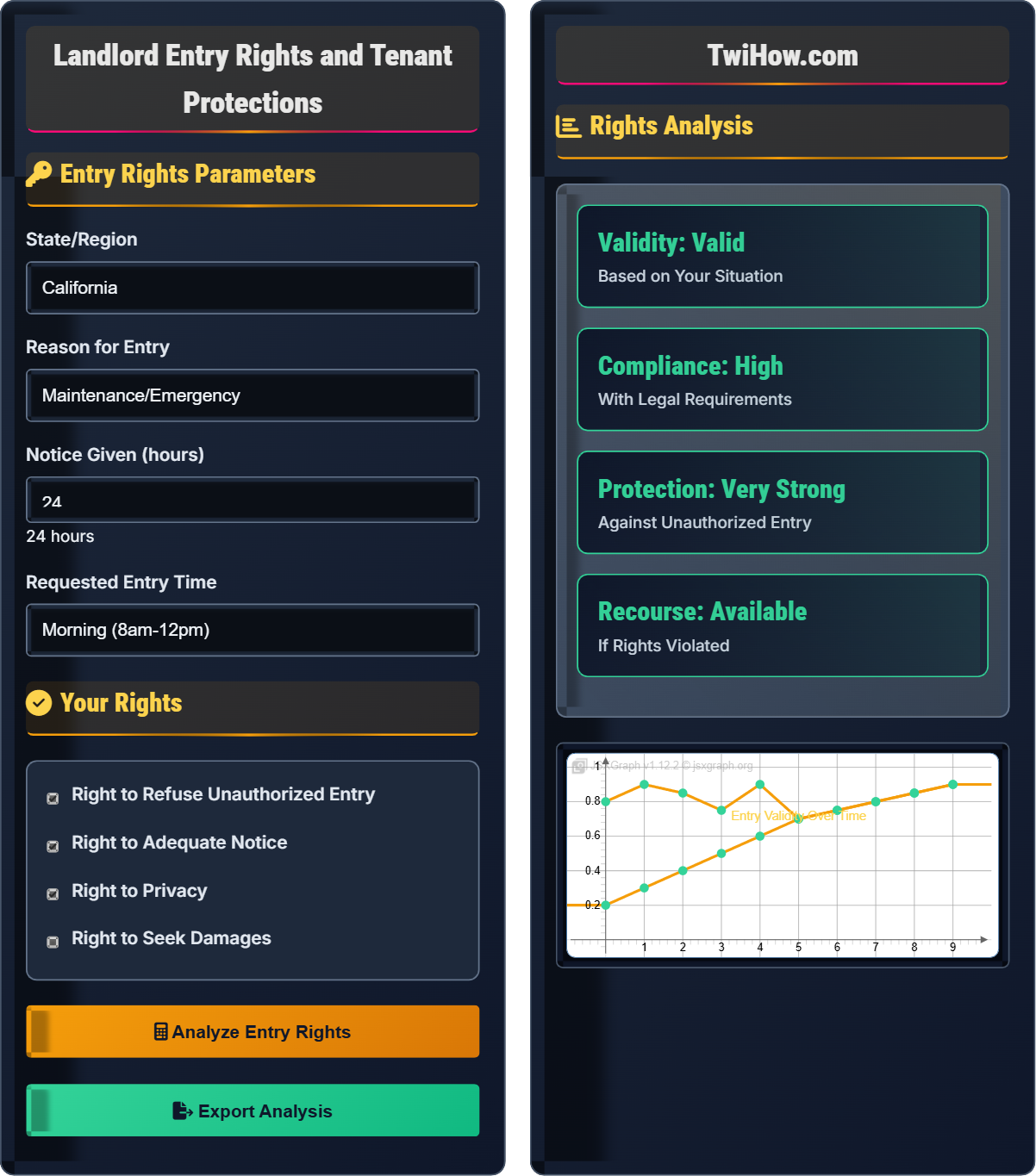
Rights Analysis
| Requirement | Status | Met? | Severity |
|---|---|---|---|
| 24-hour Notice | Required | Yes | High |
| Reasonable Time | Required | Yes | Medium | Valid Reason | Required | Yes | High |
| Business Hours | Preferred | Yes | Low |
Understanding Landlord Entry Rights
Entry rights balance tenant privacy with landlord responsibilities. Tenants have the right to "quiet enjoyment" of their rental unit, which includes protection from unauthorized entry. However, landlords also have legitimate needs to access the property for maintenance, inspections, and other purposes. The law attempts to balance these competing interests.
Landlord entry rights are governed by:
- State Statutes: Minimum notice requirements and valid reasons
- Local Ordinances: Additional protections in some municipalities
- Lease Agreements: Specific terms that may supplement or override laws
- Common Law: Established legal principles about property rights
- Constitutional Rights: Privacy protections in some situations
- Emergency Powers: Exceptions for immediate safety concerns
This formula evaluates the validity of a landlord's entry request. Each factor is scored from 0-10, with the weighted sum providing an overall validity score. Notice compliance typically carries significant weight as it's the most fundamental requirement for non-emergency entry.
For example, if Notice Compliance = 8, Reason Validity = 9, Time Appropriateness = 7, and Lease Compliance = 8, the Entry Validity would be: (8×0.3) + (9×0.3) + (7×0.2) + (8×0.2) = 2.4 + 2.7 + 1.4 + 1.6 = 8.1/10.
Generally accepted reasons for landlord entry include:
- Emergency Situations: Fire, water damage, gas leaks, medical emergencies
- Maintenance & Repairs: Necessary for property safety or functionality
- Inspections: Routine checks required by lease or law
- Showings: To prospective tenants or buyers
- Contractor Access: For authorized improvements or work
- Delivery: For necessary services or equipment
Legal protections for tenants include:
- Notice Requirements: Minimum advance notice periods
- Time Restrictions: Entry during reasonable hours
- Frequency Limits: Reasonable frequency of entries
- Harassment Protection: Prohibition of abusive entry patterns
- Legal Recourse: Remedies for rights violations
- Quiet Enjoyment: Right to peaceful possession
Entry Rights Fundamentals
Notice requirements, quiet enjoyment, valid entry reasons, reasonable time, emergency access, harassment protection.
Entry Validity = Σ(Factor Score × Weight)
Where Factor Score ranges from 0-10 and weights sum to 100%. The formula accounts for multiple criteria that influence the validity of landlord entry requests.
- Tenants have right to privacy and quiet enjoyment
- Most entries require advance notice
- Emergencies allow immediate access
- Reasonable times for non-emergency entry
Best Practices
Documentation, communication, legal research, lease review, notice verification, rights assertion.
- Research your state's specific entry laws
- Review your lease agreement carefully
- Document all entry requests and communications
- Respond appropriately to entry notices
- Know when to assert your rights
- State laws vary significantly
- Lease terms may provide additional protections
- Emergencies override normal requirements
- Documentation is crucial for legal protection
Entry Rights Quiz
What is the typical minimum notice period required for non-emergency landlord entry?
Most states require 24-48 hours of advance notice for non-emergency landlord entry. This allows tenants time to prepare and ensures their privacy is respected. The exact notice period varies by state, but 24-48 hours is the most common requirement. Emergency situations (fire, gas leaks, medical emergencies) typically allow immediate entry without notice.
The answer is B) 24-48 hours.
This question highlights the fundamental balance between tenant privacy and landlord access rights. The 24-48 hour notice requirement is designed to give tenants sufficient time to prepare for the entry while allowing landlords to schedule necessary maintenance or inspections. This period is long enough for tenants to make arrangements but short enough to allow landlords to address property needs in a timely manner. Emergency situations are the exception to this rule, as immediate access may be necessary to prevent harm.
Quiet Enjoyment: Tenant right to peaceful possession
Reasonable Notice: Sufficient advance warning for entry
Emergency Entry: Immediate access for safety threats
• Most states require 24-48 hours notice
• Emergencies allow immediate entry
• Check your state's specific requirements
• Document all entry notices
• Respond appropriately to valid notices
• Assuming all entry requires 24 hours
• Not knowing emergency exceptions
• Failing to document entry requests
Explain when landlords can enter without notice and what constitutes an emergency situation.
Emergency Situations: Landlords can enter without notice during genuine emergencies that threaten health, safety, or property. These include:
Fire or Smoke: Immediate danger to life or property
Water/Gas Leaks: Significant damage prevention
Medical Emergencies: Tenant requires immediate assistance
Severe Weather Damage: Structural integrity concerns
Gas Leaks: Explosion or poisoning risks
Electrical Hazards: Fire or electrocution risks
Valid Consent: Tenant explicitly allows entry
Important: The emergency must be genuine and imminent. Landlords cannot use the emergency exception to circumvent notice requirements for routine maintenance. Courts evaluate the reasonableness of the landlord's belief that an emergency existed.
The emergency exception is a critical balance in tenant-landlord law. It recognizes that property safety sometimes requires immediate action that cannot wait for the standard notice period. However, this exception is narrowly interpreted to prevent abuse. The emergency must be objectively verifiable and pose an immediate threat. Landlords who misuse the emergency exception may face legal consequences for violating tenant privacy rights.
Emergency Entry: Access without notice for safety threats
Imminent Threat: Immediate danger requiring action
Objective Standard: What a reasonable person would consider emergency
• Emergencies must pose immediate threat
• Assess if danger is truly immediate
• Verify emergency claims when possible
• Document emergency entries
• Misinterpreting minor issues as emergencies
• Not verifying emergency claims
• Failing to document emergency entries
Sarah receives a text message from her landlord at 11 PM stating: "Need to show your apartment to potential renters tomorrow at 7 AM. Please have it ready." Sarah has a 2-year-old child who usually goes to bed at 8 PM. The lease allows entry for showings with 24-hour notice. What are Sarah's rights and options?
Notice Violation: The landlord gave only 8 hours notice, far short of the required 24 hours. This violates the lease terms and likely state law.
Unreasonable Time: 7 AM is extremely early and may be considered unreasonable for showing, especially with a young child in the home.
Sarah's Rights: Sarah can refuse the entry as it violates both notice and time requirements. She should respond in writing documenting the violation.
Recommended Action: Sarah should politely decline, citing the insufficient notice, and suggest a more appropriate time with proper notice. She should document this interaction.
Legal Recourse: If the landlord persists, Sarah can file a complaint with housing authorities or seek legal counsel for rights violations.
This scenario demonstrates multiple violations: insufficient notice and potentially unreasonable time. It shows how landlords sometimes attempt to bypass requirements by claiming urgency. Tenants should understand that routine showings require proper notice and reasonable times. The presence of young children is a valid consideration for reasonable entry times. Sarah's best approach is to assert her rights while maintaining a professional relationship with her landlord.
Reasonable Time: Normal business hours during normal circumstances
Notice Violation: Entry without required advance notice
Quiet Enjoyment: Right to peaceful possession of rental
• Proper notice is required for non-emergencies
• Know your state's notice requirements
• Document all entry requests
• Respond professionally but firmly
• Allowing insufficient notice
• Not documenting violations
• Not asserting rights due to fear
Your landlord has entered your apartment 4 times in the past 2 weeks for "routine inspections" without any maintenance issues. Each time was during your work hours, and you received minimal notice. You suspect this is harassment. What constitutes entry harassment and what can you do?
Harassment Indicators: Excessive frequency of entries, inappropriate timing, lack of legitimate purpose, and pattern of behavior that interferes with quiet enjoyment. Four entries in two weeks without clear necessity may constitute harassment.
Legal Standards: Entry harassment occurs when a landlord enters unreasonably frequently or at unreasonable times to interfere with tenant's quiet enjoyment. Courts look for patterns of behavior that exceed normal landlord duties.
Documentation: Keep detailed records of all entries: date, time, notice given, purpose, and any communications. This evidence is crucial for proving harassment.
Response: Send a written request asking for reasonable entry patterns. File complaints with housing authorities if harassment continues. In severe cases, consult an attorney about constructive eviction or lease termination rights.
Legal Remedies: You may be entitled to damages, rent reduction, or lease termination if harassment is proven.
This scenario demonstrates how legitimate landlord entry can become harassment through frequency and pattern. The law recognizes that excessive entry, even if technically compliant with notice requirements, can violate tenant rights if it interferes with quiet enjoyment. The key is establishing a pattern of behavior rather than isolated incidents. Documentation is crucial because it provides evidence of the pattern that courts require to prove harassment.
Entry Harassment: Excessive entry interfering with quiet enjoyment
Quiet Enjoyment: Right to peaceful possession
Pattern of Behavior: Repeated actions forming consistent practice
• Excessive entry can violate tenant rights
• Document all entries with details
• Look for patterns over time
• Respond in writing to demands
• Not documenting frequent entries
• Assuming all entry is acceptable
• Not recognizing harassment patterns
Can a lease agreement override state laws regarding landlord entry?
Lease agreements can sometimes override state laws, but only for reasonable terms that don't waive fundamental tenant rights. Courts generally enforce lease terms that provide additional protections but may refuse to enforce terms that waive essential rights like privacy or quiet enjoyment. The law typically prohibits waivers of fundamental rights.
The answer is C) Sometimes, but only for reasonable terms.
This question addresses the complex relationship between lease agreements and state law. Generally, lease terms that provide additional protections are enforceable, while terms that waive fundamental rights are not. Courts recognize that tenants may unknowingly waive important rights in standard lease agreements, so they scrutinize provisions that significantly favor landlords. The key is whether the lease term is reasonable and doesn't violate public policy.
Lease Override: Contract terms superseding statutory law
Public Policy: Legal principle against harmful agreements
Fundamental Rights: Rights considered essential by law
• Fundamental rights generally cannot be waived
• Review lease terms carefully
• Research state tenant rights
• Consult attorney for complex leases
• Assuming all lease terms are enforceable
• Not researching fundamental rights
• Signing without understanding implications
FAQ
Q: Can my landlord enter to show the apartment to potential buyers without my consent?
A: Yes, landlords can typically enter to show the property to potential buyers, but they must follow notice requirements (usually 24-48 hours) and enter at reasonable times. You can request reasonable restrictions on showing frequency and timing. Some states require your consent for showings during lease term, while others allow entry with proper notice. Check your local laws and lease terms. You have the right to ask for advance notice and reasonable scheduling.
Q: What can I do if my landlord enters without permission?
A: Document the violation with dates, times, and details. Send a written notice to your landlord demanding compliance with notice requirements. File a complaint with local housing authorities if necessary. You may be entitled to damages for privacy violations. In severe cases of repeated violations, you might have grounds for lease termination or legal action. Consult with a tenant rights attorney to understand your specific remedies under local law.