Tenant Rights Regarding Rent Increases
Complete tenant rights guide • Legal protections
Tenant Rights & Rent Increases:
Show Rights AnalyzerUnderstanding your rights when facing rent increases is crucial for protecting your housing stability. Tenants have legal protections that vary by location, including notice requirements, rent control laws, and anti-retaliation protections. Knowing these rights helps tenants respond appropriately to rent increases and take action when landlords violate the law.
Key tenant protections:
- Notice Requirements: Landlords must provide advance written notice
- Reasonable Increases: Limits on how much rent can increase
- No Retaliation: Protection against retaliation for exercising rights
- Non-Discrimination: Equal treatment regardless of protected class
Modern tenant rights have evolved to address housing affordability challenges, with many jurisdictions implementing stronger protections for renters facing significant rent increases.
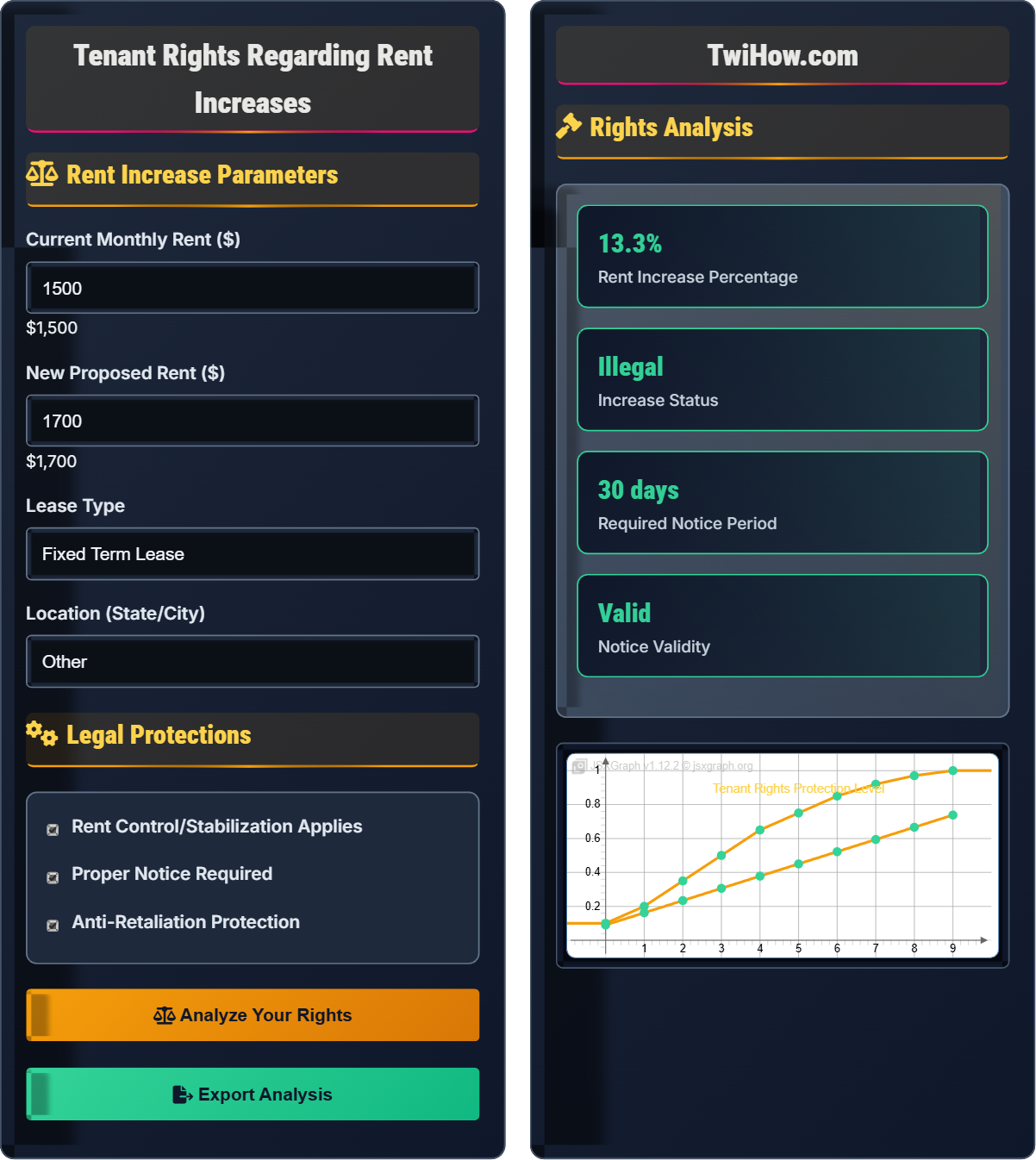
Rent Increase Parameters
Legal Protections
Rights Analysis
| Right | Status | Details | Action |
|---|---|---|---|
| Notice Period | Valid | 60 days required | None |
| Rent Control | Compliant | Below 10% limit | None |
| Anti-Retaliation | Protected | No retaliation allowed | Document everything |
| Non-Discrimination | Protected | Equal treatment | Report violations |
Tenant Rights and Rent Increases
Tenant rights regarding rent increases vary by jurisdiction but generally include notice requirements, limits on increases, and anti-retaliation protections. Understanding these rights helps tenants respond appropriately to rent increases and take action when landlords violate the law.
Percent Increase = [(New Rent - Current Rent) / Current Rent] × 100
Compliance Check = (Increase % ≤ Local Limit) AND (Notice ≥ Required Days)
Where:
- New Rent: Proposed monthly rent amount
- Current Rent: Current monthly rent amount
- Local Limit: Maximum allowable increase percentage
- Required Days: Minimum notice period required by law
Common tenant protections regarding rent increases:
- Notice Requirements: Written notice with specific timeframes
- Rent Control: Limits on rent increase percentages
- Just Cause: Requirements for reasons to increase rent
- Anti-Retaliation: Protection against punishment for exercising rights
- Non-Discrimination: Equal treatment regardless of protected class
- Right to Counsel: Legal representation in eviction proceedings
- Negotiate: Discuss the increase with your landlord
- Organize: Connect with other tenants facing similar increases
- Document: Keep records of all communications
- Seek Help: Contact tenant unions or legal aid
- Know Your Lease: Understand your lease terms and renewal options
Tenant Rights Fundamentals
Rent increases, notice requirements, rent control, anti-retaliation, tenant protections, lease agreements.
Percent Increase = [(New Rent - Current Rent) / Current Rent] × 100
Where Percent Increase = rent increase percentage, New Rent = proposed monthly rent, Current Rent = current monthly rent.
- Landlords must provide advance notice
- Rent increases may be limited by local laws
- Tenants have anti-retaliation protections
Response Considerations
Lease terms, local laws, notice period, increase amount, landlord relationship, legal options.
- Review lease and local rent control laws
- Verify notice requirements were met
- Calculate if increase exceeds limits
- Document all communications
- Respond appropriately based on findings
- Local laws vary significantly
- Lease terms may affect rights
- Document all interactions
- Seek legal help if needed
Tenant Rights Quiz
What is the typical minimum notice period a landlord must give before raising rent?
Notice requirements vary significantly by state and jurisdiction. While 30 days is common for month-to-month tenancies and 60 days for longer leases, many areas have different requirements. California requires 30 days for increases under 10% and 60 days for increases of 10% or more. New York City has different rules for rent-stabilized apartments.
The answer is D) Varies by state/jurisdiction.
Tenant rights are primarily governed by state and local laws, which means requirements vary widely. This is why it's crucial for tenants to research their specific jurisdiction's laws rather than relying on general information. The variation exists because different areas have different housing markets and political priorities regarding tenant protections.
Notice Period: Time required before rent increase takes effect
Jurisdiction: Geographic area with specific legal authority
Month-to-Month: Lease that renews every month
• Notice requirements vary by location
• Different rules for different lease types
• Research local laws before responding
• Check local tenant rights websites
• Contact tenant unions for guidance
• Document notice receipt date
• Assuming all areas have same rules
• Not verifying local requirements
• Missing deadline to respond
Explain how rent control laws protect tenants and what limitations they typically have.
Protection Mechanisms: Rent control laws limit how much landlords can increase rent annually, typically to a percentage tied to inflation or a fixed cap. Some areas have "just cause" requirements that mandate landlords provide valid reasons for rent increases.
Common Limitations: Most rent control laws have exemptions for newer buildings (often constructed after 1978), owner-occupied properties with fewer than 4 units, and luxury units above certain rent thresholds.
Typical Caps: Many jurisdictions limit annual increases to 3-5% plus inflation adjustments, though this varies widely.
Rent control laws represent a balance between tenant stability and landlord investment incentives. The limitations exist to prevent discouraging property investment and maintenance. Understanding whether your unit is covered by rent control is crucial for knowing your specific protections.
Rent Control: Laws limiting rent increases
Just Cause: Required valid reasons for rent increases
Exemption: Situations where laws don't apply
• Coverage varies by property type
• Verify if your unit is covered
• Check with local rent board
• Research exemption criteria
• Assuming all units are covered
• Not checking for exemptions
• Confusing rent control with rent stabilization
You recently filed a complaint about unsafe living conditions with the city housing inspector. Three weeks later, you receive a rent increase notice that seems unusually high. What are your rights in this situation and what should you do?
Your Rights: Most jurisdictions have anti-retaliation laws that prohibit landlords from increasing rent in response to tenants exercising their legal rights (like filing complaints about unsafe conditions).
Timeframe: Retaliation protections typically cover actions taken within 6 months of the tenant's complaint.
What to Do: Document the timeline of events, keep all correspondence, and contact a tenant rights organization. The rent increase may be illegal retaliation, and you may have grounds to challenge it.
Legal Action: You may be entitled to damages if retaliation is proven, and the rent increase could be invalidated.
Anti-retaliation laws are crucial for protecting tenants who exercise their rights. Without these protections, tenants would be afraid to report unsafe conditions or other violations. The law recognizes that landlords shouldn't punish tenants for reporting legitimate concerns.
Anti-Retaliation: Protection against punishment for exercising rights
Retaliation: Punishment for exercising legal rights
Timeframe: Period during which protection applies
• Document all interactions
• Keep complaint records
• Contact tenant organizations
• File complaints in writing
• Not documenting the timeline
• Assuming all increases are valid
• Failing to seek help
Your landlord gave you a 30-day notice of rent increase from $1,200 to $1,500 (25% increase) for your month-to-month lease in a city without rent control. The notice was delivered 15 days before the increase was supposed to take effect. Is this legal and what can you do?
Notice Violation: The notice period is insufficient. Most jurisdictions require at least 30 days for month-to-month tenancies, and the notice was only given 15 days in advance.
Amount Consideration: While 25% is quite high, in areas without rent control, there may not be specific limits on increase amounts.
Legal Response: The rent increase is likely invalid due to improper notice. You can refuse to pay the increased rent until proper notice is provided. Document the inadequate notice and consider contacting tenant rights organizations.
Next Steps: Continue paying current rent, document the violation, and potentially negotiate with the landlord about proper notice.
Proper notice is a fundamental tenant right that cannot be waived, even if rent control doesn't apply. The notice requirements exist to give tenants adequate time to respond to changes in their housing costs. Even in areas without rent control, procedural requirements still apply.
Notice Period: Time required before changes take effect
Rent Control: Laws limiting rent increase amounts
Procedural Requirement: Process that must be followed
• Notice requirements apply regardless of rent control
• Procedural violations invalidate increases
• Document all violations
• Know your local notice requirements
• Document inadequate notices
• Continue paying current rent
• Paying increased rent despite violations
• Not documenting violations
• Assuming no protections exist
When facing an illegal rent increase, which of the following is typically the best course of action?
Continuing to pay current rent while contesting the increase is typically the best approach. This maintains your tenancy while allowing you to challenge the illegal increase. Stopping rent payments could lead to eviction proceedings, while ignoring the notice or moving out prematurely may forfeit your rights to challenge the increase.
The answer is C) Continue paying current rent and contest the increase.
When contesting illegal rent increases, it's important to maintain your legal standing as a tenant while challenging the violation. Continuing to pay the legal rent amount demonstrates good faith and prevents the landlord from claiming you're in default. This approach gives you the strongest position to challenge the illegal increase.
Good Faith: Honest intention to comply with obligations
Legal Standing: Right to take legal action
Tenancy: Legal right to occupy property
• Maintain tenancy while contesting
• Pay legal rent amount
• Document all actions
• Continue paying current rent
• Document everything
• Seek legal advice
• Stopping rent payments
• Moving out prematurely
• Not documenting actions
FAQ
Q: Can my landlord raise my rent during my lease term?
A: Generally, no. During a fixed-term lease (typically 6 months to 1 year), landlords cannot raise rent unless:
Lease Provision: The lease specifically allows for rent increases (rare but possible)
Local Law: Some jurisdictions allow mid-lease increases under specific circumstances
Agreement: Both parties agree to modify the lease terms
Once your lease expires, the landlord can propose a new rent for the renewal, but you're not obligated to accept it. Month-to-month tenancies allow for rent increases with proper notice.
Q: What's the difference between rent control and rent stabilization?
A: These terms are sometimes used interchangeably, but they have distinct meanings:
Rent Control: Typically refers to rent ceilings that limit how much landlords can charge. Units may be grandfathered in at controlled rates.
Rent Stabilization: Usually refers to limits on how much rent can increase annually (e.g., 3% + inflation). Doesn't cap initial rent but controls increases.
Both aim to maintain affordable housing, but rent control is generally more restrictive. The specific definitions vary by jurisdiction, so check local laws for precise definitions in your area.