What Are My Rights If My Rental Unit Has Mold, Pests, or Safety Issues?
Complete guide • Step-by-step explanations
Tenant Rights:
Show Rights Assessment ToolAs a tenant, you have fundamental rights to live in a habitable rental unit. Landlords are legally required to maintain rental properties in a condition that is safe and fit for living. When mold, pests, or safety issues arise, you have specific rights and remedies available to address these problems.
The right to habitability means your rental unit must have functioning utilities, safe electrical and plumbing systems, and be free from health hazards like mold and pest infestations. These rights are protected by state and local laws, though specifics vary by jurisdiction.
Key aspects of tenant rights for habitability issues include:
- Right to Repair: Landlord must fix issues in reasonable time
- Right to Withhold Rent: In some states, for serious violations
- Right to Break Lease: For severe habitability issues
- Right to Sue: For damages caused by landlord neglect
Understanding your specific state and local laws is essential for exercising these rights effectively.
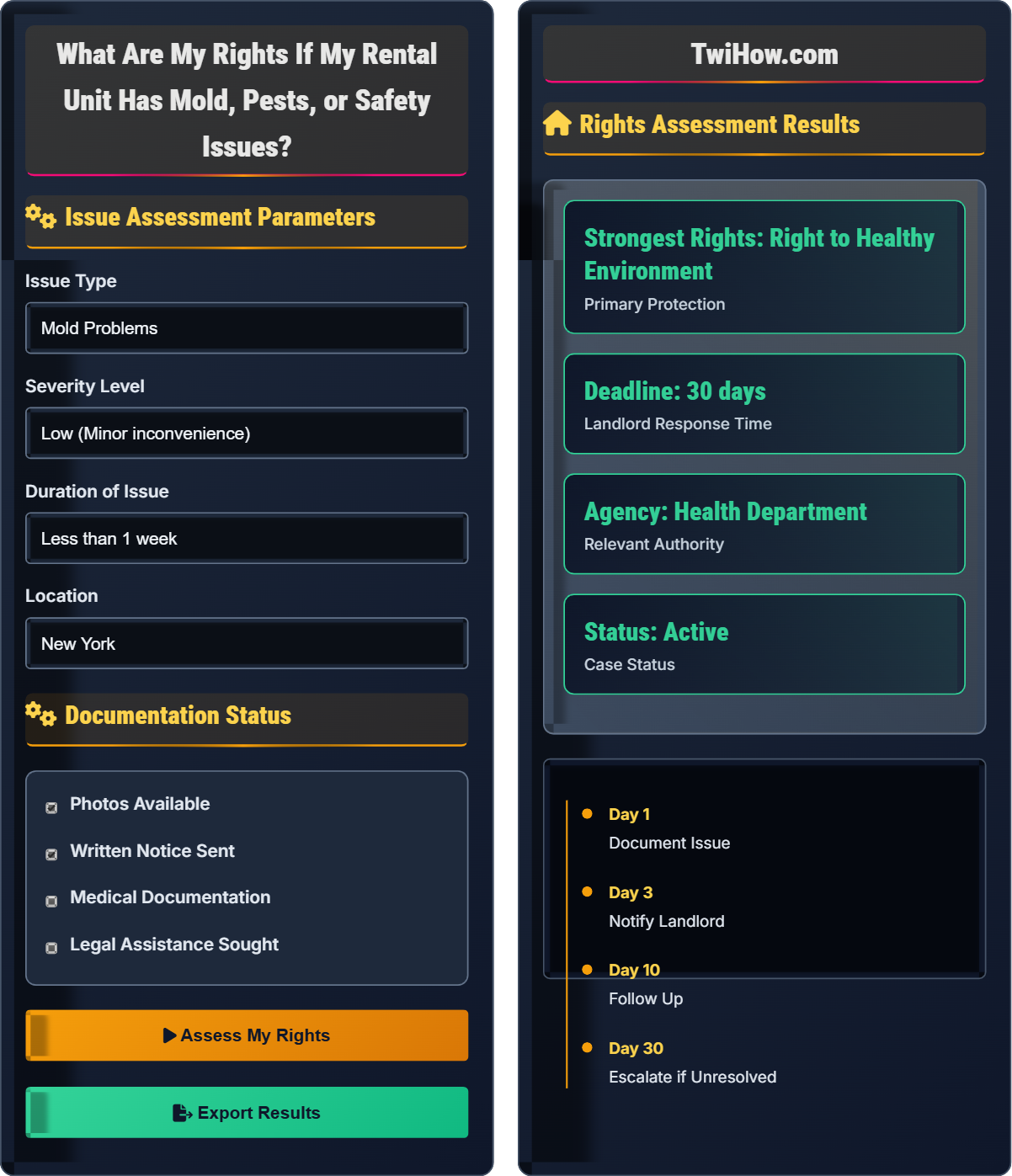
Issue Assessment Parameters
Documentation Status
Rights Assessment Results
| Right | Strength | Availability | Status |
|---|---|---|---|
| Right to Repair | 95 | Yes | Available |
| Rent Withholding | 70 | Yes | Conditional |
| Move Out | 60 | Yes | With Notice |
| Legal Action | 85 | Yes | Available |
Tenant Rights for Mold, Pests, and Safety Issues Explained
The implied warranty of habitability is a fundamental tenant right that requires landlords to maintain rental properties in a condition fit for human habitation. This includes addressing mold, pest infestations, and safety issues that could affect tenant health and safety. When landlords fail to meet these obligations, tenants have legal recourse.
Common habitability issues that violate tenant rights include:
- Mold Problems: Water damage, poor ventilation, inadequate maintenance
- Pest Infestations: Cockroaches, bedbugs, rodents, termites
- Safety Issues: Faulty wiring, broken locks, unsafe stairs
- Plumbing Problems: Broken toilets, leaky pipes, lack of hot water
- Heating/Cooling: Non-functional HVAC systems
- Structural Issues: Damaged walls, unsafe floors, ceiling problems
Effective pursuit of tenant rights requires thorough documentation:
Photographic Evidence: Take clear photos of all issues from multiple angles, showing the extent and duration of problems.
Written Communication: Send all notices to your landlord in writing with delivery confirmation, keeping copies for your records.
Medical Documentation: If health issues arise, obtain medical records linking symptoms to environmental conditions.
Timeline Records: Document dates of issues, notifications, and landlord responses or lack thereof.
- Act Promptly: Address issues as soon as they arise
- Document Everything: Keep detailed records of all communications
- Know Your Rights: Research state and local tenant protection laws
- Communicate Professionally: Maintain respectful but firm communication
- Build Evidence: Gather witness statements and expert opinions
- Seek Support: Contact tenant rights organizations for guidance
Tenant Rights
Right to habitable housing, right to repair, right to privacy, right to quiet enjoyment, and right to non-retaliation.
Issue Documentation → Written Notice → Follow-up → Escalation → Legal Action
Where Issue = Specific violation, Documentation = Evidence collection, Notice = Formal written communication.
- Always document before taking action
- Give landlord reasonable time to fix issues
- Follow proper notice procedures
Remedies
Rent withholding, repair and deduct, move out, legal action, and contacting authorities.
- Self-help remedies (repair and deduct)
- Financial remedies (rent withholding)
- Exit remedies (move out)
- Legal remedies (suing for damages)
- State laws vary significantly
- Proper notice is usually required
- Retaliation is illegal
- Documentation is crucial
Tenant Rights Learning Quiz
Under most state laws, what is a tenant's primary right when dealing with mold in their rental unit?
The primary right when dealing with mold is the right to have the landlord fix the issue. This falls under the implied warranty of habitability, which requires landlords to maintain rental units in a condition fit for human habitation. Landlords must address mold problems that affect habitability.
The answer is C) Right to have landlord fix the issue.
The implied warranty of habitability is the foundation of tenant rights regarding mold, pests, and safety issues. This legal doctrine holds that landlords must maintain rental properties in a livable condition. When mold develops, it typically indicates underlying moisture problems that create an uninhabitable environment. The primary remedy is requiring the landlord to address the root cause and remediate the mold.
Implied Warranty of Habitability: Landlord obligation to maintain livable conditions
Mold Remediation: Process of identifying and removing mold
Moisture Source: Underlying cause of mold growth
• Landlords must address habitability issues
• Proper notice is usually required
• Reasonable time for repairs varies by state
• Document mold with photos
• Notify landlord in writing
• Research local mold regulations
• Assuming all mold requires professional removal
• Not giving landlord chance to fix issue
• Failing to document properly
Explain the tenant's rights when facing a pest infestation and the typical legal remedies available. How do these rights differ from other habitability issues?
Tenant Rights for Pests: Tenants have the right to live in pest-free housing. Landlords are typically responsible for pest control, especially for insects and rodents that indicate structural issues or poor maintenance.
Legal Remedies: 1) Right to repair (landlord must eliminate infestation), 2) Rent withholding (in states that allow it), 3) Move out (if conditions become uninhabitable), 4) Sue for damages (medical costs, alternative housing).
Differences from Other Issues: Pest control often requires multiple treatments, unlike repairs for broken appliances. Some pests (like bedbugs) may require specialized treatment and coordination between units. The timeline for resolution may be longer due to treatment cycles.
Pest infestations are unique among habitability issues because they often require ongoing treatment rather than a one-time repair. Bedbugs, for example, can spread between units and require coordinated efforts. The key principle remains the same - landlords must maintain habitable conditions, but the approach to achieving this may differ for pest issues compared to structural repairs.
Pest Control: Methods to eliminate or control insects/rodents
Integrated Pest Management: Comprehensive approach to pest control
Bedbug Protocol: Specialized treatment procedures
• Landlords typically responsible for pest control
• Professional treatment often required
• Coordination may be needed between units
• Research pest control laws in your area
• Document infestation with photos
• Coordinate with neighbors if needed
• Attempting DIY pest control for serious infestations
• Not coordinating with landlord
• Failing to document the issue
You discover that the lock on your front door doesn't work properly, leaving your unit insecure. You've notified your landlord twice over the past month with no response. Additionally, there's a broken handrail on the stairs leading to your apartment. Describe your rights and the appropriate steps to take, considering both the security and safety aspects of these issues.
Your Rights: You have the right to a secure and safe living environment. Both the broken lock and handrail constitute safety and security violations that affect habitability.
Appropriate Steps:
1. Document: Take photos of both issues and keep records of all notifications
2. Written Notice: Send another formal notice describing both security and safety concerns
3. Authority Contact: Contact local code enforcement or housing authority
4. Temporary Measures: Consider additional security measures while waiting
5. Legal Consultation: Speak with tenant rights organizations
These issues represent immediate safety concerns that require prompt attention from your landlord.
Safety and security issues require immediate attention because they pose direct risks to tenant welfare. Broken locks and handrails are particularly serious because they create immediate dangers. The combination of security and safety violations strengthens your position when advocating for repairs. Landlords have a duty to address these issues promptly to prevent harm to tenants.
Security Issue: Condition that compromises tenant safety
Safety Violation: Condition that poses physical danger
Reasonable Time: Period expected for repairs
• Safety issues require prompt response
• Security is part of habitability
• Documentation strengthens your case
• Prioritize immediate safety concerns
• Keep all correspondence documented
• Contact multiple agencies if needed
• Waiting too long to escalate serious issues
• Not documenting the problems
• Assuming landlord will fix issues without pressure
You've discovered mold in your bathroom, but your landlord claims it's "normal bathroom humidity" and refuses to address it. The mold is black, has a musty smell, and appears to be spreading. How should you document this issue to support your claim that it's a health hazard requiring professional remediation?
Documentation Strategy:
1. Photography: Take high-resolution photos from multiple angles, showing extent of mold and affected areas
2. Timeline Photos: Document progression over time to show worsening condition
3. Environmental Conditions: Note humidity levels, temperature, and ventilation issues
4. Health Impact: Document any respiratory symptoms or allergic reactions experienced
5. Expert Consultation: Consider hiring a mold inspector to provide professional assessment
6. Comparison: Show normal bathroom humidity vs. actual mold growth
Professional documentation will help distinguish between normal bathroom moisture and actual mold infestation.
Documentation is crucial when landlords dispute mold claims. The key is differentiating between normal bathroom humidity (which may cause temporary condensation) and actual mold growth (which indicates persistent moisture problems). Professional assessments carry significant weight in legal proceedings and can establish the health risks associated with the mold.
Normal Humidity: Typical moisture levels without mold growth
Mold Growth: Visible fungal development on surfaces
Professional Assessment: Expert evaluation of mold conditions
• Distinguish between humidity and mold
• Document health impacts
• Consider professional assessment
• Use timestamped photos
• Monitor humidity levels
• Keep health symptom diary
• Accepting landlord's subjective assessment
• Not documenting the progression
• Failing to show health impacts
Which of the following is TRUE regarding retaliation protection when tenants exercise their rights for habitability issues?
Retaliation protection is a fundamental tenant right in most states. After tenants exercise their rights regarding habitability issues, landlords cannot evict, increase rent, or reduce services as punishment. This protection encourages tenants to report issues without fear of consequences.
The answer is B) Retaliation is illegal in most states.
Retaliation protection is essential for tenant rights enforcement. Without this protection, tenants might remain silent about habitability issues out of fear of eviction or other consequences. Most states have specific laws preventing landlords from retaliating against tenants who exercise their legal rights, including reporting violations to authorities.
Retaliation: Negative action taken in response to tenant rights exercise
Protected Activity: Actions tenants can take without fear of retaliation
Whistleblower Protection: Legal safeguards for reporting violations
• Retaliation is prohibited in most jurisdictions
• Protected activities include complaints
• Time limits apply for retaliation claims
• Document all communications
• Know your state's retaliation laws
• Report retaliation immediately
• Assuming retaliation is allowed
• Not documenting landlord responses
• Failing to report retaliation
FAQ
Q: What should I do if my landlord doesn't respond to safety issues?
A: If your landlord doesn't respond to safety issues:
1. Document: Take photos and keep records of all communication attempts
2. Written Notice: Send formal written notice via certified mail
3. Contact Authorities: Reach out to local code enforcement or health department
4. Legal Consultation: Speak with a tenant rights attorney
5. Temporary Measures: Take reasonable steps to ensure safety while waiting
6. Organizations: Contact tenant rights organizations for assistance
Remember that safety issues often require immediate attention, so don't wait indefinitely.
Q: Can I withhold rent for habitability issues?
A: Rent withholding laws vary significantly by state:
• States that Allow It: California, New York, and others allow rent withholding for serious habitability issues
• Requirements: Typically requires written notice to landlord, reasonable time for repairs, and court approval
• Risks: May lead to eviction proceedings if done improperly
• Alternatives: Rent escrow accounts or paying rent to court
Before withholding rent, consult with a tenant rights attorney or organization in your area to understand local laws and proper procedures.