What Are the Considerations for Renting in a Building with Amenities?
Complete guide • Step-by-step explanations
Amenities Renting Guide:
Show Cost CalculatorRenting in a building with amenities offers convenience and luxury but comes with important considerations. From fitness centers and pools to concierge services and co-working spaces, amenities can enhance your living experience while potentially increasing costs and responsibilities.
Key considerations when renting with amenities include:
- Cost Analysis: Understanding amenity fees and their value
- Usage Rights: Knowing your access and restrictions
- Maintenance: Who's responsible for upkeep
- Rules & Regulations: Following community guidelines
Balancing the benefits of premium amenities with associated costs and responsibilities helps ensure a satisfying rental experience.
Amenity Cost Analysis
Preferences
Amenity Analysis
| Category | Amount | Percentage | Notes |
|---|---|---|---|
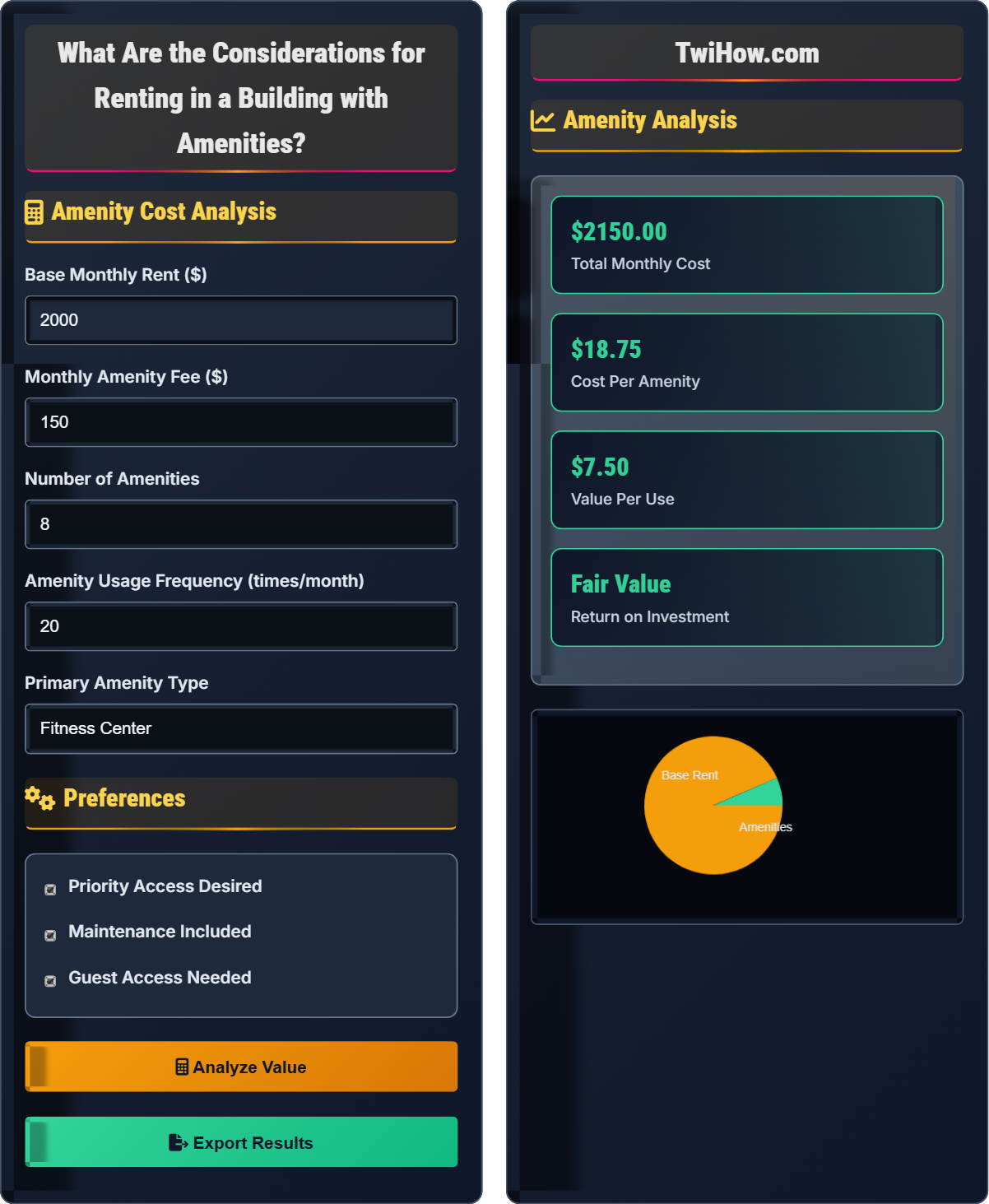
| Base Rent | $2,000.00 | 93.0% | Standard rent |
| Amenity Fee | $150.00 | 7.0% | Monthly amenity cost |
| Total Cost | $2,150.00 | 100% | With amenities |
Monthly Fees: Additional recurring costs
Opportunity Cost: Higher rent elsewhere
Usage Frequency: Value depends on actual use
Reservation Systems: Limited access during peak times
Guest Policies: Restrictions on visitors
Behavior Standards: Community rules apply
Shared Responsibility: Issues affect all residents
Repair Delays: Coordination required
Seasonal Closures: Limited availability
Understanding Building Amenities and Their Impact
Building amenities are additional features, services, or facilities provided to tenants beyond the basic residential unit. These can range from simple conveniences to luxury features:
- Basic Amenities: Laundry facilities, parking, storage units
- Recreational Amenities: Fitness centers, swimming pools, game rooms
- Business Amenities: Co-working spaces, conference rooms, business centers
- Service Amenities: Concierge, maintenance, security services
- Social Amenities: Lounges, outdoor spaces, community rooms
The cost-benefit analysis of amenity fees involves understanding:
Where:
- Monthly Value: Estimated savings from not paying for external services
- Amenity Fee: Additional monthly charge for amenities
- ROI: Return on investment percentage
Generally, amenities are worth considering if your usage provides value exceeding the cost.
Popular building amenities and their typical value propositions:
- Fitness Centers: Save gym membership costs and time
- Swimming Pools: Luxury feature with limited year-round use
- Co-working Spaces: Convenient for remote workers
- Laundry Facilities: Essential convenience with high usage
- Concierge Services: Premium service for busy professionals
- Actual Usage: Don't pay for amenities you won't use
- Peak Times: Consider reservation requirements
- Maintenance Quality: Well-maintained facilities are crucial
- Future Plans: Consider lifestyle changes during lease
- Contract Terms: Understand what's included in fees
Amenity Fundamentals
Building amenities, amenity fees, HOA charges, common area maintenance, facility access, usage restrictions.
Amenity Value = (Usage Frequency × External Alternative Cost) - Amenity Fee
Where Usage Frequency = Times per month, External Alternative Cost = Equivalent service cost elsewhere.
- Calculate actual usage before committing
- Understand all associated fees
- Review access policies carefully
- Consider seasonal variations
Cost-Benefit Analysis
Monthly fees, annual costs, opportunity costs, value comparisons, ROI calculations.
- Calculate total monthly cost with amenities
- Estimate external alternatives' cost
- Compare usage frequency to cost
- Factor in convenience and time savings
- Calculate annual savings or premium
- Usage frequency affects value
- Convenience has subjective value
- Peak demand affects access
- Maintenance quality matters
Amenities Renting Quiz
Which of the following is the most important factor when determining if amenity fees provide good value?
The value of amenity fees depends primarily on your actual usage. Even if a building has numerous luxurious amenities, they provide no value if you don't use them. A building with fewer amenities but higher usage frequency can offer better value than one with many unused amenities. The key is matching your lifestyle and habits with the amenities offered.
The answer is B) Your actual planned usage frequency.
Value in economics is determined by utility - the satisfaction or benefit derived from consumption. In the context of building amenities, the value is directly proportional to usage frequency. This principle helps renters make informed decisions by focusing on practical benefits rather than superficial features. Understanding this concept prevents overpaying for amenities that won't be used regularly.
Utility: Satisfaction or benefit derived from consumption
Usage Frequency: How often you plan to use an amenity
Value Proposition: Benefits relative to cost
• Match amenities to your lifestyle
• Calculate actual usage before committing
• Consider opportunity costs
• Keep a usage log for similar amenities
• Calculate external alternatives' costs
• Consider seasonal variations in usage
• Being swayed by luxury appearances
• Assuming more amenities equals better value
• Ignoring actual usage patterns
Explain how to conduct a thorough cost-benefit analysis for building amenities, including the calculation methods, factors to consider, and decision-making criteria.
Step 1 - Cost Calculation (Monthly): Total monthly cost = Base rent + Amenity fee
Step 2 - Benefit Estimation (Monthly): Calculate value of external alternatives
Example: Gym membership ($50/month) + Parking ($100/month) + Co-working space ($150/month) = $300/month value
Step 3 - Usage Frequency: Multiply benefit by expected usage rate
If you expect to use 70% of amenities' equivalent value: $300 × 0.7 = $210
Step 4 - ROI Calculation: (Benefit - Cost) / Cost × 100
($210 - $150) / $150 × 100 = 40% return
Decision Criteria: Positive ROI indicates value, but also consider intangible benefits like convenience and time savings.
The cost-benefit analysis provides a quantitative framework for evaluating amenities. By converting convenience and time savings into monetary terms, you can make more objective decisions. The analysis should also account for qualitative factors like stress reduction and lifestyle enhancement, which have real but difficult-to-quantify value.
ROI: Return on investment percentage
Opportunity Cost: Value of next best alternative
Intangible Benefits: Non-monetary advantages
• Quantify tangible benefits
• Consider intangible benefits
• Account for usage patterns
• Research external alternative costs
• Factor in time and convenience
• Consider seasonal usage variations
• Ignoring actual usage patterns
• Focusing only on upfront costs
• Neglecting intangible benefits
James is considering two apartments: Apartment A rents for $1,800/month with $100/month in amenity fees, offering a gym, pool, and co-working space. Apartment B rents for $1,600/month with no amenities. James currently pays $40/month for a gym, $80/month for a co-working space, and occasionally uses a $20/day public pool. He estimates he'd use the apartment amenities 15 times per month for the gym, 8 times for the co-working space, and 4 times for the pool. Calculate the value proposition and recommend which apartment offers better value.
Apartment A Total Cost: $1,800 + $100 = $1,900/month
Apartment B Total Cost: $1,600/month
External Alternative Costs:
- Gym: $40/month (current cost)
- Co-working: $80/month (current cost)
- Pool: 4 visits × $20/day = $80/month (estimated)
Total External Cost: $40 + $80 + $80 = $200/month
Value Comparison:
- Apartment A provides $200/month value for $100/month fee
- Difference: $200 - $100 = $100/month net benefit
- Apartment A total cost: $1,900 vs Apartment B: $1,600
- Net cost difference: $1,900 - $1,600 = $300/month premium
- But value gained: $200/month
- Effective premium: $300 - $200 = $100/month
Recommendation: Apartment A offers better value if James values the convenience and time savings of on-site amenities at $100/month or more.
This problem demonstrates the complexity of amenity valuation. While Apartment A costs more initially, the embedded value of amenities reduces the effective premium. The decision ultimately depends on James's valuation of convenience and time savings. This illustrates why individual lifestyle patterns are crucial in amenity decisions.
Net Benefit: Value received minus cost paid
Effective Premium: True cost after accounting for value received
Embedded Value: Worth of included services
• Calculate total costs including fees
• Compare with external alternatives
• Factor in convenience value
• Track current spending on similar services
• Consider time and convenience savings
• Evaluate seasonal usage patterns
• Ignoring current service costs
• Not calculating effective premiums
• Overlooking convenience value
You are helping a friend decide between two apartment buildings. Building A charges $200/month in amenity fees for a gym, pool, business center, and concierge. Building B charges $75/month for laundry, parking, and storage only. Your friend is a remote worker who rarely exercises, doesn't swim, but needs reliable internet and workspace. Create a prioritization framework to help them decide based on their specific needs and lifestyle.
Prioritization Framework:
1. Lifestyle Alignment: Rank amenities by relevance to daily routine
2. Usage Probability: Estimate frequency of use for each amenity
3. Substitution Availability: How easily can external alternatives be found?
4. Cost Comparison: Calculate value of external alternatives
Analysis for Friend:
Building A (High-cost): Gym and pool are low priority, but business center is valuable for remote work. Concierge service has moderate value.
Building B (Lower-cost): Laundry, parking, and storage are essential daily conveniences. No workspace for remote work.
Recommendation: Building B likely offers better value because:
1. Essential amenities (laundry, parking) are used frequently
2. Business center in Building A may not meet professional needs
3. Friend can find external workspace alternatives
4. Lower monthly fee provides flexibility
This scenario demonstrates the importance of aligning amenities with specific lifestyle needs rather than choosing based on quantity alone. The framework emphasizes personal relevance over generic value propositions. It also highlights how professional needs (like workspace requirements) can outweigh recreational amenities for some individuals.
Lifestyle Alignment: Matching amenities to daily habits
Substitution Analysis: Evaluating external alternatives
Usage Relevance: Importance to daily routine
• Match amenities to lifestyle priorities
• Consider professional needs separately
• Evaluate substitution possibilities
• List your daily routines and needs
• Rank amenities by necessity vs. luxury
• Consider seasonal lifestyle changes
• Choosing amenities based on appearance
• Ignoring lifestyle-specific needs
• Overvaluing recreational amenities
Which of the following is often an overlooked cost associated with building amenities?
The opportunity cost of higher rent is often overlooked when evaluating amenities. When a building charges higher rent partly due to amenities, tenants lose the opportunity to invest or spend that extra money elsewhere. This "hidden" cost isn't immediately apparent but represents real financial value lost. For example, $100/month in amenity fees equals $1,200/year that could otherwise be invested or spent on personally valuable activities.
The answer is B) Opportunity cost of higher rent.
Opportunity cost is a fundamental economic concept representing the value of the next best alternative foregone. In amenity decisions, this means the potential returns from investing the extra rent money or spending it on personally valuable experiences. Many renters focus only on immediate costs and benefits, missing the long-term financial implications of higher rent payments.
Opportunity Cost: Value of next best alternative
Present Value: Current worth of future cash flows
Compound Interest: Growth of investment over time
• Consider long-term financial impact
• Calculate opportunity costs
• Factor in investment potential
• Calculate 5-year cost differences
• Consider investment returns on extra rent
• Evaluate personal spending priorities
• Focusing only on immediate costs
• Ignoring long-term financial impact
• Not considering alternative investments
FAQ
Q: Is it worth paying extra for a building with a gym if I only exercise 2-3 times per week?
A: For 2-3 workouts per week, a building gym might not provide significant value unless it's well-equipped and convenient for your schedule. Calculate: if a basic gym membership costs $30-40/month and you're paying $50+ in amenity fees for infrequent use, you're overpaying for the convenience. However, if the building gym saves you 30+ minutes each workout day and is well-maintained, the time savings might justify the cost. Consider your equipment needs and whether the building's facilities meet them.
Q: What should I look for in amenity maintenance and management?
A: Key indicators of good amenity management include: regular maintenance schedules posted publicly, quick response to repair requests (within 24-48 hours), cleanliness standards maintained consistently, and adequate staffing during peak hours. Visit amenities during different times to assess condition and usage patterns. Ask current residents about maintenance responsiveness. Look for signs of deferred maintenance like broken equipment, dirty facilities, or outdated safety equipment. Well-managed amenities should feel secure, clean, and functional.