Renting in New Development or Pre-Construction
Complete guide to tenant rights • Step-by-step explanations
New Construction Leasing:
Show Risk CalculatorRenting in new developments or pre-construction properties offers unique opportunities and challenges. Understanding the specific considerations helps you make informed decisions and protect your interests as a tenant.
Key considerations:
- Construction Timeline: Potential delays and their impact on move-in
- Lease Terms: Flexibility for construction-related changes
- Tenant Rights: Unique protections for new construction
- Warranty Periods: Coverage for defects and repairs
- Property Management: Experience with new developments
Successfully navigating new construction rentals requires careful planning, thorough documentation, and awareness of your specific rights and obligations.
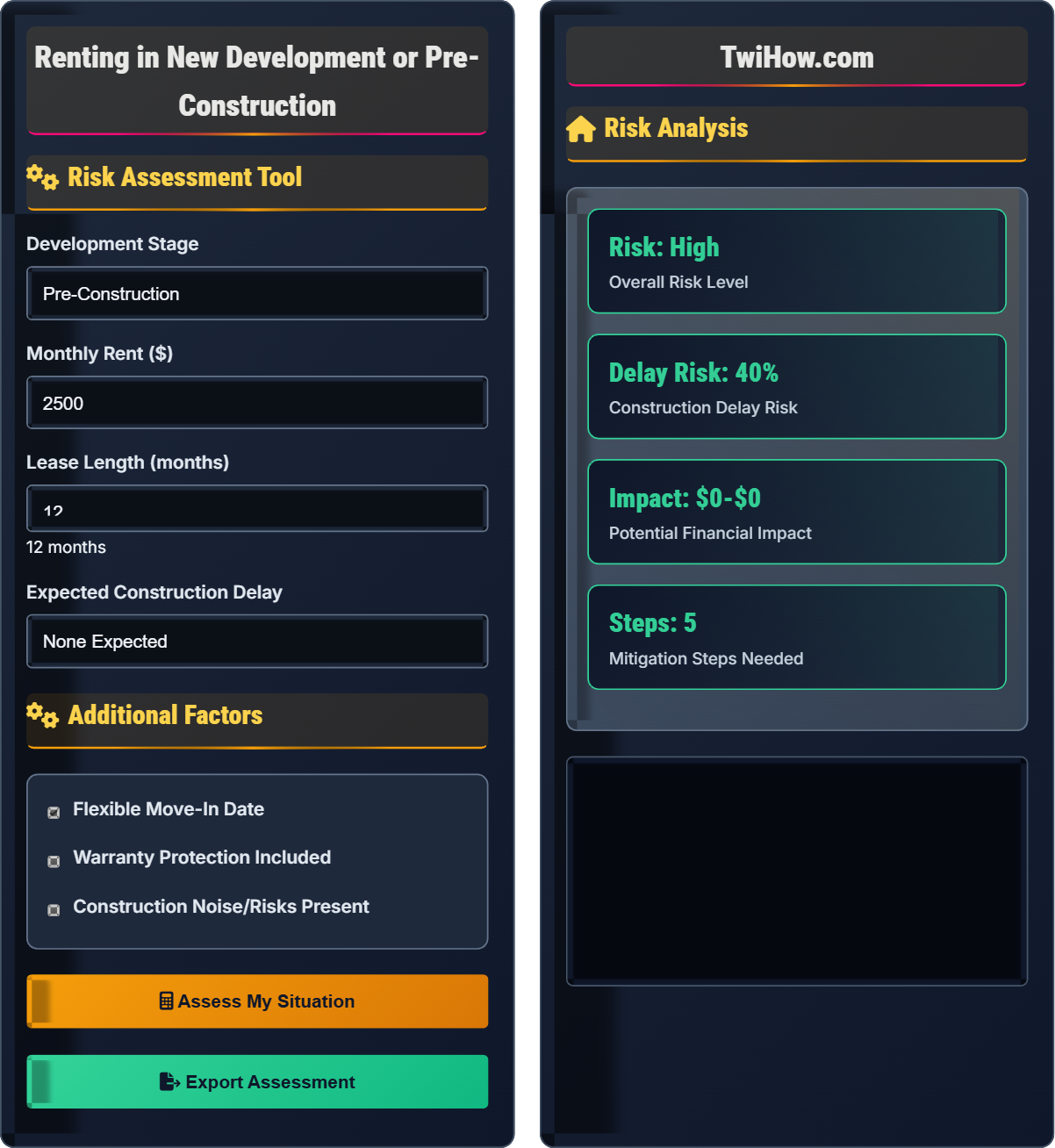
Risk Assessment Tool
Additional Factors
Risk Analysis
| Factor | Assessment | Status |
|---|---|---|
| Development Stage | Pre-Construction | High Risk |
| Construction Timeline | Expected Delays | Active Risk |
| Warranty Protection | Included | Protected |
| Mitigation Measures | Partial | Improve |
Recommended Actions
- Verify construction timeline and permits
- Negotiate flexible lease terms
- Document property condition
- Understand warranty coverage
Understanding New Development Rental Considerations
New development rentals are properties that are either under construction or recently completed. These rentals offer modern amenities and updated building codes but come with unique considerations compared to established properties.
Key characteristics include:
- Construction Phases: Properties may be in various stages of completion
- Modern Features: Latest building technologies and energy efficiency
- Warranty Periods: Builder warranties covering defects and repairs
- Unestablished Communities: Ongoing development of surrounding area
Renting in new developments is governed by:
Renting in new developments presents several unique risks:
- Construction Delays: Potential delays in move-in dates and ongoing work
- Settling Issues: Foundation settling, plumbing adjustments, and system calibrations
- Noise and Disruption: Ongoing construction affecting daily life
- Warranty Management: Ensuring proper documentation and coverage
- Unestablished Services: Potentially unreliable utilities and services
Special protections for new construction tenants include:
- Right to move-in date flexibility
- Protection against construction-related disruptions
- Access to builder warranty information
- Right to terminate for significant delays
- Compensation for extended delays
Pre-Lease Considerations
Construction timeline, permit status, warranty coverage, property management experience, lease flexibility.
Decision Quality = (Information Gathering × Risk Assessment × Lease Terms) / Uncertainty
Where higher values indicate better preparation.
- Verify all construction permits are approved
- Understand warranty coverage and duration
- Negotiate flexible move-in terms
During Tenancy
Documentation, communication, warranty claims, construction disruption management.
- Document all construction-related issues
- Maintain regular communication with property manager
- File warranty claims promptly
- Track any construction disruptions
- Coordinate with ongoing development activities
- Report issues immediately
- Keep detailed records
- Understand your rights during construction
- Know the warranty claim process
New Development Rental Knowledge Quiz
What should tenants consider when a new development lease includes a projected move-in date?
When renting in new developments, tenants should verify the projected move-in date by checking official permits and the actual construction schedule. Construction projects frequently experience delays due to weather, supply chain issues, inspections, or permit delays. Understanding the actual progress and timeline helps set realistic expectations.
The answer is B) Verify the date with official permits and construction schedule.
Construction projects are complex undertakings with many variables that can affect completion dates. While developers provide projected timelines, these are estimates that can change. Verification through permits and site visits provides more accurate information.
Projected Move-in Date: Estimated date when property will be ready for occupancy
Construction Schedule: Timeline of planned construction activities
Building Permits: Official approvals required for construction work
• Verify projected dates with official documentation
• Understand that estimates can change
• Negotiate flexible terms for delays
• Visit the construction site periodically
• Ask for monthly progress reports
• Include delay compensation in lease
• Treating projected dates as guarantees
• Not verifying construction progress
• Failing to plan for delays
Explain the importance of warranty protection for tenants in new construction rentals. What types of issues are typically covered?
Importance of Warranty Protection: New construction warranties provide crucial protection for tenants by covering defects that commonly occur in newly built properties during the settling and adjustment period.
Typical Warranty Coverage Includes:
Structural Elements: Foundation, framing, roof, and structural components for typically 1-10 years depending on the element.
Systems: HVAC, electrical, and plumbing systems for 1-2 years.
Workmanship: Installation of fixtures, finishes, and general construction quality for 1 year.
Appliances: Manufacturer warranties that typically extend beyond the lease term.
Waterproofing: Roofs, windows, and exterior elements for 1-5 years.
Warranty protection ensures that tenants aren't responsible for construction-related defects and provides peace of mind during the settling period when issues commonly arise.
New construction undergoes a settling period where materials adjust and systems calibrate. Warranties protect tenants from bearing the cost of construction defects. Understanding warranty terms helps tenants know what repairs are covered and how to file claims.
Builder Warranty: Guarantee covering construction defects and workmanship
Settling Period: Time when new construction adjusts and materials settle
Construction Defect: Flaw in design, materials, or workmanship
• Understand warranty duration for each component
• Get warranty details in writing
• Document property condition at move-in
• Report issues promptly to preserve warranty
• Not understanding warranty terms
• Failing to document issues promptly
• Assuming all issues are covered
Sarah signed a lease for a new apartment that was supposed to be ready in 3 months, but construction is now 6 months behind schedule. The developer offers to extend the lease start date without penalty, but Sarah has already paid first month's rent and security deposit. She's currently staying in expensive temporary housing. Analyze Sarah's situation and recommend the best course of action.
Analysis: Sarah faces a common issue with new development rentals where construction delays impact move-in dates. The developer's offer to extend the lease start date addresses the timing issue but doesn't compensate for Sarah's interim expenses.
Recommended Course of Action:
1. Review Lease Terms: Check for any delay compensation clauses or penalties for late delivery.
2. Negotiate Compensation: Request reimbursement for temporary housing costs or rent credit.
3. Document Expenses: Keep detailed records of all additional costs incurred due to delays.
4. Verify Construction Status: Request regular updates and proof of actual construction progress.
5. Consider Alternatives: Evaluate if the delay is reasonable or if breaking the lease might be better.
While extending the lease start date solves the timing issue, Sarah should negotiate for compensation for the additional expenses she incurred due to the delay.
This scenario demonstrates the financial impact of construction delays on tenants. Developers may offer time extensions but not necessarily compensate for additional costs. Tenants should negotiate for fair compensation when delays occur through no fault of their own.
Construction Delay: Failure to complete construction by projected date
Interim Expenses: Additional costs incurred due to delaysLease Extension: Adjustment to lease start/end dates
• Document all delay-related expenses
• Negotiate compensation for delays
• Verify actual construction progress
• Include delay compensation in original lease
• Request monthly progress updates
• Plan backup housing arrangements
• Not planning for potential delays
• Failing to document additional expenses
• Accepting delays without compensation
Mike moved into a new development 2 months ago. The adjacent building is still under construction, causing significant noise, dust, and traffic disruption during business hours. His lease has no provisions for construction disruptions. The property manager says this is temporary and will end in 3 months. Evaluate Mike's options and suggest the best approach.
Options Evaluation: Mike has several options for addressing construction disruptions:
Direct Negotiation: Request rent abatement or temporary rent reduction for the disruption period.
Documentation: Record the disruptions with dates, times, and impact on daily life.
Warranty Claims: If construction affects his unit (noise, dust infiltration), file claims under new construction warranties.
Local Authorities: Check noise ordinances and construction hour restrictions in the area.
Lease Modification: Negotiate amendments to include disruption compensation.
Best Approach: Mike should document the disruptions, communicate with management about rent adjustments, and explore local noise ordinances. Since he's in a new development, the property owner has incentive to maintain good relationships with early tenants.
Construction disruptions are common in new developments, but tenants have rights to reasonable quiet enjoyment. While some disruption may be expected, excessive noise and inconvenience can warrant compensation. Early tenants are valuable to property owners.
Quiet Enjoyment: Right to use property without significant interference
Rent Abatement: Temporary reduction in rent for habitability issues
Construction Disruption: Noise, dust, or access issues from ongoing work
• Document all disruptions
• Communicate with property management
• Know local noise ordinances
• Keep a log of daily disruptions
• Request temporary rent reduction
• Explore local construction hour restrictions
• Accepting excessive disruptions without documentation
• Not negotiating compensation
• Failing to explore legal rights
Which lease provision is most important when renting in a new development that's still under construction?
Construction delay and compensation clauses are most important when renting in a new development under construction. These provisions protect tenants from the inherent risks of construction schedules and provide recourse if delays occur. They can specify rent credits, alternative housing assistance, or lease termination options if delays exceed certain thresholds.
The answer is B) Construction delay and compensation clauses.
While all lease terms are important, new construction rentals carry unique risks that require specific protections. Construction delays are common and can significantly impact tenants' plans and finances. Specialized clauses address these risks proactively.
Construction Delay Clause: Lease provision addressing move-in date changes
Compensation Clause: Provisions for rent credits or other compensation
Force Majeure: Circumstances beyond control that affect lease terms
• Prioritize construction-specific clauses
• Negotiate delay compensation
• Understand force majeure provisions
• Review construction timeline carefully
• Negotiate specific delay protections
• Include termination options for major delays
• Overlooking construction-specific risks
• Not negotiating delay protections
• Assuming standard lease terms are sufficient
Frequently Asked Questions
Q: Is it risky to rent in a new development that's still under construction?
A: Renting in new construction has both advantages and risks. Advantages include modern amenities, updated building codes, and warranty protection. However, there are risks such as potential construction delays, ongoing noise and disruption, settling issues, and potentially inexperienced property management. The key is to understand these risks and negotiate appropriate protections in your lease agreement.
Many tenants find new construction rentals rewarding, especially if they're flexible about timing and prepared for potential disruptions during the settling period.
Q: What should I look for in a lease when renting new construction?
A: When reviewing a lease for new construction, pay special attention to:
1. Move-in Date Flexibility: Provisions for construction delays and how they affect your lease start date.
2. Warranty Information: Details about builder warranties and your rights to claim repairs.
3. Construction Disruption: Rights and compensation for noise, dust, or access issues during ongoing construction.
4. Property Management: Experience level of the management company with new developments.
5. Inspection Rights: Your right to inspect the unit before finalizing the lease.
These provisions protect you from the unique risks associated with new construction.
Q: How do I document issues in a new construction rental?
A: Proper documentation is crucial for new construction rentals:
1. Pre-Move-In Inspection: Take detailed photos of the entire unit, including all fixtures, finishes, and appliances.
2. Move-In Checklist: Complete any provided checklist thoroughly and note any existing issues.
3. Ongoing Issues: Document any construction-related problems with dates, photos, and written descriptions.
4. Communication Log: Keep records of all interactions with property management about issues.
5. Warranty Claims: Maintain copies of all warranty claim forms and responses.
This documentation protects your rights and supports any warranty claims during your tenancy.