Rules Around Subletting or Having Roommates
Real estate guide • Step-by-step explanations
Subletting & Roommate Rules:
Show Rule CheckerUnderstanding the rules around subletting and having roommates is crucial for tenants to avoid lease violations and maintain good standing with landlords. These rules are primarily governed by lease agreements, local laws, and property policies. Subletting involves temporarily transferring your lease to another person, while having roommates typically means sharing the rented space with others under your lease.
Key considerations for subletting and roommates include:
- Lease Agreement Terms: Specific clauses about subletting and additional occupants
- Landlord Permission: Whether approval is required and the process
- Legal Requirements: Local laws governing tenant rights and responsibilities
- Liability Issues: Responsibility for damages and rent payments
- Screening Process: Background checks and approval requirements
- Financial Obligations: How rent and utilities are handled
Violating these rules can result in lease termination, eviction, or legal consequences, making it essential to understand and follow all requirements.
Subletting & Roommate Parameters
Legal Considerations
Rule Analysis
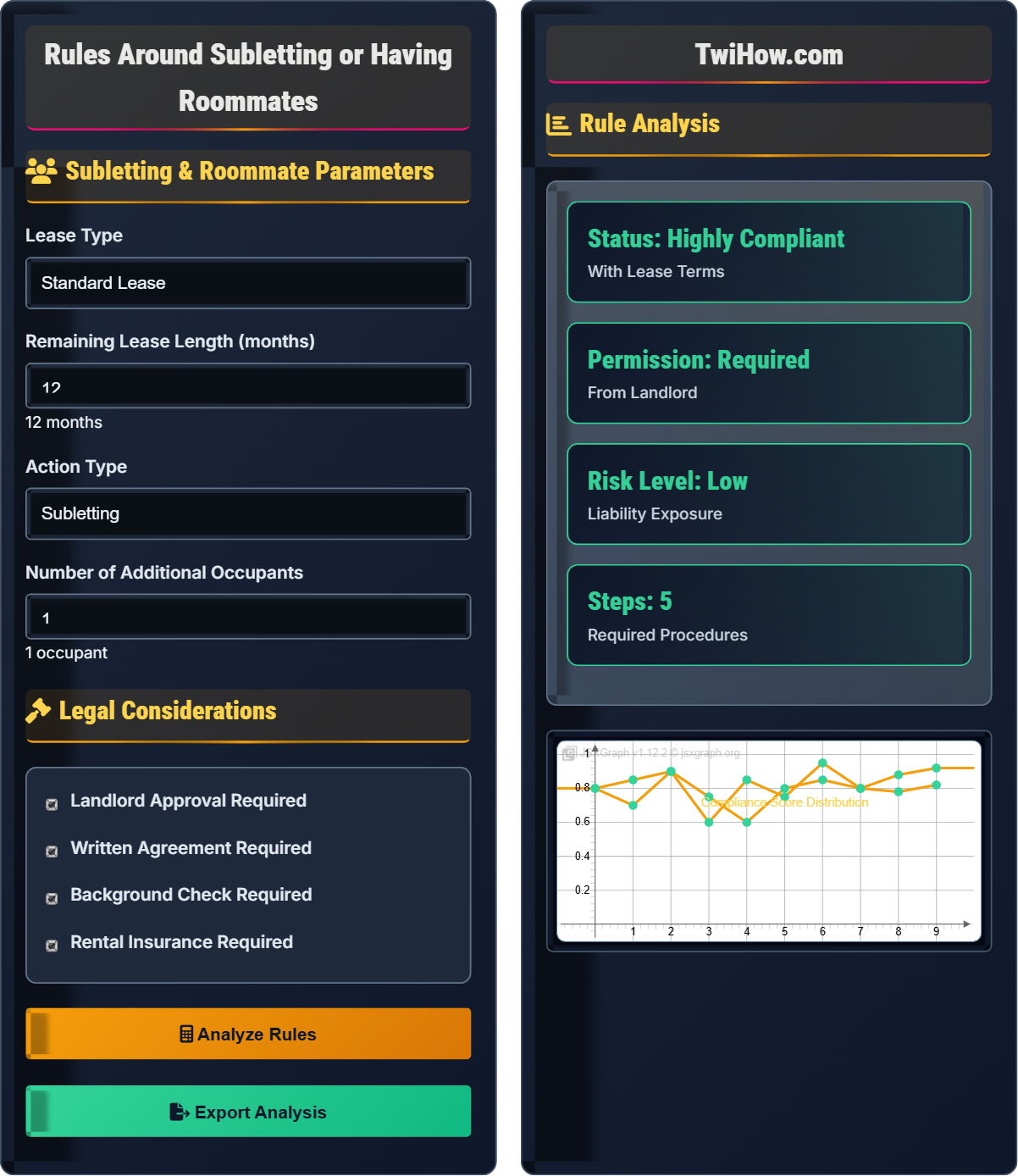
| Requirement | Status | Details | Priority |
|---|---|---|---|
| Landlord Approval | Required | Written consent needed | High |
| Background Check | Required | SSN, credit, criminal | High |
| Rental Insurance | Recommended | Additional liability coverage | Medium |
| Written Agreement | Required | Formal lease addendum | High |
Understanding Subletting and Roommate Rules
Subletting is the process of renting your leased property to another person while you remain the primary tenant responsible for the lease. The subtenant pays rent to you, and you continue to pay rent to your landlord. This arrangement is temporary and typically occurs when the original tenant needs to leave the property for a period but doesn't want to break the lease.
Adding roommates typically means allowing someone else to live in your rental unit while you remain the sole tenant on the lease. The roommate may pay you rent for their portion of the space, but you remain fully responsible to the landlord for all lease obligations. This is different from subletting, where you temporarily transfer tenancy to another person.
This formula helps evaluate the level of compliance with subletting and roommate rules. Each factor is scored from 0-10, with the weighted sum providing an overall compliance score. Lease agreement compliance typically carries the highest weight since violating lease terms can result in immediate termination.
For example, if Lease Agreement Compliance = 8, Landlord Consent = 7, Legal Requirements = 9, and Documentation = 6, the Compliance Score would be: (8×0.4) + (7×0.3) + (9×0.2) + (6×0.1) = 3.2 + 2.1 + 1.8 + 0.6 = 7.7/10.
Key requirements for compliant subletting or adding roommates include:
- Lease Review: Confirm subletting/roommate policies in your lease agreement
- Landlord Consent: Obtain written permission before proceeding
- Proper Screening: Background checks, credit reports, and references
- Written Agreements: Formal contracts outlining responsibilities
- Insurance Coverage: Ensure adequate liability protection
- Rent Structure: Clear payment arrangements and responsibility allocation
Common risks associated with subletting and having roommates include:
- Financial Liability: Remaining responsible for rent and damages caused by others
- Lease Violations: Risk of eviction for unauthorized arrangements
- Property Damage: Being held accountable for roommate actions
- Relationship Conflicts: Disputes over responsibilities and shared spaces
- Legal Consequences: Potential lawsuits for lease violations
- Security Deposits: Risk of losing deposits due to others' actions
Fundamental Rules
Subletting, roommate agreements, lease compliance, landlord consent, liability exposure, legal requirements.
Compliance Score = Σ(Factor Score × Weight)
Where Factor Score ranges from 0-10 and weights sum to 100%. The formula accounts for multiple criteria that influence compliance with rental regulations.
- Always review your lease agreement first
- Obtain written landlord consent before proceeding
- Follow local laws and regulations
- Document all arrangements properly
Best Practices
Lease review, landlord communication, proper screening, written agreements, insurance verification, rent management.
- Thoroughly review your lease agreement
- Consult with your landlord about policies
- Screen potential subtenants or roommates
- Create formal written agreements
- Establish clear payment structures
- Local laws may override lease terms
- Landlords cannot unreasonably deny requests
- Written agreements protect all parties
- Proper documentation is essential
Subletting & Roommate Rules Quiz
What is the most common consequence of subletting without landlord permission?
Unauthorized subletting is a serious lease violation that can result in immediate lease termination and eviction proceedings. Landlords have the legal right to evict tenants who violate lease terms, including subletting without permission. This is because the landlord has not approved the new occupant and may not meet their screening criteria.
The answer is B) Eviction and lease termination.
Lease agreements are legally binding contracts that specify who is authorized to occupy the rental property. When you sublet without permission, you're introducing someone not approved by the landlord, which violates the lease terms. This creates potential liability for the landlord (who may not want to be responsible for unknown tenants) and undermines the landlord's right to approve occupants. The severe consequence of eviction emphasizes the importance of following proper procedures.
Subletting: Temporarily transferring lease to another person while remaining liable
Lease Violation: Breach of terms in the rental agreement
Eviction: Legal process to remove tenant from property
• Unauthorized subletting violates lease agreements
• Landlords have right to approve occupants
• Violations can result in eviction
• Always read your lease carefully before subletting
• Request written permission from your landlord
• Follow proper legal procedures
• Assuming subletting is allowed without checking lease
• Not obtaining written landlord consent
• Failing to document subletting arrangements
Explain the rights and responsibilities of landlords when tenants request to sublet or add roommates, and how these rights vary by jurisdiction.
Landlord Rights: Landlords have the right to approve or deny subletting and roommate requests, though they cannot unreasonably withhold consent. They can screen potential occupants using the same criteria applied to the original tenant, including credit checks, background checks, and income verification.
Responsibilities: Landlords must follow fair housing laws during the screening process, cannot discriminate based on protected characteristics, and must respond to requests within a reasonable timeframe (often specified by local law).
Jurisdictional Variations: Some states like California require landlords to reasonably approve subletting requests, while others give landlords more discretion. Some jurisdictions limit the grounds for denial or require specific reasons for rejection. Local rent control ordinances may also affect subletting policies.
Documentation: Landlords may require formal lease assignments or addendums, and can insist on updated insurance coverage. They retain the right to inspect the property and ensure lease compliance.
Landlord-tenant relationships are governed by both contract law (the lease) and statutory law (local and state regulations). While landlords have significant control over who occupies their property, they must exercise this authority within legal bounds. The balance between tenant autonomy and landlord control varies by location, making it essential for both parties to understand local laws. The "reasonable" standard for approving requests is a common legal concept that prevents arbitrary denials while preserving landlord discretion.
Fair Housing Laws: Regulations prohibiting discrimination in housing
Reasonable Standard: Legal requirement that decisions be rational and justified
Lease Assignment: Transfer of lease rights to another party
• Landlords can screen subtenants using standard criteria
• Research local subletting laws before making requests
• Provide complete applications for potential roommates
• Understand your jurisdiction's specific requirements
• Not understanding local subletting regulations
• Failing to provide complete screening information
• Assuming all jurisdictions have the same rules
John has a one-year lease and needs to move to another city for work after six months. His lease contains a clause stating that subletting requires written landlord consent. John finds a qualified subtenant who passes all background checks, but his landlord refuses to approve the sublet, claiming he simply doesn't want to deal with new tenants. John's lease has no termination clause for job relocations. What are John's rights and options in this situation?
John's Situation: In most jurisdictions, landlords cannot unreasonably withhold consent for subletting when the tenant has a legitimate reason and the proposed subtenant is qualified. However, the definition of "unreasonable" varies by location.
Options: John should first attempt to negotiate with his landlord, emphasizing the qualified subtenant and his own good rental history. He should document all communications. If the landlord's refusal is truly arbitrary, John may have grounds for legal action in some jurisdictions.
Alternative Solutions: John could try to find a way to terminate the lease through other means if allowed by local law, or continue paying rent while the subtenant occupies the property (though this carries risk). In some areas, John might be able to assign the lease instead of subletting.
Legal Consultation: Given the complexity of lease law variations, John should consult with a tenant rights organization or attorney familiar with local laws to determine his specific rights and remedies.
This scenario illustrates the tension between tenant flexibility needs and landlord property control. Lease agreements are binding contracts, but they exist within a legal framework that includes tenant protection laws. The concept of "reasonable" consent is subjective and varies by jurisdiction. Some states have laws specifically addressing subletting, while others leave it to lease terms. This example shows why understanding local laws is crucial for both tenants and landlords.
Lease Assignment: Transfer of all lease obligations to another party
Subletting: Temporary transfer while original tenant remains liable
Reasonable Refusal: Legitimate grounds for denying a request
• Landlords cannot unreasonably refuse qualified subtenants
• Lease terms must comply with local laws
• Communication documentation is important
• Research local tenant protection laws
• Document all communications with landlords
• Provide comprehensive subtenant applications
• Not understanding local subletting regulations
• Failing to document landlord communications
• Assuming all refusals are valid
Sarah sublets her apartment to Tom with landlord approval. Tom pays Sarah $1,200/month, and Sarah continues to pay the landlord $1,000/month. If Tom fails to pay Sarah for two months and also causes $3,000 in property damage, who is liable to the landlord for rent and damages?
Rent Liability: Sarah remains liable to the landlord for the full rent amount, regardless of whether Tom pays her. The original lease between Sarah and the landlord remains in effect, making Sarah responsible for all lease obligations.
Damage Liability: Sarah is typically liable for damages caused by Tom, as she is the named tenant on the lease. The landlord can hold Sarah responsible for all property damage, regardless of who caused it.
Recovery Options: Sarah can pursue Tom for the unpaid rent and damages through legal channels, but this doesn't absolve her of responsibility to the landlord. Sarah should have a separate agreement with Tom that outlines his obligations and her recourse options.
Protection Measures: Sarah should require Tom to carry renter's insurance with liability coverage and possibly pay a security deposit directly to the landlord to protect against damages.
This scenario highlights the fundamental principle that in a subletting arrangement, the original tenant remains legally bound to the landlord regardless of the subtenant's actions. The subletting agreement is a separate contract between the original tenant and subtenant, but it doesn't alter the original lease obligations. This is why subletting carries significant financial risk for the original tenant, who becomes responsible for collecting rent from the subtenant while still being liable to the landlord.
Primary Tenant: Original leaseholder responsible to landlord
Subtenant: Person occupying property under sublet
Privity of Contract: Direct legal relationship between parties
• Original tenant remains liable to landlord
• Subletting creates separate contract with subtenant
• Damages are typically the original tenant's responsibility
• Require subtenant insurance coverage
• Collect security deposits from subtenants
• Create detailed subletting agreements
• Not understanding ongoing liability to landlord
• Failing to collect adequate security deposits
• Not requiring subtenant insurance
What is the most important element to include in a roommate agreement?
While all roommate agreement elements are important, financial responsibilities and rent division are the most critical. Money-related disputes are the leading cause of roommate conflicts and can have serious legal and financial consequences. Clear agreements about rent payments, utility costs, security deposits, and how to handle non-payment are essential for maintaining the living arrangement and avoiding legal issues.
The answer is B) Financial responsibilities and rent division.
Financial disagreements are among the most common causes of roommate conflicts because they have tangible consequences. When one roommate doesn't pay their share, it directly affects the others' finances. Without clear agreements, it becomes difficult to enforce payment responsibilities or determine who owes what. Financial clarity upfront prevents many disputes and provides a framework for resolution if issues arise. While lifestyle preferences are important, they rarely have the same level of serious consequence as financial disagreements.
Roommate Agreement: Contract between co-tenants outlining responsibilities
Joint Liability: Shared responsibility for lease obligations
Financial Obligations: Monetary responsibilities in shared living
• Financial agreements prevent major conflicts
• Clear payment structures are essential
• Document all financial arrangements
• Specify exact rent amounts and due dates
• Outline how utilities will be split
• Include procedures for handling non-payment
• Not specifying exact financial responsibilities
• Assuming verbal agreements are sufficient
• Not planning for non-payment scenarios
FAQ
Q: Can my landlord raise my rent if I add a roommate?
A: Generally, landlords cannot raise rent simply because you add a roommate, unless your lease specifically allows for it or local rent control laws permit it. However, if your lease limits the number of occupants and adding a roommate violates this term, the landlord might have grounds for rent increase or lease termination. Always check your lease agreement and local laws before adding roommates. Some jurisdictions require landlords to approve additional occupants without raising rent if the lease doesn't limit occupancy.
Q: What's the difference between subletting and assigning a lease?
A: Subletting is a temporary arrangement where you rent your property to another person while remaining the primary tenant responsible for the lease. You're still liable for rent and damages. Lease assignment is a permanent transfer where you transfer all lease obligations to another person, and ideally, you're released from all future responsibilities. However, without explicit release from the landlord, you may still be liable even after assignment. Lease assignments typically require landlord approval and a formal agreement.