Process for Breaking a Lease Early Legally
Real estate guide • Step-by-step explanations
Lease Breaking Guide:
Show Legal Process ToolBreaking a lease early legally requires understanding your lease terms, local laws, and available legal options. While leases are legally binding contracts, there are several legitimate ways to terminate early without facing significant penalties. The key is following proper procedures and documenting everything.
Common legal grounds for breaking a lease include:
- Early Termination Clause: Pre-agreed conditions in the lease
- Military Service: Active duty orders requiring relocation
- Constructive Eviction: Landlord failing to maintain habitability
- Domestic Violence: Safety concerns requiring immediate relocation
- Job Relocation: Some states allow for employment moves
- Health Issues: Medical necessity requiring different living arrangements
Following proper legal procedures protects you from financial liability and maintains your rental history.
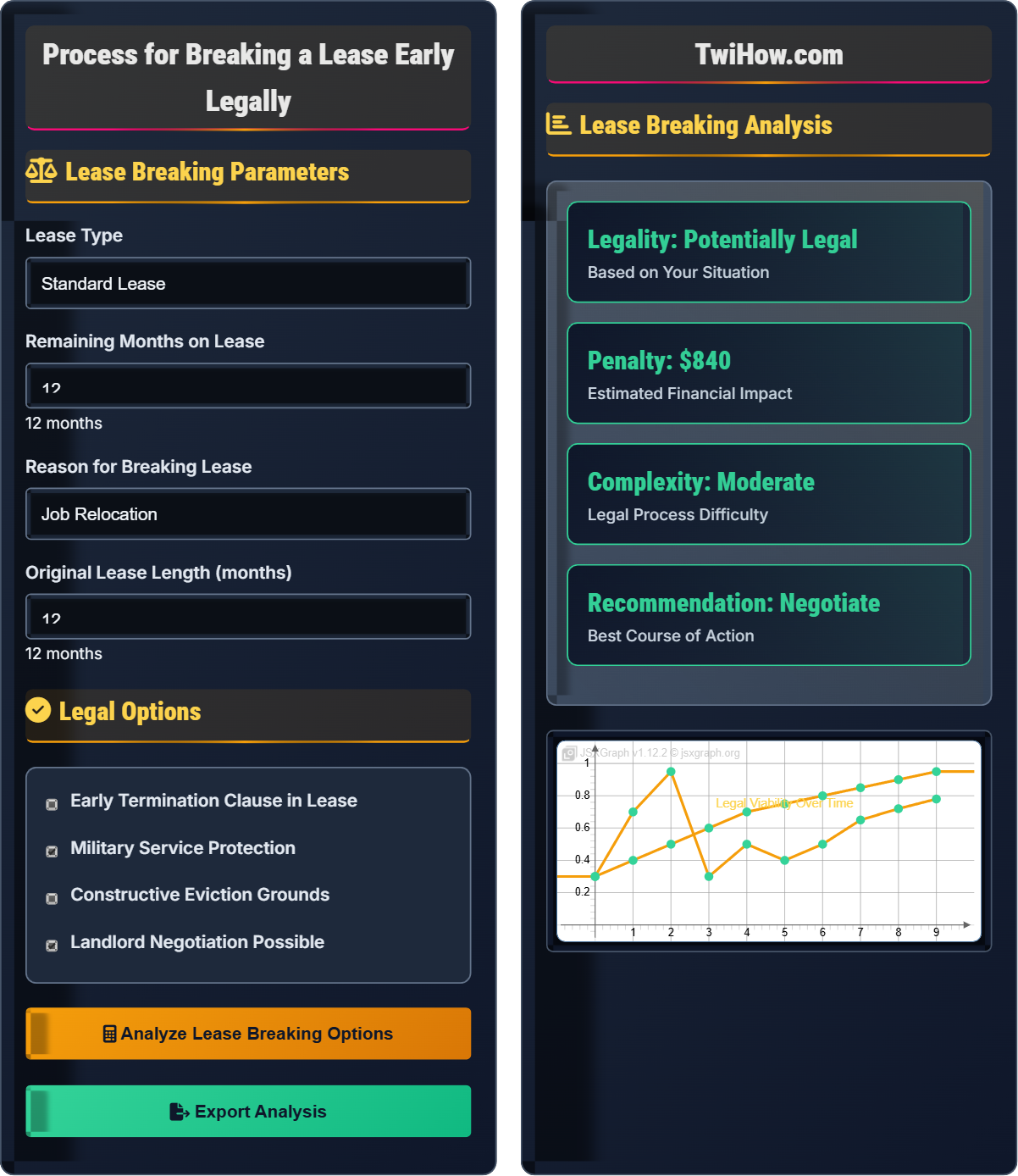
Lease Breaking Parameters
Legal Options
Lease Breaking Analysis
| Option | Viability | Difficulty | Timeline |
|---|---|---|---|
| Early Termination Clause | High | Low | Immediate |
| Landlord Negotiation | Medium | Low | 1-2 weeks |
| Military Service | High | Medium | 30 days |
| Constructive Eviction | Low | High | 2-4 weeks |
Understanding Lease Breaking
Lease breaking refers to terminating a rental agreement before its scheduled end date. While leases are legally binding contracts, tenants may have legitimate reasons to break them early. The key is understanding the legal pathways available in your jurisdiction and following proper procedures to minimize financial and legal consequences.
Several legal grounds allow tenants to break leases without significant penalties:
- Early Termination Clauses: Pre-agreed conditions in the lease
- Military Service: Federal protections under SCRA
- Domestic Violence: Special protections in most states
- Constructive Eviction: Landlord's failure to maintain habitability
- Health Issues: Medical necessity requiring different living arrangements
- Job Relocation: Some states provide protections for work moves
This formula evaluates the likelihood of successfully breaking a lease early. Each factor is scored from 0-10, with the weighted sum indicating the overall probability of success. Valid legal grounds carry the highest weight, as they provide the strongest foundation for lease termination.
For example, if Valid Legal Grounds = 8, Proper Documentation = 9, State Law Compliance = 7, Communication Quality = 8, and Landlord Cooperation = 5, the Success Probability would be: (8×0.3) + (9×0.25) + (7×0.2) + (8×0.15) + (5×0.1) = 2.4 + 2.25 + 1.4 + 1.2 + 0.5 = 7.75/10.
Key steps for legally breaking a lease include:
- Review Your Lease: Look for early termination clauses and requirements
- Research Local Laws: Understand tenant protections in your area
- Document Everything: Keep records of all communications and issues
- Negotiate First: Try to reach an agreement with your landlord
- Find a Replacement Tenant: Help locate qualified substitute
- Follow Proper Procedures: Submit written notice as required
Breaking a lease without proper legal grounds can result in:
- Financial Penalties: Loss of security deposit and additional fees
- Legal Action: Landlord may sue for remaining rent
- Credit Impact: Negative entries on credit reports
- Rental History: Difficulty renting in the future
- Eviction Record: Appears on tenant screening databases
- Guarantor Liability: Co-signers may be responsible for damages
Legal Fundamentals
Early termination, constructive eviction, military protections, domestic violence exceptions, lease assignment, subletting.
Success Probability = Σ(Factor Score × Weight)
Where Factor Score ranges from 0-10 and weights sum to 100%. The formula accounts for multiple criteria that influence lease breaking success.
- Always review lease terms first
- Research local and state laws
- Document everything
- Try negotiation before legal action
Best Practices
Lease review, legal research, documentation, negotiation, replacement tenant, proper notice.
- Thoroughly review your lease agreement
- Research applicable local and state laws
- Document all relevant circumstances
- Attempt to negotiate with your landlord
- Find qualified replacement tenant if needed
- Some states have stronger tenant protections
- Military personnel have federal protections
- Domestic violence victims have special rights
- Proper documentation is crucial
Lease Breaking Quiz
Which of the following is NOT typically a valid legal ground for breaking a lease early?
Simply wanting to move to a better apartment is not a legally recognized ground for breaking a lease early. While job relocation is protected in some states, and military service and domestic violence have federal protections, personal preference alone does not constitute a legal reason to break a lease without penalty.
The answer is C) Simply wanting to move to a better apartment.
This question highlights the difference between personal desires and legal protections. Lease agreements are binding contracts that require either mutual agreement or specific legal grounds for early termination. Personal preferences, even if reasonable, do not override the legal obligation unless specifically provided for in the lease terms. This is why understanding your lease agreement and applicable laws is crucial before attempting to break a lease.
Lease Agreement: Legally binding contract between tenant and landlord
Early Termination: Ending lease before scheduled end date
Legal Grounds: Justifiable reasons recognized by law
• Leases are binding contracts
• Personal preference is not a legal ground
• Specific legal protections exist for certain situations
• Review lease for early termination clauses
• Research local tenant protection laws
• Negotiate with landlord before breaking lease
• Assuming personal reasons justify lease breaking
• Not researching legal protections
• Failing to negotiate with landlord first
Explain the Servicemembers Civil Relief Act (SCRA) protections for military personnel who need to break their lease early due to active duty orders.
SCRA Overview: The Servicemembers Civil Relief Act provides federal protection for military personnel who receive orders requiring relocation or deployment.
Notice Requirements: Service members must provide written notice to the landlord and a copy of military orders. The notice must be delivered in accordance with the lease terms or state law.
Timeline: The lease termination becomes effective 30 days after the next rent payment is due, following delivery of notice. This provides a maximum of 90 days of protection.
Financial Responsibility: Service members are only responsible for rent through the effective date of termination. They are not liable for the remaining lease term.
Documentation: A copy of military orders is typically required to invoke SCRA protections.
Scope: SCRA applies to leases signed before entering active duty or receiving qualifying orders.
The SCRA represents a significant federal protection for military personnel, acknowledging the unique challenges of military service. This protection is automatic upon meeting the requirements, but proper documentation and notice are crucial. The law recognizes that military personnel cannot control their assignments and should not face financial penalties for serving their country. The 30-day notice period provides landlords with time to find replacement tenants while protecting service members from extended liability.
SCRA: Servicemembers Civil Relief Act - federal law protecting military
Active Duty: Full-time military service as ordered
Qualifying Orders: Official military orders requiring relocation
• Must provide written notice and military orders
• Keep copies of all documentation
• Deliver notice according to lease requirements
• Maintain good relationship with landlord
• Not providing proper written notice
• Failing to include copy of military orders
• Assuming protection applies to post-duty leases
Sarah signed a 12-month lease in January. In March, she received a job promotion that requires her to relocate to another state in May. Her lease doesn't have an early termination clause. Sarah's state has laws protecting tenants for job relocations, but she must provide 60 days notice and pay one month's rent as a penalty. The new job is 300 miles away, and she cannot commute. What should Sarah do to legally break her lease with minimal penalties?
Legal Analysis: Sarah has a valid legal ground under her state's job relocation protection laws. She should follow the specific requirements outlined in the law.
Steps to Take: 1) Review the specific state law requirements for job relocations. 2) Prepare written notice to the landlord explaining the job relocation. 3) Include documentation of the new job offer and relocation requirement. 4) Pay the required penalty (one month's rent) as specified by state law. 5) Provide the required 60-day notice period. 6) Begin searching for a replacement tenant to minimize landlord's losses.
Timeline: Sarah should provide notice by early April to meet the May relocation deadline. This allows for the 60-day notice period while respecting the lease terms.
Documentation: Keep copies of all communications, the job offer letter, and any state law provisions that support her right to terminate early.
This scenario demonstrates how state laws can provide protections beyond federal requirements. The key is understanding and following the specific procedural requirements. Sarah's situation shows that legitimate job relocations can justify lease termination when supported by state law. The notice period and penalty provisions are designed to balance tenant needs with landlord interests, providing compensation while allowing for necessary moves.
Job Relocation: Employment requirement to move to different location
State Protection: Legal provision allowing early lease termination
Notice Period: Required advance warning before lease termination
• Research state-specific protections
• Follow all procedural requirements
• Provide proper documentation
• Research state laws before accepting job
• Negotiate lease terms during signing
• Document all relocation requirements
• Not researching state-specific protections
• Failing to follow procedural requirements
• Not providing adequate documentation
Mark has lived in his apartment for 8 months. The landlord has repeatedly failed to address serious plumbing issues, including sewage backups and lack of hot water for weeks. The apartment has become uninhabitable, but Mark still has 16 months left on his lease. What constitutes constructive eviction, and what steps must Mark take to legally break his lease under these conditions?
Constructive Eviction Definition: When a landlord's failure to maintain habitable conditions forces a tenant to leave. The property becomes essentially unusable for normal living purposes.
Required Conditions: 1) Landlord's breach of duty to maintain habitability 2) Landlord's failure to address serious issues after reasonable notice 3) Conditions make property uninhabitable 4) Tenant vacates within reasonable time after breach
Steps for Mark: 1) Document all issues with photos and written records 2) Provide written notice to landlord demanding repairs 3) Give landlord reasonable time to respond (usually 30 days) 4) Continue documenting landlord's inaction 5) Formally notify landlord of intent to vacate due to constructive eviction 6) Vacate the premises and return keys 7) Keep all documentation for potential legal proceedings
Important: Mark should not stop paying rent until he has properly documented the landlord's failure to act and formally notified them of constructive eviction. Consulting with a tenant rights attorney is advisable for complex cases.
Constructive eviction is a serious legal doctrine that protects tenants from uninhabitable living conditions. It requires clear documentation of the landlord's failure to maintain the property. The key is that the tenant must demonstrate they gave the landlord adequate opportunity to fix the problems before vacating. This prevents tenants from arbitrarily breaking leases while ensuring landlords maintain habitable conditions. The burden of proof is on the tenant, making thorough documentation essential.
Constructive Eviction: Landlord's failure forcing tenant to leave
Habitability: Property suitable for normal living conditions
Landlord Duties: Obligations to maintain rental property
• Must provide landlord reasonable notice and time
• Document everything immediately
• Send notices via certified mail
• Consult tenant rights organizations
• Not giving landlord adequate time to respond
• Failing to document issues properly
• Vacating before proper notice period
What is the most important characteristic of an early termination clause in a lease agreement?
The most important characteristic of an early termination clause is that it must be clearly defined with specific conditions. This provides both parties with certainty about when early termination is permitted and what procedures must be followed. Vague or ambiguous clauses can lead to disputes and may not be enforceable.
The answer is B) It must be clearly defined with specific conditions.
Clarity in lease terms is fundamental to contract law. An early termination clause that is vague or ambiguous may not be enforceable in court, leaving both parties uncertain about their rights and obligations. Clear terms specify the conditions under which early termination is allowed, the required notice period, any associated fees, and the procedures to follow. This protects both tenant and landlord by establishing mutual expectations and reducing the potential for disputes.
Early Termination Clause: Lease provision allowing early lease end
Contract Clarity: Clear and unambiguous contract terms
Enforceability: Ability to be legally enforced
• Lease terms must be clear and specific
• Both parties must understand the terms
• Ambiguous terms may not be enforceable
• Negotiate clear early termination terms
• Ask for clarification on unclear terms
• Ensure both parties understand all conditions
• Accepting vague early termination clauses
• Not understanding specific conditions
• Assuming standard terms apply
FAQ
Q: Can I break my lease if I'm experiencing domestic violence?
A: Yes, most states have laws that allow tenants to break their lease early if they are experiencing domestic violence, sexual assault, or stalking. You typically need to provide written notice to your landlord along with documentation such as a restraining order, police report, or statement from a qualified third party (counselor, advocate, etc.). The specific requirements vary by state, but these protections are designed to help victims escape dangerous situations without facing financial penalties. Some states also allow for immediate termination without the standard notice period in emergency situations.
Q: What happens to my security deposit if I break my lease legally?
A: If you break your lease legally (following proper procedures and valid legal grounds), you are generally entitled to your security deposit back minus any legitimate deductions. These deductions typically include unpaid rent up to the termination date, cleaning costs beyond normal wear, and repair costs for damage beyond normal wear and tear. However, if you break the lease without legal justification, the landlord may keep the entire deposit and potentially sue for additional damages. The key is following legal procedures, which preserves your right to a deposit refund minus legitimate deductions.