How to File a Complaint Against a Landlord
Complete guide • Step-by-step explanations
Tenant Rights:
Show Complaint Process SimulatorFiling a complaint against a landlord is a crucial step in protecting your rights as a tenant. Whether dealing with maintenance issues, safety violations, or lease breaches, knowing the proper procedure helps ensure your concerns are addressed appropriately.
The complaint process typically involves documenting the issue, notifying your landlord in writing, escalating to local authorities if necessary, and potentially seeking legal assistance. Each step is important for building a strong case and ensuring your rights are protected.
Key aspects of landlord complaints include:
- Documentation: Photographs, videos, and written records
- Communication: Formal written notices and follow-ups
- Legal Resources: Tenant rights organizations and legal aid
- Government Agencies: Local housing authorities and code enforcement
Understanding your state and local laws regarding tenant rights is essential, as these vary significantly across jurisdictions.
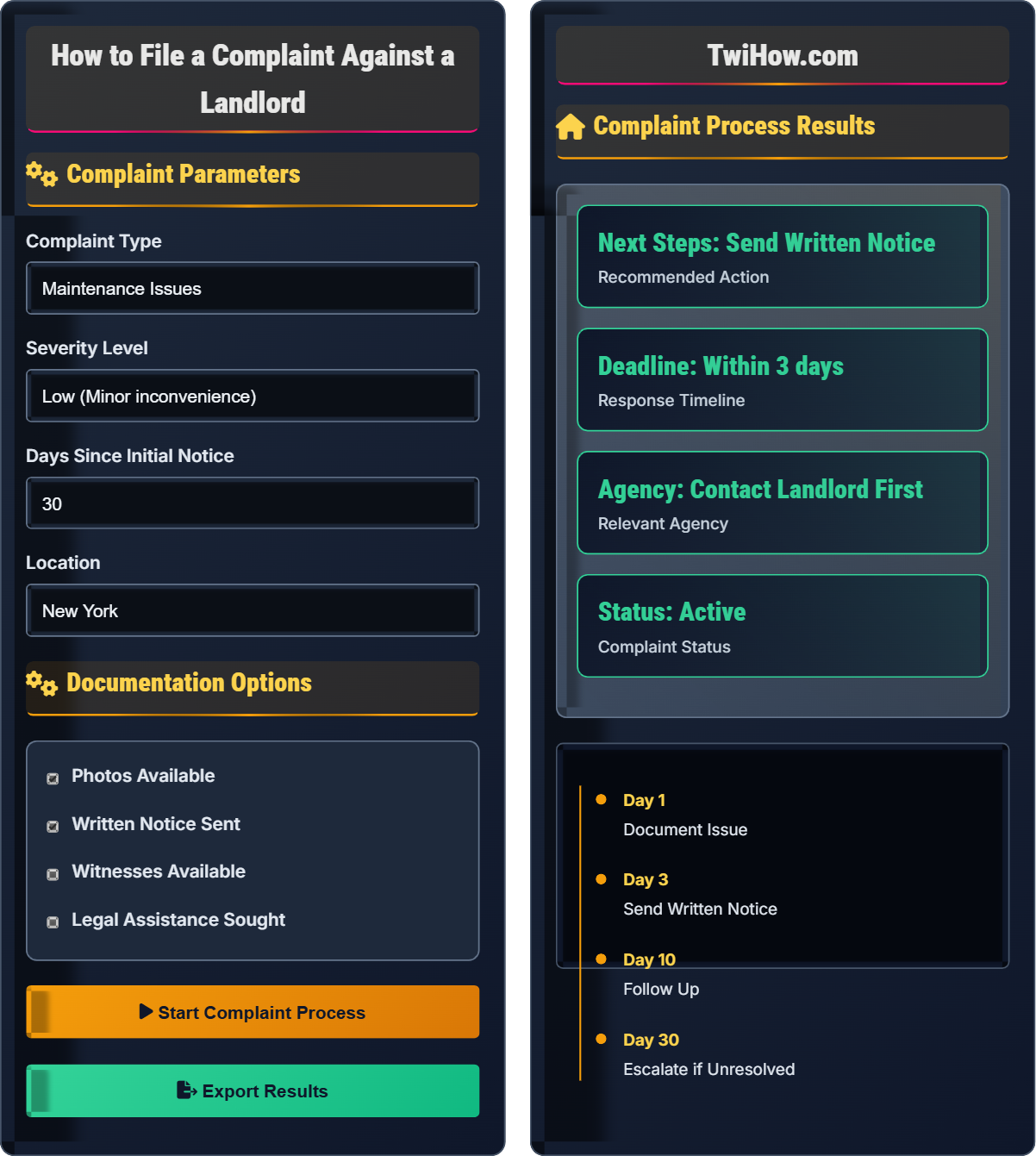
Complaint Parameters
Documentation Options
Complaint Process Results
| Step | Action | Timeline | Status |
|---|---|---|---|
| 1 | Document Issue | Day 1 | Done |
| 2 | Send Notice | Day 3 | Done |
| 3 | Wait Response | Day 10 | Pending |
| 4 | Escalate | Day 30 | Pending |
How to File a Complaint Against a Landlord Explained
Tenant rights are legal protections that ensure landlords maintain safe, habitable living conditions and follow fair practices. When landlords violate these rights, tenants have the right to file complaints through various channels including direct communication, local agencies, and legal proceedings.
Typical reasons for filing complaints against landlords include:
- Maintenance Issues: Unaddressed repairs, plumbing problems, heating/cooling issues
- Safety Violations: Electrical hazards, structural damage, pest infestations
- Lease Violations: Unauthorized entry, breach of lease terms
- Discrimination: Refusing to rent based on protected characteristics
- Security Deposits: Improper withholding or deductions
- Rent Increases: Violating local rent control laws
Key legal protections for tenants include:
- Right to Habitable Housing: Safe, clean, and properly maintained living conditions
- Right to Privacy: Proper notice before entry (typically 24-48 hours)
- Right to Security Deposit Return: Timely return with itemized deductions
- Right to Non-Discrimination: Equal treatment regardless of protected characteristics
- Right to Quiet Enjoyment: Peaceful use of the rental property
- Right to Withhold Rent: In some states, for serious maintenance issues
- Keep Detailed Records: Document all issues, communications, and expenses
- Know Your Lease: Understand your rights and obligations under the lease
- Research Local Laws: Familiarize yourself with city and state tenant protections
- Act Promptly: Address issues before they become major problems
- Communicate in Writing: Keep paper trails of all correspondence
- Build Evidence: Gather witness statements and supporting documentation
Tenant Rights
Right to habitable housing, privacy, security deposit return, non-discrimination, quiet enjoyment, and reasonable accommodations.
Issue Identification → Documentation → Written Notice → Follow-up → Escalation → Legal Action
Where Issue = Specific violation, Documentation = Evidence collection, Notice = Formal written communication.
- Always document before taking action
- Give landlord opportunity to fix issues first
- Follow proper notice procedures
Resources
Housing authorities, tenant unions, legal aid societies, state attorney general offices, and local mediation services.
- Government agencies
- Non-profit organizations
- Legal services
- Mediation services
- Know your local jurisdiction
- Understand state-specific laws
- Be aware of statute of limitations
- Consider cost vs. benefit
Tenant Rights Learning Quiz
What is the typical notice period a landlord must give before entering a rental property?
Most states require landlords to provide 24-48 hours advance notice before entering a rental property, except in emergency situations. This protects the tenant's right to privacy and quiet enjoyment of the premises.
The answer is C) 24-48 hours.
The right to privacy is fundamental for tenants. Landlords cannot enter the rental property without proper notice, except in emergencies like fires or floods. This notice requirement gives tenants time to prepare and ensures respect for their living space. The exact time required varies by state, but 24-48 hours is the most common standard.
Quiet Enjoyment: Right to use property without interference
Reasonable Notice: Sufficient time to prepare for entry
Emergency Entry: Immediate access needed for safety
• Landlords must provide advance notice for non-emergency entries
• Notice period varies by state (check local laws)
• Emergencies may allow immediate entry without notice
• Check your lease agreement for specific entry policies
• Document unauthorized entries
• Know your state's specific notice requirements
• Assuming landlords can enter anytime
• Not documenting unauthorized entries
• Confusing emergency with routine maintenance
Explain the timeline and requirements for security deposit returns in most states. What happens if a landlord fails to comply?
Timeline Requirements: Most states require landlords to return security deposits within 21-30 days after lease termination. The deposit must be returned with an itemized list of any deductions for damages beyond normal wear and tear.
Deduction Requirements: Landlords can only deduct for unpaid rent, cleaning costs (beyond normal cleaning), and repair of damages caused by the tenant (not normal wear and tear).
Consequences of Non-Compliance: If landlords fail to return deposits timely or provide proper accounting, tenants may be entitled to penalties ranging from double the deposit amount to attorney fees, depending on state law.
Security deposits serve as financial protection for landlords against damages and unpaid rent, but they're held in trust for tenants. The timeline and accounting requirements ensure transparency and protect tenants from arbitrary deductions. Understanding these rules helps tenants know when to expect their money back and what constitutes legitimate deductions.
Normal Wear and Tear: Deterioration from ordinary use (faded paint, worn carpet)
Damage: Deterioration beyond normal wear (holes in walls, broken fixtures)
Itemized List: Detailed accounting of all deductions
• Return timeline is typically 21-30 days
• Itemized list required for any deductions
• Only legitimate damages can be deducted
• Document condition with move-in/move-out photos
• Review lease terms regarding deposits
• Request itemized accounting if not provided
• Not documenting initial condition
• Accepting vague deduction explanations
• Missing deadline for dispute resolution
You discover that your apartment's heating system has completely failed during winter. Your landlord has been notified twice over the past two weeks but hasn't responded. Describe your rights and the appropriate next steps to take, considering both tenant rights and potential legal remedies.
Your Rights: Tenants have the right to habitable living conditions, which includes functional heating in most jurisdictions during winter months. This constitutes a serious health and safety issue.
Next Steps:
1. Document: Take photos of the heating system and record temperatures
2. Written Notice: Send another formal notice demanding immediate repair
3. Local Authorities: Contact your city's housing authority or code enforcement
4. Alternative Housing: Consider temporary relocation if health is at risk
5. Legal Action: Consult tenant rights organizations or attorneys
Legal Remedies: You may have grounds for rent withholding, rent escrow, or constructive eviction depending on your state's laws.
Heating system failures during winter represent serious habitability issues that landlords are legally required to address promptly. The failure to maintain essential services like heat violates the implied warranty of habitability. Documenting the issue and following proper procedures strengthens your legal position while seeking resolution.
Warranty of Habitability: Implied guarantee of livable conditions
Rent Withholding: Stopping rent payments until repairs made
Constructive Eviction: Making property uninhabitable forcing tenant out
• Essential services must be maintained
• Landlords have reasonable time to respond
• Health/safety issues require prompt action
• Prioritize health and safety first
• Keep all correspondence documented
• Contact multiple agencies if needed
• Waiting too long before escalating
• Not documenting the issue
• Stopping rent without legal guidance
You applied for an apartment and were denied without clear explanation. Later you learned that the landlord made comments about your family status and national origin. Explain how to file a discrimination complaint and what evidence would strengthen your case.
Filing Process: File complaints with HUD (Housing and Urban Development), your state's fair housing agency, and local fair housing organizations. You have one year from the discriminatory act to file with HUD.
Strengthening Evidence:
1. Written Records: Application materials, correspondence, and advertisements
2. Witness Statements: People who heard the discriminatory comments
3. Pattern Evidence: Similar treatment of others with protected characteristics
4. Audio/Video: Recordings of conversations (where legal)
5. Comparable Applications: Evidence of different treatment of similarly situated applicants
Protected classes typically include race, color, religion, sex, national origin, disability, and familial status.
Fair housing laws prohibit discrimination in rental housing based on protected characteristics. Proving discrimination often requires circumstantial evidence showing disparate treatment. The burden shifts to the landlord to prove legitimate, non-discriminatory reasons for the decision once a prima facie case is established.
Fair Housing Act: Federal law prohibiting housing discrimination
Prima Facie Case: Initial evidence suggesting discrimination occurred
Protected Classes: Characteristics protected by anti-discrimination law
• File within one year of the incident
• Provide detailed evidence of discrimination
• Keep all application-related documents
• Document everything immediately
• Find witnesses willing to testify
• Research comparable situations
• Missing filing deadlines
• Not collecting sufficient evidence
• Assuming all rejections are discriminatory
Which of the following is TRUE regarding rent control laws in most states?
Rent control laws vary significantly by location and are primarily implemented at the local level in jurisdictions that permit them. Most states do not have statewide rent control, and many states actually prohibit local rent control ordinances. Where permitted, rent control typically limits the amount and frequency of rent increases rather than preventing all increases.
The answer is C) Rent control is primarily a local option.
Rent control represents a complex area of housing law that differs dramatically between jurisdictions. While some cities like New York City and San Francisco have strong rent control measures, many states have preemption laws that prevent local rent control ordinances. Tenants should research their specific local laws rather than assuming rent control exists.
Rent Control: Laws limiting rent increases
Preemption: Higher government restricting local authority
Just Cause Eviction: Required reason for terminating tenancy
• Rent control is not universal
• Check local laws specifically
• Many states preempt local rent control
• Research your city's specific rent laws
• Check state preemption statutes
• Understand local tenant protection ordinances
• Assuming rent control exists everywhere
• Confusing rent control with rent stabilization
• Not checking local vs. state laws
FAQ
Q: What should I do if my landlord refuses to make repairs?
A: If your landlord refuses to make necessary repairs, follow these steps:
1. Document: Take photos/videos of the issue and keep records of all communication
2. Written Notice: Send a formal written notice describing the problem and requesting repairs
3. Follow Up: Continue following up in writing with specific timelines
4. Contact Authorities: Reach out to your local housing authority or code enforcement
5. Legal Consultation: Speak with a tenant rights attorney or organization
6. Repair and Deduct: In some states, you may be able to pay for repairs and deduct from rent
Remember to research your state's specific laws, as procedures and rights vary significantly.
Q: How do I file a complaint with HUD for housing discrimination?
A: To file a complaint with HUD for housing discrimination:
1. Timing: File within one year of the alleged discriminatory act
2. Method: File online at HUD.gov, by phone at 1-800-669-9777, or by mail
3. Information Needed: Your contact info, property address, description of discrimination, and protected characteristic involved
4. Investigation: HUD will investigate and attempt conciliation
5. Legal Action: If conciliation fails, HUD may pursue legal action or refer you to the Department of Justice
HUD enforces the Fair Housing Act which prohibits discrimination based on race, color, religion, sex, national origin, disability, and familial status.