How Do Vaccines Work? Complete Guide to Immunology
Immunology fundamentals • Vaccine mechanisms • Step-by-step explanations
Immune System:
Show Vaccine SimulatorVaccines work by training the immune system to recognize and fight specific pathogens. They contain weakened, killed, or parts of disease-causing organisms that stimulate immune responses without causing serious illness. The immune system creates antibodies and memory cells that provide protection against future infections.
Key aspects of vaccines:
- Antigen Exposure: Introduces harmless pathogen components
- Immune Response: Triggers antibody and memory cell production
- Memory Formation: Creates long-term protection
- Herd Immunity: Community-wide protection when enough vaccinated
Vaccines have prevented millions of deaths and eliminated diseases like smallpox, demonstrating the power of preventive medicine.
Vaccine Parameters
Advanced Options
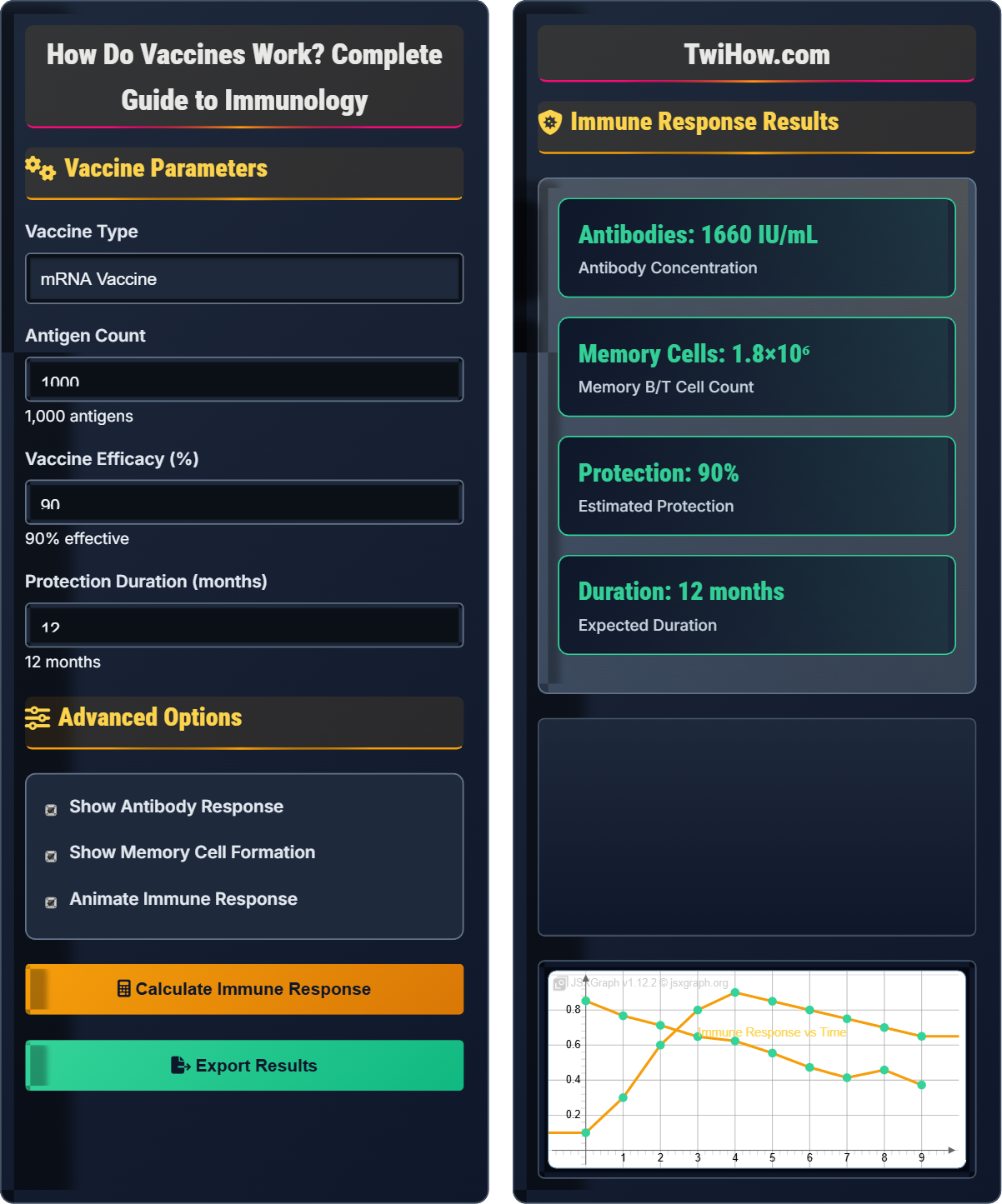
Immune Response Results
| Stage | Process | Timeline | Key Players |
|---|---|---|---|
| Recognition | Antigen presentation | Hours | Dendritic cells |
| Activation | B/T cell activation | Days | Helper T cells |
| Production | Antibody creation | Weeks | Plasma cells |
| Memory | Long-term immunity | Months | Memory cells |
Where mRNA instructs cells to produce viral proteins, triggering immune recognition and response without using live virus.
How Vaccines Work
Vaccines are biological preparations that provide acquired immunity to specific infectious diseases. They contain agents resembling disease-causing microorganisms, often made from weakened or killed forms of the microbe, its toxins, or one of its surface proteins. Vaccines stimulate the immune system to recognize and destroy these agents, creating memory cells that provide protection against future infections.
Where:
- Antibody Level: Concentration of specific antibodies
- Memory Cell Persistence: Longevity of memory B and T cells
- Protection: Effective immune response against pathogen
Higher antibody levels and longer memory cell persistence correlate with better protection.
Different vaccines work through various mechanisms:
- mRNA Vaccines: Provide genetic instructions for protein production
- Live Attenuated: Weakened live pathogens that replicate safely
- Inactivated: Killed pathogens that cannot replicate
- Subunit: Specific antigen components (proteins, polysaccharides)
- Viral Vector: Modified viruses carrying pathogen genes
Each type has advantages and limitations based on safety, efficacy, and manufacturing considerations.
- Disease Prevention: Polio, measles, hepatitis, COVID-19
- Herd Immunity: Community protection when vaccination rates are high
- Global Health: Eradication of smallpox, near-elimination of polio
- Travel Medicine: Protection against regional diseases
- Public Health: Economic benefits and disease control
Vaccine Fundamentals
Vaccines, antigens, antibodies, memory cells, immunity, adjuvants, herd immunity.
Protection = f(Antibody titer, Memory cell count, Duration)
Where protection effectiveness depends on antibody levels and memory cell persistence.
- Memory cells provide long-term immunity
- Booster doses enhance immune memory
- Vaccines prevent disease transmission
- Herds need high vaccination rates for protection
Real-World Applications
Childhood immunization, travel vaccines, seasonal flu shots, pandemic responses.
- Antibody titer tests for immunity verification
- Challenge studies for efficacy evaluation
- Population surveillance for outbreak prevention
- Post-marketing surveillance for safety monitoring
- Vaccine effectiveness varies by population
- Immune responses may wane over time
- Pathogens can mutate to evade immunity
- Adjuvants enhance immune responses
Immunology Quiz
Which cells are primarily responsible for long-term immunity after vaccination?
Memory B and T cells are the key players in long-term immunity. Memory B cells can quickly differentiate into plasma cells to produce antibodies upon re-exposure to the same antigen. Memory T cells provide rapid cellular immune responses. These cells persist in the body for years or decades, providing lasting protection against reinfection.
Other cells like neutrophils and macrophages provide immediate but temporary responses during the initial infection.
The answer is B) Memory B and T cells.
This concept is fundamental to vaccination. The primary immune response creates memory cells that respond much faster and more effectively during subsequent exposures. This secondary response is why vaccinated individuals are protected against diseases they encounter later in life.
Memory B Cells: Long-lived cells that produce antibodies rapidly
Memory T Cells: Long-lived cells that coordinate immune responses
Primary Response: First exposure to antigen
• Memory cells provide long-term protection
• Secondary response is faster and stronger
• Memory cells persist for years
• Think of memory cells as "trained soldiers"
• Primary response: slow, secondary: fast
• Memory = long-term immunity
• Confusing immediate with long-term responses
• Thinking all immune cells provide memory
• Forgetting the role of memory T cells
Explain the concept of herd immunity and calculate the minimum vaccination rate needed to achieve herd immunity for a disease with an R₀ (basic reproduction number) of 4.0. How does this protect vulnerable populations?
Herd Immunity: The indirect protection from infectious diseases that occurs when a large portion of a population becomes immune, either through vaccination or previous infection.
Calculation:
- Herd immunity threshold = 1 - (1/R₀)
- For R₀ = 4.0: 1 - (1/4.0) = 1 - 0.25 = 0.75 = 75%
Protection of Vulnerable Populations:
- Protects those who cannot be vaccinated (allergies, medical contraindications)
- Shields immunocompromised individuals
- Protects newborns who haven't been vaccinated yet
- Reduces disease circulation in the community
With 75% of the population vaccinated, the disease cannot spread efficiently, protecting even unvaccinated individuals.
Herd immunity demonstrates the community benefit of vaccination. The R₀ value represents how many people one infected person will infect in a susceptible population. Higher R₀ values require higher vaccination rates for herd immunity. This concept is crucial for public health policy and disease elimination efforts.
R₀: Basic reproduction number (average secondary infections)
Herd Immunity: Population-level disease protection
Vulnerable Populations: Those unable to be vaccinated
• Higher R₀ requires higher vaccination rate
• Herd immunity threshold = 1 - (1/R₀)
• Protects entire community
• R₀ > 1 means disease spreads
• Higher R₀ = more contagious
• Herd immunity protects everyone
• Forgetting the formula for herd immunity threshold
• Confusing R₀ with other epidemiological measures
• Underestimating community benefits
In a clinical trial with 40,000 participants (20,000 vaccinated, 20,000 placebo), 20 people in the vaccinated group developed the disease compared to 200 in the placebo group. Calculate the vaccine efficacy and interpret the result. What does this mean for real-world protection?
Vaccine Efficacy Calculation:
- Attack rate in unvaccinated = 200/20,000 = 0.01 (1.0%)
- Attack rate in vaccinated = 20/20,000 = 0.001 (0.1%)
- Vaccine efficacy = (1 - Attack rate vaccinated/Attack rate unvaccinated) × 100%
- VE = (1 - 0.001/0.01) × 100% = (1 - 0.1) × 100% = 90%
Interpretation: The vaccine is 90% effective at preventing disease. This means vaccinated individuals are 90% less likely to develop the disease compared to unvaccinated individuals.
Real-world implications: A 90% effective vaccine provides strong protection, though not complete. Some vaccinated individuals may still get sick, but severity is typically reduced. The vaccine significantly reduces disease burden and transmission in the population.
Vaccine efficacy measures how well a vaccine works in controlled trial settings. It's calculated by comparing disease rates between vaccinated and unvaccinated groups. Real-world effectiveness may differ due to various factors like population characteristics and implementation challenges.
Vaccine Efficacy: Disease prevention rate in clinical trials
Attack Rate: Disease incidence in exposed population
Placebo Group: Control group receiving inactive treatment
• VE = (1 - ARv/ARu) × 100%
• Higher efficacy = better protection
• Efficacy differs from effectiveness
• Compare disease rates between groups
• Efficacy is percentage reduction
• 100% means perfect protection
• Confusing efficacy with effectiveness
• Forgetting to multiply by 100%
• Misinterpreting the calculation
Explain how mRNA vaccines work differently from traditional vaccines. Describe the advantages and challenges of this technology, and discuss how it enabled rapid development of COVID-19 vaccines.
mRNA Vaccine Mechanism:
- mRNA contains genetic instructions for spike protein production
- Cells use mRNA to synthesize viral proteins
- Immune system recognizes proteins as foreign and mounts response
- Memory cells form without live virus exposure
Advantages:
- No live virus handling required (safer manufacturing)
- Rapid development and production possible
- High efficacy rates achieved
- Can be easily modified for variants
Challenges:
- Requires ultra-cold storage
- Novel technology (limited long-term data)
- Higher reactogenicity (side effects)
- Public acceptance concerns
Rapid Development: Scientists had been researching mRNA technology for years. When the SARS-CoV-2 genetic sequence was published, the spike protein sequence could be quickly incorporated into mRNA vaccines, accelerating development.
mRNA vaccines represent a revolutionary approach that bypasses traditional methods. Instead of using killed or weakened viruses, they provide genetic instructions for the body to produce the antigen itself. This technology has opened new possibilities for rapid vaccine development against emerging threats.
mRNA: Messenger RNA that carries genetic instructions
Reactogenicity: Ability to cause adverse reactions
Antigen: Substance that triggers immune response
• mRNA doesn't enter nucleus
• mRNA is degraded after use
What is the primary purpose of adjuvants in vaccines?
Adjuvants are substances added to vaccines to enhance the body's immune response to the antigen. They work by stimulating the innate immune system, promoting stronger and longer-lasting adaptive immunity. Common adjuvants include aluminum salts, oil emulsions, and Toll-like receptor agonists.
Adjuvants allow for smaller amounts of antigen to be used while achieving the same protective effect, making vaccines more efficient and cost-effective. They are essential for many vaccines, particularly inactivated vaccines that would otherwise produce weak immune responses.
The answer is B) To enhance the immune response to the antigen.
Adjuvants act as "helpers" for the immune system, amplifying the response to vaccine antigens. Without adjuvants, many vaccines would be much less effective. This enhancement is crucial for vaccines that use killed or subunit antigens, which naturally trigger weaker immune responses than live attenuated vaccines.
Adjuvant: Substance that enhances immune response
Innate Immunity: First-line immune defense
Adaptive Immunity: Specific, learned immune response
• Adjuvants enhance, don't replace antigens
• Many vaccines require adjuvants
• Safety tested extensively
• Think of adjuvants as "immune boosters"
• They make weak responses stronger
• Essential for many vaccine types
• Confusing adjuvants with preservatives
• Thinking they kill pathogens
• Forgetting their importance
FAQ
Q: Why do some vaccines require multiple doses?
A: Multiple doses are needed for several reasons: 1) Priming dose activates initial immune response, 2) Booster doses strengthen and mature the response, 3) Multiple exposures create more memory cells, 4) Some vaccines need repeated exposure to achieve adequate protection. The schedule is optimized to provide maximum protection with minimal side effects. Examples include DTaP (5 doses) and HPV (2-3 doses depending on age).
Q: How do vaccines provide protection without causing disease?
A: Vaccines use various strategies: 1) Live attenuated vaccines use weakened viruses that can't cause disease, 2) Inactivated vaccines use dead pathogens that can't replicate, 3) Subunit vaccines use only parts of the pathogen, 4) mRNA vaccines provide genetic instructions without the actual virus. The immune system recognizes these harmless components as foreign and creates memory cells, but the pathogen cannot cause serious illness. The immune response is triggered without the risks of natural infection.
Q: How long does vaccine protection last?
A: Duration varies widely by vaccine type and individual factors. Some vaccines provide lifelong protection (MMR, polio), others require boosters (tetanus every 10 years), and some need annual updates (flu vaccine). Factors affecting duration include: 1) Vaccine type (live vs. inactivated), 2) Individual immune response, 3) Age at vaccination, 4) Pathogen mutation rate. Immune memory generally persists longer than antibody levels, providing continued protection even when titers decline.