How Does Light Work?
Complete light physics guide • Step-by-step explanations
Light Fundamentals:
Show Light SimulatorLight is a form of electromagnetic radiation that behaves both as a wave and as a particle (wave-particle duality). It travels at approximately 299,792,458 meters per second in a vacuum and is composed of massless particles called photons.
Light exhibits various behaviors including reflection, refraction, diffraction, and interference. It has properties such as wavelength, frequency, amplitude, and polarization.
Key light concepts:
- Electromagnetic Waves: Oscillating electric and magnetic fields
- Photons: Discrete packets of energy
- Wave-Particle Duality: Dual nature of light
- Spectrum: Range from radio waves to gamma rays
Light enables vision, photosynthesis, communication technologies, and countless applications in science and technology.
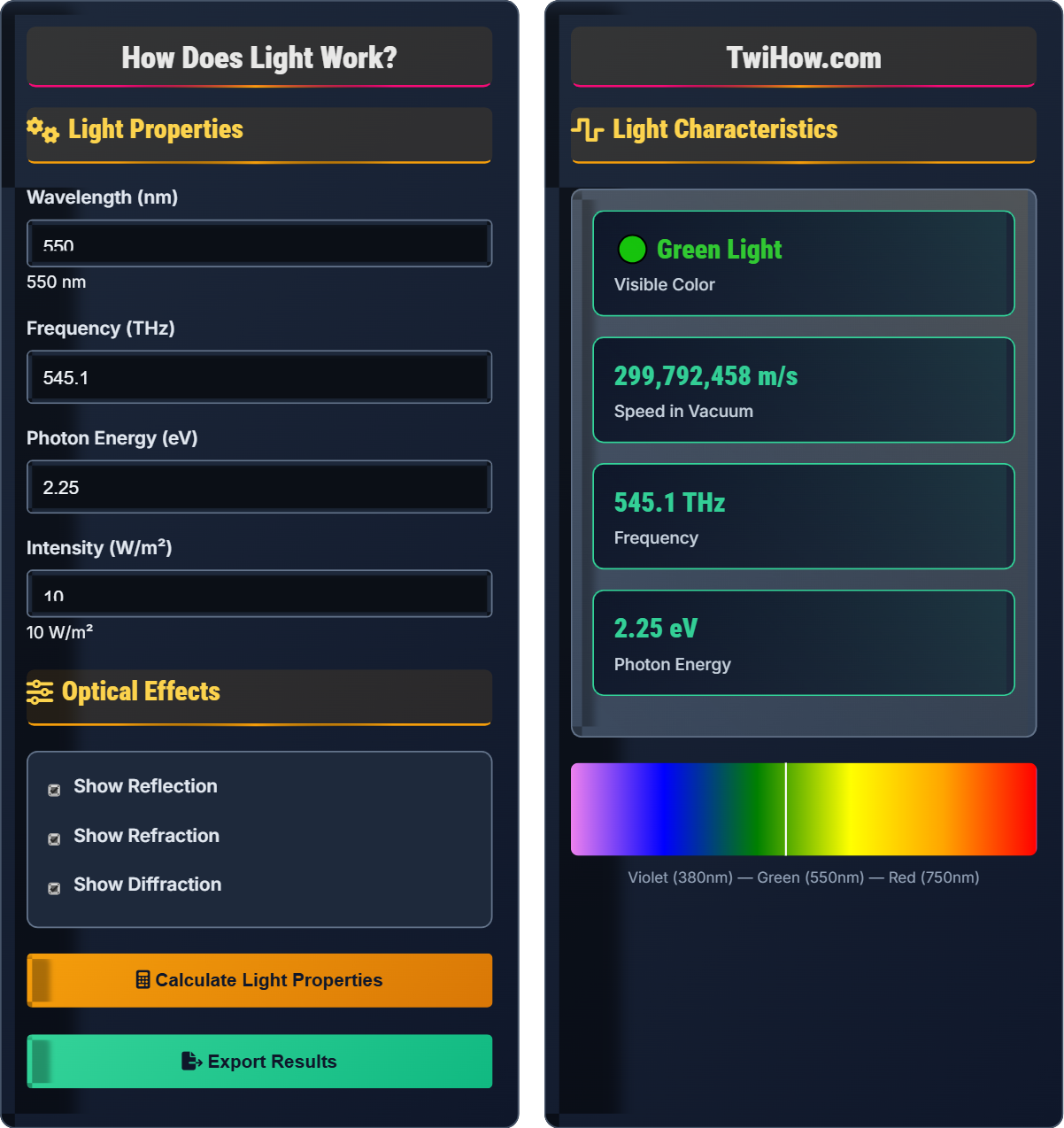
Light Properties
Optical Effects
Light Characteristics
| Property | Value | Description |
|---|---|---|
| Wavelength | 550 nm | Distance between wave peaks |
| Frequency | 545 THz | Oscillations per second |
| Energy | 2.25 eV | Per photon |
| Intensity | 10 W/m² | Power per area |
Ray Diagram: Incident, Reflected, and Refracted Light
How Light Works Explained
Light is an electromagnetic wave consisting of oscillating electric and magnetic fields perpendicular to each other and to the direction of propagation. This wave nature explains phenomena like interference and diffraction.
Where:
- c: Speed of light in vacuum (3×10⁸ m/s)
- f: Frequency of the wave
- λ: Wavelength of the wave
Light also behaves as discrete packets of energy called photons. This particle nature explains the photoelectric effect and quantum phenomena.
Where:
- E: Energy of the photon
- h: Planck's constant (6.626×10⁻³⁴ J·s)
- f: Frequency of the light
- c: Speed of light
- λ: Wavelength
Visible light is a small portion of the electromagnetic spectrum ranging from approximately 380 nm (violet) to 750 nm (red).
Colors in order: Violet, Blue, Green, Yellow, Orange, Red (decreasing wavelength)
Wave Nature
Particle Nature
Light exhibits both wave and particle properties depending on the experimental setup. This duality is fundamental to quantum mechanics.
- Reflection: Light bounces off surfaces (angle of incidence = angle of reflection)
- Refraction: Light bends when passing through different media (Snell's Law)
- Diffraction: Light spreads around obstacles and through apertures
- Interference: Light waves combine constructively or destructively
- Polarization: Orientation of light's electric field
Light Fundamentals
Electromagnetic waves, photons, wave-particle duality, electromagnetic spectrum, quantum mechanics.
c = fλ where c = speed of light, f = frequency, λ = wavelength
Speed of light in vacuum = 299,792,458 m/s (exact value)
- Light speed is constant in vacuum
- Lower wavelengths have higher frequencies
- Higher frequencies have more energy per photon
Applications
Fiber optics, lasers, photography, microscopy, spectroscopy, solar panels, LCD screens.
- Telecommunications (fiber optic cables)
- Medical imaging (endoscopy, laser surgery)
- Energy generation (solar panels)
- Scientific research (spectroscopy)
- Material properties affect light behavior
- Quantum effects become significant at small scales
- Relativistic effects at high speeds
- Environmental factors influence propagation
Light Physics Learning Quiz
Which of the following statements about light is TRUE?
Light exhibits wave-particle duality, meaning it behaves both as a wave and as a particle depending on the experimental setup. This is one of the fundamental principles of quantum mechanics.
The answer is C) Light exhibits both wave and particle properties.
Understanding wave-particle duality is crucial to comprehending quantum mechanics. Light demonstrates wave properties in phenomena like interference and diffraction, while showing particle properties in the photoelectric effect. This dual nature challenges our classical intuitions about the physical world.
Wave-Particle Duality: Concept that particles exhibit both wave and particle properties
Photoelectric Effect: Emission of electrons when light hits a material
Interference: Combination of waves resulting in reinforcement or cancellation
• Light behaves as wave in some experiments
• Light behaves as particle in others
• Both natures are fundamental to light
• Remember: wave nature explains interference
• Remember: particle nature explains photoelectric effect
• Think of light as having dual personality
• Thinking light is only a wave or only a particle
• Not understanding the context-dependent nature
• Assuming classical behavior applies
Calculate the frequency of light with a wavelength of 600 nm. Explain the relationship between wavelength and frequency in the context of light propagation.
Using the equation c = fλ:
Given: λ = 600 nm = 600 × 10⁻⁹ m
c = 3 × 10⁸ m/s (speed of light in vacuum)
f = c/λ = (3 × 10⁸) / (600 × 10⁻⁹) = 5 × 10¹⁴ Hz = 500 THz
The frequency of light with wavelength 600 nm is 500 THz.
Wavelength and frequency are inversely proportional: as wavelength increases, frequency decreases, and vice versa. This relationship holds because the speed of light in vacuum is constant.
The inverse relationship between wavelength and frequency is fundamental to wave physics. For light, since the speed is constant in vacuum, longer wavelengths correspond to lower frequencies and lower energy photons, while shorter wavelengths correspond to higher frequencies and higher energy photons.
Wavelength: Distance between consecutive wave peaks
Frequency: Number of wave cycles per second
Speed of Light: Maximum speed of information transfer (constant in vacuum)
• c = fλ (always true in vacuum)
• c = 3 × 10⁸ m/s (exact value)
• λ and f are inversely related
• Convert all units to SI units first
• Remember: higher frequency = higher energy
• Use scientific notation for large/small numbers
• Forgetting to convert nanometers to meters
• Mixing up direct vs inverse relationships
• Using wrong value for speed of light
A solar panel is designed to capture sunlight most efficiently. Given that the sun emits peak intensity at approximately 500 nm wavelength, calculate the energy per photon at this wavelength. Explain why this wavelength is optimal for solar energy conversion.
Using E = hc/λ:
h = 6.626 × 10⁻³⁴ J·s (Planck's constant)
c = 3 × 10⁸ m/s (speed of light)
λ = 500 nm = 500 × 10⁻⁹ m
E = (6.626 × 10⁻³⁴ × 3 × 10⁸) / (500 × 10⁻⁹) = 3.98 × 10⁻¹⁹ J
To convert to electron volts: E = (3.98 × 10⁻¹⁹) / (1.602 × 10⁻¹⁹) ≈ 2.48 eV
This wavelength is optimal because it corresponds to the peak of the sun's emission spectrum, providing maximum energy density. Silicon solar cells have bandgaps around 1.1 eV, making visible light photons energetic enough to generate electron-hole pairs efficiently.
Solar energy conversion relies on the photoelectric effect, where photons with sufficient energy excite electrons in semiconductor materials. The sun's emission spectrum peaks in the visible range, making this range particularly effective for solar power generation.
Bandgap: Energy needed to free an electron in a semiconductor
Photoelectric Effect: Electron emission when light hits a material
Electron Volt (eV): Unit of energy for atomic particles
• Photon energy depends on frequency/wavelength
• Materials have specific bandgap energies
• Matching photon energy to bandgap maximizes efficiency
• Remember: E = hf = hc/λ
• Know conversion: 1 eV = 1.602 × 10⁻¹⁹ J
• Consider material properties in applications
• Not converting wavelength to meters
• Forgetting Planck's constant value
• Not considering material bandgap
Optical fibers use total internal reflection to transmit light signals over long distances. If the core of an optical fiber has a refractive index of 1.46 and the cladding has a refractive index of 1.41, calculate the critical angle for total internal reflection. Explain how this principle enables long-distance communication.
Using Snell's Law for critical angle: sin θc = n₂/n₁
n₁ = 1.46 (core refractive index)
n₂ = 1.41 (cladding refractive index)
sin θc = 1.41/1.46 = 0.9658
θc = arcsin(0.9658) ≈ 75.0°
For angles greater than 75.0°, light undergoes total internal reflection and remains trapped in the core. This allows light to travel along the fiber without escaping, enabling high-speed data transmission over thousands of kilometers with minimal loss.
Total internal reflection occurs when light travels from a denser medium to a less dense medium at angles greater than the critical angle. In optical fibers, this principle keeps light signals confined to the core, allowing efficient transmission over long distances.
Refractive Index: Measure of how much light slows in a medium
Total Internal Reflection: Complete reflection at boundary
Critical Angle: Minimum angle for total internal reflection
• Total reflection occurs when θ > θc
• θc = arcsin(n₂/n₁) where n₁ > n₂
• Higher refractive index difference = smaller θc
• Always identify denser medium first
• Remember: n₁ > n₂ for TIR
• Critical angle depends on index ratio
• Reversing the refractive index ratio
• Forgetting to use arcsin function
• Not identifying the correct medium
Which phenomenon is primarily responsible for the formation of rainbows?
Rainbows form when sunlight enters water droplets, undergoes refraction (bending), internal reflection, and then exits the droplet with further refraction. Different wavelengths (colors) bend at slightly different angles due to dispersion, creating the characteristic color sequence. The primary process is refraction combined with dispersion.
The answer is B) Refraction and Dispersion.
Rainbow formation is a beautiful example of multiple light behaviors working together. Refraction separates colors (dispersion), internal reflection redirects the light, and exit refraction further disperses the colors. The observer sees different colors from different droplets at specific angles.
Dispersion: Separation of light into colors by wavelength
Refraction: Bending of light at medium boundaries
Internal Reflection: Reflection inside a medium
• Different wavelengths refract differently
• Rainbow angle is ~42° for primary bow
• Multiple internal reflections cause secondary bows
• Remember: shorter wavelengths bend more
• Red is outermost color in rainbow
• Sun must be behind observer
• Thinking only reflection creates rainbows
• Not understanding the role of dispersion
• Confusing with other optical phenomena
FAQ
Q: How can light be both a wave and a particle at the same time?
A: Light doesn't behave as both simultaneously in a single experiment - it exhibits either wave or particle properties depending on the observation method. This is called wave-particle duality. In interference experiments, light acts as a wave. In the photoelectric effect, it acts as a particle (photon). This isn't a contradiction but rather indicates that our classical concepts of "wave" and "particle" don't fully describe quantum entities like light. Instead, light is described by quantum field theory, which encompasses both behaviors mathematically.
Q: What determines the color of light we see?
A: The color of light is determined by its wavelength (or equivalently, its frequency). Visible light ranges from approximately 380 nm (violet) to 750 nm (red). Our eyes have three types of color receptors (cones) that respond to different wavelength ranges. The brain interprets the combination of signals from these cones as specific colors. White light contains all visible wavelengths mixed together. When light interacts with matter (through absorption, reflection, or transmission), we perceive the remaining wavelengths as color.
Q: Why does light slow down in different mediums like glass or water?
A: Light doesn't actually slow down permanently - its phase velocity decreases in materials due to interactions with atoms. As light propagates through a medium, its electric field causes atoms to oscillate, creating secondary electromagnetic waves. The original light wave and these secondary waves interfere, resulting in a combined wave that appears to travel slower. The fundamental speed of light (c) remains unchanged in vacuum, but the effective speed in materials is reduced by the refractive index (n = c/v). This interaction explains phenomena like refraction and dispersion.