What is Chemistry? Complete Guide to Chemical Sciences
Chemistry fundamentals • Atomic structure • Step-by-step explanations
Chemical Sciences:
Show Chemistry SimulatorChemistry is the scientific study of matter, its properties, composition, structure, and reactions. It explores how atoms and molecules interact, combine, and transform to form new substances. Chemistry bridges physics and biology, explaining the molecular basis of life and materials. The discipline encompasses organic, inorganic, physical, analytical, and biochemistry.
Key aspects of chemistry:
- Atomic Theory: All matter consists of atoms
- Chemical Bonds: Atoms combine through various bonding mechanisms
- Periodic Table: Organization of elements by properties
- Chemical Reactions: Rearrangement of atoms to form new compounds
Chemistry is fundamental to understanding life processes, materials science, medicine, and environmental science.
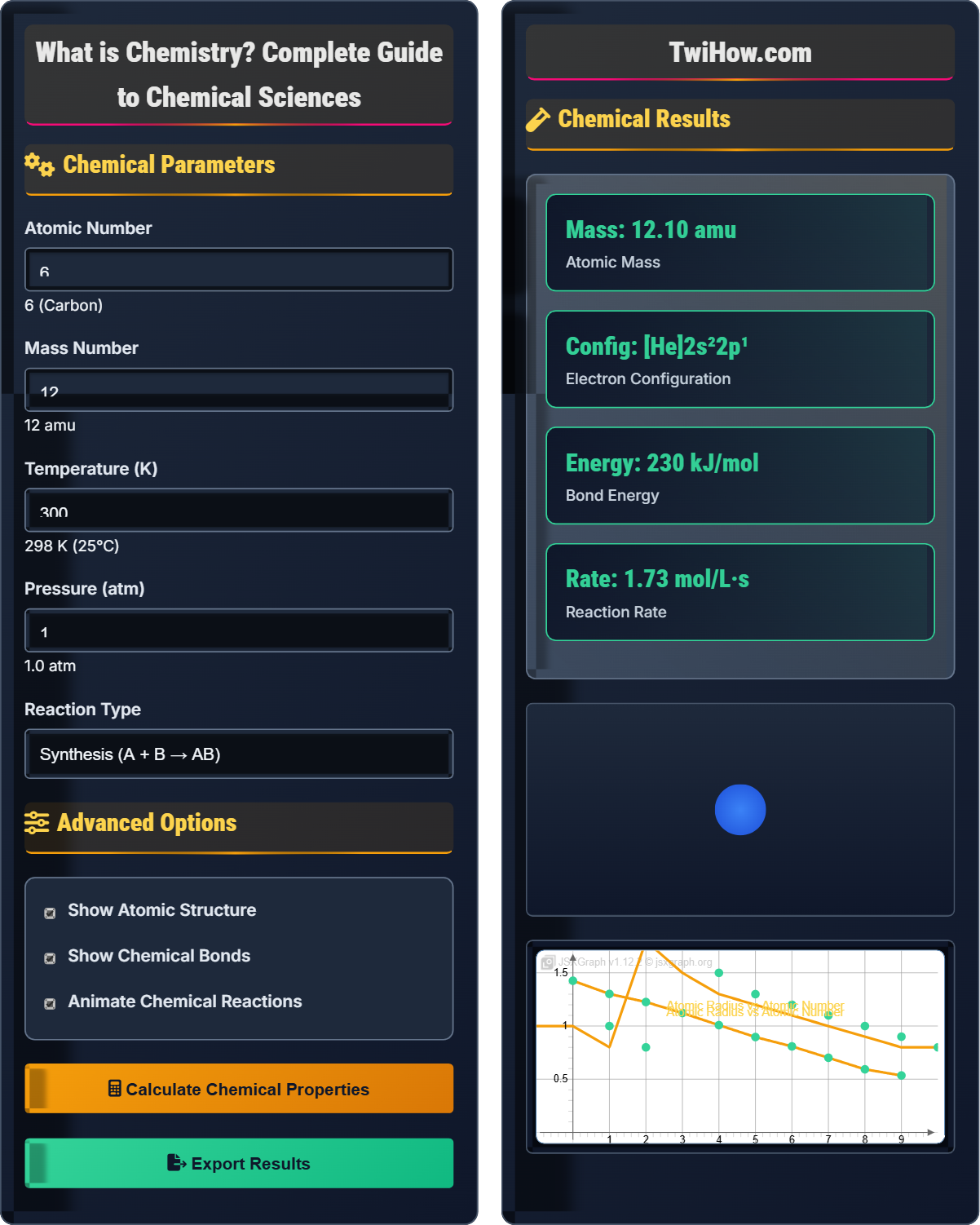
Chemical Parameters
Advanced Options
Chemical Results
| Property | Value | Unit | Significance |
|---|---|---|---|
| Protons | 6 | count | Determines element identity |
| Neutrons | 6 | count | Affects isotope properties |
| Electrons | 6 | count | Determines chemical behavior |
| Valence | 4 | electrons | Forms 4 covalent bonds |
Where P is pressure, V is volume, n is moles, R is gas constant, and T is temperature in Kelvin. This equation relates the macroscopic properties of ideal gases.
How Chemistry Works
Chemistry is the scientific study of matter, its properties, composition, structure, and reactions. It explores how atoms and molecules interact, combine, and transform to form new substances. Chemistry bridges physics and biology, explaining the molecular basis of life and materials. The discipline encompasses organic, inorganic, physical, analytical, and biochemistry.
Where:
- A, B: Reactants
- C, D: Products
- a, b, c, d: Stoichiometric coefficients
- →: Yields arrow
Chemical equations must be balanced according to the law of conservation of mass: atoms are neither created nor destroyed in chemical reactions. Stoichiometry allows calculation of reactant and product amounts.
Elements in the periodic table show predictable trends:
- Atomic Radius: Decreases left to right, increases top to bottom
- Electronegativity: Increases left to right, decreases top to bottom
- Ionization Energy: Increases left to right, decreases top to bottom
- Electron Affinity: Generally increases left to right
These trends result from changes in nuclear charge and electron shielding across the table.
- Medicine: Drug design, pharmaceutical synthesis
- Materials Science: Polymers, alloys, nanomaterials
- Energy: Batteries, fuel cells, solar panels
- Environmental: Pollution remediation, green chemistry
- Food Science: Nutrition, flavor chemistry, preservation
Chemistry Fundamentals
Atoms, molecules, elements, compounds, chemical bonds, periodic table, stoichiometry.
PV = nRT (Pressure × Volume = Moles × Gas Constant × Temperature)
Where P = pressure, V = volume, n = moles, R = gas constant (8.314 J/mol·K), T = temperature in Kelvin.
- Matter is conserved in chemical reactions
- Atoms combine in whole number ratios
- Energy can be absorbed or released
- Reaction rates depend on conditions
Real-World Applications
Pharmaceuticals, agriculture, cosmetics, cleaning products, industrial processes.
- Spectroscopy for molecular identification
- Titration for concentration determination
- Chromatography for separation
- Mass spectrometry for molecular weight
- Chemical reactions follow thermodynamic principles
- Kinetics affects reaction rates
- Safety protocols essential in laboratory
- Environmental impact of chemical processes
Chemistry Quiz
Which element has the electron configuration [Ne]3s²3p⁵?
The electron configuration [Ne]3s²3p⁵ means:
- [Ne] represents the electron configuration of neon (1s²2s²2p⁶)
- 3s² means 2 electrons in the 3s orbital
- 3p⁵ means 5 electrons in the 3p orbital
Total electrons = 10 (from Ne) + 2 (3s) + 5 (3p) = 17 electrons
An element with 17 electrons has atomic number 17, which is Chlorine (Cl).
Chlorine is in Group 17 (halogens) and Period 3 of the periodic table.
The answer is B) Chlorine (Cl).
This question tests understanding of electron configurations and periodic table organization. The noble gas notation [Ne] is shorthand for neon's complete electron configuration. Counting total electrons reveals the atomic number, which identifies the element. The valence electrons (3s²3p⁵ = 7) determine chemical properties and placement in Group 17.
Electron Configuration: Arrangement of electrons in orbitals
Valence Electrons: Outermost electrons determining chemical behavior
Periodic Table: Organization of elements by properties
• Atomic number = number of electrons in neutral atom
• Noble gas notation abbreviates inner electrons
• Valence electrons determine chemical properties
• Count total electrons to find atomic number
• Valence electrons = group number (main groups)
• Period number = highest principal quantum number
• Forgetting to add noble gas electrons
• Confusing group and period numbers
• Miscounting electrons in p orbitals
Compare and contrast ionic and covalent bonding. Explain the conditions that favor each type of bond formation and provide examples of compounds that exhibit each type.
Ionic Bonding:
- Formation: Complete transfer of electrons from metal to nonmetal
- Electronegativity difference: >1.7 (large difference)
- Electron behavior: Electrons are donated/accepted
- Compound type: Metal + Nonmetal
- Properties: High melting points, conduct electricity when dissolved
- Examples: NaCl, MgO, K₂S
Covalent Bonding:
- Formation: Sharing of electrons between nonmetals
- Electronegativity difference: <1.7 (small difference)
- Electron behavior: Electrons are shared
- Compound type: Nonmetal + Nonmetal
- Properties: Variable melting points, generally don't conduct electricity
- Examples: H₂O, CH₄, CO₂
Conditions Favoring Each:
- Ionic: Large difference in electronegativity, metal + nonmetal
- Covalent: Small electronegativity difference, nonmetal + nonmetal
Some compounds show intermediate character (polar covalent bonds).
Bonding type depends primarily on electronegativity differences. When atoms have very different attractions for electrons, transfer occurs (ionic). When attractions are similar, sharing occurs (covalent). The bond type affects physical properties like melting point, solubility, and conductivity. Understanding this helps predict compound behavior.
Electronegativity: Atom's ability to attract electrons
Ionic Compound: Made of charged ions
Covalent Compound: Made of shared electron pairs
• ΔEN > 1.7 → Ionic bonding
• ΔEN < 1.7 → Covalent bonding
• Metal + Nonmetal → Usually ionic
• Metals tend to form cations
• Nonmetals tend to form anions
• F, O, N are highly electronegative
• Thinking all compounds are purely ionic or covalent
• Forgetting about polar covalent bonds
• Confusing ionic with covalent properties
Consider the reaction: 2H₂ + O₂ → 2H₂O. If you start with 4 grams of hydrogen gas and 32 grams of oxygen gas, determine the limiting reactant, calculate the theoretical yield of water, and identify how much excess reactant remains.
Step 1: Convert masses to moles
- H₂: 4 g ÷ 2.016 g/mol = 1.98 mol H₂
- O₂: 32 g ÷ 32.00 g/mol = 1.00 mol O₂
Step 2: Determine limiting reactant
- From balanced equation: 2 mol H₂ reacts with 1 mol O₂
- Available ratio: 1.98 mol H₂ / 1.00 mol O₂ = 1.98
- Required ratio: 2 mol H₂ / 1 mol O₂ = 2.00
- Since 1.98 < 2.00, H₂ is limiting
Step 3: Calculate theoretical yield
- From equation: 2 mol H₂ → 2 mol H₂O
- 1.98 mol H₂ → 1.98 mol H₂O
- Mass of H₂O: 1.98 mol × 18.02 g/mol = 35.7 g
Step 4: Calculate excess reactant
- Required O₂: 1.98 mol H₂ × (1 mol O₂ / 2 mol H₂) = 0.99 mol O₂
- Excess O₂: 1.00 mol - 0.99 mol = 0.01 mol
- Mass of excess O₂: 0.01 mol × 32.00 g/mol = 0.32 g
Hydrogen is the limiting reactant, theoretical yield is 35.7 g water, and 0.32 g oxygen remains in excess.
Stoichiometry problems require converting between mass, moles, and molecular ratios. The limiting reactant determines the maximum product yield. Always balance equations first, then use mole ratios from coefficients. This principle is essential in industrial chemistry and laboratory synthesis.
Limiting Reactant: Reactant that gets consumed first
Theoretical Yield: Maximum product obtainable
Stoichiometry: Quantitative relationships in reactions
• Balance equation first
• Convert to moles for calculations
• Use coefficient ratios
• Always check units cancel properly
• Calculate required vs available amounts
• Limiting reactant produces least product
• Forgetting to balance equations
• Using mass ratios instead of mole ratios
• Incorrectly identifying limiting reactant
Explain the relationship between enthalpy (ΔH), entropy (ΔS), and Gibbs free energy (ΔG) in predicting spontaneous reactions. Calculate ΔG for a reaction with ΔH = -120 kJ and ΔS = +50 J/K at 298 K, and determine if the reaction is spontaneous.
Gibbs Free Energy Equation: ΔG = ΔH - TΔS
Relationships:
- ΔG < 0: Reaction is spontaneous
- ΔG > 0: Reaction is non-spontaneous
- ΔG = 0: Reaction is at equilibrium
Calculation:
- ΔH = -120 kJ = -120,000 J
- ΔS = +50 J/K
- T = 298 K
- ΔG = ΔH - TΔS
- ΔG = -120,000 J - (298 K)(50 J/K)
- ΔG = -120,000 J - 14,900 J = -134,900 J = -134.9 kJ
Since ΔG is negative (-134.9 kJ), the reaction is spontaneous at 298 K.
Thermodynamic Interpretation: The negative ΔH (exothermic) and positive ΔS (increased disorder) both favor spontaneity. The negative ΔG indicates the reaction will proceed without external energy input.
Thermodynamics predicts whether reactions will occur but not their rate. Enthalpy measures heat change, entropy measures disorder change, and Gibbs free energy combines both to predict spontaneity. The temperature factor makes entropy more important at higher temperatures. This is fundamental to understanding chemical equilibrium and reaction feasibility.
Enthalpy: Heat content at constant pressure
Entropy: Measure of disorder
Spontaneous: Occurs without external energy
• ΔG = ΔH - TΔS always
• Negative ΔG = spontaneous
• Temperature affects entropy term
• Always convert units to match
• Temperature must be in Kelvin
• Exothermic + disorder = usually spontaneous
• Forgetting temperature unit conversion
• Confusing signs of thermodynamic quantities
• Thinking spontaneity relates to reaction rate
What is the pH of a solution with [H₃O⁺] = 1.0 × 10⁻⁴ M?
The pH is calculated using the formula: pH = -log[H₃O⁺]
Given: [H₃O⁺] = 1.0 × 10⁻⁴ M
pH = -log(1.0 × 10⁻⁴)
pH = -(-4) = 4.0
A pH of 4.0 indicates an acidic solution. The pH scale ranges from 0-14, where:
- pH < 7: Acidic
- pH = 7: Neutral
- pH > 7: Basic
The answer is A) 4.0.
The pH scale is logarithmic, meaning each unit represents a tenfold change in hydronium ion concentration. The negative logarithm makes higher H₃O⁺ concentrations result in lower pH values. This logarithmic relationship makes it easier to work with the wide range of possible H₃O⁺ concentrations in aqueous solutions.
pH: -log[H₃O⁺], measure of acidity
Hydronium: H₃O⁺ ion in aqueous solutions
Logarithmic: Base-10 logarithm scale
• pH = -log[H₃O⁺] always
• Higher [H₃O⁺] = Lower pH
• pH + pOH = 14 at 25°C
• Use scientific notation for easy calculation
• The exponent gives pH value directly for 1.0×10⁻ˣ
• Acids have pH < 7
• Forgetting the negative sign in the formula
• Confusing pH with pOH
• Thinking higher numbers mean more acidic
FAQ
Q: Why do some elements form ions while others form molecules?
A: This depends on electronegativity differences and electron configurations. Metals (low electronegativity) readily lose electrons to form cations, while nonmetals (high electronegativity) readily gain electrons to form anions. When the electronegativity difference is large, electron transfer occurs (ionic bonding). When differences are small, electrons are shared (covalent bonding). Elements achieve stability by attaining full outer electron shells, either through transfer or sharing.
Q: How do catalysts work and why don't they change the equilibrium position?
A: Catalysts work by providing an alternative reaction pathway with a lower activation energy, speeding up both forward and reverse reactions equally. They do not change the equilibrium position because they affect both directions of the reaction to the same extent. The equilibrium constant (K) depends only on the relative energies of reactants and products, not on the pathway taken. Catalysts only change the rate at which equilibrium is reached, not the final concentrations.
Q: What's the difference between accuracy and precision in chemistry?
A: Accuracy refers to how close a measurement is to the true value, while precision refers to how reproducible measurements are (how close they are to each other). A measurement can be precise but inaccurate (consistent wrong values) or accurate but imprecise (scattered around true value). Good chemistry requires both accuracy and precision. For example, a burette reading consistently to 0.01 mL shows precision, while a calibration that ensures the true volume is delivered shows accuracy.